

Donor-advised funds for Christian givers sit at the intersection of stewardship, tax law, and ecclesial conscience. They can serve the work of the Kingdom with clarity and discipline, but they can also create moral distance between a donor and the actual ministries that receive support. For mature Christians who take Jesus’s warnings about money seriously, the question is not whether a donor-advised fund is “allowed,” but whether it helps us give faithfully, transparently, and in a timely way.
Scripture does not provide a line-item policy for modern charitable vehicles. It does, however, provide governing principles: we are stewards, not owners (Psalm 24:1); we are warned against storing up treasure as a posture of the heart (Matthew 6:19–21); and we are instructed to give deliberately and cheerfully rather than under compulsion (2 Corinthians 9:6–8). A donor-advised fund can support those ends. It can also complicate them when it becomes a substitute for actual generosity, or when it dulls our obligation to know what we are funding.
Our argument is straightforward. Donor-advised funds can be a prudent tool for Christians who give consistently, especially in years of unusual income or major liquidity events. They are not a discernment shortcut. Christian donors still have a duty to evaluate the ministries they support, to avoid harm, and to ensure that tax-advantaged giving translates into real-world, mission-true impact rather than perpetual warehousing.
How donor-advised funds work and why Christians are using them
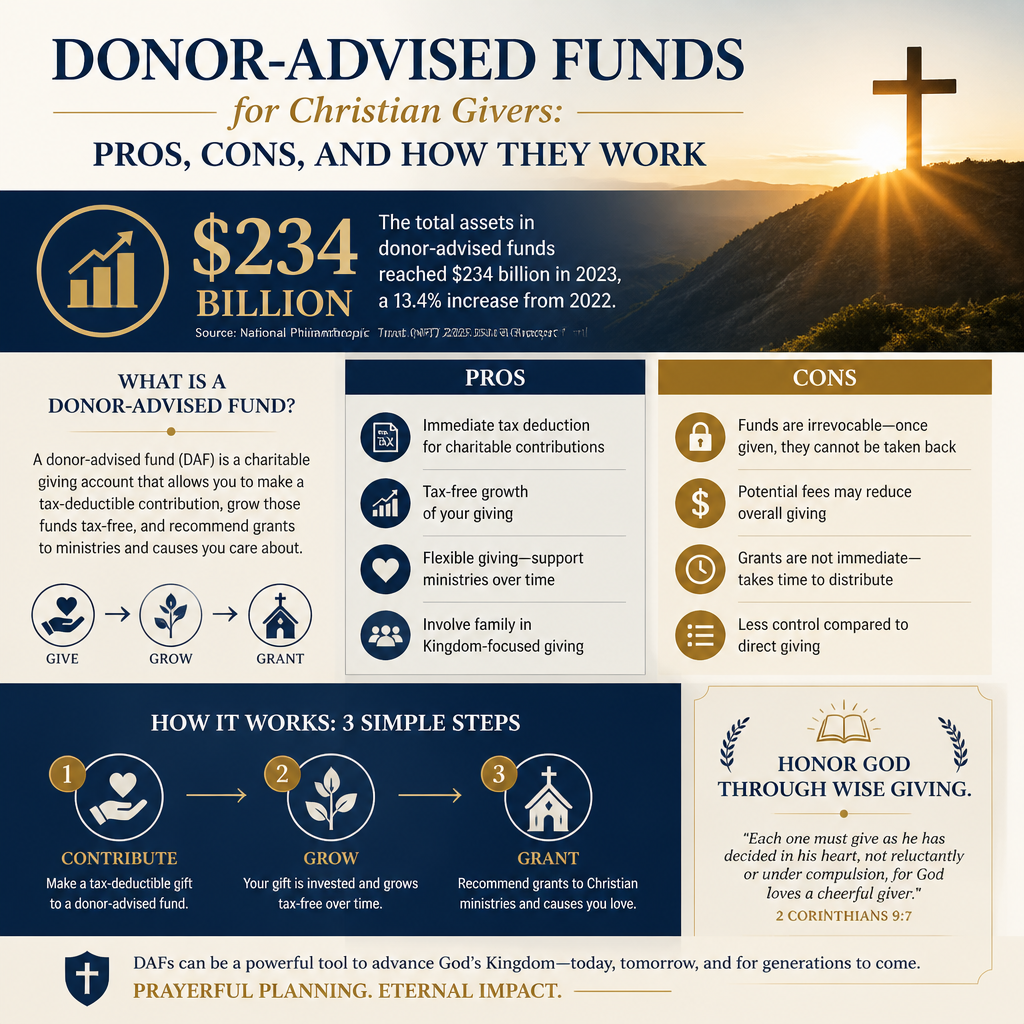
A donor-advised fund, commonly shortened to DAF, is an account housed at a sponsoring organization that is itself a public charity. You contribute assets—cash, appreciated securities, and sometimes more complex holdings—receive a charitable tax deduction (subject to IRS rules), and then recommend grants over time to IRS-qualified public charities. The sponsor has legal control of the assets, and the donor retains advisory privileges, which sponsors generally honor so long as grant recommendations are lawful and consistent with their policies.
For many Christian households, the attraction is not novelty but order. A DAF can separate the decision to set aside funds for giving from the later work of discerning where those funds should go. It can also simplify recordkeeping: one receipt for the contribution into the DAF, then a grant history for downstream giving. In a world where many Christians support multiple ministries across local church, missions, and mercy work, administrative simplification is not spiritually neutral; it can either remove friction that hinders faithfulness or create distance that reduces attentiveness.
Common structures you will encounter
Most DAFs fall into a few categories: national financial-institution sponsors; community foundations; and explicitly faith-based sponsors. The operational differences matter. Investment options, administrative fees, grant minimums, processing time, and policies on anonymity vary widely. Some sponsors provide strong compliance support for complex gifts; others operate like standardized platforms built for simplicity.
Christian donors should also distinguish between a DAF and a private foundation. A private foundation typically offers more control and may support a broader range of charitable activity, but it brings heavier administration, different payout rules, and greater public disclosure. A DAF generally has lower overhead and fewer reporting burdens for the donor, but also less legal control and less built-in transparency to the public.
What happens to the money between contribution and grant
Contributed funds can often be invested while they sit in the DAF, which may increase eventual grant-making capacity. The moral tension is obvious: investment growth can fund more ministry, but delayed distribution can also postpone urgently needed work. A DAF is structurally capable of generosity and structurally capable of procrastination. The tool does not decide; the steward does.

The potential benefits for Christian stewardship
Christians often treat “tax efficiency” as a worldly distraction. It can be. It can also be a legitimate form of stewardship when the goal is to direct more resources toward mission-aligned work rather than toward avoidable tax burden. The question is never whether the tax code sanctifies a gift. The question is whether we are using lawful tools with integrity and with a conscience formed by Scripture.
Giving appreciated assets without unnecessary loss
Many donors give cash because it is familiar, even when appreciated securities would be more efficient. Contributing appreciated stock into a DAF can, in many cases, allow a donor to avoid capital gains tax while still taking a charitable deduction, leaving more value available for grants. This is not financial cleverness for its own sake; it is a way to reduce friction between intention and execution when a household desires to give substantially.
Stability for ministries and discipline for donors
Ministries plan around predictability. A DAF can help donors establish a steady pattern of grant-making even when income is irregular. Pastors and ministry leaders regularly testify that volatility in giving creates pressure that distorts decisions, including hiring, program commitments, and cashflow management. Christians should not promise what they cannot sustain, but stability is a form of neighbor-love in the nonprofit economy.
There is also a pastoral dimension for donors. Some Christians want to give more than they do, but giving happens late, haphazardly, and in response to urgent appeals rather than in prayerful planning. A DAF can make it easier to allocate a portion of resources for charitable use and then do the slower work of discernment about recipients.
Year-end and one-time income events handled with clarity
In years with unusual income—business sale, large bonus, or required minimum distributions for some households—DAFs can help donors decouple the tax-year contribution from the timing of grants. This can preserve a thoughtful pace of giving rather than forcing rushed decisions under calendar pressure. Rushed giving tends to reward the most visible organizations, not necessarily the most faithful or effective ones.

Real risks and theological tensions Christian donors should name directly
Donor-advised funds can serve wise stewardship. They can also serve avoidance: avoidance of discernment, avoidance of accountability, and avoidance of the uncomfortable proximity that generosity creates between a Christian and the needs of others. Mature stewardship names these risks rather than treating them as fringe concerns.
The warehousing problem and delayed mercy
DAFs are not legally required to pay out at a fixed annual rate the way private foundations are. That flexibility is part of their appeal, but it also creates the possibility of indefinite accumulation. The ethical question is straightforward: if resources have been set aside for charitable use, what justifies retaining them for long periods while needs are present and known?
Regulators and researchers have raised this concern publicly. A 2024 report from the U.S. Government Accountability Office describes growth in DAFs and discusses policy debates about payout and transparency, reflecting a broader concern that some DAF assets may remain undistributed for extended periods U.S. Government Accountability Office.
Anonymity that protects and anonymity that evades
DAFs can facilitate anonymous giving. Sometimes that protects the spiritual intent of the gift, guarding against the temptation to be seen. Sometimes it shields a donor from relational accountability and from the necessary work of learning whether a ministry is trustworthy. Christian tradition has long recognized that secrecy can be virtue and can also be a refuge for vice. The difference is discerned in the heart and tested in fruit.
Moral distance from what is actually funded
DAFs can make giving feel like asset management rather than Christian discipleship. When grants are executed with a few clicks, donors can forget that they are resourcing real claims about God, the gospel, and the good of neighbor. That moral distance is especially dangerous when giving crosses borders, funds vulnerable populations, or supports ministries with weak governance. Good intentions do not prevent harm, and structural distance can reduce the likelihood that donors will notice warning signs.
Donor guidance for using a DAF with integrity
Christian donors generally ask the wrong first question. The first question is not “Which DAF has the lowest fees?” but “What practices will keep our giving honest before God and responsible toward neighbor?” Costs matter, but the deeper risk is a tool that makes us less attentive, less accountable, and slower to act.
Set a distribution conviction, not just an investment policy
Many DAF sponsors will help you choose an investment model. Fewer will ask you to choose a moral stance about pace. We recommend setting a written distribution practice, such as granting a meaningful percentage each year or committing to full distribution within a defined timeframe unless a clear reason requires otherwise. This is not a legal requirement; it is a discipline designed to prevent charitable delay from becoming normal.
For Christians, the theological logic is not primarily efficiency but mercy. A DAF should not function as a spiritual hedge: “we gave, but we are not ready to decide.” When the decision to give has been made, the remaining work is discernment, not deferral.
Choose recipients with verifiable clarity
DAFs do not remove the donor’s responsibility to know what is being funded. In practice, we see three recurring weaknesses in Christian giving that DAFs can intensify:
- Overreliance on brand and charisma, where the most visible ministry receives funds regardless of governance strength.
- Confusion between moving stories and measurable faithfulness, where narrative replaces accountability.
- Neglect of financial and governance questions, especially where donors assume shared faith ensures shared integrity.
Across our verification work at Most Trusted, ministries that are healthiest over time tend to document their faith commitments clearly, maintain independent oversight, report financials consistently, and communicate outcomes with candor rather than marketing polish. Those patterns are not guarantees, but they are observable indicators of maturity.
Use The Most Trusted Standard as a discipline for giving decisions
A DAF is a financial container. The more consequential work is deciding which ministries should receive grants. The Most Trusted Standard is designed precisely for that moment of discernment: assessing ministries across faith commitments, financial integrity, governance, and transparency about results. The goal is not cynicism; it is love expressed through due diligence.
When donors adopt a consistent verification framework, two things tend to happen. First, giving becomes calmer and more principled, less driven by urgency cycles. Second, donors become better partners to ministries because questions are asked early, expectations are clear, and funding aligns with the real work rather than the public narrative.
Clarify what a DAF cannot do
A DAF generally cannot be used to satisfy a legally binding pledge, and it cannot be used for personal benefits such as buying event tickets or receiving goods and services in exchange for a grant. Policies vary by sponsor, and responsible sponsors enforce these boundaries. Christian donors should welcome that clarity; it protects integrity and prevents the subtle redefinition of giving into self-interest with a charitable label.
DAFs also do not make a ministry faithful. They simply make a gift easier to execute. The moral and practical burden remains: to give to ministries that teach the true gospel, treat people with dignity, and handle funds with rigor.
DAFs and Christian nonprofits: what your giving signals to ministry leaders
DAFs affect ministries, not only donors. They can change cashflow patterns, donor relationships, and even organizational incentives. Understanding that downstream impact helps donors give with greater wisdom.
Many ministries appreciate DAF gifts because they can be substantial and because they reduce the administrative burden of receipting individual securities gifts. At the same time, DAF grants can increase uncertainty when donors contribute to the DAF in one year but delay grants in subsequent years. Ministries rarely know whether a donor’s DAF balance represents future support or merely past intent.
The sector has also wrestled with transparency questions. Because DAF sponsors are the legal donors, the public often cannot see which individual donors are funding which organizations, and in some cases cannot see granular patterns of grantmaking. The National Philanthropic Trust’s annual reporting has tracked the growth and scale of DAFs, reflecting their increasing influence in charitable giving National Philanthropic Trust. Growth itself is not proof of virtue or vice, but scale increases the moral stakes.
Christian donors should consider what their patterns communicate. If a DAF becomes a mechanism for episodic, opaque, or delayed support, ministries can be pushed toward short-term fundraising tactics to compensate. If a DAF becomes a mechanism for steady, principled, and accountable support, ministries gain room for long-term planning and faithful execution.
FAQs for Donor-Advised Funds for Christian Givers: Pros, Cons, and How They Work
Can we use a donor-advised fund to give to our local church?
In many cases, yes, because most churches are treated as charitable organizations under U.S. tax law even if they do not file Form 990. DAF sponsors typically require the church’s legal name and mailing address and will apply their own due diligence procedures. Donors should also confirm whether the sponsor has any restrictions related to churches, designated gifts, or international work.
Can a donor-advised fund fulfill a pledge we made to a ministry?
Generally, a DAF grant should not be used to satisfy a legally binding pledge, because the sponsor is the legal donor and the donor is only advising. Many DAF sponsors explicitly prohibit grants that reference fulfilling a pledge. The prudent approach is to avoid making binding pledges you intend to pay through a DAF and to communicate clearly with ministries about how DAF giving will be structured.
Is a donor-advised fund a way to avoid scrutiny in Christian giving?
It can be used that way, which is precisely the danger. A DAF can reduce public visibility and can create psychological distance from the recipient. Christians who want to give faithfully should treat the DAF as a recordkeeping and asset-management tool, not as a moral cover. The burden of discernment remains, and in some respects becomes heavier because the tool makes giving easier to execute than to evaluate.
What should we look for in a DAF sponsor as Christian donors?
Fee transparency, grant processing reliability, clear policies on restricted gifts and anonymity, and a track record of compliance are baseline considerations. Beyond that, Christian donors should ask whether the sponsor’s policies support integrity: clear rules on prohibitions, consistent documentation, and practices that discourage warehousing. The sponsor cannot supply spiritual maturity, but it can either support or undermine disciplined stewardship.
Giving with faith, speed, and discernment
A donor-advised fund can be an instrument of ordered generosity: giving that is planned, honest, and anchored in stewardship rather than impulse. It can also become an instrument of delay, distance, and reduced accountability. Christian donors do not honor Christ by choosing the most convenient tool; we honor Christ by giving in a way that is true, timely, and responsibly attentive to what our gifts actually fund.
When a DAF is paired with a serious approach to ministry verification—examining faith commitments, financial integrity, governance, and transparency using a coherent framework such as The Most Trusted Standard—it can help donors give with confidence and with fear of God rather than fear of scarcity. That is the goal: not simply to give more efficiently, but to give more faithfully.



