

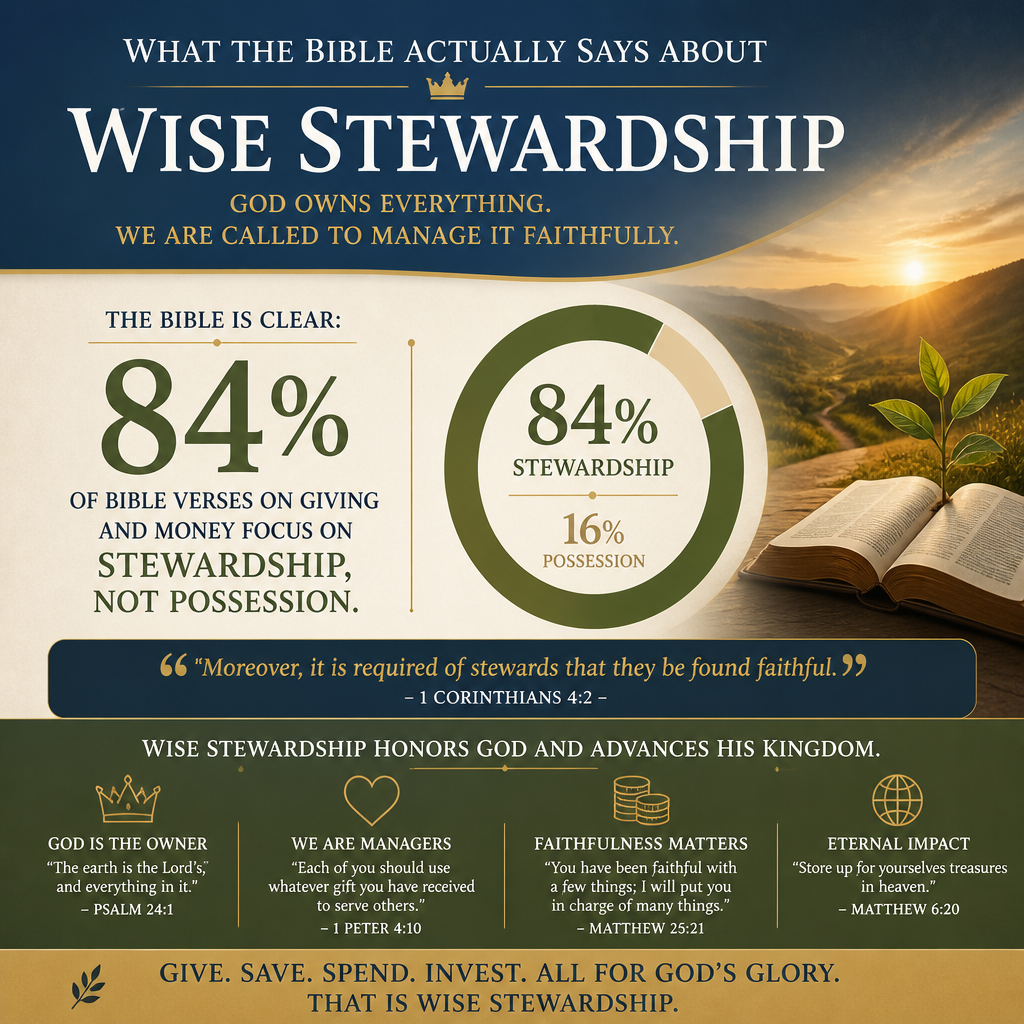
What the Bible actually says about wise stewardship is both bracing and clarifying: God owns; we manage; and our management is a moral and spiritual matter. Scripture does not treat stewardship as a private preference or a technique for personal prosperity. It treats it as accountable trust under a holy God, tested over time in ordinary decisions about spending, saving, and giving.
For Christian donors, the stakes are not merely financial efficiency. Giving is worship, and it is also power. Donors can strengthen faithful ministry, but they can also fund dysfunction, enable vanity metrics, and unintentionally harm vulnerable people. Wise stewardship therefore includes generosity, discernment, and the humility to admit that good intentions are not the same as good outcomes.
The Bible’s teaching is not simplistic. It commends sacrifice and prudence, urgency and patience, compassion and accountability. Christians genuinely disagree about some applications—how much to prioritize overhead ratios, how to think about restricted gifts, what constitutes “impact” in spiritual work, and how to weigh local church giving against parachurch causes. The mature donor does not resolve these tensions by ignoring them. We resolve them by returning to Scripture’s central claims and then applying them with evidence, governance safeguards, and moral clarity.
Stewardship begins with ownership and ends with accounting
Wise stewardship starts where the Bible starts: the world and everything in it belong to God. “The earth is the LORD’s and the fullness thereof” (Psalm 24:1). Wealth is not ultimate security and it is not moral status. It is entrusted resource. The Christian donor is not first an investor and not first a patron. We are stewards under a Master.
Jesus consistently framed stewardship in terms of entrusted responsibility and eventual reckoning. The parable of the talents (Matthew 25:14–30) and the parable of the dishonest manager (Luke 16:1–13) do not reduce stewardship to financial maximization, but they do insist on accountability, foresight, and integrity. The key question is not whether we possessed resources, but whether we were faithful with what we were given.
Faithfulness is measured, not asserted
Scripture’s moral logic pushes against vague self-justification. “Moreover, it is required of stewards that they be found faithful” (1 Corinthians 4:2). “Found” implies tested. It implies scrutiny. The donor who insists that “our hearts are in the right place” while refusing evaluation is not thinking biblically about stewardship.
That principle applies to individuals and institutions. Proverbs commends honest scales and weights (Proverbs 11:1). Paul, handling a collection for the poor, took pains to avoid reproach: “We take this course so that no one should blame us about this generous gift… for we aim at what is honorable not only in the Lord’s sight but also in the sight of man” (2 Corinthians 8:20–21). Wise stewardship expects honorable handling of funds, and it expects visible safeguards that protect honor in the sight of observers who do not share our assumptions.
Stewardship is not a euphemism for accumulation
Modern stewardship language can be bent into a respectably religious form of self-protection: “being responsible” as an excuse for never being generous, never taking risks of love, never opening the hand. Scripture dismantles that posture. Jesus warns that storing up treasure can become a form of practical atheism—living as though God will not provide and as though death will not come (Luke 12:16–21). The Bible does not condemn planning, but it does condemn hoarding as an identity and as a refuge.
At the same time, the Bible also rejects impulsive giving that ignores consequences. Proverbs praises prudent preparation (Proverbs 21:5) and rebukes rash vows (Proverbs 20:25). The tension is intentional: generosity must be real, and it must be wise.

The Bible ties wise stewardship to formation of the heart
Jesus’ most frequent financial teaching was not about techniques. It was diagnostic. “Where your treasure is, there your heart will be also” (Matthew 6:21). Wise stewardship is not merely about what the donor funds. It is about what the donor loves.
That is why the New Testament treats greed as spiritually lethal. Paul names greed as idolatry (Colossians 3:5) and warns that “the love of money is a root of all kinds of evils” (1 Timothy 6:10). The donor who gives from surplus but refuses any material inconvenience may be accomplishing real good while still avoiding the sanctifying edge of Christian generosity.
Generosity is a discipline, not a mood
The widow’s offering (Mark 12:41–44) is not a sentimental story about small amounts. It is an indictment of giving that costs nothing. Jesus praises her because she gave “all she had to live on.” Wise stewardship does not equate to minimal risk. It includes planned, sustained generosity that actually rearranges our lives.
Paul instructed the Corinthians to give regularly and intentionally: “On the first day of every week, each of you is to put something aside” (1 Corinthians 16:2). This is neither manipulation nor spontaneity. It is formation. A budget that includes meaningful giving is a spiritual document as much as a financial one.
Wise stewardship holds together grace and responsibility
Christian giving is not purchasing divine favor. It is response to divine mercy. “You know the grace of our Lord Jesus Christ, that though he was rich, yet for your sake he became poor” (2 Corinthians 8:9). The gospel creates generosity not by guilt but by gratitude.
Yet grace does not erase responsibility. Zacchaeus’ repentance included financial repair (Luke 19:8–9). The early church’s generosity included real administration: appointing trusted leaders to handle distributions when complaints arose (Acts 6:1–6). The Bible never suggests that spiritual motivation eliminates the need for competent oversight.
Wise stewardship seeks justice for the vulnerable without romanticizing outcomes
Scripture repeatedly connects faithful use of wealth to the protection of the poor. Proverbs warns that whoever closes his ear to the cry of the poor will himself call out and not be answered (Proverbs 21:13). Isaiah condemns religious performance that ignores oppression (Isaiah 58:6–10). James rebukes the church for honoring the rich while neglecting the poor (James 2:1–7). Wise stewardship therefore includes a moral bias toward mercy and justice.
But the Bible also requires truthfulness about results. It is possible to “do good” in ways that flatter donors, expand institutions, and yet fail the people the gift was meant to serve. The modern nonprofit sector has had to reckon with this at scale. The “When Helping Hurts” framework articulated by Steve Corbett and Brian Fikkert has shaped Christian development practice by warning that certain forms of aid can create dependency, undermine local capacity, and fracture community agency when outsiders assume they are the primary problem-solvers (When Helping Hurts).
The Bible’s concern is not only intention but effect
Scripture does not use modern program-evaluation language, but it does demand that leaders and communities assess fruit. Jesus warns that false prophets are known by their fruits (Matthew 7:15–20). Paul speaks of testing work to see what endures (1 Corinthians 3:12–15). In practical donor terms, wise stewardship asks: Who benefits? Who is harmed? What incentives does this funding create? What accountability exists when a program fails?
That posture is not cynicism. It is neighbor-love disciplined by reality. A gift that makes the donor feel righteous but leaves recipients less secure is not the kind of righteousness Scripture commends.
Compassion must be paired with competence
The Good Samaritan did not merely feel compassion; he took concrete, costly steps, and he arranged ongoing care (Luke 10:33–35). His mercy was organized. Wise stewardship funds ministries that can describe their work clearly, show how they learn, and demonstrate that the vulnerable are not props for fundraising.
Christian donors often sense this intuitively and still feel trapped: either give quickly and risk funding harm, or slow down and fear becoming hard-hearted. The Bible does not require haste; it requires faithfulness. Due diligence can be an act of love when it prevents exploitation and improves care.
What wise stewardship means for donors evaluating ministries
Wise stewardship is not reducible to a single metric. Donors have been taught to ask, “How much goes to programs?” but Scripture’s categories are broader: honesty, justice, accountability, and faithfulness over time. Modern research has also pushed back on simplistic overhead fixation. The “Overhead Myth” statement—signed by GuideStar, Charity Navigator, and BBB Wise Giving Alliance—warned that overhead ratios are a poor proxy for nonprofit performance and can create harmful incentives to underinvest in infrastructure and evaluation (Overhead Myth).
What this means in practice is that donors should expect ministries to fund competent finance, safeguarding, and measurement. Under-resourced administration is not automatically virtuous. It can be reckless.
Financial integrity that withstands scrutiny
Wise stewardship begins with verifiable financial practices. At a minimum, donors should look for clear financial statements, consistent reporting, and independent oversight. In the United States, a nonprofit’s Form 990 provides a standardized window into governance, compensation, and financial patterns for many organizations (IRS). Many churches are not required to file a 990; that makes voluntary transparency even more important for donor confidence.
Transparency does not mean publishing every internal detail. It means providing enough information for a reasonable donor to understand where funds go, what controls exist, and how conflicts of interest are handled. A ministry that refuses reasonable questions is not protecting mission; it is protecting power.
Governance that limits harm and temptation
Scripture assumes that leaders are accountable, not untouchable. Elders must be “above reproach” (1 Timothy 3:2), and accusations are to be handled with due process (1 Timothy 5:19–20). Donors should therefore ask whether a ministry has a functioning board, meaningful financial controls, and clear policies for safeguarding and reporting misconduct.
Across our verification work at Most Trusted, one repeated pattern is that strong ministries do not fear governance. They welcome it. Healthy boards ask hard questions, manage conflicts, and set boundaries around charismatic founders. Weak governance often correlates with financial opacity, staff turnover, and reputational crises that eventually injure the very people the ministry claims to serve.
Effectiveness that is honest about what can be measured
Christian ministry includes outcomes that are not easily quantified: spiritual formation, reconciliation, integrity, courage, repentance. Donors should resist a secular demand that everything must fit into a numerical dashboard.
But donors should also resist the opposite error: treating spiritual language as an exemption from evidence. Ministries can articulate clear theories of change, describe practices, report outputs responsibly, and show learning over time without turning discipleship into a spreadsheet. Wise stewardship expects clarity: what the ministry does, why it believes it works, how it safeguards participants, and what it does when evidence contradicts assumptions.
How The Most Trusted Standard aligns with biblical stewardship
Wise stewardship requires a framework that takes theology and verification seriously. Donors do not need perfect certainty, but we do need grounded confidence: that a ministry is doctrinally faithful, financially responsible, ethically governed, and transparent about results and limitations.
Most Trusted exists to serve that need. We evaluate Christian nonprofits against The Most Trusted Standard, a 15-criteria framework spanning faith commitments, financial integrity, governance and leadership, and transparency and effectiveness. That framework is not a replacement for prayerful discernment. It is a disciplined form of the discernment Scripture commends: testing what is presented, avoiding partiality, and insisting on what is honorable in the sight of God and people.
The Most Trusted Standard reflects several biblical stewardship convictions:
- Stewardship is accountable. Organizations should be able to show how funds are handled and who is responsible.
- Leadership is morally consequential. Character, governance, and safeguards are not peripheral; they are central to faithfulness.
- Truthfulness is part of righteousness. Clear, accurate communication with donors is a moral obligation, not a marketing preference.
- Love of neighbor includes protection of the vulnerable. Policies, reporting mechanisms, and independent oversight are part of mercy in practice.
Christians sometimes worry that verification frameworks import a secular corporate mindset. That concern deserves respect. Some forms of “accountability” can become bureaucratic theater. Yet Scripture’s own pattern runs in the other direction: visible integrity, multiple witnesses, careful handling of funds, and leadership tested over time. Discernment that refuses evidence is not spiritual maturity. It is vulnerability to manipulation.
FAQs for What the Bible Actually Says About Wise Stewardship
Does the Bible teach that Christians should tithe?
The Old Testament contains clear tithing practices connected to Israel’s covenant life (for example, Leviticus 27:30). The New Testament does not command a flat percentage tithe in the same way, but it does command generous, willing, and proportionate giving (2 Corinthians 9:6–7; 1 Corinthians 16:2). Many Christians treat ten percent as a useful baseline; others see New Testament generosity as potentially more demanding than a percentage. Wise stewardship focuses less on legal minimums and more on faithful, planned generosity that reflects God’s grace.
Is it unspiritual to ask a ministry for financial details?
No. Paul treated transparent handling of funds as part of honor before God and people (2 Corinthians 8:20–21). Requesting clarity is not hostility; it is stewardship. The manner matters. Questions should be fair and proportionate. But mature ministries should be prepared to answer them with substance.
Should donors prioritize low overhead ratios?
Not as a primary measure of faithfulness or effectiveness. Overhead ratios can be manipulated and can punish organizations that invest in compliance, staff care, evaluation, and safeguarding. The Overhead Myth statement by GuideStar, Charity Navigator, and BBB Wise Giving Alliance warned that overhead is a poor proxy for performance and can create unhealthy incentives (Overhead Myth). Wise stewardship asks broader questions: governance quality, financial controls, transparency, and credible evidence of service to the vulnerable.
How can donors evaluate spiritual impact when it cannot be measured like a business metric?
Not everything that matters is quantifiable, and Scripture itself acknowledges fruit that emerges over time. Still, donors can look for clarity and honesty: the ministry’s theological commitments, the practices it uses to form disciples, the safeguards protecting participants, and its willingness to learn. Wise stewardship does not demand false precision, but it does require truthful reporting and responsible claims.
Wise stewardship is disciplined love under God
What the Bible actually says about wise stewardship is not a niche teaching for finance-minded Christians. It is a central feature of discipleship because money exposes the heart and because wealth can either serve neighbor-love or serve self-rule. Christian donors are called to be generous, and we are also called to be discerning.
The goal is not suspicion. The goal is faithfulness: giving that honors God, protects the vulnerable, strengthens credible ministry, and refuses the comfortable illusion that intention alone is enough. When donors combine open-handed generosity with disciplined verification, we practice a stewardship that Scripture can recognize as both worship and wisdom.



