

Recurring vs. one-time giving is not a contest between “better” and “worse.” It is a question of fit: what a ministry actually needs to do faithful work over time, and what a donor is trying to practice before God. Scripture affirms both patterns. The early church received periodic gifts for famine relief and mission needs, and it also sustained ongoing ministry through regular support and shared responsibility.
The stakes are not theoretical. One-time gifts can fund expansion, capital needs, and crisis response. Recurring giving can stabilize staffing, allow long-range planning, and reduce the hidden cost of constant fundraising. Yet either pattern can be poorly stewarded or poorly discerned. Christian donors are not only deciding how to give, but also whom to trust with what kind of money.
We recommend a both-and approach for most mature donors: a baseline of recurring giving to ministries with demonstrated integrity and effectiveness, supplemented by one-time gifts that respond to clear opportunities, emergencies, and strategic projects. The harder work is not choosing a format; it is choosing ministries whose theology, governance, and financial practices can bear the weight of consistent support.
Why recurring giving changes how ministries operate
Most ministries do not struggle primarily because they lack vision. They struggle because they cannot reliably match commitments to cash. Staff salaries, missionary support, program delivery, compliance costs, and basic systems do not pause when donations fluctuate. Recurring giving addresses that specific vulnerability by turning a portion of revenue into a predictable stream.
Predictability reduces mission drift
When funding is volatile, organizations are tempted toward reactive fundraising: chasing whatever storyline produces the next burst of giving. That pressure can distort priorities, shorten timelines, and reward what is most marketable rather than what is most faithful. Recurring giving does not remove those temptations, but it reduces the degree to which next month’s payroll depends on next week’s email appeal.
There is also a theological dimension. The New Testament assumes ordered, deliberate generosity rather than impulsive giving alone. Paul commends planned giving when he instructs believers to set aside funds regularly for the collection for the saints (1 Corinthians 16:2). Regularity is not spirituality in itself, but it can be a concrete way of resisting the tyranny of the urgent.
Lower fundraising friction frees real capacity
Ministries with a healthy recurring base typically spend less time and money re-acquiring the same donors each year. That does not mean they stop communicating; it means the communications burden is less existential. In philanthropic research, donor retention has long been a weakness across the sector, and retention drives fundraising efficiency in ways donors rarely see from the outside. For example, the 2024 Fundraising Effectiveness Project report shows that recurring donor retention substantially outperforms non-recurring donor retention, and that overall donor retention remains a persistent challenge across the sector (Association of Fundraising Professionals Fundraising Effectiveness Project).
Christian donors often prefer that a ministry spend less on acquisition and more on direct program work. A stable recurring base is one of the few ethical ways to move in that direction without starving an organization’s necessary operating functions.
Recurring revenue can also mask underlying weakness
Predictable income is not the same as faithful stewardship. A ministry can build a large recurring base and still lack meaningful accountability, board governance, or clarity about outcomes. Recurring giving can even enable unhealthy patterns if donors stop paying attention because the gift feels automatic. The discipline required is shared: ministries must remain accountable, and recurring donors must remain engaged enough to evaluate whether the ministry still merits trust.

What one-time gifts do well, and what they cannot do
One-time giving remains essential to the Christian philanthropic ecosystem. Many of the most important needs in ministry are irregular by nature: disaster response, matching grants, capital projects, legal emergencies, and constrained opportunities that require quick action. One-time gifts also allow donors to respond directly to conviction, seasons of abundance, and particular burdens the Lord places before them.
One-time gifts fund inflection points
Church planting launches, property purchases, technology upgrades, and program expansions often require a concentrated influx of capital. For these needs, recurring gifts alone may be too slow or too small in aggregate. A well-structured campaign can be appropriate stewardship when it is honest about risk, transparent about budgets, and realistic about ongoing operating costs after the project is built.
Donors should notice whether a ministry can articulate what changes after the one-time gift is spent. “We need $500,000 for a building” is not yet a case; it is a request. A case includes the ministry’s plan for program growth, staffing, maintenance, and the long-term financial model that prevents a new facility from becoming a future crisis.
One-time gifts can respect donor discernment
Some Christian donors hesitate to commit to recurring giving because they have learned, sometimes painfully, that ministries can change leadership, drift theologically, or become less transparent over time. One-time giving can be an appropriate posture when trust is partial or still forming.
This is not cynicism; it is prudent stewardship. Jesus assumes that his disciples will evaluate fruit (Matthew 7:16–20). The New Testament also includes sober warnings about leaders who exploit the flock. Donors are not required to fund every compelling appeal. They are called to give faithfully, wisely, and without self-deception.

One-time giving can unintentionally create a starvation cycle
Irregular revenue can force ministries into short-term behavior: reducing staff development, delaying systems improvements, or underinvesting in governance. This pattern is well documented in the nonprofit field. The “starvation cycle” language is often associated with research and commentary on chronic underfunding of overhead and capacity, including analysis published in Stanford Social Innovation Review (Stanford Social Innovation Review).
Christian donors sometimes reinforce this dynamic unintentionally when we prefer project gifts but resist funding the real costs of healthy operations. A ministry can report inspiring stories while its internal finances remain fragile. One-time giving is not the problem; the problem is one-time giving that is disconnected from a realistic view of what ministry work actually requires.
The spiritual and ethical stakes for donors
Christian giving is not merely a transaction. It is an act of worship and a form of moral responsibility. Scripture holds together freedom and accountability: “Each one must give as he has decided in his heart, not reluctantly or under compulsion” (2 Corinthians 9:7), and “it is required of stewards that they be found faithful” (1 Corinthians 4:2). Those truths apply to both donors and ministries.
Recurring giving forms habits, for better or worse
Recurring giving can be a wise tool for forming consistent generosity, especially for donors who want their giving to be anchored rather than reactive. It can also become a spiritual anesthesia: giving that continues while discernment disappears. Mature donors treat recurring commitments as reviewable commitments. A recurring gift should not mean unexamined trust.
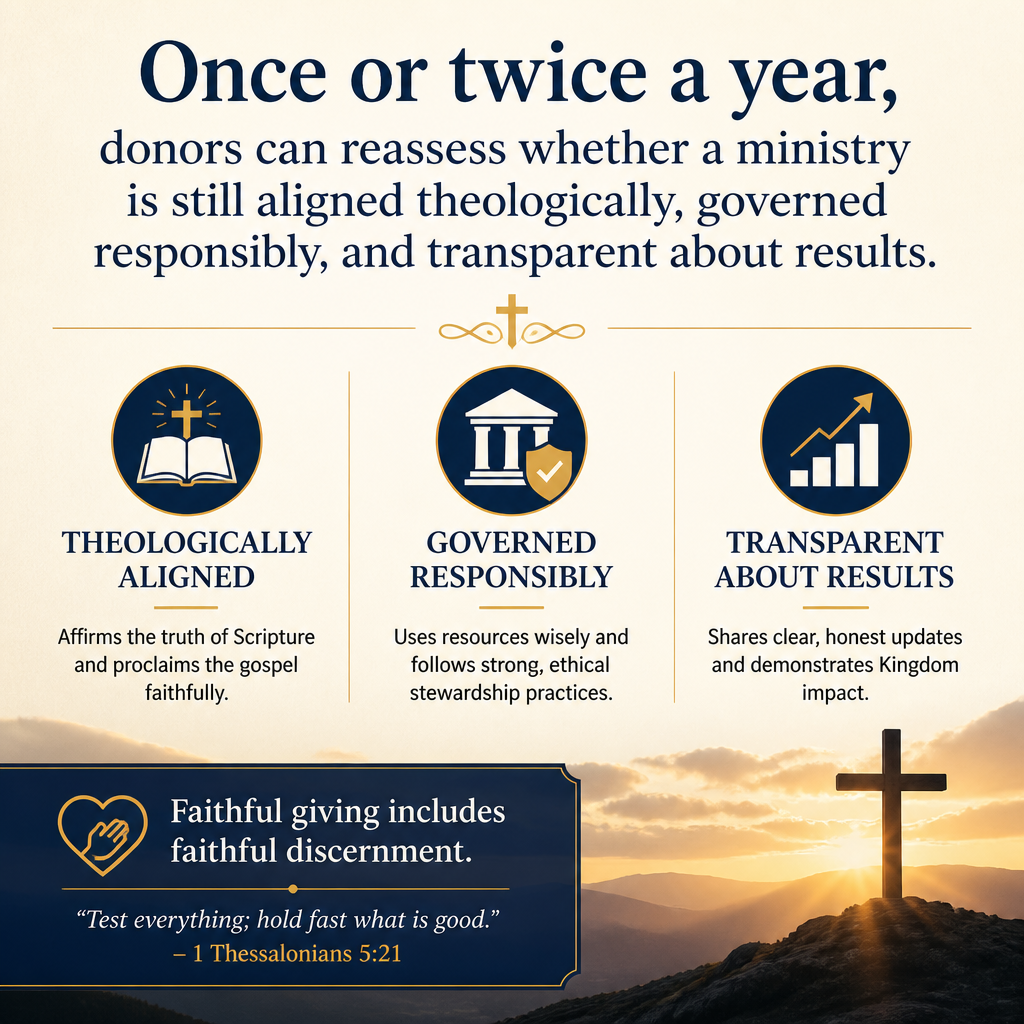
Practically, this means setting a cadence for review. Once or twice a year, donors can reassess whether a ministry is still aligned theologically, governed responsibly, and transparent about results. Recurring giving remains recurring; the scrutiny should remain recurring as well.
One-time giving can reflect generosity, or avoidance
One-time gifts can express joyful responsiveness to need. They can also allow donors to avoid the uncomfortable work of long-term partnership: asking hard questions, reading financials, and staying engaged through seasons when ministry outcomes are slow and unglamorous. The Christian life includes both mercy to immediate need and endurance in long obedience.
Many ministries serving vulnerable populations do not produce dramatic short-term stories. Prison ministry, trauma care, and pastoral training are often slow work. Donors who only give when the narrative is urgent may inadvertently favor flash over faithfulness.
Both forms require clear accountability
The question is not whether recurring or one-time giving is more spiritual. The question is whether the ministry can be trusted with the kind of money being given. Regular gifts should support organizations that are structurally able to steward them. Large one-time gifts should go to organizations that can execute complex projects without cutting corners, obscuring costs, or weakening governance under pressure.
Donor guidance that holds ministries to a higher standard
Sophisticated Christian donors do not merely ask, “Is this ministry doing good work?” We also ask, “Is this ministry demonstrably trustworthy with resources entrusted by God?” Across our verification work at Most Trusted, the ministries that meet The Most Trusted Standard tend to show a consistent pattern: clear theological commitments, serious governance, disciplined financial practices, and public transparency that invites scrutiny rather than resenting it.
When recurring giving is the wiser tool
Recurring giving is generally appropriate when a ministry can credibly answer three questions.
- Does the ministry have stable, accountable leadership? Look for an engaged board, meaningful policies for conflicts of interest, and clear lines of authority. Founder-led ministries can be fruitful, but they are also a known risk category when boards are passive or composed primarily of friends.
- Does the ministry report finances in a way that can be evaluated? Ministries should be able to provide recent financial statements, a budget, and clear explanations of major revenue sources and expenses. Donors do not need perfection; we do need candor.
- Does the ministry describe outcomes with appropriate humility and evidence? For gospel proclamation ministries, fruit is not always measurable in the same way as social services. Even so, ministries can report responsibly: who is being served, what is being delivered, what is changing, and what limitations remain.
If these elements are absent, recurring giving may function as subsidized opacity. In that case, one-time giving—or refraining—can be the more responsible choice until trust is earned.
When one-time giving is the wiser tool
One-time giving is generally appropriate when the need is time-bound, the deliverable is clear, and the ministry has shown it can manage complexity without hiding trade-offs.
- Capital projects and expansion campaigns: Request a full project budget, not merely a fundraising target. Ask what operating costs increase afterward and how they will be sustained.
- Disaster response: Ask whether the ministry has established local partners and a plan for responsible aid distribution. In crisis work, speed can be necessary, but unaccountable speed can cause harm.
- Scholarship funds and restricted gifts: Clarify what “restricted” means in practice, whether unused funds can be reassigned, and how the ministry reports use of restricted funds.
One-time giving becomes dangerous when it is driven by emotional urgency without verification. Crisis appeals are a known environment for exaggerated claims, underdeveloped plans, and weak controls.
Signals of trustworthiness that matter more than fundraising polish
Donors are often pressured to evaluate ministries on marketing quality. A more faithful evaluation focuses on governance and truthfulness.
- Clarity about identity and doctrine: Ministries should state their faith commitments plainly and consistently, not merely use Christian language as branding.
- Transparency that is public, not private: If meaningful information is only available after repeated requests, the default posture may be concealment rather than accountability.
- Reasonable compensation and related-party safeguards: Donors should not assume malice, but we should insist on policies that prevent self-dealing and protect witness.
- Outcome claims that are bounded and honest: Beware of ministries that promise more certainty than their work can deliver. Integrity is often visible in the limitations they are willing to name.
The widely endorsed “Overhead Myth” statement, signed by major nonprofit evaluators, underscores that simplistic overhead ratios are a poor proxy for effectiveness and can pressure organizations into underinvesting in healthy infrastructure (The Overhead Myth). Christian donors should apply the same maturity: a ministry that invests in proper accounting, safeguarding, and program evaluation is often protecting the mission, not diverting from it.
How recurring and one-time giving work together in a faithful strategy
Many Christian households already practice a blended approach without naming it. We support our local church as a steady commitment. We also respond to special offerings, missionaries, benevolence needs, and emergencies. The question is how to apply that same wisdom to parachurch ministries and nonprofit work.
A helpful framework is to think in three layers: (1) consistent commitments to the institutions and ministries that shape Christian life over time, (2) ongoing support to trusted frontline work that requires stability, and (3) one-time responsiveness to strategic opportunities and crises. The proportions will differ by calling, income, and season of life, but the logic remains coherent.
Recurring giving is particularly well suited for ministries where relationships, staffing continuity, and long-term presence matter: pastoral training, church planting networks, translation work, prison discipleship, crisis pregnancy care, and refugee resettlement partners. One-time giving is particularly well suited for bounded needs: vehicles, facilities, equipment, matching challenges, and urgent relief.
Christians genuinely disagree about the best way to balance these categories. Some donors prioritize flexibility because they have watched institutions drift. Others prioritize stability because they have seen ministries harmed by donor volatility. The constructive path is not to moralize the preference, but to demand a higher level of verifiable trust from the organizations we fund, and a higher level of intentionality from ourselves.
FAQs for Recurring vs. One-Time Giving: Which Is Better for Ministries?
Is recurring giving always better for a ministry?
No. Recurring giving is often better for planning and staffing, but it can also reduce donor attentiveness and enable unhealthy organizations to persist. The ministry’s governance, transparency, and ability to steward predictable revenue matter more than the format of the gift.
Should Christians prioritize recurring giving to the local church over parachurch ministries?
Many Christians do, and there are sound theological and practical reasons to treat the local church as a primary commitment. Parachurch ministries can be legitimate extensions of the Church’s work, but they should not function as substitutes for the Church. Donors should make these decisions in conversation with Scripture, conscience, and wise counsel.
What if a ministry pressures donors to switch to monthly giving?
A clear invitation is appropriate; pressure is not. Donors should ask what the ministry would do differently with more predictable revenue, and whether it can show transparent budgets and accountable leadership. If a ministry cannot explain the operational reason for recurring support, the request may be driven more by fundraising fashion than stewardship need.
How often should recurring donors re-evaluate a ministry?
At least annually, and more often if there is leadership turnover, significant controversy, or a shift in stated mission. Donors should review publicly available financial information, governance signals, and the ministry’s honesty about outcomes. Recurring giving should not mean permanent giving.
A faithful answer is usually both, with verification
Recurring vs. one-time giving is best approached as a stewardship decision rather than a binary choice. Recurring giving can strengthen faithful ministries by making long-term work possible. One-time giving can fund urgent mercy and strategic growth. Both can also be misdirected when donors substitute sentiment for scrutiny.
We serve donors through Most Trusted by evaluating ministries against The Most Trusted Standard, because the central question behind every giving method is trustworthiness. When a ministry’s faith commitments are clear, its finances are intelligible, its governance is accountable, and its reporting is transparent, recurring giving becomes a stabilizing partnership rather than a leap of faith. And one-time giving becomes targeted generosity rather than financial guesswork.



