

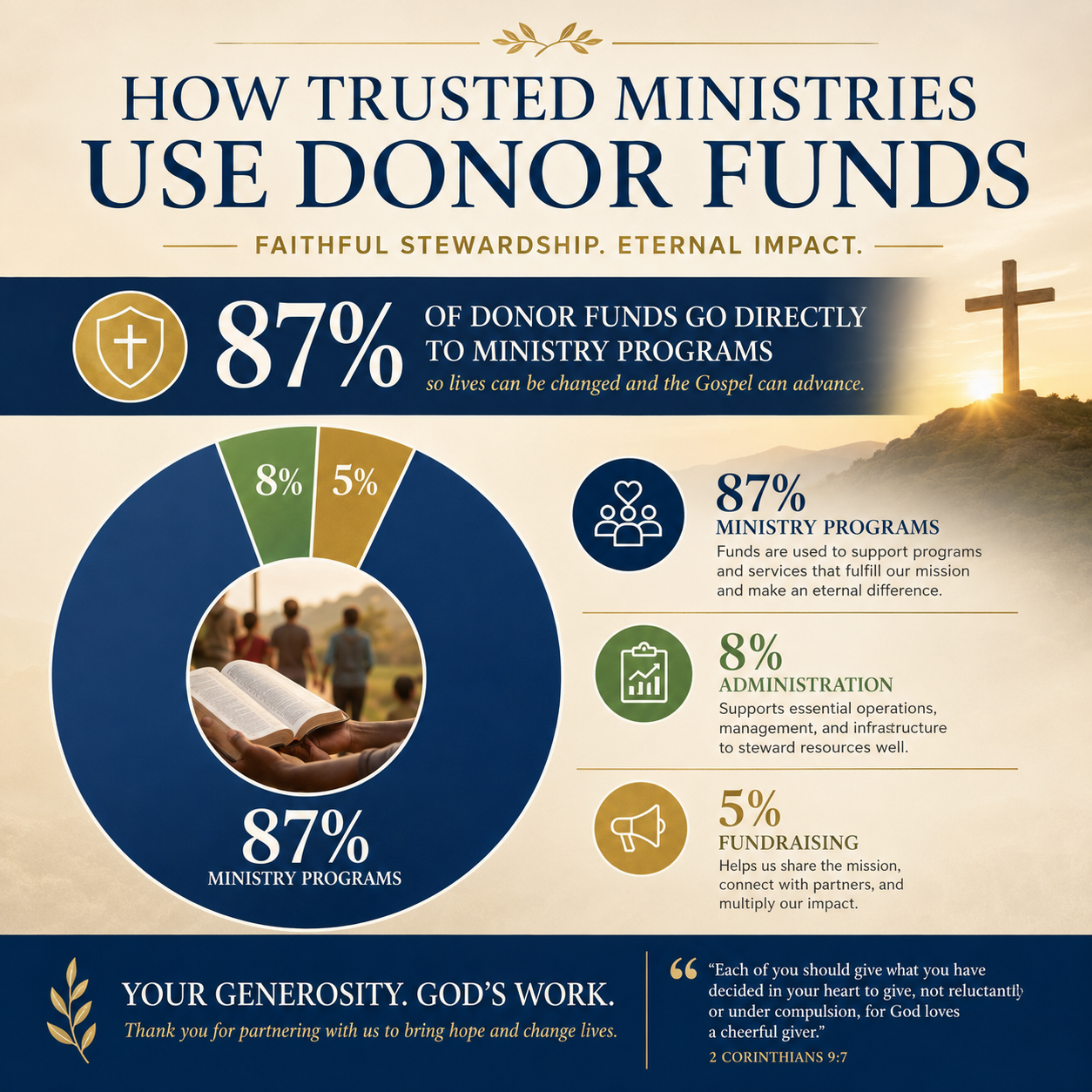
How trusted ministries use donor funds is not primarily a question of marketing competence. It is a question of moral integrity before God. Scripture treats money as a spiritual matter because it reveals what a heart loves and what a people believe. When Christian donors give, we are not purchasing outcomes; we are entrusting resources that ultimately belong to the Lord (Psalm 24:1) to stewards who will answer for their handling of them.
That accountability cuts two ways. Donors have real obligations: to give generously, to give wisely, and to resist the temptation to outsource discernment to emotion or reputation. Ministries have corresponding obligations: to tell the truth, to count the cost, to refuse manipulation, and to demonstrate that funds are used for the purposes promised. Mature donors sense the stakes because they have seen both the beauty of faithful stewardship and the damage of financial opacity, inflated claims, and mission drift.
What this means in practice is that trustworthy ministries do not merely “spend efficiently.” They spend in ways that are coherent with their calling, governed with accountability, reported with candor, and measured with a sober commitment to effectiveness that is appropriate to their mission. This is the kind of stewardship we evaluate at Most Trusted through The Most Trusted Standard, a 15-criteria framework spanning faith foundation, financial integrity, governance and leadership, and transparency and effectiveness.
Theology shapes spending before spreadsheets do
The New Testament’s central financial category is not overhead; it is stewardship. Jesus’ parables assume accountability for resources entrusted to servants (Matthew 25:14–30). Paul’s language assumes fidelity: “it is required of stewards that they be found faithful” (1 Corinthians 4:2). That theological frame does not remove the need for budgets and controls. It deepens it. A ministry that speaks constantly about faith but treats donor funds casually is offering a contradiction.
Trusted ministries tend to show a coherent relationship between their stated mission and their actual spending. Program expenditures are not simply high; they are intelligible. Staff roles make sense. Restricted gifts are handled carefully. Fundraising is positioned as a necessary tool, not a stage for self-promotion. The organization’s financial decisions reflect the truth that the mission is received, not invented, and that the ministry is accountable to Christ, not merely to a market.
Why the overhead debate misleads serious donors
Christians genuinely disagree about how to interpret financial ratios, and some disagreements are warranted. It is possible to waste money while maintaining attractive ratios, and it is possible to build durable capacity while showing less flattering ratios in the short term. The sector has widely recognized that simplistic overhead fixation distorts behavior and discourages healthy investment in systems, staff development, evaluation, and security.
The broader philanthropic field articulated this clearly in the “Overhead Myth” statement, arguing that donors should focus on results and transparency rather than arbitrary caps on administrative and fundraising costs; the statement was signed by leaders from GuideStar (now Candid), Charity Navigator, and the BBB Wise Giving Alliance (OverheadMyth.com). Christian donors should take that critique seriously without swinging to the opposite extreme of ignoring cost discipline altogether. Faithfulness includes prudence.
Restricted gifts are a test of truthfulness
One of the clearest ways to discern trustworthiness is to observe how a ministry handles restricted funds. A restricted gift is not a general endorsement; it is a promise. Mature ministries maintain systems that track restrictions, allocate expenses appropriately, and communicate when a restriction can no longer be honored as written. They do not treat restrictions as donor preference suggestions. They treat them as a matter of honesty.
Less trustworthy organizations often blur categories: “missions” becomes a label for almost anything, and restricted appeals subtly subsidize unrelated costs. Donors cannot police this individually, which is why independent verification and disciplined financial controls matter. Trusted ministries design their finance practices so that truthfulness is not dependent on the memory or goodwill of a single leader.

Trusted ministries budget for real ministry, not imagined ministry
Most donor frustration is not about the existence of administrative costs; it is about the sense that money disappears into a machine that produces compelling stories but thin substance. Trusted ministries tend to budget for real deliverables: trained staff, safe operations, appropriate safeguarding, and long-term presence. They resist the temptation to prioritize optics over reality, even when the optics raise more money.
Capacity is not a compromise of calling
Many Christian donors were formed by a generation of ministry appeals that treated “lean” as synonymous with “holy.” There is a legitimate impulse here: the fear that money can corrupt and that ministry can become self-perpetuating. Yet Scripture’s warnings about greed do not imply that competence is ungodly. A ministry that serves vulnerable people without appropriate controls, policies, and staff training is not more faithful; it is more dangerous.
Trusted ministries fund the unglamorous infrastructure that makes long-term faithfulness possible: secure data handling for donors and beneficiaries, audited financials when appropriate, background checks and safeguarding policies, and leadership development that prevents a ministry from becoming a personality cult. These costs rarely produce the kind of stories that fundraising prefers. They are still a form of love.
Program spending should be describable in concrete terms
Donors should be able to understand what a ministry’s program spending does without reading marketing language. A credible ministry can explain, in straightforward categories, what it pays for: field staff, local partnerships, materials, housing support, curriculum, translation, travel, security protocols, monitoring, and evaluation. When a ministry cannot describe its spending concretely, it often indicates that the organization has not done the internal work of defining what its programs actually are.

That concreteness also protects against a common temptation: counting the same activity multiple times for promotional effect. For example, “served” can mean a meal provided, a tract distributed, a clinic visit, or an online impression. Trusted ministries define their terms, even when precision makes the numbers smaller. In Christian ministry, truth-telling is never a concession to cynicism; it is obedience.
Governance is where donor funds are either protected or exposed
Financial misuse in Christian nonprofits is often framed as a “bad actor” problem. Sometimes it is. More often it is a governance problem: unchecked authority, weak boards, conflicts of interest, and cultures that equate questions with disloyalty. Trusted ministries build structures that make temptation harder and correction possible.
A healthy board does more than approve budgets. It asks whether spending aligns with mission. It reviews executive compensation in a defensible way. It ensures that related-party transactions are disclosed and governed. It insists that major risks are named rather than spiritualized away. Many ministries have strong intentions; fewer have strong accountability. The difference matters when money is involved.
Conflict of interest policies are not bureaucratic formalities
In Christian communities, relationships are a gift and a vulnerability. The same relational trust that strengthens ministry can also mask self-dealing: contracts awarded to friends, family members on payroll without appropriate oversight, housing allowances and expense reimbursements handled casually, and boards populated by close associates who cannot exercise meaningful independence.
Trusted ministries do not treat these as awkward topics to avoid. They adopt conflict of interest policies, require regular disclosures, and document decisions. This is not suspicion; it is protection—for the ministry, for the donors, and for the leaders themselves. Proverbs assumes the wisdom of safeguards because it assumes the reality of temptation.
Executive compensation should be transparent and defensible
Christians can disagree about what constitutes appropriate pay for nonprofit leaders. The real question is whether the compensation is disclosed, governed, and justified by comparable data and responsibilities. Trusted ministries avoid secrecy. They report compensation in ways consistent with applicable law and donor expectations, and boards document the rationale for pay decisions.
Opacity here is rarely neutral. When donors feel misled, the damage is not limited to one organization; it spreads cynicism across the whole field of Christian ministry. A ministry that believes it is serving Christ should not treat donor trust as expendable.
Transparency is more than publishing numbers
Some ministries publish extensive financial reports and still leave donors unable to understand what funds accomplished. Other ministries publish less but communicate with a candor that makes accountability possible. Trusted ministries tend to do both: they provide accessible financial information and interpret it with integrity.
Transparency includes reporting that is timely, consistent, and comparable year to year. It includes acknowledging setbacks, not only successes. It includes clarity about what is measured and what is not. Mature donors are not asking ministries to promise certainty. They are asking ministries to refuse exaggeration.
Outcomes should match the kind of ministry being done
Not every Christian ministry can be evaluated with the same metrics. A Bible translation effort has different indicators than a prison discipleship program. A pastoral training network will often show fruit over years, not quarters. Trusted ministries select indicators that fit their work and avoid the temptation to import business-style “growth” measures that sound impressive but misrepresent spiritual realities.
At the same time, a refusal to measure anything can become a spiritual alibi. Scripture does not bless vagueness. When a ministry claims that donor funds change lives, it should be able to describe the change it is seeking, the practices it uses to pursue it, and the evidence it has that those practices are bearing the intended fruit.
When helping hurts is a real stewardship concern
The field has had to reckon with the ways good intentions can produce dependency, distort local economies, and displace local leadership. The “When Helping Hurts” framework, articulated by Steve Corbett and Brian Fikkert, has shaped a generation of thinking about poverty alleviation and short-term missions by pressing ministries to design help that strengthens, rather than replaces, local capacity (When Helping Hurts).
Trusted ministries budget accordingly. They fund local leadership development. They pay attention to unintended consequences. They resist donor-driven strategies that feel compassionate but erode dignity. They also communicate these trade-offs clearly, even when it requires re-educating supporters who have been trained to equate urgency with effectiveness.
Donor guidance for scrutinizing ministry spending with charity and rigor
Christian donors often feel caught between two errors: naïveté that enables misuse and cynicism that withholds generosity. The better path is disciplined love—giving that is warm-hearted and clear-eyed. Trusted ministries welcome that posture because it treats them as accountable servants, not as untouchable celebrities or suspected thieves.
Ask for coherence before you ask for ratios
Begin with coherence questions that reveal whether spending makes sense in light of mission:
- What is the ministry claiming to do, concretely? If the answer is mostly slogans, financial analysis will not become clearer.
- What does the ministry actually fund to do that work? Look for staff roles, partner relationships, safeguarding, and operational realities.
- Does the ministry’s spending pattern match its stated strategy? A discipleship ministry spending heavily on constant acquisition marketing may have a misalignment problem, even if it is legal.
Ratios can support these questions, but they cannot replace them. A ministry can meet a donor’s preferred overhead threshold and still be poorly governed or ineffective. Conversely, a ministry investing in evaluation, security, or compliance may look less “efficient” in the short term while actually becoming more trustworthy.
Scrutinize truthfulness in fundraising language
Many donor disappointments begin with language that implies more than it can deliver. Pay attention to:
- Specificity: Does the appeal define what the gift will do, or does it rely on emotional imagery?
- Implied guarantees: Are outcomes framed as certain when they are not?
- Use of restricted giving: Are restrictions clearly explained, and does the ministry have a credible way to honor them?
Trusted ministries do not manipulate donors into urgency by obscuring the real financial picture. They may press for generosity, as Scripture does, but they will not do it with half-truths. A ministry that repeatedly blurs lines in appeals is often blurring lines in spending as well.
Look for governance signals that protect the mission
Donors cannot sit in every board meeting, but we can look for signs of real oversight:
- Independent board governance: Not a board dominated by employees, relatives, or close personal associates of the founder.
- Clear financial reporting: Readable statements, consistent categories, and willingness to answer reasonable questions.
- External accountability: Audits or reviews where appropriate to the organization’s size and complexity, and a posture of openness to scrutiny.
This is one reason independent verification exists. At Most Trusted, our evaluation work against The Most Trusted Standard is designed to make these signals visible: not merely whether a ministry has documents, but whether governance, financial integrity, faith commitments, and public transparency form a coherent whole.
FAQs for How Trusted Ministries Use Donor Funds
Is a higher program percentage always better?
No. Program percentage can be helpful, but it can also mislead. Some administrative and fundraising spending is necessary for compliance, safeguarding, donor reporting, and sustainable operations. The more reliable question is whether the ministry’s spending is coherent with its mission, governed with accountability, and reported with clarity. The philanthropic sector has warned against simplistic overhead fixation in the “Overhead Myth” statement from Charity Navigator, GuideStar, and BBB Wise Giving Alliance (OverheadMyth.com).
What should we expect a trustworthy ministry to disclose publicly?
At a minimum, donors should expect clear statements about mission and programs, responsible financial reporting appropriate to the ministry’s size, basic governance information, and candid communication that does not rely on inflated claims. Larger or more complex organizations should generally disclose more, including audited financial statements and detailed annual reporting. The key is not volume but intelligibility and consistency.
How do trusted ministries handle restricted gifts?
They treat restrictions as promises rather than preferences. That typically means using accounting systems and internal controls that track restricted funds, allocating expenses accordingly, and communicating with donors when circumstances require a change. A ministry that routinely blurs restricted and unrestricted use is asking donors to finance a story rather than a mission.
Do effective ministries always measure outcomes?
They should measure in ways appropriate to their work. Not every ministry can quantify spiritual fruit, and many faithful outcomes unfold over long horizons. Still, a refusal to define goals, track meaningful indicators, or evaluate effectiveness can become an excuse for unaccountable spending. Trusted ministries are careful about what they claim, clear about what they measure, and humble about what they cannot.
Trustworthy spending is faithful stewardship made visible
Christian donors do not give merely to fund activity. We give to participate in obedience, mercy, and witness—to put resources into the hands of stewards whose lives and institutions are ordered toward Christ. How trusted ministries use donor funds is therefore inseparable from governance, truthfulness, and spiritual seriousness. The most credible ministries do not ask donors to suspend judgment; they invite scrutiny because they understand that accountability is part of their calling.



