

How Christian apologetics ministries address atheism questions is no longer a peripheral concern for donors who want the church’s public witness to remain intellectually credible and spiritually faithful. In a culture where disbelief is often framed as the default posture of educated people, apologetics ministries are asked to do two demanding things at once: engage real arguments with rigor, and honor the image of God in the person raising them.
The harder question for Christian donors is not whether questions deserve answers, but what kind of ministry deserves investment. Some apologetics work strengthens the church by clarifying the gospel and discipling believers toward mature faith. Other work can become combative, celebrity-driven, or careless with truth claims. Our responsibility is to fund ministries that serve the church with integrity, not merely ministries that win exchanges.
Atheism questions are rarely only intellectual
Atheism presents as a set of arguments, but it often arrives in the church as a lived rupture: grief, disappointment with hypocrisy, moral injury, unanswered prayer, or alienation from Christian community. Apologetics ministries that treat every atheist question as a logic puzzle usually misdiagnose the pastoral dimension. The New Testament’s account of persuasion assumes both truth and love: “speaking the truth in love” is not a slogan but an ethical constraint on Christian speech (Ephesians 4:15).
What this means for donors is that the best apologetics ministries are often those with theological depth and emotional steadiness. Their public tone matters because it trains donors’ churches in how to speak. A ministry may be able to rebut an argument and still damage the credibility of the gospel by contempt, caricature, or triumphalism.
Intellectual honesty is part of Christian discipleship
Christian faith is not a demand for credulity. Scripture commends reasoning under God: “Come now, let us reason together” (Isaiah 1:18). Historically, the church’s best thinkers—from Augustine to Aquinas—understood that clarity about God is an act of love toward neighbor and an act of worship.
Strong apologetics ministries model this posture by admitting complexity and naming limits. They distinguish between what Christianity must affirm (the resurrection of Jesus, the authority of Scripture, the reality of sin and grace) and what Christians legitimately debate (questions about divine hiddenness, the interpretation of Genesis, or the problem of evil in its philosophical forms).
Public engagement shapes the church’s moral credibility
Atheism questions are often bound up with moral critiques of the church: abuse scandals, racial injustice, political idolatry, or the mismatch between professed beliefs and lived behavior. Apologetics that never acknowledges these realities can sound evasive. Apologetics that acknowledges sin in the church without collapsing into cynicism can actually strengthen witness by demonstrating repentance and moral seriousness.

The most common questions and the strongest patterns of response
Across the apologetics field, certain questions recur because they address the core plausibility structure of Christianity: whether God exists, whether miracles are possible, whether Jesus rose from the dead, and whether the Bible is trustworthy. Mature ministries tend to build layered responses that address both the philosophical framing and the human stakes.
Does God exist if suffering exists
The problem of evil remains a central question, especially when atheism presents itself as moral protest. Strong ministries avoid glib answers. They distinguish between logical and evidential forms of the problem and address them with appropriate tools: classical theism, the nature of creaturely freedom, and the Christian claim that God is not distant from suffering but enters it in Christ.
Many ministries also draw from the long tradition of theodicy while recognizing that suffering is not primarily a debate topic for those in pain. The cross does not function as a tidy argument; it functions as God’s self-giving presence and as a promise that evil will not have the final word (Romans 8:18–39).
Is faith irrational or anti science
Apologetics ministries often address the science question by clarifying categories: science as an empirical method, not a comprehensive philosophy; and faith as trust grounded in testimony, evidence, and encounter, not mere wishfulness. At their best, they point out that atheism also rests on philosophical commitments—about metaphysics, morality, and meaning—that cannot be settled by laboratory method alone.
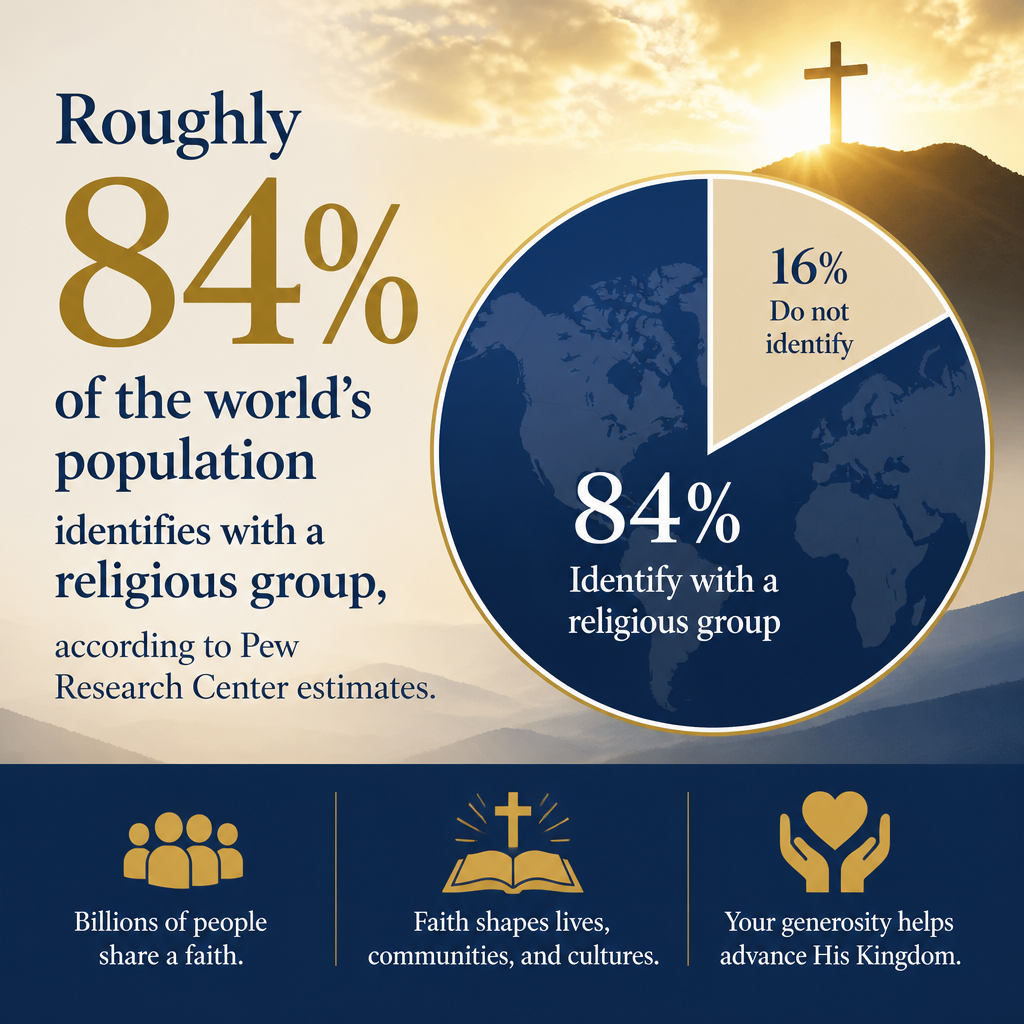
On the cultural side, it is worth observing that religious belief remains globally significant even as certain Western institutions become more secular. Roughly 84% of the world’s population identifies with a religious group, according to Pew Research Center estimates.Pew Research Center This is not a proof of Christianity, but it does challenge the claim that faith is merely a residue of pre-modern ignorance.
Methods that serve both truth and neighbor
Apologetics is not only about which arguments are used, but how they are used. The church has always needed evangelists who can reason, but the church also needs saints who can listen. The ministries most worthy of donor confidence tend to combine intellectual seriousness with spiritual formation.

Classical evidential and cumulative case approaches
Many ministries use a classical structure: arguments for God’s existence, then evidence for the reliability of the New Testament, then the historical case for the resurrection. Others prefer a cumulative case approach that gathers multiple lines of evidence—philosophical, historical, experiential—without pretending any single argument compels belief.
This work can be especially valuable for donors concerned about young adults leaving the church. The data is often summarized in simplistic ways, but the directional signal is clear: the religious landscape in the United States has shifted. Pew Research Center reports that the share of U.S. adults who identify as Christian has declined over recent decades, while the religiously unaffiliated have grown.Pew Research Center Religion Apologetics cannot reverse every cultural force, but it can reduce avoidable intellectual stumbling blocks and equip churches for honest conversation.
Conversational and pastoral apologetics
Some ministries emphasize dialogue over debate, often drawing from practices associated with Socratic questioning, reflective listening, and narrative apologetics. This is not relativism. It is the recognition that arguments land differently depending on a person’s history, community, and moral imagination.
Donors should not assume that “winsome” equals “weak.” A ministry that refuses to caricature atheism, that cites sources carefully, and that can state the strongest atheist objections before answering them often demonstrates more confidence in truth than a ministry that relies on rhetorical force.
What donor due diligence should look for
Apologetics ministries operate in a high-trust environment: the audience often lacks time to verify claims, and the subject matter includes scholarship that can be selectively quoted. This is precisely where disciplined giving matters. Most Trusted exists to help donors give with confidence by evaluating Christian nonprofits against The Most Trusted Standard, a 15-criteria framework spanning faith commitments, financial integrity, governance, and public transparency.
When donors ask how to evaluate an apologetics ministry, we recommend moving beyond personality and platform size toward verifiable indicators of fidelity and stewardship. A ministry’s content may be compelling, but donors are not only funding content; they are funding an organization.
Markers of theological and scholarly integrity
Healthy ministries show their work. They cite primary sources, acknowledge counterarguments, and correct errors publicly when needed. They also clarify what kind of apologetics they do. Some focus on analytic philosophy, some on historical Jesus scholarship, some on cultural critique, and some on evangelistic training. Confusion here often produces donor disappointment later.
For donors who want a broader view of how these organizations fit together, it is often helpful to review the landscape of Christian Apologetics Ministries with an eye toward mission focus, audience served, and accountability structures.
Operational stewardship and accountability
Apologetics ministries sometimes face the same temptations as other media-adjacent nonprofits: donor-funded expansion without mature oversight, high dependence on a single founder, and unclear measures of effectiveness beyond views, downloads, or event attendance. Those metrics can matter, but they are not inherently signs of spiritual fruit.
A practical screen for donors is to ask whether the ministry provides clear financial reporting, an independent board with real oversight, and transparent policies for conflicts of interest and related-party transactions. The point is not suspicion; it is faithful stewardship. Scripture treats financial integrity as a moral matter, not an administrative inconvenience (2 Corinthians 8:20–21).
- Clarity of mission that distinguishes evangelism, discipleship, and academic work without conflating them
- Documented faith commitments and theological accountability that is more than branding
- Transparent finances with accessible reporting and responsible fundraising practices
- Governance maturity that does not collapse into a founder-centered structure
- Evidence of impact that includes training outcomes, church partnerships, and pastoral safeguards
How donor support can strengthen the church’s public witness
Donors sometimes treat apologetics as a specialized add-on for a small subculture of debaters. In practice, apologetics shapes ordinary believers’ confidence and public speech. It also shapes the tone by which the church addresses skeptics, doubters, and those wounded by Christian failure.
Financial support is therefore a moral act with downstream effects. Funding ministries that handle atheism questions with intellectual precision and spiritual maturity can help churches avoid two errors: a brittle fundamentalism that fears questions, and a thin accommodationism that dissolves Christian claims into generic spirituality.
Support that encourages formation, not only content production
Some of the best apologetics work happens off camera: training pastors, equipping campus ministers, developing curricula that churches can use, and creating disciplined pathways for inquiry that do not shame doubt. These efforts are often less visible than viral clips, but they frequently represent the kind of long-term investment that donors say they want.
Apologetics ministries also differ in how they handle the ethical dimensions of persuasion. We recommend favoring organizations that avoid manipulation, respect personal agency, and tell the truth even when the truth does not serve a fundraising narrative.
Engagement that understands cultural engagement as discipleship
Atheism questions today arrive through specific cultural channels: social media, university life, professional guilds, and political polarization. Ministries that meet this moment do not only argue for God; they help Christians understand the moral and spiritual pressures shaping unbelief and belief alike.
Donors seeking this wider frame will often find it within the broader domain of Cultural Engagement in Christian Apologetics, where apologetics is treated as part of a larger ecclesial responsibility to speak truthfully and live faithfully in public.
FAQs for How Christian apologetics ministries address atheism questions
Should donors prioritize philosophical arguments or resurrection evidence when evaluating apologetics ministries?
Both matter, and the best ministries typically connect them. Philosophical work can clarify whether belief in God is coherent; historical work addresses whether Christianity’s central claims about Jesus are true in history. Donors should look for ministries that avoid false binaries and that show careful sourcing, intellectual humility, and clear theological commitments.
What are red flags that an apologetics ministry may not be a wise investment?
Consistent misrepresentation of opponents, a pattern of overclaiming credentials, refusal to correct errors, opaque finances, and governance that lacks independent oversight should give donors pause. Apologetics that builds an audience by contempt rarely forms Christians in the character of Christ, and weak accountability structures can turn public platforms into private empires.
A faithful apologetics ministry is both truthful and accountable
Christian apologetics ministries address atheism questions best when they treat truth as sacred, people as image-bearers, and stewardship as discipleship. Donors are not only funding answers; they are funding a model of Christian speech in the public square. The ministries most worthy of trust tend to combine intellectual rigor, pastoral seriousness, and organizational accountability that can bear the weight of influence.



