
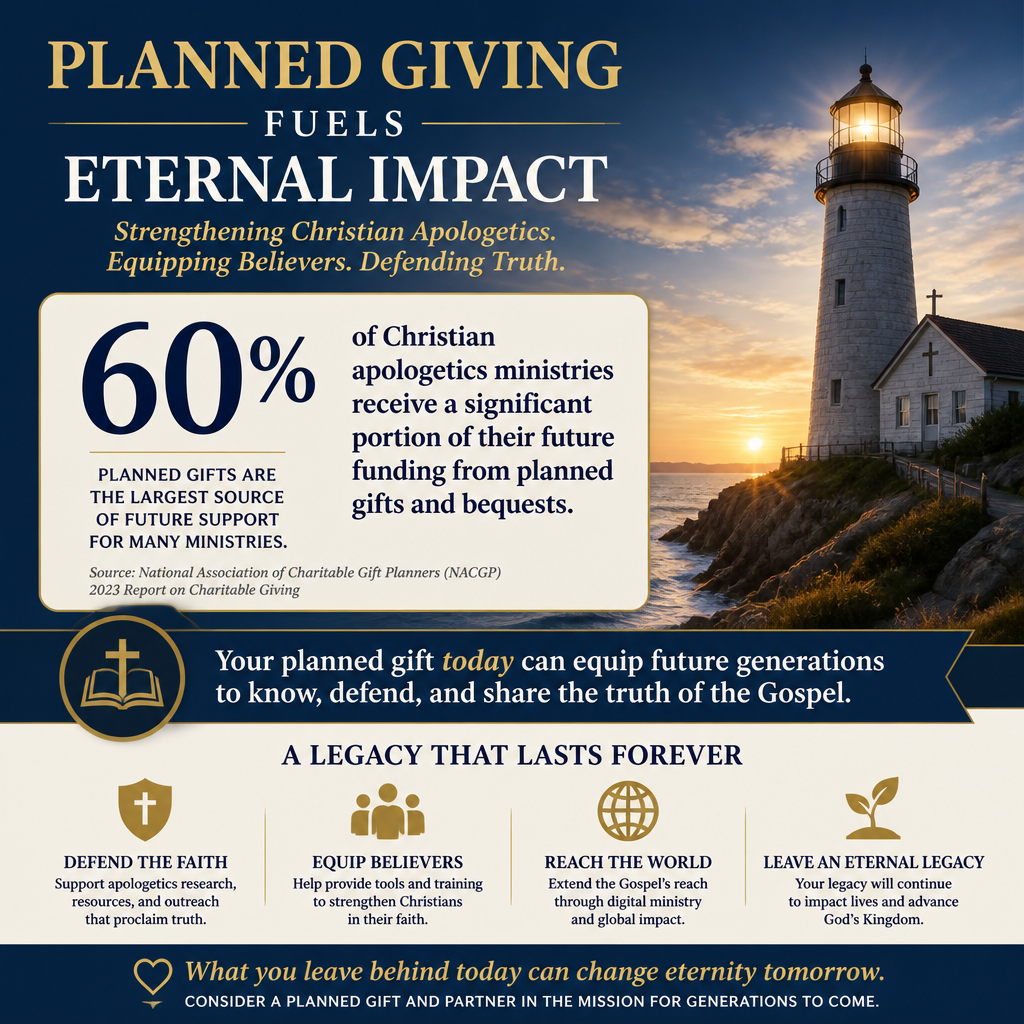
Planned giving for Christian apologetics ministries is a stewardship decision about what we will defend and commend to the next generation when our own voices are no longer present. Apologetics work is often slow, intellectually demanding, and culturally contested; it seldom produces the immediate narratives that dominate modern fundraising. Yet Scripture consistently treats long-horizon faithfulness as wisdom, and it commends those who “provide for their households” without collapsing that duty into mere accumulation (1 Timothy 5:8, ESV, esv.org).
The harder question is not whether apologetics deserves support, but how to give in a way that is durable, ethically coherent, and verifiable. Some donors want to underwrite public-facing argumentation; others want to strengthen scholarship, translation, campus engagement, or digital evangelism. Planned giving can serve each of those aims—if donors insist on clear ministry outcomes, clean governance, and an articulated theology of persuasion that resists both triumphalism and fear.
Why planned giving fits apologetics work
Christian apologetics ministries tend to build assets that compound over time: trained speakers, curricula, research libraries, academic partnerships, media distribution channels, and long-form content that continues circulating for years. Planned giving aligns with that reality. A bequest, beneficiary designation, or charitable trust can fund the kind of work that is difficult to sustain through annual appeals, especially when public controversy makes revenue volatile.
At the same time, apologetics is not merely an intellectual enterprise. Scripture does not give the church permission to win arguments at the cost of charity. Peter’s instruction to “always be prepared to make a defense” is joined to a moral requirement: it must be done “with gentleness and respect” (1 Peter 3:15, NIV, biblegateway.com). Donors who pursue planned giving in this space are not only underwriting content; they are investing in a posture of witness. That makes governance, accountability, and spiritual leadership more—not less—important.
Long-term capital for long-term formation
Many apologetics organizations operate at the intersection of the academy, the local church, and the media ecosystem. That intersection rewards stability. Endowment-like reserves can underwrite scholarships for training programs, editorial production schedules, faculty appointments, and translated resources that take years to mature. Planned giving is particularly well-suited to those forms of capacity-building, because it can be designated to strengthen the ministry’s long-term resilience rather than next quarter’s budget gap.
Apologetics donors often carry specific fears
Christian donors frequently describe the same burdens: grandchildren leaving the church, children absorbing secular plausibility structures, pastors stretched thin, and public institutions that are more skeptical of Christianity than they were a generation ago. Those concerns are not imaginary, but they can tempt us toward reactive giving—funding only what feels urgent or combative. Planned giving creates space for calmer discernment. It permits donors to underwrite work that is careful, research-driven, and spiritually mature rather than merely loud.
A sober view of measurement
Apologetics is notoriously difficult to quantify. A single conversation can reshape someone’s intellectual credibility structure without yielding immediate conversion. That does not excuse vague reporting, but it does mean donors should look for honest indicators: reach, engagement depth, training completion rates, partnerships, content lifecycle, and theological clarity about the role of reason in evangelism. Ministries that promise guaranteed results often reveal more about marketing incentives than about the work itself.

Planned giving vehicles that donors actually use
Planned giving is not one instrument; it is a set of tools that connect donor intent, tax law, and ministry mission. Each tool carries trade-offs in flexibility, timing, and complexity. For Christian donors supporting apologetics, the most common options are straightforward—and they can be structured without compromising biblical priorities like provision, honesty, and peace among heirs.
Bequests and beneficiary designations
For many households, the simplest planned gift is a bequest through a will or trust. Donors can leave a specific amount, a percentage, or a residual gift after other obligations are met. Beneficiary designations for IRAs, 401(k)s, and life insurance are often even simpler because they pass outside probate and can be updated without rewriting a will. For retirement assets, charitable beneficiaries can also reduce the income tax consequences heirs might otherwise face, since traditional retirement accounts are generally taxable to non-spouse heirs.
Because donors often support multiple ministries, clarity matters. A bequest should identify the legal name of the organization and, where possible, its EIN. If the intent is to fund apologetics work specifically, donors should discuss with the ministry whether a designated purpose can be honored without creating administrative fragility. Overly narrow restrictions can become unworkable years later when programs change or the ministry merges.
Donor-advised funds and complex assets
Many established givers use donor-advised funds for annual giving because they provide orderly recordkeeping and allow bunching of deductions in high-income years. Donor-advised funds can also be part of a legacy plan. Some sponsors allow successor advisors (often children) or charitable successor beneficiaries, which can extend a family’s giving pattern into the next generation while still keeping the assets dedicated to charitable use.
For donors holding appreciated stock, planned giving may overlap with current giving. Appreciated securities can be contributed directly to a ministry or to a donor-advised fund, often avoiding capital gains tax and providing a charitable deduction if itemizing. The tax treatment depends on the asset and the donor’s circumstances, so it should be coordinated with a tax professional.
Required minimum distributions and qualified charitable distributions
For donors over age 70½, qualified charitable distributions from an IRA can satisfy required minimum distributions while excluding the distribution from taxable income, subject to annual limits and IRS rules. This approach can be particularly attractive for donors who no longer itemize deductions and still want tax-efficient generosity. IRS guidance provides the governing rules, and donors should ensure the gift is made directly from the IRA custodian to the charity to qualify (irs.gov).
What to verify before naming an apologetics ministry in an estate plan
Planned gifts are unusually weighty because they are often irreversible at the moment they are realized. A donor may be gone, and heirs may not have the authority—or the knowledge—to correct a misalignment. That is why verification is not a bureaucratic exercise. It is a moral obligation in stewardship, especially when a ministry’s public profile can be shaped by charismatic leaders, polarized audiences, and media incentives.
Across Most Trusted’s verification work, we observe that ministries that meet The Most Trusted Standard tend to treat donor intent as a covenantal responsibility rather than as fundraising strategy. They document policies, disclose governance structures, address conflicts of interest directly, and report outcomes without manipulating the reader’s emotions. That posture is particularly significant for apologetics, where credibility is part of the ministry’s witness.
Faithfulness in theology and tone
Donors should ask what the ministry believes about Scripture, the gospel, and the church—and how those convictions shape its apologetics method. Some ministries emphasize evidential arguments; others focus on worldview critique or presuppositional approaches. Christians genuinely disagree about which approach is most effective in a given cultural moment. What is less disputable is the spiritual danger of pride, contempt, and platform-building. A ministry’s teaching and public engagement should reflect the moral texture of Christian witness, not only intellectual sharpness.
Financial integrity and the reality of overhead
Planned gifts can be large, and they can distort incentives if a ministry lacks strong controls. Donors should look for audited financial statements when size warrants it, clear explanations of reserves, and evidence that the board understands internal controls. Ministry leaders should be able to explain why certain administrative costs exist and how they protect the mission.
Many donors have been taught to distrust “overhead,” but the broader philanthropic field has recognized that simplistic overhead ratios can mislead. The well-known “Overhead Myth” statement—signed by GuideStar (now Candid), BBB Wise Giving Alliance, and Charity Navigator—argues that donors should focus on transparency, governance, and results rather than a single percentage (candid.org). For apologetics ministries, legitimate costs may include editorial quality, research support, safeguarding policies for minors in training programs, and compliance for international content distribution.
Governance, leadership, and succession
A planned gift is, in part, a bet on continuity. Donors should ask whether the ministry has a functioning board, documented conflict-of-interest practices, and a succession plan. Apologetics organizations can be founder-driven, and founder transitions are among the most common stress points in ministry life. A credible ministry should be able to describe how authority is distributed, how doctrine is protected without becoming personality cult, and how the organization will endure leadership change.
Transparency and effectiveness without exaggeration
Apologetics ministries often report reach metrics—downloads, views, event attendance, subscriptions. Those numbers can be useful, but they are also easy to inflate with marketing. Donors should ask for a balanced account: what the ministry can verify, what it cannot, and what the ministry has learned from critique. When a ministry shows its work—publishing annual reports, explaining methods, and acknowledging limitations—it earns trust in a way that is consistent with apologetics itself.
For donors evaluating organizations in this category, our research at Most Trusted is designed to support that discernment within Christian Apologetics Ministries, using The Most Trusted Standard as a disciplined framework for what should be verifiable.
Structuring a legacy gift with heirs, attorneys, and ministry leaders
Planned giving is not merely a transaction between donor and ministry. It touches family dynamics, legal responsibilities, and spiritual formation. The most faithful estate plans tend to be those that reduce confusion and resentment, not those that treat heirs as obstacles to generosity.
Clarify intent and reduce the burden on executors
Executors and trustees carry fiduciary duties. They need clear instructions and accurate identifying details. Donors should ensure each ministry is named correctly and that contact information is accessible. If a gift is restricted, the restriction should be written in a way that is durable and administratively realistic. Many ministries can provide suggested bequest language, but donors should still have counsel review it in the context of the full estate plan.
Coordinate tax receipts and substantiation
Even though planned gifts are often handled by estates, substantiation still matters. Donors and their representatives should understand what documentation the IRS requires for charitable deductions and how the ministry issues receipts or acknowledgments. When gifts involve non-cash assets, valuation rules can be complex, and appraisals may be required. A ministry that treats receipting casually can create needless legal exposure for an estate.
Make room for family discipleship
Some donors want to use a donor-advised fund or family foundation structure to involve children and grandchildren in recommended grants, reading programs, or site visits. Others prefer a simpler bequest to avoid administrative burdens. Both can be faithful. The key is to name the spiritual aim honestly: whether the goal is to maximize immediate ministry funding, to form heirs in generosity, or to do both in a balanced way.
Scripture’s warnings about wealth are not only about greed; they are about the spiritual dullness wealth can produce across generations. Planned giving can serve as a counter-formative act when it is paired with clear family communication and an intelligible rationale rooted in the gospel.
Giving that endures beyond a donor’s lifetime
Planned giving for Christian apologetics ministries is one way to make a long obedience possible: to strengthen institutions that defend the faith without reducing Christianity to argument, and to ensure that public witness remains tethered to the character of Christ. The most credible legacy gifts are those built on verifiable trust—clear doctrine, accountable leadership, transparent finances, and honest reporting—so that what is funded in a future decade still deserves the confidence that motivated the gift today.



