
How child sponsorship ministries serve the Great Commission is not primarily a question of fundraising technique. It is a question of whether the church’s care for children can be ordered toward Christ’s command to make disciples of all nations, without confusing relief, development, and evangelism. Mature Christian donors sense the tension: a sponsorship photo can invite generous love, but it can also invite a thin story about poverty, a transactional view of discipleship, or a results narrative that Scripture does not authorize.
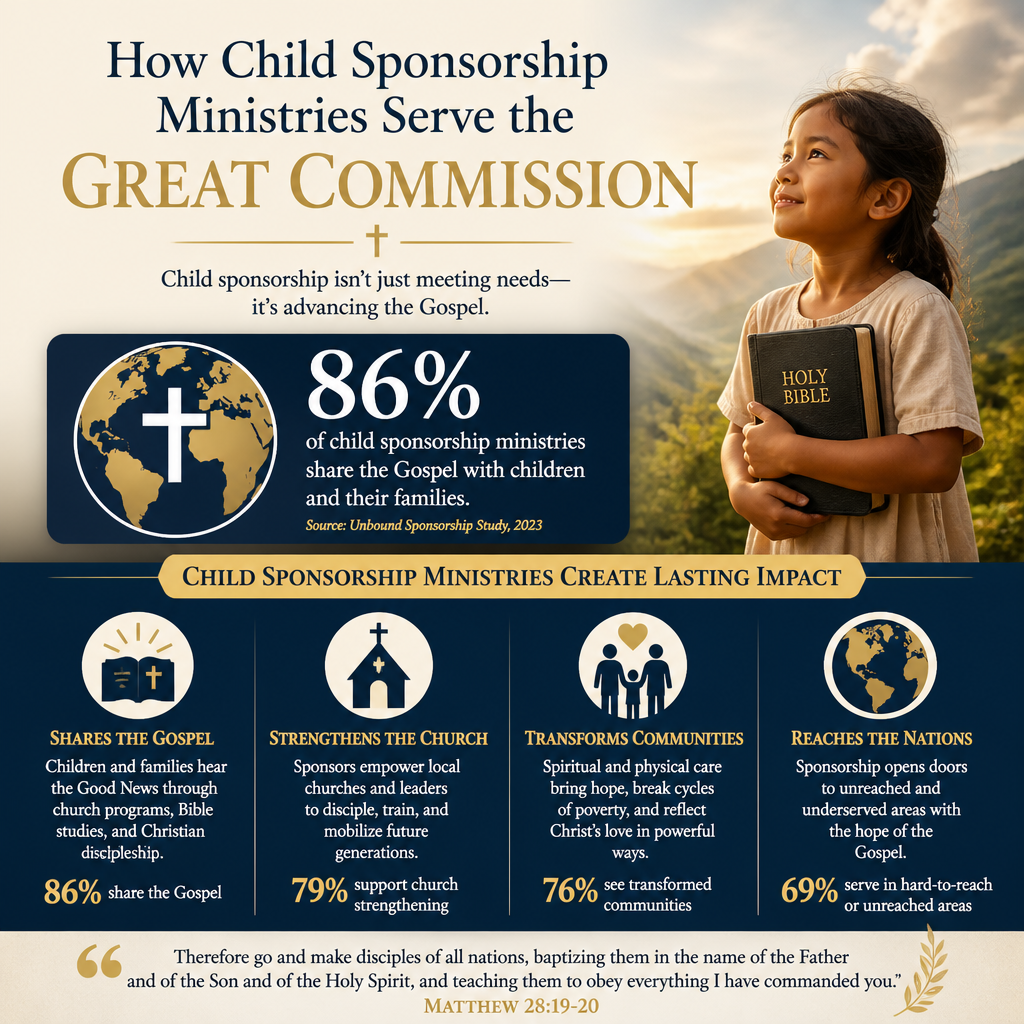
The Great Commission in Matthew 28 is explicit about both scope and substance: “make disciples … teaching them to observe all that I have commanded you.” The church is sent to peoples and places, not merely to projects; and it is sent to baptize and teach, not merely to improve outcomes. Child sponsorship is at its best when it is a means of faithful presence—strengthening families, forming local churches, and supporting long obedience in the same direction—rather than a substitute for the ordinary means of grace.
The Great Commission is about disciples, not merely beneficiaries
Matthew 28 sets the terms for Christian compassion
Jesus’ command joins proclamation, baptism, and teaching into a coherent mission. That coherence matters for donors because child sponsorship can be framed as a humanitarian product: a monthly gift “changes a life,” and a child becomes a unit of impact. Scripture gives a different grammar. The nations are not addressed as markets, and children are not addressed as deliverables; they are persons made in God’s image, and potential disciples under the authority of Christ.
When child sponsorship ministries are intentionally integrated with local-church life, the connection to the Great Commission becomes more than rhetorical. The New Testament pattern is not disembodied philanthropy, but church-anchored ministry that makes Christ visible in word and deed. Christians have long held these together. The Lausanne Covenant’s articulation of “evangelism and socio-political involvement” as “both part of our Christian duty” remains a defining statement for many evangelical mission leaders, even as debates continue about emphasis and boundaries (Lausanne Movement).
Children belong in the center of the church’s witness
Jesus received children with a seriousness his disciples did not expect. “Let the little children come to me” is not sentimental permission; it is a rebuke to adult gatekeeping and a revelation of kingdom values. A sponsorship ministry that treats children primarily as marketing assets contradicts that posture. A sponsorship ministry that treats children as persons to be protected, taught, and formed aligns with it.

Child sponsorship can strengthen local churches when it is structurally accountable
The local church is not an accessory to mission
Many donors assume child sponsorship is “missions” by default. The harder question is whether it strengthens the church in the places it serves, or whether it runs parallel to the church with occasional religious language. A Great Commission-shaped sponsorship model is explicit about ecclesial partnership: Who is doing the discipling? Who is accountable for doctrine? Who shepherds children when donors are absent?
This is one reason we encourage donors to read sponsorship ministries through the lens of Biblical Foundations for Child Sponsorship. Christian compassion is not merely about intention; it is about the structures that protect vulnerable people and the theological commitments that govern practice. Ministries that can explain their church relationships with clarity—governance agreements, shared safeguarding standards, mutual accountability—tend to withstand scrutiny better than ministries that rely on generalized claims.
Subsidiarity and dignity matter in sponsorship design
Christians genuinely disagree about how much a sponsor should know, how direct sponsor-child contact should be, and whether sponsorship should be framed as “one-to-one” or community-based. These are not minor details. They shape incentives on the ground. They can either reinforce local agency or undermine it.
Development practitioners often describe the principle of subsidiarity: decisions should be made as close as possible to the people affected. While donors do not need technical language, they should look for the reality it names. Sponsorship that empowers local caregivers, local educators, and local church leaders will generally align better with human dignity than sponsorship that centralizes decision-making with donors and distant headquarters.
Wise sponsorship avoids common harms and perverse incentives
Poverty is complex, and simplistic narratives can injure
Most sponsorship appeals compress poverty into a single story: a child lacks resources, a sponsor provides resources, a life changes. That narrative can mobilize generosity, but it can also train donors to expect linear transformation and to imagine poverty as primarily a shortage of cash. The When Helping Hurts framework, articulated by Steve Corbett and Brian Fikkert, has reshaped how many Christian leaders think about poverty as broken relationships— with God, self, others, and creation—rather than merely material lack (When Helping Hurts).
What this means in practice is that effective sponsorship ministries usually invest beyond fees and supplies. They invest in family stability, trauma-informed care, spiritual formation, and local livelihoods. They also resist public storytelling that turns a child into an object lesson for Western generosity.
Safeguarding and family integrity are Great Commission issues
Any ministry working with children must be judged by whether it protects children from abuse, coercion, and exploitation. This is not merely a compliance category; it is a credibility category for Christian witness. Donors should expect clear safeguarding policies, trained staff, vetted partners, and reported incidents handled with transparency.
Family integrity is part of that moral field. Where children can be safely cared for in families, strengthening families is usually more faithful than substituting for them. Global child protection research has documented the risks associated with institutionalization; a frequently cited synthesis is the 2009 report “Orphans and Vulnerable Children: Discussion Paper” and related guidance that shaped later reforms, including a strong preference in many settings for family-based care over long-term institutions (UNICEF).
- Are children’s photos and stories used with informed consent and dignity?
- Does the ministry have a written safeguarding policy and partner enforcement?
- Does the program strengthen families when reunification or preservation is possible?
- Are local churches meaningfully involved in discipleship and pastoral care?
- Are financial flows and program outcomes communicated without exaggeration?
Donor trust requires verifiable integrity, not inspirational reporting
Great Commission giving still requires ordinary stewardship
Jesus spoke about money as a spiritual matter, but he never treated financial integrity as optional. Mature donors understand that zeal for mission does not excuse weak controls. The question is not whether a ministry feels faithful; it is whether it is demonstrably accountable.
Across our verification work at Most Trusted, we see a consistent pattern: ministries that are most persuasive in spiritual vision are not always the ministries strongest in governance, financial controls, or measured effectiveness. That is why we built The Most Trusted Standard, a 15-criteria framework spanning Faith Foundation, Financial Integrity, Governance and Leadership, and Transparency and Effectiveness. Donors deserve more than assurances; they deserve evidence proportionate to the vulnerability of the children served and the theological seriousness of the claims made.
Transparency must be more than a dashboard
Some ministries respond to donor concern with more metrics. Metrics can help, but they can also mislead. A sponsorship program can report high participation rates and still fail to protect children. It can report graduation counts and still create unhealthy incentives for staff to keep children “on roster” rather than doing the slower work of family strengthening.
What donors should seek is a transparent account of how the ministry knows what it claims to know: independent audits, clear restricted-fund policies, incident reporting processes, partner due diligence, and credible evaluations where feasible. The call for this kind of transparency is not unique to Christian charity; it is a broadly recognized need in modern philanthropy. For example, the “Overhead Myth” open letter—endorsed by organizations including GuideStar and BBB Wise Giving Alliance—argued that simplistic overhead ratios can distort donor understanding and harm nonprofit performance (Candid GuideStar).
Sponsorship serves the Great Commission when it forms enduring Christian presence
The long horizon is a spiritual horizon
Discipleship is not a short-term output. It is a lifetime of learning Christ. Sponsorship that is structured for longevity—stable local staff, consistent church partnerships, careful transitions, and durable community institutions—fits the moral shape of the Great Commission better than sponsorship that is optimized for rapid donor gratification.
This is also where donor expectations must be disciplined. The New Testament does not promise that faithfulness will always be legible in quarterly outcomes. It does insist that fruit will come in God’s time, and that faithfulness includes truthful speech, honest accounting, and love that protects the vulnerable.
How to discern whether a ministry is ordered toward disciple-making
Donors often ask whether a sponsorship ministry “shares the gospel.” The better question is whether the ministry is ordered toward making disciples in a way that honors conscience, protects children, and strengthens the church. Coercive proselytism is not Great Commission faithfulness; it is a distortion of Christian witness. Clear confession of Christ, offered without manipulation, in partnership with local churches, is something different.
For donors weighing options, we recommend starting with the broader field of Child Sponsorship Ministries and then asking for documentation: doctrinal commitments, safeguarding policies, audited financials, partner agreements, and evidence of local-church integration. Strong ministries welcome these questions because their credibility does not depend on sentiment; it rests on truth.
FAQs for How child sponsorship ministries serve the Great Commission
Is child sponsorship compatible with the Great Commission if it focuses on education and health?
Yes, when education and health are pursued as expressions of Christian love within an accountable Christian witness, rather than as a substitute for disciple-making. The Great Commission is not limited to verbal proclamation, but it does include teaching and baptism; sponsorship aligns best when it strengthens local churches and supports holistic formation without diluting the ministry’s confession of Christ.
What should donors ask to ensure sponsorship is ethical and not exploitative?
Donors should ask for safeguarding policies, consent practices for photos and stories, clarity on how funds are allocated, and evidence of partner accountability. It is also wise to ask how the ministry protects family integrity, avoids incentives that separate children from families, and ensures that any spiritual programming is offered without coercion and with local-church oversight.
Great Commission sponsorship is measured by faithfulness and verifiable care
Child sponsorship ministries serve the Great Commission most faithfully when they are more than a funding channel between donor and child. They are instruments of enduring Christian presence: strengthening families, protecting children, partnering with local churches, and speaking truthfully about what can and cannot be promised. Donors who insist on both theological coherence and verifiable integrity are not complicating mission; they are honoring it.



