

Discerning a trustworthy Christian nonprofit is not primarily a branding exercise. It is a stewardship question that Scripture treats with moral weight. When Paul describes the collection for the saints, he insists on “taking precaution” so that no one should blame the administrators, aiming to do what is honorable not only in the Lord’s sight but also in the sight of man (2 Corinthians 8:20–21). Christian donors are not asked to suspend prudence in the name of generosity.
The modern giving environment makes that prudence harder. Christian ministries operate in a crowded attention economy, and donors are often asked to respond quickly to emotionally charged stories, crisis appeals, and urgent spiritual claims. Some of those appeals reflect faithful, effective work. Some reflect sincere but poorly governed efforts. And some are manipulative or structurally unable to be accountable. The cost of getting it wrong is not only wasted money; it can be harm to beneficiaries, scandal that discredits gospel witness, and donor fatigue that quietly shrinks the church’s long-term capacity to serve.
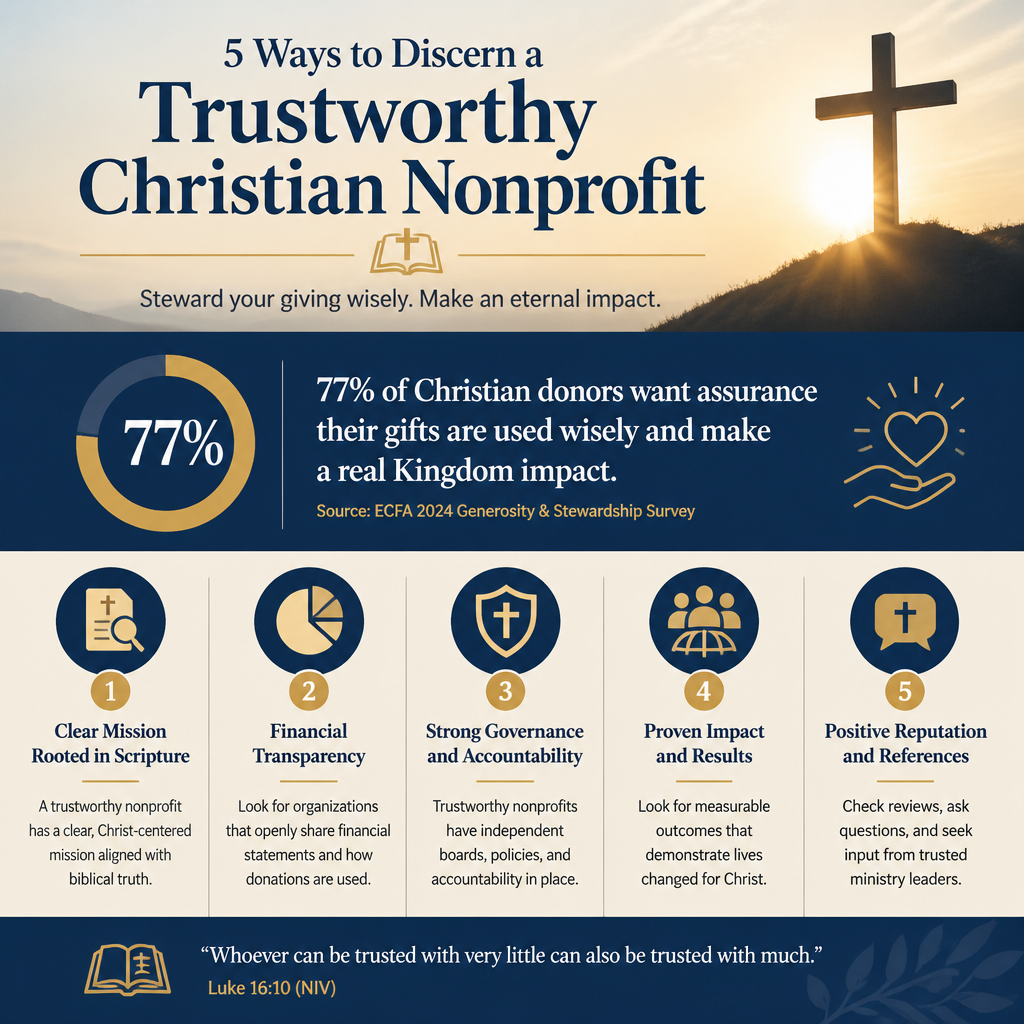
Trustworthy ministries can be discerned. The signals are rarely glamorous, and they rarely fit into a single metric. They are patterns of evidence that mature organizations sustain over time: a clear Christian identity that is more than a slogan, financial practices that do not rely on secrecy or pressure, governance that is real rather than ceremonial, and transparency that allows donors to test claims. What follows are five ways we recommend Christian donors evaluate credibility with the seriousness the subject deserves.
1. Test whether the ministry’s Christian identity is substantive and accountable
Many nonprofits can use Christian language. A trustworthy Christian nonprofit can show that its faith is not merely a fundraising aesthetic but a governing reality: shaping mission priorities, staff formation, ethical boundaries, and the way power is handled. In the New Testament, the issue is not whether leaders can speak convincingly, but whether their life and doctrine hold together under scrutiny (1 Timothy 4:16). Donors can apply the same principle at the organizational level.
Look for confessional clarity rather than generic spirituality
A ministry does not need to mirror every donor’s denominational distinctives to be credible, but it should state plainly what it believes about the gospel, Scripture, and the church. Vague statements about “values” often function as a way to avoid accountability when hard questions arise. Clear doctrinal commitments, by contrast, create a standard the organization can be held to by its board, staff, partners, and donors.
In practice, this means examining whether the organization’s public theological statements are coherent and whether they match what the ministry actually does. A prison ministry, for example, should not only speak about redemption but also show ethical guardrails in volunteer engagement, trauma awareness, and partnerships with correctional institutions. A disaster relief ministry should connect compassion to Christian witness without making coercive evangelism the price of aid. Christian donors have learned to be cautious precisely because spiritual language can be used to silence legitimate questions.
Ask how spiritual authority is constrained
Where ministry leaders claim spiritual authority, trustworthy organizations build visible constraints: independent board oversight, clear grievance pathways, and policies that prevent leaders from being insulated from correction. Abuse scandals often share a pattern: charismatic leaders treated as untouchable, boards that function as loyalists, and a culture that equates dissent with disloyalty to God. Theological seriousness includes a sober doctrine of sin, including within leadership.
Christians genuinely disagree about the boundary between church and parachurch authority. Some donors expect a ministry to be formally accountable to a local church or denomination; others accept independent governance. What should not be disputed is that spiritual authority without meaningful accountability is dangerous. Trustworthy ministries expect to be examined.

2. Follow the money, but with mature categories
Financial integrity is more than avoiding fraud. It is the disciplined refusal to treat donors as a revenue stream and beneficiaries as a means to fundraising. Scripture condemns dishonest scales not because accounting is technical, but because God cares about justice in ordinary economic life (Proverbs 11:1). Christian donors should therefore read financial signals as moral signals.
Do not be misled by simplistic overhead arguments
Many donors were trained to treat “low overhead” as the hallmark of faithfulness. The sector has had to correct that narrative. The “Overhead Myth” statement—signed by Charity Navigator, GuideStar, and the BBB Wise Giving Alliance—argues that overhead ratios alone are a poor measure of performance and can even incentivize underinvestment in governance, evaluation, and staff development.https://overheadmyth.com/
What this means in practice is that a trustworthy Christian nonprofit may spend significant resources on financial controls, program evaluation, safeguarding policies, and staff training. Those are not luxuries. They are part of love of neighbor when programs affect vulnerable people. Donors should still ask whether spending is disciplined and aligned with mission, but they should not treat “administration” as inherently suspect.
Seek audited financials and clear reporting
For larger organizations, an independent financial audit is a basic expectation. It is not a guarantee of virtue, but it is an important layer of accountability. For smaller ministries, a full audit may be financially impractical, but trustworthy organizations can still provide financial statements, clear budget categories, and evidence of board-level review. The key question is whether the organization welcomes scrutiny or treats it as an intrusion.
Donors should also examine how restricted gifts are handled. If a ministry solicits funds for a particular project, does it document that funds were used as represented? When plans change, does it communicate candidly and offer options? Trustworthy ministries treat donor intent as a moral obligation, not a marketing detail.
Watch for pressure-based fundraising and financial opacity
High-pressure appeals are not automatically unethical. Crises can be real. But trustworthy ministries resist manipulation: exaggerated claims, countdown tactics designed to bypass deliberation, or spiritualized coercion (“God told us you must give”). Mature Christian donors recognize the difference between urgency and emotional leverage.
Opacity is also revealing. If an organization cannot explain major revenue sources, related-party transactions, executive compensation philosophy, or the financial relationship between a U.S. fundraising entity and overseas operations, donors should slow down. Some cross-border contexts are legitimately complex, but complexity should lead to clearer documentation, not less.
3. Examine governance and leadership as the ministry’s moral architecture
Most nonprofit failures are not primarily failures of vision; they are failures of governance. A ministry can have a compelling mission and sincere leaders and still be structurally unable to stay healthy. In Christian terms, governance is part of what it means to “take pains to do what is right” in the sight of others (2 Corinthians 8:21). Donors should treat boards, policies, and leadership succession as frontline spiritual issues because they are where temptation is most predictable.
A credible board is independent, engaged, and willing to correct
Board independence is not a technicality. If a board is composed primarily of family members, paid staff, or close personal friends of the founder, it may be unable to confront misconduct or strategic drift. The question is not whether the board loves the leader; it is whether the board can govern the leader.
Trustworthy ministries can describe how their board functions: meeting frequency, committee structure, conflict-of-interest policies, and how major decisions are made. They can also explain how the board evaluates the CEO, sets compensation, and handles whistleblower complaints. Donors do not need every internal detail, but they should see evidence that governance is real.
Leadership credibility includes how power is handled
Christian ministry tends to attract leaders who are persuasive and driven. Those qualities can serve the mission, but they can also concentrate power. Donors should look for shared leadership, clear decision rights, and policies that reduce single-point-of-failure risk. Founder-led ministries are not inherently untrustworthy, but they require especially strong governance because charisma can become a substitute for accountability.
The harder question is how the organization responds when leadership fails. A trustworthy ministry does not treat scandal management as “protecting the kingdom.” It treats truth as part of obedience. Christians have seen too many public cases where reputation was defended at the expense of victims and integrity. The appropriate response to failure is not perfection but repentance, repair, and structural change.
Succession planning is a trust signal
Many Christian nonprofits are built around a founder’s calling and gifts. That can be faithful. But if the ministry cannot imagine its future without one personality, donors should ask whether it is a durable institution or an extended personal platform. Succession planning—documented, board-owned, and periodically updated—indicates that the organization prioritizes mission over personality.
4. Demand transparency that allows claims to be tested
Transparency is not a public-relations posture. It is the willingness to be measured by reality. Scripture does not commend ministries that are impressive; it commends ministries that are faithful. Faithfulness, in the practical world of nonprofit work, requires enough openness that donors can distinguish between fruit and mere activity.
Separate stories from evidence without despising stories
Human stories matter because people are not metrics. But stories alone are also easy to curate. Trustworthy organizations pair testimony with credible reporting: program outputs, outcome tracking where feasible, third-party evaluations when appropriate, and honest discussion of limitations. The point is not to reduce Christian ministry to social science; it is to treat beneficiaries as real people whose outcomes matter, not as narrative material for fundraising.
Some fields have more mature measurement norms than others. International relief and development, for example, often uses established evaluation methods, while pastoral care or discipleship programs may rely more on qualitative reporting. Christians genuinely disagree about what “effectiveness” should mean in spiritual formation contexts. Even there, trustworthy ministries can articulate what success looks like, how they learn, and what safeguards they use to prevent self-deception.
Ask what the ministry does with bad news
Every ministry that operates in complex human environments will experience setbacks: programs that underperform, partnerships that fail, staff turnover, and unintended harm. The question is whether the organization can tell the truth about those realities. Trustworthy organizations publish annual reports that include both progress and constraints, explain strategic changes, and avoid inflated language.
When a ministry refuses to acknowledge any difficulty, donors should be cautious. Spiritual language can become a way to deny reality: “God is doing amazing things” as an all-purpose substitute for evidence. Mature Christian donors are not opposed to joy; they are opposed to vagueness that functions as concealment.
Verify safeguarding and ethics policies, especially with vulnerable populations
If a nonprofit serves children, survivors of trauma, refugees, prisoners, or people in extreme poverty, safeguarding is central, not optional. Donors should look for written child protection policies, background check practices, training requirements, and reporting mechanisms. The absence of such policies does not always indicate ill intent—some small ministries are simply underdeveloped—but it does indicate heightened risk. Love of neighbor includes risk reduction.
5. Apply a disciplined donor process, not a reactive one
Christian donors often carry a quiet burden: the desire to be generous, the fear of being naïve, and the awareness that cynicism is its own spiritual danger. A disciplined process protects against both gullibility and hard-heartedness. The goal is not to eliminate all risk. The goal is to give with integrity, proportionate to the size and complexity of the gift.
Use a two-tier approach for your giving
We recommend separating giving into (1) relational giving and (2) due-diligence giving. Relational giving is support for your local church, known missionaries, and ministries where you have meaningful firsthand trust. Due-diligence giving is support for organizations you know primarily through public claims. Both are legitimate. They simply require different levels of verification.
For due-diligence giving, the size of the gift should determine the rigor. A $100 gift may warrant reading a ministry’s annual report and Form 990, while a $25,000 gift may warrant a deeper review of governance, safeguards, and audited statements. Mature stewardship is proportional.
Know what to scrutinize in public documents
Several documents are especially revealing when read carefully:
- Form 990: Look for governance disclosures, related-party transactions, and whether the organization documents a conflict-of-interest policy. Executive compensation should be explainable and board-approved.
- Audited financial statements (when available): Look for whether an independent firm issued an unqualified opinion and whether internal control notes raise concerns.
- Annual reports: Look for clarity on programs, geography, and outcomes, not just fundraising highlights.
- Board list: Look for diversity of expertise, independence from staff, and evidence the board is more than symbolic.
None of these documents alone guarantees trustworthiness. Together, they form a pattern. The pattern is what donors are trying to discern.
Where Most Trusted fits within responsible Christian giving
At Most Trusted, our verification work is designed for donors who want more than impressions and more than a single metric. We evaluate ministries against The Most Trusted Standard, a 15-criteria framework that examines faith commitments, financial integrity, governance and leadership practices, and transparency and effectiveness. The purpose is not to replace the donor’s discernment, but to strengthen it with consistent, document-based evaluation.
Across our verification work, we observe that ministries that meet The Most Trusted Standard tend to share a common posture: they expect accountability, they document decisions, they invest in controls that prevent predictable failures, and they communicate with donors in ways that respect maturity rather than exploiting emotion. That posture is itself a theological claim. It reflects a belief that truth can be borne in the light.
FAQs for 5 Ways to Discern a Trustworthy Christian Nonprofit
Is a Christian nonprofit automatically trustworthy if it has a strong testimony or a well-known leader?
No. Testimony and visibility can be genuine gifts from God, but they are not safeguards. Trustworthiness is evidenced by accountable structures: independent governance, transparent finances, clear policies, and a demonstrated willingness to tell the truth when outcomes are mixed or leadership fails.
Should Christian donors prioritize low overhead when choosing a ministry?
Not as a primary criterion. Overhead ratios can be misleading and can incentivize unhealthy underinvestment in staffing, controls, and evaluation. The nonprofit sector’s “Overhead Myth” statement—signed by Charity Navigator, GuideStar, and BBB Wise Giving Alliance—argues that overhead is a poor proxy for performance.https://overheadmyth.com/ Donors should look for disciplined spending aligned with mission and adequate investment in accountability.
What if a ministry is small and cannot afford an audit or sophisticated evaluation?
Smaller ministries can still be trustworthy. The expectation should be proportional: clear financial statements, board review of budgets, conflict-of-interest policies, safeguarding basics where relevant, and transparent communication. A small organization’s limitation becomes concerning when it is paired with defensiveness, secrecy, or pressure-based fundraising.
How can donors avoid becoming cynical while practicing due diligence?
Cynicism assumes hidden motives everywhere and eventually withholds generosity. Christian discernment assumes sin is real, grace is real, and structures matter. Due diligence is one way donors practice love of neighbor: protecting beneficiaries from harm, protecting the church’s witness, and strengthening ministries that can bear the weight of trust.
Trust is a stewardship, not a sentiment
Christian donors are not called to give blindly, nor are they called to withhold because the field is imperfect. Scripture commends generosity that is paired with integrity, and it treats accountability as part of what it means to walk in the light. The five practices above—testing faith commitments, examining financial integrity with mature categories, scrutinizing governance, demanding meaningful transparency, and using a disciplined donor process—help donors give with confidence and clarity.
The ministries most worthy of trust are rarely those that promise the most. They are those that can bear examination, tell the truth about their work, and submit their leadership and finances to accountable oversight. That is not merely good nonprofit practice. It is a form of Christian faithfulness.



