

How discipleship ministries use donor funds responsibly is not a secondary question for Christian donors; it is part of the moral content of giving itself. Scripture’s language for money is stewardship language, and Jesus treats stewardship as a matter of discipleship, not mere administration (Luke 16:10–11). When donors support ministries that form believers, they are not only funding activities. They are entrusting resources meant to serve people made in God’s image, under leaders who will give an account.
The harder question is that “responsible use” is not always obvious from a glossy annual report or a low overhead ratio. Discipleship work often happens in small groups, informal mentoring, training pipelines, and local church partnerships that do not translate neatly into simple cost-per-outcome claims. Yet the absence of perfect measurement does not excuse the absence of controls, clarity, and truthful reporting. Responsible stewardship is visible through patterns: how decisions are made, how money is safeguarded, how impact is described, and how leaders respond when trade-offs surface.
Responsible stewardship begins with a theology of formation and finance
Discipleship is spiritual work with material obligations
Christian donors are right to expect discipleship ministries to speak plainly about money, because Jesus did. He repeatedly warned that money competes for the heart’s allegiance (Matthew 6:24), and he insisted that faithfulness in “unrighteous wealth” is a test of whether someone can be trusted with greater responsibilities (Luke 16:10–12). A ministry’s budget, then, is not simply a management tool; it is a theological document that reveals priorities, constraints, and convictions.
Responsible ministries treat donor funds as restricted by purpose even when they are legally unrestricted. That posture shows up in conservative cash policies, sober fundraising claims, and a refusal to drift into vanity projects that win attention but dilute mission. It also shows up in how leaders talk about “success.” If discipleship is formation into Christlikeness, then growth metrics may matter, but they can never become the controlling definition of fruit.
What Christian donors should expect from spiritual seriousness
Across our verification work at Most Trusted, we find that ministries with strong stewardship practices tend to integrate theology and governance rather than treating them as separate departments. They can articulate why their model of discipleship is biblically grounded and how that model shapes spending: training curricula, leader development, pastoral care, safeguarding, and long-term follow-up.
Responsible stewardship also resists donor manipulation. The Christian fundraising world has learned that urgency can become a habit, and “storytelling” can become selective truth-telling. Donors should expect ministries to tell the truth in ways that honor the people served, not merely the emotion of the appeal.

Where donor funds tend to go in healthy discipleship ministries
Spending patterns that reflect long-term formation
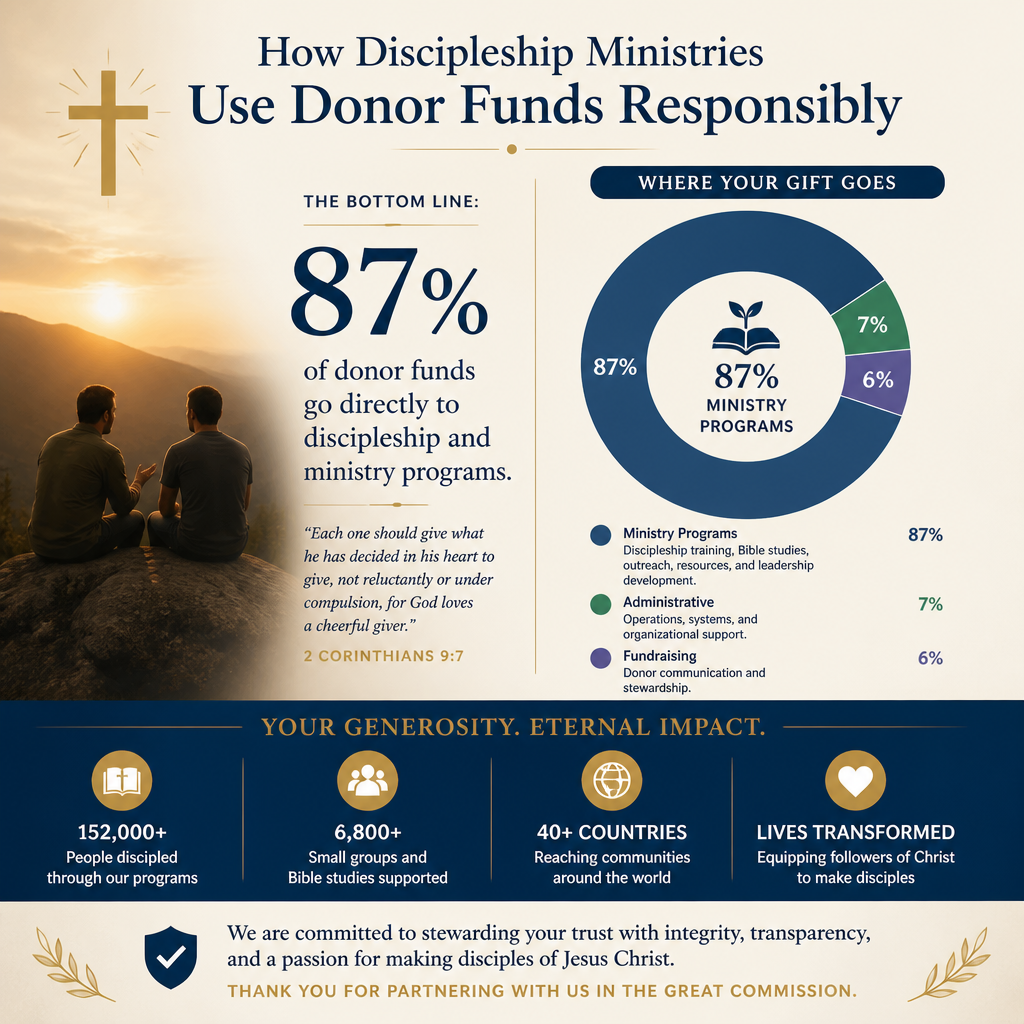
Discipleship ministries commonly allocate major expenses to staff and program delivery because formation is relational and requires consistent leadership. A simplistic suspicion of “staff costs” often confuses stewardship with austerity. The widely cited “Overhead Myth” has helped the sector mature by arguing that fixation on overhead ratios can punish necessary investments in systems, training, and accountability. That argument is summarized in the joint letter from GuideStar, Charity Navigator, and the BBB Wise Giving Alliance, which urges donors to consider governance, transparency, and results rather than overhead alone (GuideStar).
Healthy ministries can explain why staffing is necessary, how roles are structured, and what accountability exists for leaders. They can also explain how they avoid building a personality-driven platform that collapses when a charismatic leader fails. In discipleship work, that is not a theoretical risk; it is a recurring temptation.
Examples of responsible program and support expenses
While budgets vary by model, responsible use of donor funds in discipleship ministries often includes:
- Training and supervision for mentors, small-group leaders, and local partners
- Background checks and safeguarding policies where minors or vulnerable adults are involved
- Curriculum development, translation, and theological review
- Pastoral care structures for staff and volunteers to reduce burnout and moral failure risk
- Basic measurement and learning systems that test whether programs are accomplishing what is claimed
Each of these categories can be mishandled. Training can become conference tourism. Curriculum can become content production for brand expansion rather than local church service. Measurement can become performative. Responsible ministries name those risks and design controls to address them.

Financial integrity is more than clean books
Internal controls are discipleship for an organization
Financial integrity begins with ordinary disciplines: segregation of duties, documented approvals, timely reconciliation, and clear expense policies. These practices are not a lack of trust in Christian leaders; they are a recognition of human fallenness and the wisdom of accountability. A ministry that claims spiritual maturity while neglecting basic controls is inviting scandal and harm.
Where resources allow, independent audits or reviewed financial statements provide an additional layer of assurance. Smaller ministries may not be able to fund a full audit annually, but they can still practice prudent governance: an engaged board, transparent reporting, and a willingness to submit to external scrutiny when concerns arise.
Donor restrictions, designated gifts, and truthful accounting
Discipleship ministries frequently receive designated gifts for scholarships, training cohorts, church-planting residencies, or regional initiatives. Responsible stewardship requires a ministry to honor restrictions, track designated funds, and communicate clearly about what happens if a specific project is delayed, re-scoped, or concluded.
Donors should also be alert to “restricted-by-marketing” dynamics: appeals that strongly imply a narrow purpose while the gift is actually unrestricted in practice. A mature ministry avoids that ambiguity. It explains what is restricted, what is unrestricted, and what donors can reasonably expect after giving.
For donors seeking a structured lens on these questions, our work at Most Trusted evaluates ministries against The Most Trusted Standard, a 15-criteria framework that examines faith commitments, financial integrity, governance practices, and evidence of candor in public communication. Responsible stewardship is rarely one dramatic decision; it is a consistent pattern of disciplined choices.
Governance and leadership are the main safeguards for donor funds
The board’s role is oversight, not applause
When donor funds are misused in Christian ministry, it is often because governance became symbolic. Responsible discipleship ministries treat board oversight as real oversight: documented meetings, informed review of budgets and compensation, conflict-of-interest policies, and the authority to challenge executive decisions. A board that cannot say “no” is not providing governance; it is providing cover.
Christians genuinely disagree about the best governance model for different ministry types, especially where founders carry vision and credibility. Yet the moral principle is not disputed: leaders must not be above accountability. Donors should expect independent board members with relevant competence—finance, legal, ministry practice, safeguarding—rather than a circle of close friends who exist to affirm.
Compensation, related-party transactions, and moral credibility
Compensation in discipleship ministries is a recurring pressure point. Paying leaders fairly is not inconsistent with Christian stewardship; “the laborer deserves his wages” (1 Timothy 5:18). But the ministry must also protect against excess, opacity, and conflicts of interest. Clear processes matter: board-approved compensation, comparability data when appropriate, and disclosure where required.
Related-party transactions—contracts with family members, businesses owned by insiders, or shared services with closely connected entities—are not automatically improper, but they are high-risk. Responsible ministries disclose them, document competitive pricing, and ensure independent board review. This is one place where donor trust is either strengthened through candor or weakened through silence.
Transparency and effectiveness require honest claims, not inflated certainty
Discipleship outcomes are real, but they are not always reducible
Many donors have learned to distrust “lives changed” as a slogan. Discipleship ministries do aim at genuine transformation, but they should resist triumphalism and simplistic attribution. The New Testament is clear that God gives the growth (1 Corinthians 3:6–7), and responsible ministries speak in ways consistent with that truth. They can describe what they do, whom they serve, and what they observe, without pretending they can quantify sanctification with scientific precision.
That said, responsible ministries do measure what can be measured: participation, completion of training, retention of volunteer leaders, follow-up engagement, local church integration, and safeguarding compliance. They also report what did not work. Transparency is not the absence of weakness; it is the refusal to hide it.
What donors can verify without becoming investigators
Donors are not called to cynicism, but neither are they called to naiveté. A responsible ministry makes verification possible through ordinary public signals: accessible financial reporting, clear descriptions of programs, identifiable leadership, and a track record of answering hard questions.
When donors want to place a ministry within a broader field context, it helps to compare it with other work in the same domain. Engagement with Discipleship Ministries as a category can clarify what models exist, what risks recur, and what responsible norms look like across organizations rather than in a single case.
For donors who prioritize fiduciary clarity, Accountability and Transparency in Discipleship Ministries is often the most revealing area to examine first. Transparency does not guarantee virtue, but secrecy routinely protects vice.
FAQs for How discipleship ministries use donor funds responsibly
Should Christian donors avoid ministries with higher administrative costs?
Not automatically. Administrative spending can include necessary investments in finance controls, safeguarding systems, leadership development, and evaluation—all of which protect people and donor intent. The more defensible question is whether the ministry can explain those costs plainly, show appropriate oversight, and demonstrate that support functions serve the mission rather than the institution’s prestige. The joint “Overhead Myth” statement from GuideStar, Charity Navigator, and BBB Wise Giving Alliance captures why overhead alone is a weak proxy for stewardship (Charity Navigator).
What documents should a responsible discipleship ministry provide to donors?
At minimum, donors should be able to access recent financial statements (or a Form 990 for U.S. nonprofits), an annual report or ministry update with specific program descriptions, and basic governance information such as board listing and leadership identification. Larger ministries should often provide audited financial statements. If a ministry resists providing ordinary documentation, or frames reasonable questions as “lack of faith,” donors should treat that as a governance concern rather than a spiritual disagreement.
A responsible ministry makes stewardship visible
Discipleship ministries do not honor donors by promising certainty; they honor donors by practicing faithfulness. The responsible use of donor funds shows up in disciplined controls, sober governance, truthful reporting, and a theological seriousness about money’s power to distort. Christian donors are not purchasing outcomes; they are participating in the work of formation. That participation deserves ministries whose handling of resources is as mature as the discipleship they proclaim.



