
To serve nonverbal friends in disability ministry is to decide, in advance, that speech is not the measure of personhood. In a church culture that often equates verbal participation with spiritual engagement, serving nonverbal friends requires a more biblical anthropology: every person bears the image of God, and therefore every person is addressable, knowable, and worthy of patient love.
This work matters to Christian donors because communication support is not a peripheral program expense; it is a concrete way a ministry honors the dignity of those it serves. It is also an area where good intentions can drift into harm—through infantilization, coercive “compliance,” or unsafe volunteer practices. Mature disability ministry names these risks plainly and builds structures that protect both participants and volunteers.
Start with a theology of personhood, not a theory of communication
Imago Dei makes communication a moral responsibility
Scripture does not ground dignity in capacity, productivity, or independence. From Genesis onward, the image of God is bestowed, not achieved. That has direct consequences for disability ministry. If personhood is granted by God, then our obligation is not to “fix” nonverbal friends in order to welcome them; our obligation is to welcome them and then do the hard work of learning how to communicate.
The Gospels repeatedly show Jesus attending to people the crowd overlooked, and treating them as morally significant agents rather than interruptions. That posture should govern volunteer training: we speak to nonverbal friends, not about them; we ask consent in accessible ways; we assume competence even when expressive language is limited.
Acknowledge the tension between faith and technique
Christians genuinely disagree about how to speak of healing, suffering, and disability in the life of faith. Some traditions emphasize miraculous healing; others emphasize presence and perseverance. In practice, serving nonverbal friends calls for both theological clarity and clinical humility. Prayer is never a substitute for communication supports, and communication supports are never a substitute for pastoral care.
Replace assumptions with supported communication
Nonverbal does not mean noncommunicative
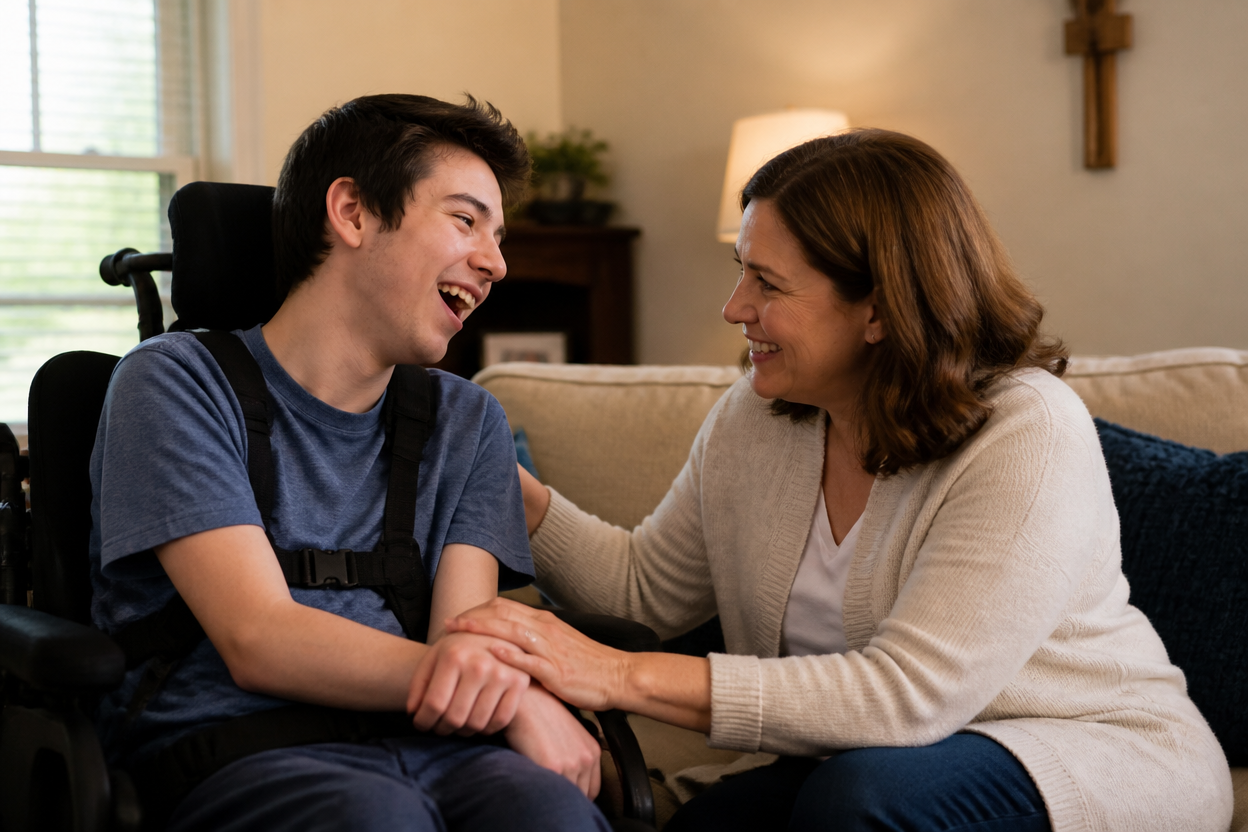
“Nonverbal” typically describes expressive speech, not the absence of understanding, intention, or relationship. Many nonverbal people communicate through gesture, eye gaze, facial expression, vocalizations, or augmentative and alternative communication (AAC). The ministry’s responsibility is to notice patterns and to make room for multiple modes of response.
What this means in practice is that volunteer teams need explicit instruction in “wait time,” observation, and the discipline of not rushing to fill silence. A common failure mode in churches is speed: greeting lines, quick transitions, and crowded rooms. Nonverbal friends are often communicating, but at a pace the environment refuses to honor.
Know the difference between behavior and message
Behavior is frequently communication, especially when a person has limited reliable speech. That does not mean every behavior is desirable or safe, but it does mean the first interpretive question is not “How do we stop this?” but “What is being expressed—pain, fear, overload, boredom, hunger, trauma, or confusion?”
Many disability ministries draw practical guidance from the broad body of work on positive behavior supports and functional behavior assessment. While churches are not clinical settings, the basic insight is transferable: reducing distress often begins with changing the environment and expectations rather than escalating control.
Build volunteer practice around consent, dignity, and safety
Consent is not optional, even when it is nonverbal
Some church volunteers were formed in environments where helping automatically implied touching: guiding an arm, moving a wheelchair without asking, hugging children, or insisting on eye contact. In disability ministry, those habits can become violations. Consent can be communicated nonverbally; it can also be supported with visual choices, simple yes/no systems, or a person’s established signals.
A practical standard we recommend is that every volunteer be trained to ask before assisting, to wait for a response, and to honor “no” without punishment. Where a participant’s safety is at risk, the ministry should have a written protocol for least-restrictive intervention, clearly approved by caregivers and leadership.
Protect against spiritualized coercion
Church contexts add a distinctive risk: spiritual language can be used to override a nonverbal person’s preferences. “Be compliant,” “be reverent,” or “be grateful” can become a form of coercion when the individual’s communication is not understood. The ministry should distinguish between discipleship and control. The fruit of the Spirit is never produced by humiliation.
For donors evaluating ministries, this is one place governance and leadership show up in daily practice: clear volunteer screening, supervision ratios, incident reporting, and caregiver partnership are not bureaucratic overhead. They are the guardrails that make dignified ministry possible.
Equip the ministry with practical tools and accountable systems
Simple supports make participation real
Many churches assume communication supports require specialized expertise or expensive technology. Sometimes they do. Often the first gains come from basic, well-chosen tools and consistent routines. The goal is not novelty; it is reliability.
- Visual schedules for what happens next
- Choice boards with photos or simple icons
- A consistent yes/no method agreed upon with caregivers
- Noise-reducing options and a quiet space for regulation
- Predictable transitions with clear warnings and timers
In U.S. public schools, AAC can be provided as part of a student’s special education services under the Individuals with Disabilities Education Act, which has helped normalize communication supports for many families. Donors who want to understand the baseline landscape can review IDEA guidance through the U.S. Department of Education at ed.gov.
Accountability is a ministry strength, not a reputational risk
Disability ministry teams sometimes hesitate to document incidents or accommodations because they fear appearing “unsafe” or “complicated.” Mature ministries do the opposite: they document because people matter. Clear reporting pathways, caregiver communication logs, and follow-up practices are how trust is built.
Across our verification work at Most Trusted, the ministries that meet The Most Trusted Standard tend to treat disability programming as a governed ministry function: written policies, trained leaders, financial transparency about restricted gifts, and evidence that feedback changes practice. These disciplines are not opposed to compassion; they are one of its primary expressions.
Fund the work donors cannot see but participants feel immediately
What donors often miss when they fund disability ministry
Donors understandably gravitate toward visible moments: a buddy alongside a participant, a sensory-friendly service, a camp scholarship. Yet serving nonverbal friends is sustained by less visible investments: training hours, background checks, adaptive materials, caregiver coordination, and staff time for planning and debriefing.
The nonprofit sector has worked to correct simplistic assumptions that low overhead automatically signals virtue. The 2013 “Overhead Myth” letter—signed by Charity Navigator, BBB Wise Giving Alliance, and GuideStar—argued that administrative and fundraising costs can be essential to effectiveness and transparency. Donors can find the statement and context through Charity Navigator at charitynavigator.org.
Due diligence should include disability-specific questions
Donors who support disability ministry can strengthen outcomes by asking targeted questions that reveal whether a ministry can serve nonverbal friends with dignity and safety. The harder question is not whether a ministry has loving volunteers; it is whether love has been translated into repeatable practice.
Within Disability Ministries, we encourage donors to pay attention to whether a ministry can describe (and document) its volunteer screening, caregiver partnership, incident response, and training cadence. Within Volunteer Training and Safety in Disability Ministries, we recommend looking for clear boundaries around touch, a nonverbal consent approach, and supervision structures that do not rely on improvisation.
FAQs for How to serve nonverbal friends in disability ministry
Should a church disability ministry require speech to participate in discipleship activities?
No. Discipleship is not limited to spoken participation. Churches can teach Scripture, prayer, and worship in ways that honor multiple communication modes: visuals, tactile items, predictable liturgy, songs with motions, and AAC-friendly prompts. The essential question is whether the ministry has made real avenues for response, not whether responses sound like those of verbal adults.
What should donors look for to know a ministry serves nonverbal friends responsibly?
Donors should look for evidence of training and accountability: written policies on consent and touch, caregiver partnership practices, incident reporting procedures, volunteer screening, and a plan for communication supports such as visuals or AAC accommodations. Ministries that can articulate these practices clearly—and show how they are implemented—are generally better positioned to protect participants and sustain trust.
A dignified ministry makes room for every voice God has given
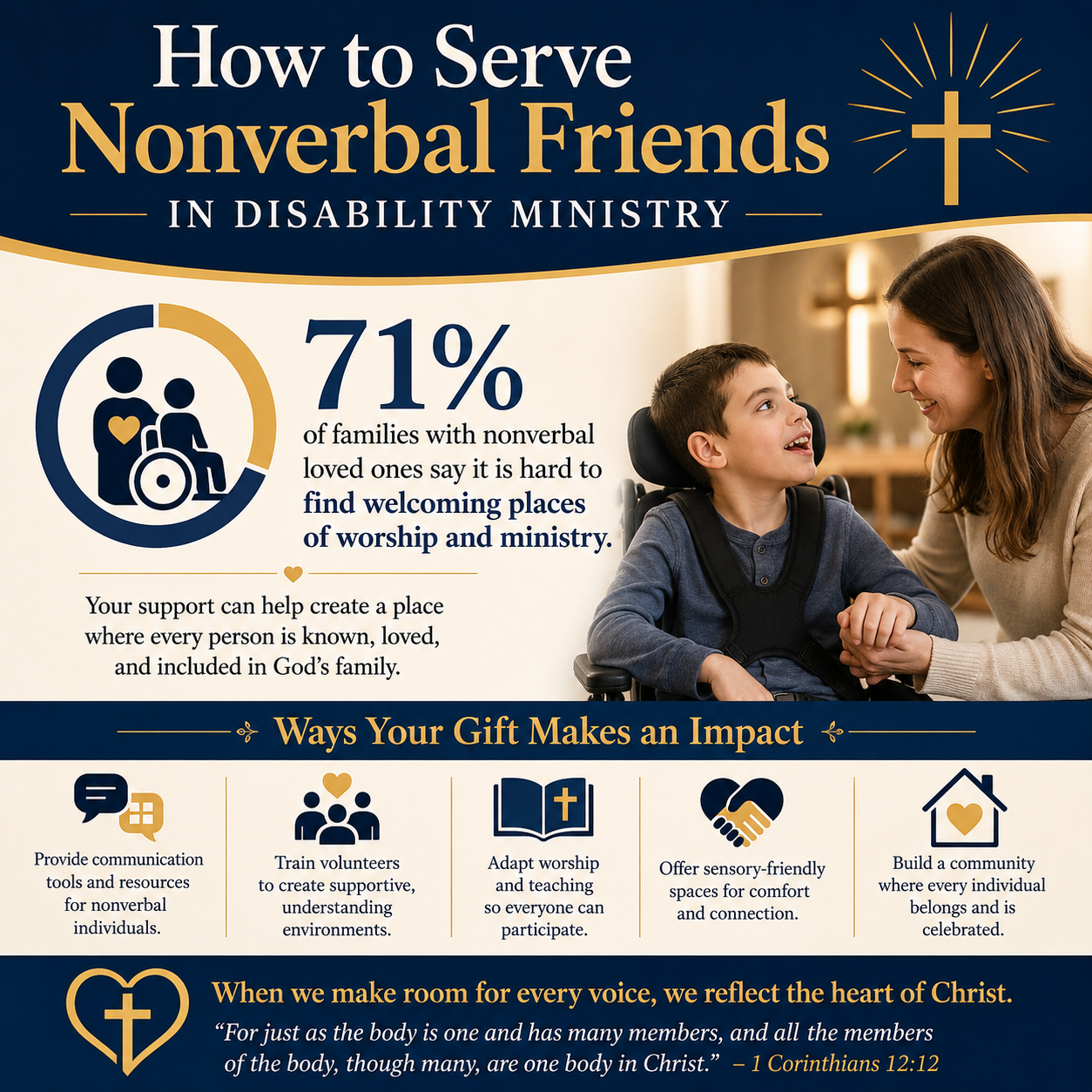
Serving nonverbal friends is not an act of charity toward the “less fortunate.” It is a decision to receive fellow image-bearers as full members of the body of Christ, and to bear the real costs of making community accessible. Donors who fund training, safeguards, and communication supports are not funding extras; they are funding the concrete practices by which the church becomes more truthful about the Kingdom it proclaims.



