
What disability ministry volunteer roles donors can fill is a stewardship question before it is a staffing question. Many donors assume their primary responsibility is to fund programs, but disability ministry is often strengthened most by donors who also contribute disciplined, accountable service that reduces risk and increases long-term faithfulness.
Scripture’s vision of the body is not sentimental; it is ordered and practical. Paul insists that “the members of the body that seem to be weaker are indispensable” (1 Corinthians 12:22), which challenges churches and ministries to build structures where people with disabilities are not merely included but meaningfully served and meaningfully serving. Donors can help by filling roles that protect dignity, guard safety, and sustain the quiet operational work that makes belonging real.
Why donor-volunteers matter in disability ministry
Disability ministry is unusually vulnerable to good intentions without adequate safeguards. Serving people who may have limited speech, mobility constraints, sensory sensitivities, or histories of medical and social trauma requires consistent practices, not improvised compassion. Donors tend to bring professional skills, governance experience, and a long time horizon—assets that can stabilize ministry systems when directed wisely.
Across our verification work at Most Trusted, we observe that ministries that earn confidence over time are rarely the ones with the most inspiring stories. They are the ones that can demonstrate repeatable training, clear role definitions, incident reporting discipline, and leadership accountability. This is where donor-volunteers can contribute without displacing those called to front-line caregiving.
Service that strengthens, not shadows, staff leadership
The harder question is how donor-volunteers serve without becoming an informal power center. Disability ministry can unintentionally privilege donors who “help” in ways that override staff judgment or family expertise. Healthy ministries define roles in writing, place volunteers under staff supervision, and require donors to submit to the same training and boundaries as anyone else.
Why safeguarding is a donor concern
People with disabilities face elevated risk of abuse and neglect, which makes safeguarding a primary ministry obligation, not an administrative detail. The U.S. Department of Justice has reported that persons with disabilities experience higher rates of violent victimization than persons without disabilities in the National Crime Victimization Survey data (Bureau of Justice Statistics). Donors who volunteer in oversight and prevention roles can help a ministry honor the moral weight of that reality.
Roles that improve safety and reduce risk
Some of the most valuable donor-filled roles are not public-facing. They create the conditions for safe ministry: background check processes, two-adult policies, transportation protocols, medical information handling, and incident response. These are not glamorous tasks, but they are the difference between a ministry that is inspiring and one that is trustworthy.
Volunteer screening and onboarding support
Many ministries are stretched thin in administrative capacity, even when the pastoral vision is strong. Donors can volunteer to support onboarding workflows under staff direction: maintaining checklists, ensuring training completion is documented, and helping schedule interviews. The value here is not efficiency for its own sake; it is auditability. Ministries that cannot demonstrate who is trained and cleared cannot credibly claim they are safeguarding well.
Safety team roles under clear authority
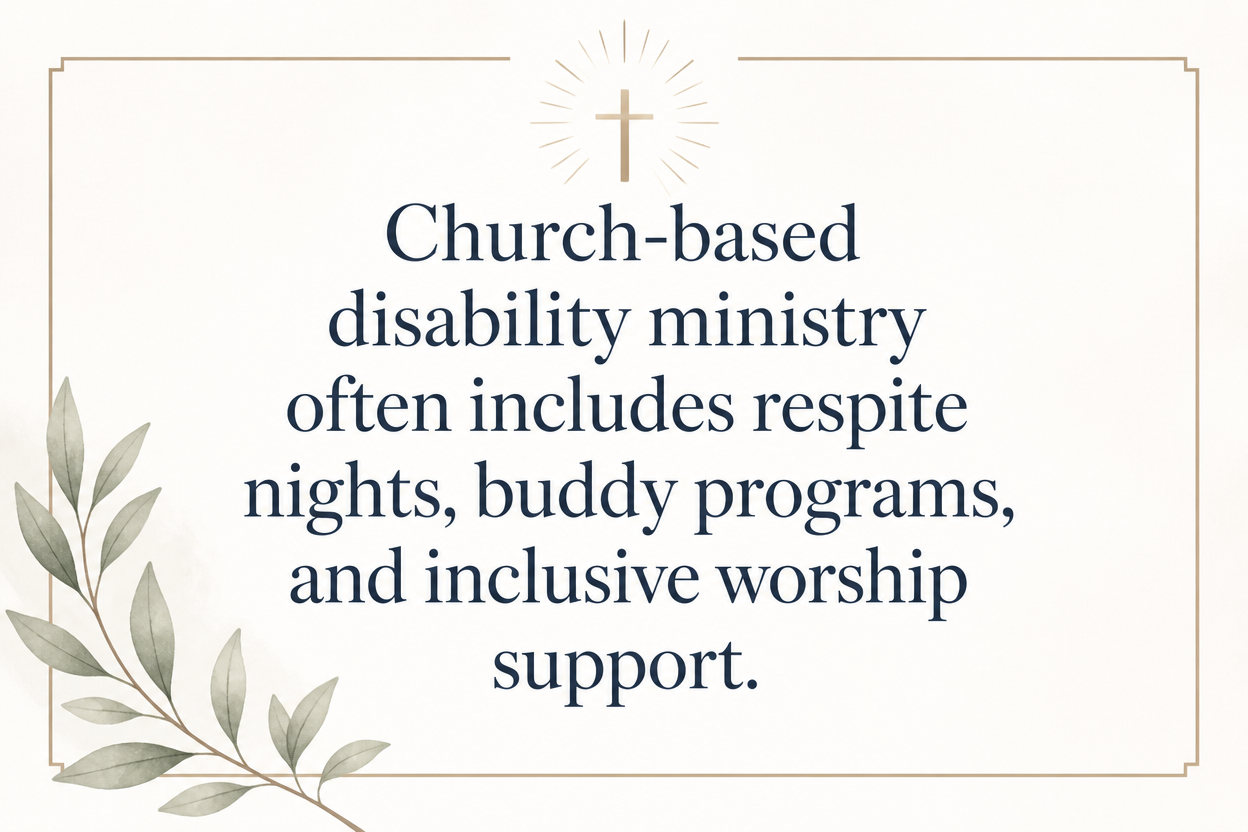
Church-based disability ministry often includes respite nights, buddy programs, and inclusive worship support. These settings require careful control of access, clear drop-off and pick-up procedures, and trained responses to medical events. Donors with experience in compliance, HR, healthcare administration, or emergency management can serve on a safety team that reviews procedures, tracks near-misses, and recommends improvements—provided staff leadership retains final authority.
- Maintain role descriptions and boundaries for buddies and caregivers
- Document incident reports and ensure follow-up actions are recorded
- Coordinate regular refreshers on mandated reporting and child protection policies
- Review facility accessibility and emergency egress plans
- Support secure handling of medical and behavioral support information
Donors sometimes ask whether such roles are “too operational.” In practice, they are often the most pastoral, because they protect those who are least able to advocate for themselves.
Roles that strengthen families and caregivers
Disability ministry that focuses only on the individual misses the household. Many families carry sustained stress: complex medical scheduling, social isolation, financial strain, and the spiritual fatigue that comes from repeated uncertainty. Effective ministries treat caregivers as part of the ministry’s direct responsibility, not as incidental beneficiaries.
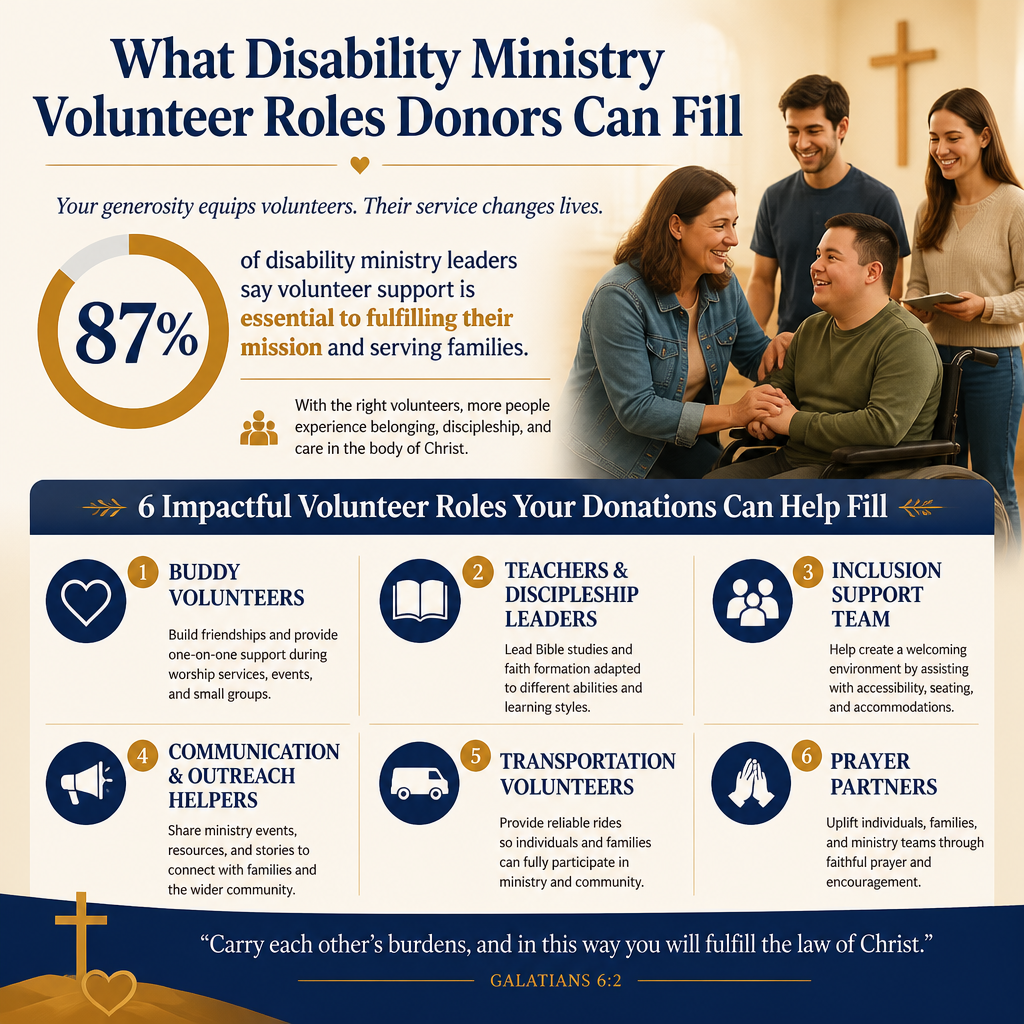
For donors wanting a broader understanding of how ministries structure this work, we keep an active view of the field through our coverage of Disability Ministries, where the most reliable organizations tend to demonstrate consistent family-centered practice rather than episodic events.
Respite coordination and caregiver hospitality
Respite is a high-impact gift, but it is also high-responsibility. Donors can volunteer in roles that do not require hands-on care: scheduling, volunteer coordination, meal planning, check-in desk support, and follow-up communication. These roles can relieve staff burden and improve caregiver trust without increasing risk exposure.
Practical helps teams with dignity safeguards
Some ministries organize home accessibility projects, transportation assistance, or emergency household support. Donors with construction management, occupational therapy familiarity, or community resource navigation experience can help assess what is realistic, safe, and respectful. The theological caution here is not abstract: assistance that bypasses family agency can become a form of control. The When Helping Hurts framework, articulated by Steve Corbett and Brian Fikkert, has helped many Christian ministries name this risk and aim for help that strengthens rather than replaces agency (When Helping Hurts).
Roles that build organizational trust and accountability
Disability ministry is sustained over decades, not seasons. Donors often have the ability to provide continuity where volunteer turnover is high. The most constructive way to use that continuity is not to become indispensable personalities, but to improve governance habits, financial clarity, and communication integrity.
Board and committee service that respects mission and expertise
Some donors are well-suited for board service, especially when they understand fiduciary duty and are willing to be held to conflict-of-interest discipline. In disability ministry, boards serve best when they seek expertise they do not naturally possess, including disability self-advocates, caregivers, clinicians, special education leaders, and pastoral practitioners. Donor-volunteers can help recruit that breadth rather than unintentionally narrowing leadership to those with financial capacity.
Financial and internal control support without overreach
Donors with accounting, audit, or finance backgrounds can serve as volunteer advisors on internal controls, budgeting clarity, and restricted gift tracking. This is not a call to distrust staff; it is a recognition that ministries handling designated gifts, program fees, and sensitive client information need controls that protect everyone involved. The Evangelical Council for Financial Accountability has long emphasized governance and financial integrity as Christian obligations, not merely best practices (ECFA).
Most Trusted’s work evaluating ministries against The Most Trusted Standard consistently reinforces a simple point: transparency is not primarily a marketing virtue; it is a discipleship virtue. Donors who volunteer in accountability roles can help ministries tell the truth about what they do, what it costs, and what outcomes are actually measurable.
Roles that advance inclusion in worship and community life
Disability ministry can be reduced to “special programs,” but the church’s calling is deeper: to be one body at worship, in formation, and in friendship. Donors can volunteer to help churches and partner ministries make inclusion concrete without turning people with disabilities into projects.
Accessibility and communication support
Some donor-volunteers are equipped to lead accessibility audits and project plans: seating, lighting, noise management, signage, sensory-friendly spaces, and quiet rooms. Others can support communication access: ASL coordination, captioning workflows for videos, large-print materials, or simplified service guides. These efforts require listening to disabled congregants and families rather than guessing what is needed.
Volunteer training teams grounded in policy and pastoral care
Training is often the fragile link. When training is optional, safety and dignity become optional in practice. Donors who can teach, facilitate, or develop curricula can serve on training teams—especially if they submit content to pastoral and clinical review. Many ministries also benefit from donors who can improve documentation and training records, a frequent weakness when organizations depend on rotating volunteers.
Donors seeking this kind of formation-oriented work often intersect with our research in Volunteer Training and Safety in Disability Ministries, where the strongest ministries tend to demonstrate consistent training cadence, clear boundaries, and documented compliance rather than informal verbal culture.
FAQs for What disability ministry volunteer roles donors can fill
Should donors volunteer directly with children or vulnerable adults in disability ministry?
Sometimes, but it should not be assumed. Direct care roles can be appropriate when the ministry has clear screening, training, supervision, and two-adult safeguards, and when the donor is willing to be treated as a volunteer under authority rather than as a benefactor. Many donors serve most responsibly in roles that improve systems—screening, training support, safety oversight, family care coordination—without increasing exposure to high-risk settings.
How can donors tell whether a disability ministry is safe enough to volunteer with?
We recommend asking for written safeguarding policies, role descriptions, training requirements, and an explanation of incident reporting and follow-up. A credible ministry can describe how volunteers are screened, how caregivers are supervised, and how concerns are escalated, documented, and reviewed. Ministries that resist documentation, rely on informal trust, or cannot explain who has authority in a crisis are not prepared for vulnerable ministry.
A donor’s role is to make faithfulness easier
Disability ministry is sustained by ordinary faithfulness: patient relationships, careful safeguards, and leadership willing to be accountable. Donors can fund that work, and donors can also volunteer in roles that make faithfulness easier for staff, families, and participants. The aim is not visibility. The aim is a ministry where dignity is protected, truth is spoken, and the people most easily overlooked are treated as indispensable in the household of God.



