

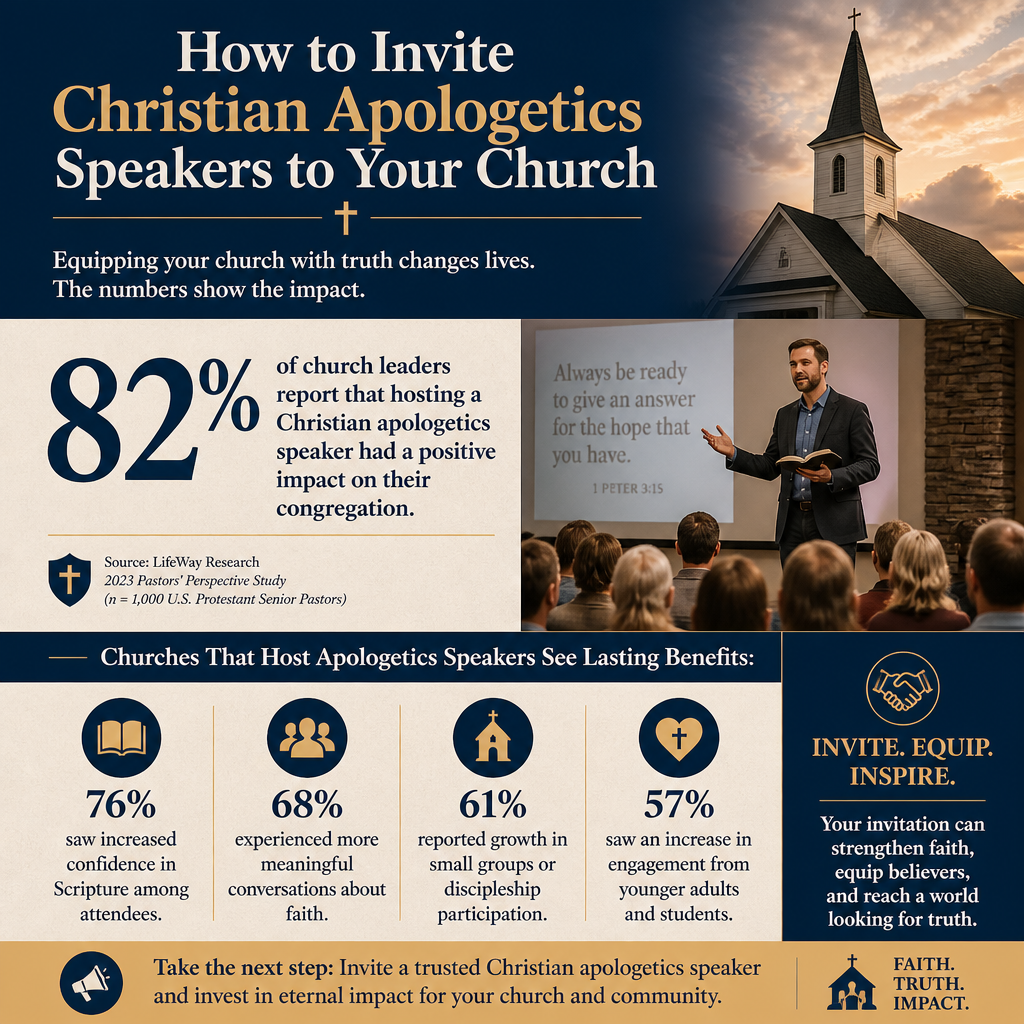
How to invite Christian apologetics speakers to your church is, at its core, a question about stewardship: stewardship of the pulpit, stewardship of congregational attention, and stewardship of donor-funded ministry relationships. Churches invite apologetics voices because the intellectual and moral pressure points of late modern life are not theoretical. Members are asked, often daily, whether Christian claims are true, whether Christian ethics are coherent, and whether Christian faith is anything more than private sentiment.
The challenge is that the apologetics “market” now spans everything from careful, church-anchored theological reasoning to culture-war commentary delivered with the cadence of revival preaching. Christians genuinely disagree about which public arguments are wisest and which emphases are faithful. Donors who fund apologetics ministries understand this complexity. The goal is not to find a celebrity, but to serve the church with truth spoken in love and defended with gentleness and respect (1 Peter 3:15–16).
Clarify the church purpose before you choose a speaker
A church that invites a Christian apologetics speaker without clarifying purpose will usually default to platforming personality. That can produce a packed room, but it rarely produces durable discipleship. A mature invitation begins with pastoral clarity: what outcome does the church seek, for which people, under what authority, and with what follow-up?
Across our verification work at Most Trusted, we observe that the healthiest ministry partnerships start with defined spiritual aims rather than event metrics. Attendance matters, but formation matters more. Apologetics can serve evangelism, strengthen believers under intellectual strain, equip parents and students, and train small-group leaders. Each purpose calls for a different kind of speaker.
Start with the theological and pastoral question
Many churches say they want “apologetics,” but they actually need something narrower: responding to deconstruction narratives, forming a Christian view of sexuality, rebuilding confidence in Scripture, or learning how to speak with friends who think Christianity is harmful. The sharper the pastoral question, the easier it becomes to discern whether a prospective speaker will serve the flock rather than stir it.
Match the format to the discipleship pathway
One-night events can be useful, but they are not neutral. A single lecture tends to reward rhetorical force, not careful catechesis. A weekend seminar with Q&A, a Sunday school series, or a training track for student leaders may better fit the church’s discipleship pathway. If the church has an evangelism strategy, ask how the event fits that strategy instead of standing apart as an isolated “special night.”

Vet for doctrinal fidelity and spiritual posture, not only intellectual credentials
Apologetics involves arguments, but it also involves spiritual tone. The New Testament’s instruction is not merely to “make a defense,” but to do so with gentleness, honor, and a clean conscience (1 Peter 3:15–16). A speaker may be academically capable and still cultivate contempt for opponents or impatience with ordinary believers who ask sincere questions. Churches pay for that posture later.
Ask questions that reveal theological center of gravity
Before scheduling, ask for a recent talk outline and a list of core doctrinal commitments. Then ask questions that expose center of gravity: How do they speak about the authority of Scripture? How do they relate apologetics to the local church? What do they think is the relationship between intellectual persuasion and the regenerating work of the Holy Spirit? These answers matter more than social media clips.
Many donors and pastors have learned to ask these questions because apologetics ministries sometimes drift toward brand-building. A speaker whose work is accountable to a church, denominational body, or clearly defined doctrinal oversight is typically easier to integrate into congregational life.
Check for the fruit of public ministry
Public ministry leaves a trail. Ask for references from pastors who have hosted the speaker in the last twelve months. Seek feedback on how the speaker handled disagreement, whether they honored church leadership, and whether the event produced meaningful follow-up conversations rather than merely emotional adrenaline. If the speaker is consistently associated with controversy, do not assume controversy equals courage; sometimes it reflects a lack of discipline.
- Request a sample contract and statement of faith before confirming a date.
- Ask whether the speaker will take moderated Q&A, and whether they will agree to pre-submitted questions from students and parents.
- Clarify expectations about political commentary in church-hosted settings.
- Confirm that any book or resource sales will be handled in a way that does not pressure congregants.
- Ask how the speaker measures faithfulness and effectiveness beyond attendance.
Do due diligence on the ministry organization and money flows
Inviting a speaker is also, in many cases, entering a financial relationship with a ministry: honorarium, travel, promotion, and sometimes a special offering. Donors expect churches to treat such relationships as real stewardship decisions. A Christian ministry may preach orthodox doctrine while operating with poor financial controls or weak board oversight.
This is one reason we built Most Trusted as an independent verification service for Christian nonprofits. Evaluating ministries against The Most Trusted Standard brings structure to questions that are otherwise handled informally: faith commitments, financial integrity, governance and leadership, and transparency and effectiveness. Churches do not need to become auditors, but they should know what they are endorsing when they bring a ministry voice into their pulpit ecosystem.
Ask for the documents reputable ministries already have
Many well-run nonprofits will readily provide an annual report, recent financial statements, a Form 990 (if they file one), and a board list. If a ministry resists basic transparency, that is not a minor inconvenience; it is a leadership signal. When a church invites a speaker, it is implicitly lending its credibility. That credibility is difficult to regain once lost.
For donors who want to understand the broader apologetics landscape and what healthy ministries tend to look like, we track common patterns in Christian Apologetics Ministries. A careful invitation is part of a careful philanthropic ecosystem.
Handle honorariums and offerings with moral clarity
Christians have long debated how money should relate to preaching and teaching. The New Testament affirms that “the laborer deserves his wages” (1 Timothy 5:18), while also warning against peddling the word of God for profit (2 Corinthians 2:17). Churches should not treat this as a mere logistics question.
Set an honorarium that is fair and modest relative to the church’s means, and be explicit about what it covers. If a special offering will be taken, communicate clearly what it supports, how it will be used, and whether the church will receive a post-event report. Clarity strengthens trust; ambiguity weakens it.
Prepare the congregation so apologetics serves discipleship, not spectacle
Apologetics events often fail at the point of preparation. Churches advertise the speaker but do not frame the spiritual work the congregation is being asked to do: to listen, to think, to repent where needed, and to love neighbors who disagree. When congregational expectations are not shaped, the loudest voices dominate Q&A, and the quiet strugglers leave unheard.
Equip leaders to host the questions that follow
A strong apologetics talk often opens painful questions: doubt, trauma, intellectual shame, family conflict, and fear about children’s faith. If the church invites a speaker, it should also prepare pastors, elders, and small-group leaders to walk with people afterward. That includes knowing when to refer to counseling, when to provide reading plans, and when to slow down and listen.
Christian formation rarely happens through a single argument. People are often persuaded through a convergence of truth, community, and integrity over time. Churches that treat apologetics as a component of discipleship, rather than a replacement for discipleship, tend to avoid the boom-and-bust cycle of event-driven momentum.
Build guardrails for Q and A
Q&A can be the most valuable part of the night, but it can also become performative. Use moderation. Invite written questions. Set norms for charity and brevity. If the topic touches contested issues within the church, acknowledge that Christians do not share uniform views on every secondary matter, and that the church will handle disagreement under Scripture and with love.
Invite in a way that honors local church authority and long-term partnership
A church does not merely “host an event.” It exercises spiritual authority in a place, for a people, with covenant responsibilities. A visiting apologetics speaker should function as a servant of that authority, not as a competing center of gravity. This is particularly important when a speaker carries a national platform and the church is tempted to outsource discipleship to the most compelling voice.
Put expectations in writing
A simple written agreement protects everyone. It should define topic, length, Q&A structure, financial terms, cancellation policies, and any expectations regarding online posting. It should also clarify that the church retains final responsibility for what is taught in its spaces. Reputable ministries will not be offended by clarity.
Think beyond the date on the calendar
Some of the most fruitful apologetics invitations are the beginning of an ongoing relationship: periodic training for youth leaders, curated resources for parents, consultation on evangelism initiatives, or co-sponsoring community forums with other churches. Donors often prefer to fund relationships that produce repeated, accountable impact rather than one-off moments.
For readers who are thinking in terms of partnerships that include donor support, not merely speaker scheduling, we address practical patterns in Donor Partnerships with Christian Apologetics Ministries. Churches and donors serve the same long-term end: faithful witness grounded in truth and expressed with love.
FAQs for How to invite Christian apologetics speakers to your church
Should a church invite a controversial apologetics speaker if they draw a crowd?
Crowd size is a weak proxy for faithfulness. The more responsible question is whether the speaker’s doctrine, tone, and public record will strengthen the church’s witness over time. If a speaker consistently trades in caricature, contempt, or partisan captivity, the short-term attendance gain may cost long-term trust, especially among seekers, students, and those already wrestling with doubt.
What should donors ask before funding an apologetics event at their church?
Donors can ask what the church hopes to accomplish, how leaders will follow up with people afterward, and what due diligence has been done on the speaker’s ministry. It is also appropriate to ask for basic financial clarity: how honorariums are set, whether a special offering will be designated, and what reporting—if any—will be provided. These questions are not suspicion; they are stewardship consistent with Christian giving that seeks integrity.
A faithful invitation is part of faithful stewardship
Churches invite Christian apologetics speakers because truth matters, and because God often uses ordinary means—teaching, conversation, patient reasoning—to steady wavering faith. Yet the church is not a stage, and apologetics is not an end in itself. When invitations are governed by pastoral purpose, doctrinal fidelity, transparent practices, and accountable relationships, apologetics can serve the church’s calling to bear witness to Christ with conviction and charity.



