

Donor partnerships with Christian apologetics ministries are rarely about a single gift. They are about sustaining a long, patient work: helping Christians love God with their minds, strengthening confidence in the gospel, and serving seekers with honest answers that do not flatten the complexities of modern life. Mature donors tend to sense the stakes. They also sense the risks—celebrity-driven brands, brittle rhetoric, and organizations that can win arguments while quietly losing moral credibility.
What responsible partnership requires, then, is not only conviction about the value of apologetics, but discernment about the kind of ministry being funded. Across our verification work at Most Trusted, we have seen that apologetics ministries can be both spiritually fruitful and institutionally vulnerable. The donors who give with confidence are usually the ones who insist on clarity about mission, candor about outcomes, and governance strong enough to withstand pressure.
Why apologetics partnerships require more than enthusiasm
Christian apologetics exists in the space where faith, reason, and culture meet. That intersection is a mission field, but it is also a temptation field. Ministries can drift toward audience capture, turn every question into a political proxy war, or treat debate performance as proof of spiritual health. A donor partnership worthy of the name is one that strengthens the ministry’s fidelity to Christ, not only its public profile.
Scripture commends reasoned witness. Peter instructs Christians to be prepared to give a defense, yet to do so “with gentleness and respect” (1 Peter 3:15). Gentleness is not an aesthetic choice; it is a theological constraint. Apologetics that hardens into contempt may preserve orthodox vocabulary while betraying orthodox fruit.
The harder question is how donors evaluate apologetics ministries when the results are not easily counted. A food pantry can report meals served. An apologetics publisher can report books sold, but sales are not the same as spiritual formation, and formation is not the same as conversion. Even when conversion occurs, many influences are involved. Partnership is about aligning with a ministry that understands this difference and refuses to substitute publicity metrics for spiritual credibility.
The field’s public credibility is contested
Apologetics ministries operate under heightened scrutiny. Their work is public by nature, and the cultural climate is often adversarial. This makes institutional integrity non-negotiable. A pattern we observe is that the ministries most resilient over time tend to cultivate internal accountability that is stronger than the external pressure to be constantly “relevant.”
Donors also need to recognize that Christians genuinely disagree about apologetics methods. Some prioritize evidential arguments; others emphasize worldview critique, narrative apologetics, or relational presence. A prudent donor partnership does not demand one uniform method. It does require clarity about what a ministry is doing, why it is doing it, and what theological and pastoral safeguards govern the work.
Digital reach is not the same as discipleship
Many apologetics ministries are now media organizations: podcasts, YouTube channels, conferences, and online academies. These formats can serve the church, but they can also train donors to equate influence with faithfulness. Digital platforms reward speed, outrage, and certainty. Christian apologetics requires patience, honesty about limits, and a willingness to say, “We do not know,” when the evidence is not decisive.
For donors, this means asking questions that do not flatter the platform. What does the ministry do to ensure theological care for its content creators? How does it respond when it is wrong? How are corrections made? These are governance and culture questions as much as content questions.

What discerning donors should look for in a long-term partnership
A mature partnership begins with a sober theory of change: how, concretely, the ministry expects its work to strengthen faith and commend Christ to outsiders. Ministries that can articulate this clearly tend to make better use of donor funding. Ministries that cannot often default to activity without accountability.
Within the world of Christian apologetics, we recommend donors pay attention to several indicators of spiritual and institutional health. These signals are not shortcuts; they are ways of observing whether a ministry’s public confidence is matched by private integrity.
Faithful posture toward Scripture and the church
Apologetics ministries sometimes drift into a posture where the church becomes an audience rather than an authority. Healthy ministries do the opposite: they serve local churches, submit their work to theological accountability, and refuse to replace the ordinary means of grace with intellectual performance. Donors can ask whether the ministry is meaningfully connected to local church life—through board membership, ecclesial oversight, or clear partnerships with pastors and seminaries.
We also watch for whether a ministry’s defense of the faith is paired with a sincere commitment to Christian unity. Apologetics can easily become a vehicle for intramural contempt. Yet Jesus ties credibility to love among his people (John 13:35). Donors should not overlook the spiritual tone a ministry cultivates.
Governance strong enough to restrain charisma
Many apologetics ministries are founder-driven. This is not inherently unhealthy; founders often carry rare gifts. But a ministry built around a single personality faces predictable risks: weak succession planning, blurred lines between personal brand and organizational mission, and boards that function as admirers rather than governors.
The Most Trusted Standard evaluates governance and leadership practices that protect ministries from those risks: independent oversight, clear conflict-of-interest policies, and decision-making that is documented rather than improvised. Donors should look for a board that can say “no” when needed and that treats integrity as more important than momentum.
Financial integrity that matches public messaging
Apologetics ministries often fund work that is expensive and slow: research, writing, translation, video production, and curriculum development. It is legitimate to spend money on excellence, but donors should expect clarity about how budgets align with mission. When ministries speak publicly about truth and transparency, they should practice it in donor reporting.
What this means in practice is reviewing audited financials when available, understanding revenue concentration risk (for example, reliance on a few large donors), and evaluating whether fundraising claims are specific and restrained. The Overhead Myth coalition has repeatedly emphasized that simplistic “low overhead” thinking is a poor proxy for effectiveness; donors should focus on whether spending choices are coherent and accountable rather than chasing a single ratio. The joint statement was issued by leading charity evaluators including GuideStar and BBB Wise Giving Alliance (GuideStar).
Forms of partnership that fit how apologetics ministries actually work
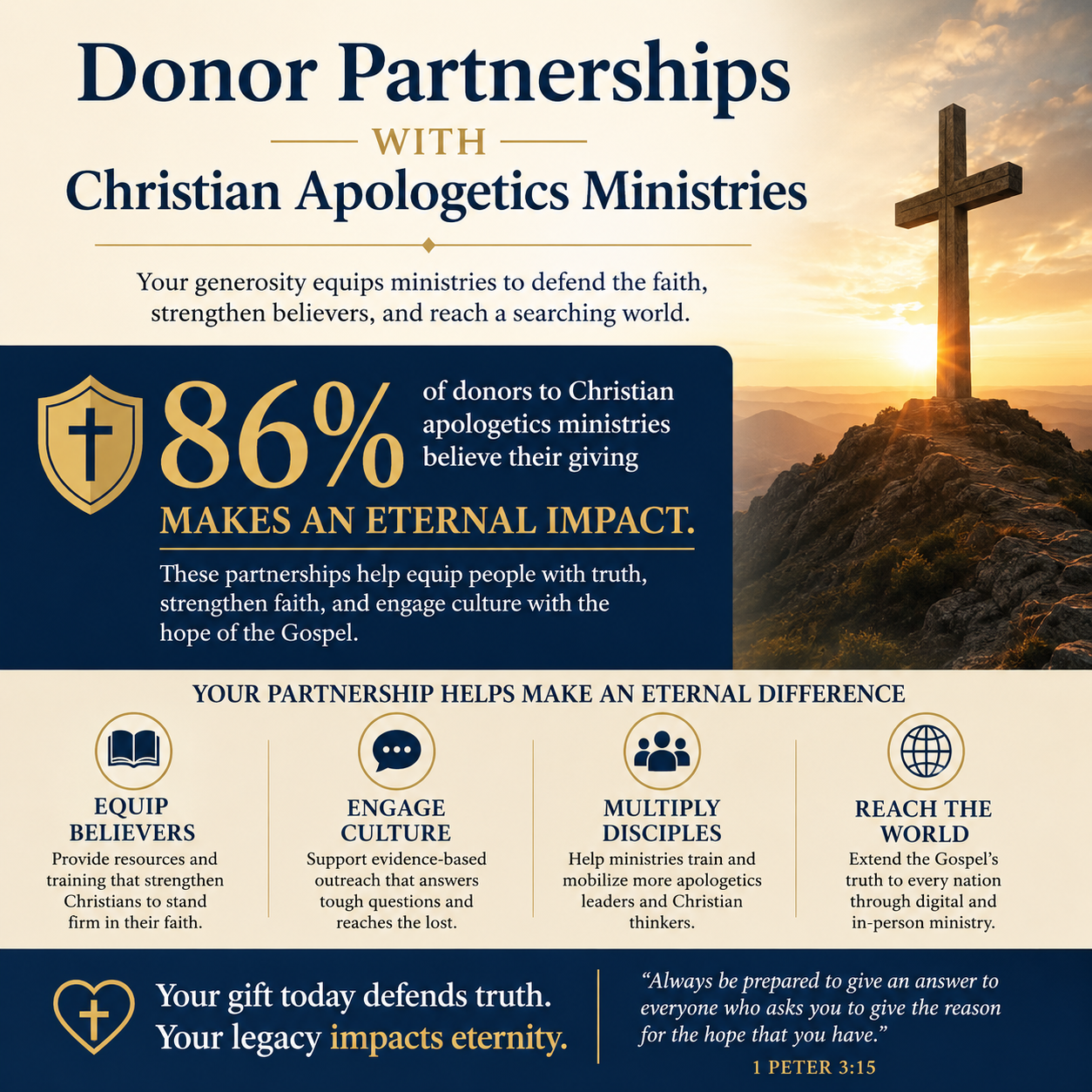
Donor partnerships with Christian apologetics ministries tend to be most fruitful when donors understand the ministry’s operational reality. This work is frequently seasonal, deadline-driven, and dependent on long lead times. It also involves people—writers, speakers, editors, producers—whose formation matters as much as their output. Funding that respects these realities strengthens both mission and staff health.
Recurring giving that stabilizes intellectual and pastoral work
Many apologetics ministries can raise a surge of support for a conference or a new media series, yet struggle to sustain the quiet work between public milestones. Recurring partnerships address that gap. They allow ministries to retain talent, plan responsibly, and avoid crisis-driven fundraising that can erode credibility.
Donors sometimes hesitate because recurring giving can feel impersonal. In apologetics, it is often the opposite: stabilizing support can make room for deeper pastoral care—more thoughtful responses to questioners, better editorial review, and more deliberate content formation. When donors ask for regular reporting that matches the rhythm of the work, recurring giving becomes accountable rather than automatic.
Scholarships and training that multiply long-term capacity
Apologetics is not only public-facing debate. It is also training ordinary Christians to understand doctrine, interpret Scripture well, and speak with humility in hard conversations. Scholarships for apologetics training—whether through institutes, online academies, or seminary-adjacent programs—can be one of the highest-leverage forms of partnership when the program is theologically sound and well governed.
Donors should ask how scholarship recipients are selected, what accountability exists for curriculum quality, and whether the ministry measures outcomes beyond completion rates. A certificate earned is not automatically a life formed. The most credible programs describe the pastoral aims of training: wisdom, courage, and love for neighbor, not merely argumentation skill.
Sponsoring media and publishing without subsidizing sensationalism
Publishing and media are natural vehicles for apologetics, but they also invite temptation: trading theological depth for clicks, polarizing language for reach, or controversy for fundraising. The donor’s role is not to censor; it is to underwrite truth-telling. Funding media projects responsibly often means requiring editorial standards, peer review where appropriate, clear sourcing, and correction mechanisms.
Donors can also prioritize translation and contextualization. Much apologetics content is produced for Western audiences, yet the global church faces distinct intellectual and cultural challenges. When a ministry can demonstrate thoughtful translation strategy—doctrinally faithful and culturally sensitive—media funding becomes a form of long-term equipping rather than short-term attention capture.
Volunteer service that strengthens operations and spiritual care
Many apologetics ministries need volunteers, but not only for event staffing. They often need help with research assistance, editing, donor care, prayer coordination, and hospitality for learners and questioners. Volunteers can also provide a necessary counterweight to celebrity culture by keeping the organization anchored in ordinary Christian service.
Donors who volunteer should treat that service as a form of accountability. It provides a closer view of whether a ministry’s internal culture matches its public messaging. Healthy ministries welcome that kind of proximity; unhealthy ones often resist it.
How Most Trusted helps donors evaluate apologetics ministries
Confidence in giving grows when donors can distinguish theological seriousness from marketing competence. Most Trusted exists to support that discernment. Our verification work evaluates ministries against The Most Trusted Standard, a 15-criteria framework spanning Faith Foundation, Financial Integrity, Governance and Leadership, and Transparency and Effectiveness. The point is not to punish imperfect organizations. The point is to identify the patterns that protect donors, staff, and beneficiaries from preventable harm.
In apologetics, several verification questions become especially significant. Does the ministry’s doctrinal basis have meaningful teeth, or is it ornamental? Is leadership accountable in practice, especially when the ministry is founder-led? Are finances clear enough for a donor to understand what is being funded, including compensation practices and related-party transactions? Does the ministry communicate impact with honesty about what can and cannot be measured?
We also encourage donors to evaluate the ministry’s posture toward the people it serves. Apologetics ministries serve doubters, seekers, pastors, students, and Christians under intellectual pressure. Those people are not projects. They are neighbors. Evidence of pastoral care—thoughtful referral pathways, appropriate boundaries in counseling situations, and partnerships with local churches—often signals a ministry that understands the moral weight of its work.
For donors who want broader context on the field, we maintain a central resource on Christian Apologetics Ministries that situates these partnership questions within a wider view of mission, accountability, and donor responsibility.
Partnerships that honor truth and love
Christian apologetics can serve the church powerfully when it is governed by the character of Christ. Donor partnerships are one of the means God uses to sustain that service, especially when the partnership insists on both doctrinal fidelity and institutional integrity. The goal is not simply more arguments won; it is stronger Christians, humbler witness, and ministries able to endure without sacrificing credibility.
When donors give with discernment—praying faithfully, funding wisely, asking hard questions, and valuing accountability—they help apologetics ministries remain what they ought to be: a reasoned defense offered with gentleness and respect, in service of the gospel that is true.



