
How to fund scholarships for apologetics ministry training is ultimately a question of stewardship: what kind of formation best serves the church’s witness, and what kind of giving structure sustains that formation without distorting it. Christian donors often feel the weight of cultural dislocation—children catechized by screens, young adults discipled by the moral imagination of the university, congregations hesitant to speak with confidence in public. Scholarship funding can be one of the most strategic responses, but only when it is designed with theological clarity and institutional rigor.
Apologetics training has always lived in a tension. The New Testament calls believers to “always be prepared to make a defense” with “gentleness and respect” (1 Peter 3:15), yet the same Scriptures warn against quarrelsome pride and “irreverent babble” that “spreads like gangrene” (2 Timothy 2:23; 2 Timothy 2:16–17). Scholarship dollars can either form faithful witnesses or subsidize performative argumentation. Mature donors name that risk upfront and fund accordingly.
Start with a theology of formation and mission
Scholarships are not merely access; they are discipleship
Apologetics scholarships are often framed as access to education, but Christian giving has never been merely about access. It is about formation for love of God and neighbor. If the goal is only to “win debates,” the program will likely select for confidence without character and skill without spiritual maturity. If the goal is to form Christians who can suffer, listen, and speak truthfully in public, scholarship design will look different.
What this means in practice is that scholarship criteria should explicitly value spiritual and ecclesial rootedness: involvement in a local church, evidence of humility under correction, a track record of service, and a willingness to learn across traditions. Christians genuinely disagree about apologetic method—presuppositional, evidential, classical, narrative, or cultural apologetics—but there is far less disagreement that Christlike posture matters as much as intellectual competence.
Define the apologetics outcomes you are actually funding
Many donors want to fund “apologetics,” but the category includes multiple callings: campus evangelism, youth catechesis, pastoral equipping, digital engagement, academic scholarship, and frontline ministry in hostile contexts. The harder question is whether a scholarship is funding credentials, competence, or mission deployment.
Across our verification work at Most Trusted, ministries that meet The Most Trusted Standard tend to be unembarrassed about their theory of change. They can say, in plain language, who they train, what competencies are expected at graduation, and what measurable signs indicate the training is bearing fruit in the church and in evangelistic witness. That clarity is not marketing. It is a moral safeguard for donors and students alike.

Choose a scholarship model that avoids common distortions
One-time awards and the temptation to treat formation like an event
Scholarships can be structured as one-time grants, multi-year commitments, or cohort-based underwriting. Each model carries a spiritual and financial logic. One-time awards are administratively simple, but they can unintentionally reinforce an “event” understanding of formation: a weekend, a course, a conference. Apologetics competence, especially when integrated with pastoral wisdom, is usually formed over time through practice, feedback, and real ministry contexts.
Multi-year funding is not always wise either. It can create dependency, especially when scholarship recipients are not meaningfully invested in their own formation through work, church support, or personal sacrifice. Donors should not romanticize suffering, but Christian formation typically includes real cost-bearing.
Cohort underwriting and the value of community accountability
A cohort model—funding a group of trainees who learn together and remain accountable to mentors—often aligns better with the ecclesial nature of discipleship. It also protects against scholarship funds being reduced to private consumption. A cohort structure can include required mentoring, supervised ministry placement, and a local-church reference process that is more than a formality.
Scholarship programs should also take seriously the warnings in James about the tongue and in 1 Corinthians about knowledge “puffing up” while love builds up (James 3; 1 Corinthians 8:1). The right scholarship model does not merely make training affordable. It makes training spiritually safer.
Evaluate the training ministry with donor-level due diligence
Financial integrity and the temptation to fund charisma
Apologetics ministries can draw donor attention quickly because the need feels urgent and the communicators are often compelling. That is precisely why scholarships require careful scrutiny. Donors should ask for audited or reviewed financial statements where appropriate, clear budgets for the scholarship program, and documented controls around selection and disbursement.
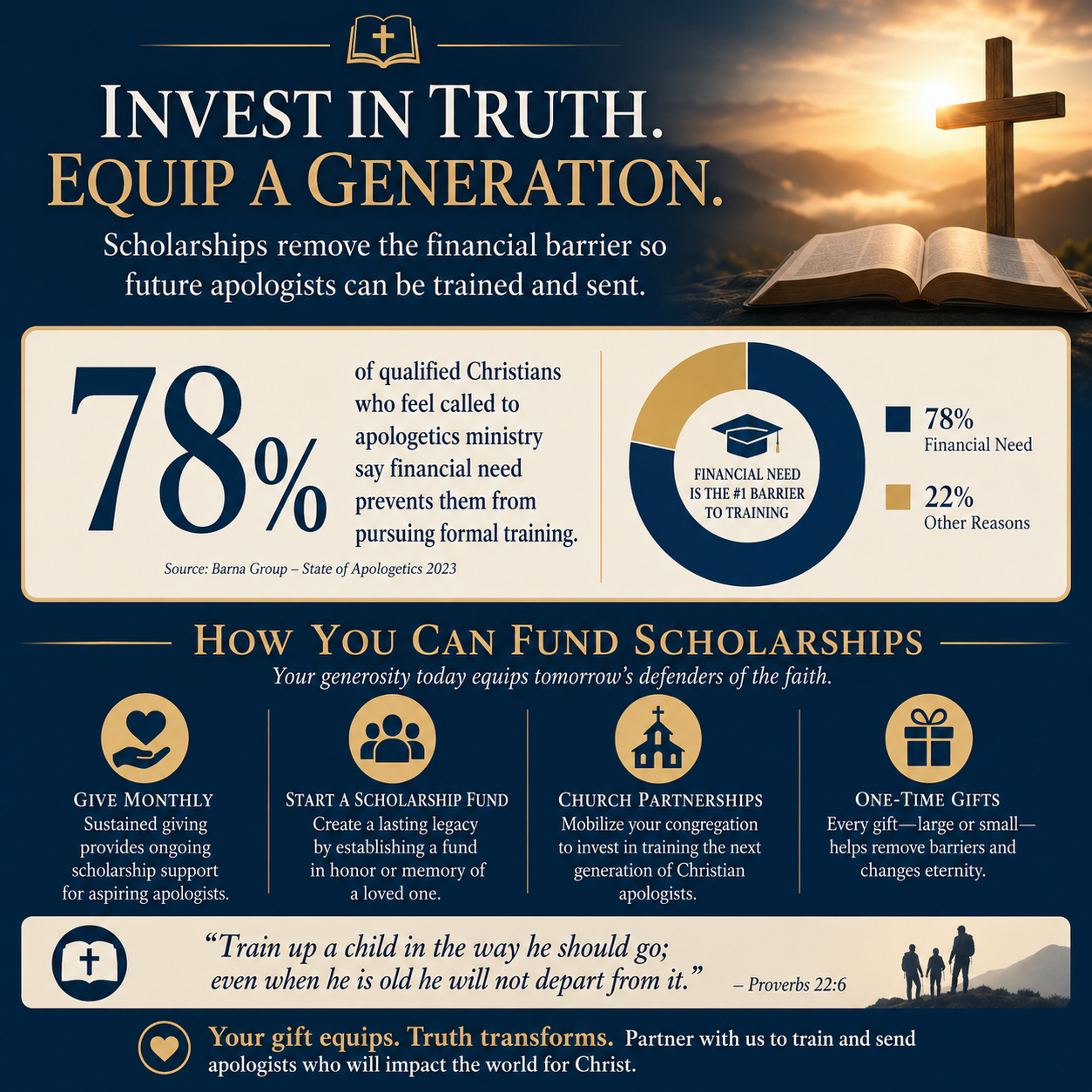
The modern philanthropic field has had to reckon with the “overhead” debate, including the widely cited “Overhead Myth” letter signed by leading charity evaluators cautioning donors against simplistic overhead ratios as a proxy for impact (GuideStar/Candid). The principle applies here: a scholarship program with adequate administrative cost may be safer and more effective than a program that appears lean because it lacks controls, tracking, or care.
Governance and transparency as spiritual safeguards
Scholarship money creates incentives. Any time incentives exist, governance matters. Donors should look for a functioning board, conflict-of-interest policies, and a transparent process for selecting recipients. Ministries should be able to explain how they prevent favoritism, insider access, or “platform-building” that advantages the already-connected.
Most Trusted exists because these questions are difficult for individual donors to answer at scale. Our evaluations against The Most Trusted Standard are designed to surface whether a ministry’s doctrinal commitments, financial integrity, governance and leadership practices, and transparency and effectiveness claims are coherent and verifiable. When donors fund scholarship programs housed in ministries that can sustain scrutiny, the giving is more likely to remain both fruitful and durable.
Fund the whole pathway, not only the tuition line
Scholarships that ignore ministry placement can underperform
Apologetics training is often evaluated at the point of completion—coursework finished, certificate earned, degree granted. But donors are not only funding education. They are funding public witness and church strengthening. If scholarship recipients finish training and then drift without placement, mentoring, or accountability, the return is frequently lower than donors expect.
A strong scholarship strategy includes a pathway: supervised ministry placements, preaching and teaching opportunities within local churches, campus or community engagement under oversight, and continuing education. That pathway also helps donors avoid funding a merely personal hobby. The goal is equipping the saints for the work of ministry (Ephesians 4:11–13).
Covering hidden costs without subsidizing entitlement
Tuition is not the only barrier. Books, travel, childcare, technology, and reduced work hours are often the decisive constraints for students with families or ministry responsibilities. A scholarship fund that can address these needs—while requiring receipts, budgets, and accountability—may expand the pool beyond young single students and toward pastors, missionaries on home assignment, and lay leaders with deep church roots.
The donor discipline is to distinguish between burden-bearing and entitlement. Scholarship programs should set clear expectations: attendance, assignments, mentoring, and ministry service. They should also include off-ramps when recipients are not participating in good faith.
- Selection criteria that value character, church involvement, and teachability
- Defined competencies that match the ministry’s mission and doctrinal commitments
- Budgeted non-tuition support with documentation requirements
- Mentoring and supervision during and after the training period
- Placement partnerships with churches, campus ministries, or mission agencies
Partner as a donor without becoming the program
Restricted giving, reporting, and the need for proportion
Donors often prefer restricted gifts for scholarships, and that preference is understandable. The tension is that heavy restrictions can create administrative burden and can unintentionally steer programs away from the best formation practices. A mature approach is to restrict gifts to a clearly defined scholarship purpose while allowing the ministry discretion to allocate within that purpose: tuition support, mentoring infrastructure, assessment tools, or cohort retreats.
Reporting should be sufficient to verify stewardship without pressuring ministries into inflated impact claims. Apologetics outcomes are not always immediate or easily quantified. Some fruit shows up years later in pastoral steadiness, faithful parenting, or patient evangelism. Still, the ministry should be able to provide verifiable indicators: completion rates, mentoring participation, placement follow-through, and qualitative feedback from supervising pastors.
Where to find credible apologetics partners
Many donors begin with ministries they already know through conferences, podcasts, or books. That familiarity can be helpful, but it should not replace due diligence. The healthiest approach is to view apologetics ministries as institutions, not merely as communicators. Institutions require governance, financial controls, and transparency.
For donors building a portfolio of relationships, it can help to study the landscape of Christian Apologetics Ministries with an eye toward mission fit and verifiable practices. Scholarship funding becomes more coherent when it is aligned with a ministry’s established training pipeline rather than added as an afterthought.
Donors also benefit from considering how scholarship giving fits within broader Donor Partnerships with Christian Apologetics Ministries, including general operating support, content translation, local church equipping, and pastoral training. Scholarship dollars are powerful, but they are not the only way to strengthen the apologetics ecosystem.
FAQs for How to fund scholarships for apologetics ministry training
Should we fund scholarships through a ministry or give directly to students?
In most cases, funding scholarships through an accountable ministry is safer than giving directly to individual students. A credible ministry can document selection standards, financial controls, mentoring requirements, and completion expectations. Direct giving can be appropriate in limited cases—such as supporting a known missionary or pastor under clear oversight—but it often lacks the governance and reporting structure donors need for long-term stewardship.
What should we ask a ministry to provide before we fund an apologetics scholarship program?
At minimum, donors should request a written description of the scholarship purpose, eligibility and selection process, budget and disbursement procedures, expected outcomes, and a reporting plan. Financial statements and basic governance documentation—board oversight, conflict-of-interest policy, and transparency around leadership compensation where appropriate—help establish whether the scholarship program is an extension of a healthy institution or a fragile add-on.
Scholarships that honor the church and protect the witness
Scholarships for apologetics ministry training can be a high-leverage gift when they are rooted in a theology of formation, structured to avoid distortions, and embedded in accountable institutions. The church does not need more religious argument for its own sake; it needs men and women formed to speak truthfully about Christ with courage, patience, and love. Donors who fund that kind of formation are not merely paying for coursework. They are investing in the credibility of Christian witness for the next generation.



