
How discipleship ministries support church leadership is not a secondary question for Christian donors. The quality of a church’s leadership shapes preaching, pastoral care, member formation, and the credibility of the church’s public witness. When leadership is faithful and competent, the church is better positioned to “equip the saints for the work of ministry” (Ephesians 4:11–12). When leadership is fragile—spiritually, relationally, or administratively—the damage is rarely contained to a single staff member or a single budget year.
Donors often feel this tension acutely. Many have watched promising leaders burn out, drift into moral compromise, or simply lack the training to shepherd conflict, discipleship, and institutional complexity at the same time. Discipleship ministries exist, in part, because local churches need more than inspiration; they need formation, tools, and accountable development pathways for pastors and lay leaders who will be entrusted with people and with resources.
Church leadership is formed, not assumed
Christian communities sometimes speak as though leadership capacity arrives with calling. Scripture honors calling, but it also assumes formation. Paul instructs Timothy not only in doctrine, but in character, household leadership, and the practical governance of the church (1 Timothy 3; Titus 1). The New Testament is clear that leaders are tested, trained, and recognized over time, not merely affirmed in a moment.
What this means in practice is that discipleship ministries serve as an extension of the church’s formative work. They help create structured environments where leaders can be taught, supervised, coached, corrected, and encouraged, especially when a local church lacks the time or specialized capacity to do this alone.
Why donors should care about formation, not only outcomes
Donors understandably want measurable results: more leaders trained, more groups launched, more churches strengthened. Yet leadership development is often a lagging indicator. A cohort can look successful on paper while quietly producing leaders who imitate unhealthy patterns: overwork baptized as zeal, charisma confused with maturity, and conflict avoidance disguised as peace.
The more reliable question is whether a ministry has a coherent theology of leadership formation and the discipline to implement it. Across our verification work at Most Trusted, the ministries that meet The Most Trusted Standard tend to show evidence of both: a stated ecclesiology and discipleship philosophy, and operating practices that align with those commitments—curriculum design, leader assessment, safeguarding, and clear accountability structures.
The pressures on pastors and lay leaders are measurable
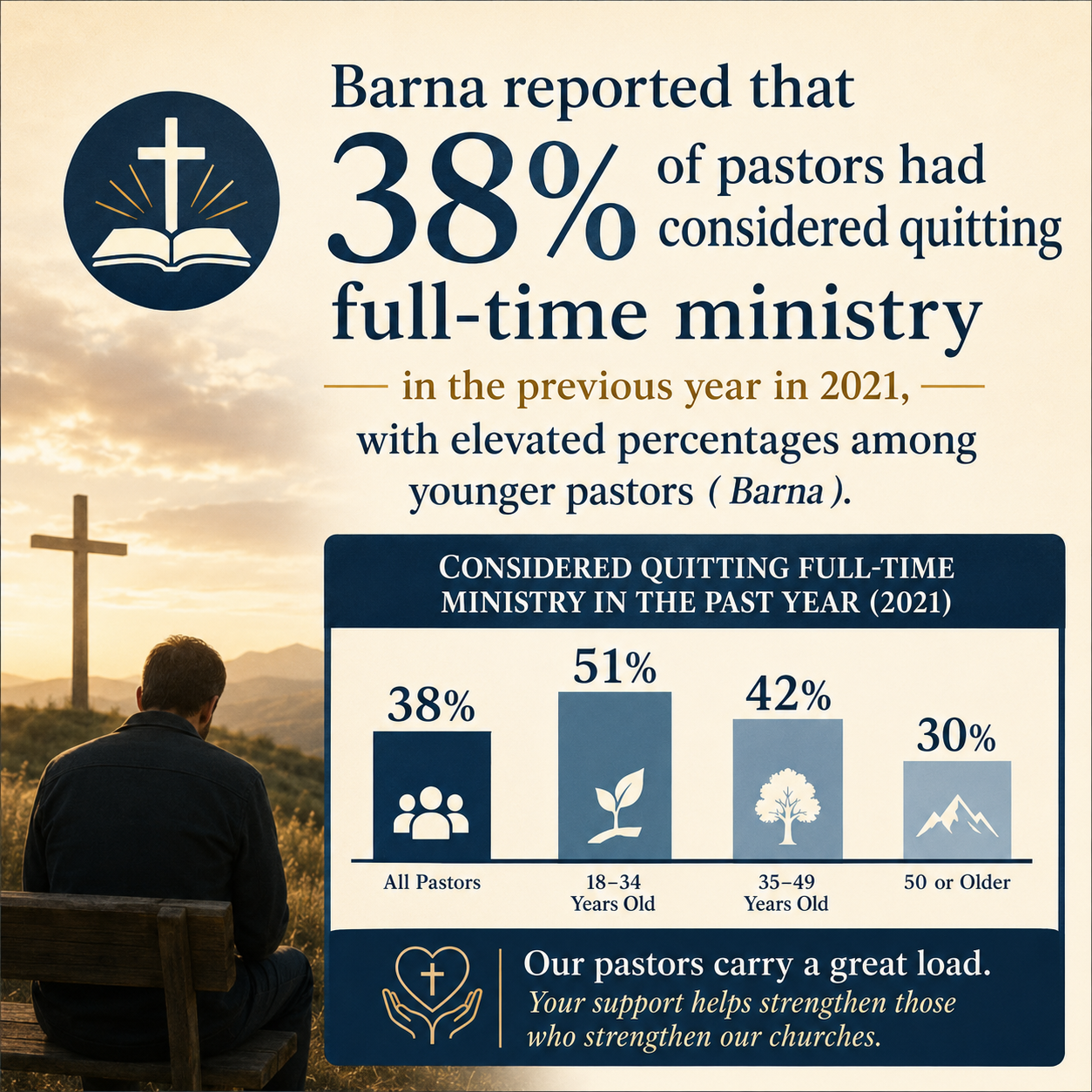
Leadership strain is not merely anecdotal. For example, research has documented that many pastors have seriously considered leaving pastoral ministry in recent years; this is not the only measure of health, but it is a signal of widespread stress and discouragement. Barna reported that 38% of pastors had considered quitting full-time ministry in the previous year in 2021, with elevated percentages among younger pastors (Barna).
Discipleship ministries are not a substitute for spiritual resilience, marriage health, or prayer. But they can be a meaningful support structure: offering coaching, peer learning, theological clarity, and practical training that reduces isolation and increases competence.

Discipleship ministries strengthen leaders through training and resources
The visible work of discipleship ministries is often programmatic: workshops, cohorts, conferences, online learning, and published materials. For donors, the harder question is what sits beneath the programming. Strong leadership support is not built around content distribution alone. It is built around an integrated approach that joins theology, spiritual formation, and skills training to the realities leaders face.
Training that integrates doctrine, character, and skill
Healthy training does not treat theology as a detachable module. It helps leaders connect biblical conviction to pastoral judgment: how to teach Scripture responsibly, how to shepherd people in suffering, how to lead change without manipulation, and how to guard the unity of the Spirit without tolerating injustice or abuse.
Many discipleship ministries also provide pathways for lay leadership development. This matters because the New Testament vision is not a clergy-only ministry but a whole-church ministry. A donor’s gift that equips lay leaders—small group facilitators, elders, deacons, children’s ministry leaders—often multiplies impact in quieter but enduring ways.
Practical resources for small group and ministry leaders
Local churches frequently rely on volunteer leaders who are spiritually serious but under-supported. Discipleship ministries help by supplying vetted curricula, leader guides, training videos, and frameworks for group multiplication and pastoral care triage. The best resources are not merely engaging; they are theologically accountable, psychologically aware, and designed for real congregational constraints.
This is also where donors should recognize a genuine tension. Standardized resources can be a gift, but they can also flatten local contextual wisdom. Faithful discipleship is always embodied in a particular place: a neighborhood, an immigrant community, a rural town, a multiethnic suburb. Strong ministries build resources that travel well while encouraging local pastors to adapt wisely, not copy mechanically.
Digital learning expands access but requires disciplined quality control
Online training can extend serious formation to leaders who cannot travel or take formal seminary courses. That broader access is a meaningful good. Yet it increases the responsibility for quality control: theological review, instructor accountability, and safeguards around counseling-adjacent content that could be misused without pastoral oversight.
For donors, the verification question is whether the ministry has governance and review processes proportionate to its reach. In our evaluation work, we look for evidence that content is reviewed by qualified leaders, that doctrinal commitments are public, and that leaders are not pushed into roles without screening and training, especially in children’s and youth contexts.
Coaching and accountability protect both leaders and congregations
Training imparts knowledge; coaching shapes judgment. Discipleship ministries that support church leadership well often include clergy coaching, mentoring networks, or peer cohorts. These structures address a predictable reality: leadership failure is frequently relational and internal before it is public and external. Isolation magnifies risk. Accountability reduces it.
How clergy coaching functions when it is healthy
Effective coaching is not therapy and should not pretend to be. It is a disciplined conversation that helps leaders clarify calling, set priorities, address ministry bottlenecks, and make decisions aligned with biblical conviction and organizational reality. It also creates a space where leaders can name discouragement and temptation without immediately performing competence.
Christians genuinely disagree about how formal coaching should be and whether it imports secular assumptions. The best discipleship ministries address this concern directly by grounding their coaching posture in pastoral theology: humility before Scripture, reverence for the church, and a commitment to truth-telling rather than image management.
Peer cohorts create a counterweight to isolation
One of the most underappreciated contributions of discipleship ministries is convening. A cohort that brings pastors and lay leaders together across churches can create a culture of mutual sharpening, practical wisdom sharing, and prayerful support. It can also normalize the kinds of questions leaders often hide: conflict with elders, family strain, discouragement in preaching, uncertainty about growth, and the fatigue that comes from never being off duty.
Peer structures are not automatically safe. They require facilitation, confidentiality expectations, and clear boundaries. Donors should ask whether the ministry has policies that protect participants from spiritual misuse, gossip dynamics, or informal “shadow counseling” that exceeds competence.
Accountability includes safeguarding and ethical clarity
Leadership development must include ethical formation. Churches have had to reckon with patterns of abuse, mishandled allegations, and power protected at the expense of victims. Discipleship ministries that serve leaders responsibly build in training on safeguarding, reporting obligations, and the difference between forgiveness and the removal of consequences.
Donors need not demand perfection, but we should expect seriousness. A ministry that avoids these topics because they are uncomfortable is not preparing leaders for the actual church.
Donor confidence depends on verifiable integrity and effectiveness
Donors are not only funding a curriculum or an event. We are funding an organization that shapes leaders who will steward people, authority, and money. That is why verification matters. In Christian giving, the temptation is to fund the most compelling story, the most gifted communicator, or the most impressive growth curve. Those signals can be meaningful, but they are not a substitute for integrity that can be examined.
Most Trusted exists to help donors give with confidence by evaluating ministries against The Most Trusted Standard, a 15-criteria framework that examines faith commitments, financial integrity, governance and leadership, and transparency and effectiveness. The point is not suspicion; it is stewardship. Scripture commends careful stewardship and honest weights (Proverbs 11:1), and the church’s credibility is harmed when donors later discover that enthusiasm outran accountability.
What to look for when funding leadership development
When donors consider supporting discipleship ministries that train church leaders, several questions are especially clarifying:
- Is the theology explicit and stable? A clear statement of faith is not a formality; it is a boundary that protects leaders from drifting into whatever is currently fashionable.
- Are training outcomes defined with integrity? Counting attendees is not the same as measuring formation. The best ministries define outcomes they can reasonably claim—completion rates, assessed competencies, leader placement, coaching engagement—without exaggeration.
- Is governance strong enough to restrain charisma? A board that is independent, engaged, and willing to ask hard questions is a safeguard, not a threat to mission.
- Are finances understandable to a careful reader? Transparent financial statements, clear explanations of program expenses, and consistent reporting practices matter because donors are accountable to God for their giving.
Resisting simplistic metrics without abandoning accountability
The nonprofit sector has matured in its understanding that overhead ratios do not, by themselves, indicate effectiveness. A coalition of major charity evaluators warned against using overhead as the primary measure of a charity’s worth, because it can incentivize underinvestment in systems and people (Charity Navigator). This principle applies to discipleship ministries as well. Underfunded training teams, weak curriculum review processes, and inadequate participant care are not marks of virtue.
Accountability is still essential. The question is whether the ministry can explain, in plain language and with documentation, how resources translate into leader formation and healthier churches. Mature donors can hold both truths: simplistic metrics mislead, and vague spiritual language can conceal poor stewardship.
Where to place this work within a broader giving strategy
Discipleship ministries are often “infrastructure” giving for the church. They strengthen the people who will preach the gospel, care for the suffering, disciple children, and lead mission in local communities. Some donors prefer direct service ministries because impact feels immediate. Leadership development can feel indirect. Yet over time, it can be among the most strategic forms of Christian philanthropy because it shapes the leaders who shape congregations.
Readers who want to situate leadership development within the wider landscape of Discipleship Ministries should think in terms of multiplication. When a ministry equips one pastor well, that pastor’s steadiness can bless hundreds. When a ministry equips dozens of lay leaders, the ministry of care and formation expands beyond what paid staff can do alone.
What faithful support of church leadership can accomplish
How discipleship ministries support church leadership is ultimately about the church’s vocation: to bear faithful witness to Christ through word and deed, across generations. The work is slow and often hidden. It includes training, resources, coaching, and accountability structures that prevent predictable failures and cultivate durable maturity.
For donors, the opportunity is to fund leadership formation with both spiritual seriousness and verifiable confidence. That requires ministries that love the church enough to tell the truth, build structures that endure, and submit their work to scrutiny consistent with the weight of what is being entrusted to them.



