

Getting a Christian medical ministry donation receipt is not merely an administrative task; it is part of faithful stewardship. A receipt is how you document that a gift was made, to whom it was made, and whether you received anything in return. When the ministry serves the sick and vulnerable, clarity matters both for conscience and for compliance.
The tax rules are not designed to burden generosity, but they do require precision. The IRS distinguishes between charitable contributions and payments that purchase goods or services. Christian donors often give through a mixture of channels—online portals, donor-advised funds, church collections, fundraising banquets, and year-end appeals. Each channel can affect what your receipt should say and what you can claim.
Start with the correct question: Is this gift a charitable contribution
The first step is to confirm whether your donation is legally treated as a charitable contribution. Most Christian medical ministries that issue tax-deductible receipts are recognized as 501(c)(3) public charities. If the ministry is not a 501(c)(3), a “receipt” may still be a record of your payment, but it will not function as a charitable contribution acknowledgment for federal income tax purposes.
Confirm the ministry’s charitable status
For U.S. donors, the most direct way to confirm status is the IRS Tax Exempt Organization Search, which lists organizations eligible to receive tax-deductible contributions. Use the legal name and location if the ministry’s public-facing name is similar to others. The IRS database is the reference point auditors use, not social proof or donor testimonials. See IRS Tax Exempt Organization Search.
Across our verification work at Most Trusted, we also find that donors benefit from distinguishing “medical ministry” as a mission category from the legal and financial structures behind it. Some Christian health initiatives operate under churches, networks, or international affiliates where the receipting entity differs from the program name. That distinction is not inherently problematic, but it should be disclosed clearly so your receipt matches the entity recognized by the IRS.
Know when a payment is not a donation
The harder question is whether you received something of value in exchange for your payment. If you received goods or services—such as event tickets, meals, merchandise, or other benefits—only the portion above the fair market value is a charitable contribution. If the ministry is a membership-based model with benefits, you should read the language carefully. The IRS’s guidance on substantiating contributions explains the documentation requirements and the role of acknowledgments. See IRS Publication 526.

What a compliant donation receipt should include
Once you have confirmed that the gift is to a qualified organization, the next step is ensuring your documentation meets the substantiation standard. A receipt is not merely “proof you gave.” It is a written acknowledgment from the organization that includes specific elements, especially for gifts of $250 or more.
Core elements for cash and cash-equivalent gifts
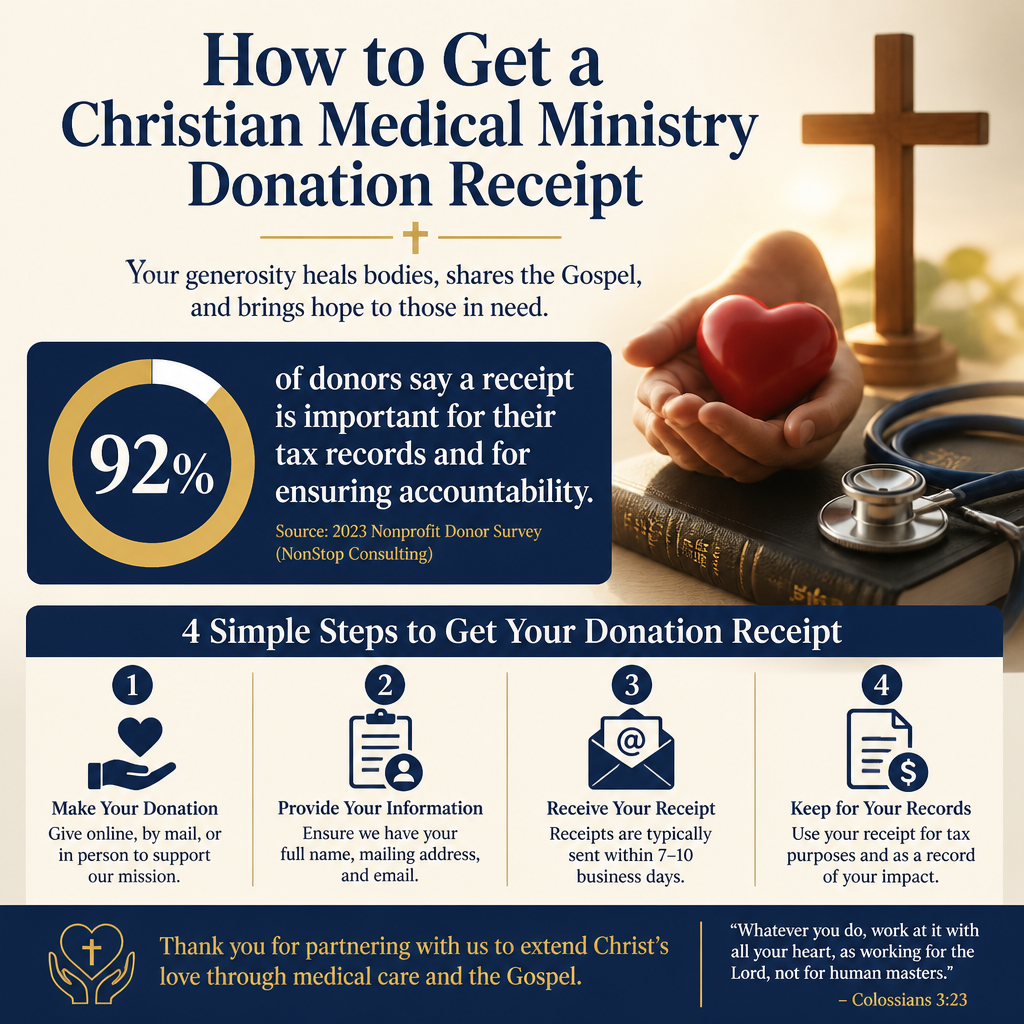
For contributions of $250 or more, you must have a contemporaneous written acknowledgment from the charity. In practice, that means you should receive the receipt by the time you file your return, or by the due date (including extensions), whichever comes first. The acknowledgment generally should include the organization’s name, the date and amount of your contribution, and a statement about whether you received goods or services in exchange. The IRS explains this “contemporaneous” rule and the required content in its charitable contribution substantiation guidance. See IRS guidance on written acknowledgments.
- Legal name of the organization as recognized for tax purposes
- Date of the contribution
- Amount for cash or cash equivalents (card, ACH, check)
- Statement whether any goods or services were provided in exchange
- If goods or services were provided, a good-faith estimate of their value
Special cases: noncash gifts, vehicles, and stock
Noncash giving introduces complexity because the donor generally bears responsibility for valuation and documentation. A ministry can acknowledge receipt of noncash property, but it typically should not assign a value unless it is a standard, low-value item. Certain categories—like vehicles—can require specific forms and additional charity reporting. The IRS’s resources on noncash contributions and valuation provide the relevant guardrails. See IRS Publication 561.
Christian donors sometimes assume that because a ministry’s mission is merciful, the paperwork can be informal. The opposite is often true: ministries that honor their calling tend to be careful with donor documentation precisely because they take integrity seriously. At Most Trusted, we treat this as a credibility indicator within The Most Trusted Standard, because receipting is one of the simplest places to demonstrate operational discipline.
How to request a missing or corrected receipt without strain
If your receipt is missing, incomplete, or inaccurate, request a correction promptly. Donors sometimes hesitate, worried they will appear mistrustful. But asking for a compliant receipt is not suspicion; it is basic governance hygiene. Strong ministries expect these requests and should have a straightforward process.
Use specific language that maps to IRS requirements
What this means in practice is that your email or call should be precise. Ask for a “contemporaneous written acknowledgment” that includes the organization’s name, the date and amount of the contribution, and the goods-or-services statement. This frames your request in objective terms and reduces back-and-forth.
When a ministry’s receipt lacks the goods-or-services statement, the fix is typically easy: the ministry reissues a letter that includes, for example, “No goods or services were provided in exchange for this contribution,” or, if applicable, “Goods or services were provided, consisting of [description], with an estimated fair market value of $X.” The ministry does not need to know your tax situation to issue a compliant acknowledgment.
If the gift was made through a third party
Many Christian donors give through donor-advised funds, workplace giving portals, payment processors, or stock-transfer platforms. In those cases, the receipt may come from the intermediary rather than the ministry, and the timing can differ. For donor-advised funds, the sponsoring organization typically provides the tax receipt because your deductible gift is to the sponsor, not a direct gift to the ultimate ministry. The IRS donor-advised fund rules and explanations are the baseline reference for how these gifts are treated. See IRS donor-advised funds.
Where donors sometimes get stuck is expecting a year-end receipt from the ministry after giving through a donor-advised fund. The ministry may properly thank you, but it should not issue a tax receipt for that contribution. Good ministries will clarify this in their correspondence so your records remain coherent.
What Christian donors should watch for in medical ministry giving
Medical ministry sits at the intersection of mercy, cost, and urgency. That combination can tempt ministries to compress administrative functions in ways that create downstream problems for donors. Christians genuinely disagree about the appropriate balance between administrative spending and program intensity, but compliance failures are not a principled position; they are a preventable risk.
Receipts are one signal of deeper organizational health
A ministry that cannot reliably produce compliant acknowledgments may also struggle with donor privacy, restricted gift handling, or board oversight. Those are not small matters. Scripture’s insistence on honest weights and measures speaks to the moral texture of financial integrity, not merely legality (Proverbs 11:1). For donors trying to give with both compassion and prudence, paperwork quality is a surprisingly useful window into whether the organization treats accountability as part of discipleship.
Most Trusted exists to serve donors precisely in these moments, when good intentions meet real-world complexity. Our evaluations against The Most Trusted Standard focus on verifiable indicators across faith commitments, financial integrity, governance, and transparency. When ministries meet these criteria, operational basics like receipting tend to be handled consistently, and exceptions are addressed with clarity rather than defensiveness. Many donors begin their research in Christian Medical Ministries to understand the landscape before making significant commitments.
Be cautious with quid pro quo appeals and designated benefits
Christian medical ministries may run banquets, sponsorship programs, or “benefit-linked” giving campaigns. Some are commendably transparent; others are less careful. If a ministry implies that your gift purchases a direct personal benefit—priority access, special services, or tangible items—that may change the character of the payment for tax purposes. Even where the program is ethically sound, the receipt must reflect whether you received goods or services in exchange.
Donors also encounter emotionally compelling designated appeals: “$50 supplies a clinic,” “$250 covers a surgery,” and similar framing. These can be helpful approximations, but the receipt should still reflect your gift as a contribution to the organization, not as a purchase of a specific medical procedure. When donor expectations are formed by transactional language, disappointment and confusion follow—especially if the ministry must reallocate funds due to clinical realities or local constraints.
Keep your records straight for year-end giving and audits
Many receipt problems surface in January, when donors are assembling documentation and ministries are handling high volumes of acknowledgments. The disciplined approach is to build a simple recordkeeping habit during the year. This reduces the pressure to chase down receipts at the deadline.
A practical recordkeeping approach
Maintain a single folder—digital or physical—for each tax year, and save receipts as they arrive. If the ministry’s system produces an email acknowledgment, save the full email and any attached PDF. If you give by check, keep a scanned image of the check or a bank record, but remember that for gifts of $250 or more you still need the charity’s written acknowledgment.
For donors giving to multiple ministries, it can help to note any benefits received (event meals, products) beside the receipt. This is not cynicism; it is accurate accounting. The IRS is explicit that the donor bears the burden of substantiation. See IRS Topic 506.
When to ask for additional transparency
If a receipt is compliant but your confidence remains unsettled, the next question is whether the ministry provides clear, accessible financial reporting and governance disclosures. A ministry can issue correct receipts and still be opaque about outcomes or internal controls. For donors who want to integrate generosity with due diligence, Tax Receipts and Compliance for Christian Medical Ministry Giving is a natural place to compare common documentation practices across the field.
FAQs for How to get a Christian medical ministry donation receipt
What if the ministry only sent a bank transaction confirmation and no letter?
For gifts under $250, a bank record (such as a canceled check or card statement) can substantiate the contribution. For gifts of $250 or more, you generally need a contemporaneous written acknowledgment from the ministry that includes the required goods-or-services statement. Request a corrected acknowledgment from the ministry that includes the organization’s name, the date and amount of the gift, and whether anything was provided in return. See IRS guidance on written acknowledgments.
Can a ministry issue a receipt if we gave through a donor-advised fund?
In most cases, no. When you contribute to a donor-advised fund, your tax-deductible gift is to the sponsoring organization, and the sponsor issues your receipt. The ministry may send a thank-you note, but it should not provide a charitable contribution acknowledgment for the donor-advised fund grant as though it were your direct gift. This is a common point of confusion, and well-governed ministries clarify it to protect donors from documentation errors. See IRS donor-advised funds.
Receipts are part of stewardship, not an interruption of it
A Christian medical ministry donation receipt is a small document with significant implications: it supports lawful tax reporting, it disciplines our giving against confusion, and it signals whether a ministry treats accountability as a form of love for neighbor and respect for donors. The healthiest ministries usually make receipting easy—not because they idolize administration, but because they understand that integrity is part of their witness.



