
How matching gifts work for Christian medical ministry donations is straightforward in concept and frequently complicated in execution. When a donor’s employer matches charitable contributions, the ministry can receive an additional gift at no extra cost to the donor, but only if the gift is processed within the employer’s rules and documented in a way that protects both donor and ministry.
For Christian donors, matching gifts raise a stewardship question rather than a mere administrative one. If God entrusts resources for the love of neighbor, then leaving a legitimate match unclaimed is not morally equivalent to waste, but it can be a missed opportunity for multiplied mercy. The wise path is disciplined clarity: understanding what a match is, how it is recorded, and how it should shape our giving decisions without distorting them.
1 Matching gifts are corporate philanthropy that follows corporate rules
What a matching gift is and what it is not
A matching gift is a second donation made by an employer because an employee gave to an eligible nonprofit. In practice, the employer’s contribution is the employer’s money, disbursed because the employee initiated a qualifying gift and completed a verification step. The ministry receives two separate contributions: your original donation and the employer’s match.
This distinction matters for Christian medical ministries because donors sometimes assume the match is an extension of their personal gift for receipt and tax purposes. It is not. The donor generally receives a tax receipt for the amount the donor gave; the employer receives credit and documentation for the matched amount. When ministries blur those lines, they invite avoidable compliance problems and undermine trust.
Why medical ministry is frequently eligible
Most matching gift programs are designed to support public benefit organizations, commonly including 501(c)(3) charities in the United States. Christian medical ministries often qualify because they provide healthcare access, medical missions, clinics, or disaster response. Still, eligibility is not guaranteed. Some employers exclude certain categories, including religious organizations, even when those organizations provide medical services.
That tension is familiar: Christian witness is not best served by hiding faith commitments to satisfy a corporate program, yet donors can still steward matching gifts by selecting eligible ministries that are both unambiguously Christian and clearly charitable in form. When we evaluate ministries at Most Trusted, we see that those meeting The Most Trusted Standard typically present their charitable purpose and their doctrinal identity with equal clarity, which reduces friction with third-party verification.

2 The process usually hinges on documentation and timing
The standard workflow from donation to match
Although each employer runs its own program, the workflow is usually consistent: you give, you submit a match request, the employer verifies eligibility, and the employer disburses the match. Verification may be automated through a workplace giving portal or handled by a vendor that requests confirmation from the ministry.
What this means in practice is that a match is often lost not because a donor lacked generosity, but because the donor missed a deadline or supplied incomplete information. Many employers enforce strict time windows for submitting a request, sometimes tied to the date of the original donation or the close of the calendar year.
Common failure points we see across donor and ministry workflows
Across our verification work, we observe that matching-gift breakdowns tend to occur at predictable points: unclear ministry naming, mismatched tax identification details, gifts routed through non-eligible channels, or documentation that does not clearly separate goods and services from pure charitable giving. A Christian medical ministry that treats receipting as a spiritual and fiduciary duty is more likely to build systems that prevent these issues.
- Ineligible donation channel such as certain peer-to-peer tools or donor-advised fund grants, which many employers exclude.
- Deadline missed for submission or employer verification.
- Name and EIN mismatch between the ministry’s legal entity and the brand name used in marketing.
- Insufficient receipt language where required, especially when any benefit was provided.
- Employment status limits for retirees, part-time employees, or subsidiaries.
Done carefully, matching gifts can extend the reach of tangible care: clinic days funded, medicines purchased, local Christian health workers trained, or transportation provided for patients who otherwise delay treatment. Done carelessly, matching gifts can generate confusion about what was given, by whom, and under what terms.
3 Tax receipts and compliance require careful separation of benefits
Your receipt is for your gift, not for the employer’s match
For U.S. donors, charitable deduction rules depend on substantiation and the nature of the gift. The IRS requires that donors have a bank record or written communication for any contribution and a contemporaneous written acknowledgment for contributions of $250 or more, including a statement about whether any goods or services were provided in exchange for the contribution.IRS Publication 526
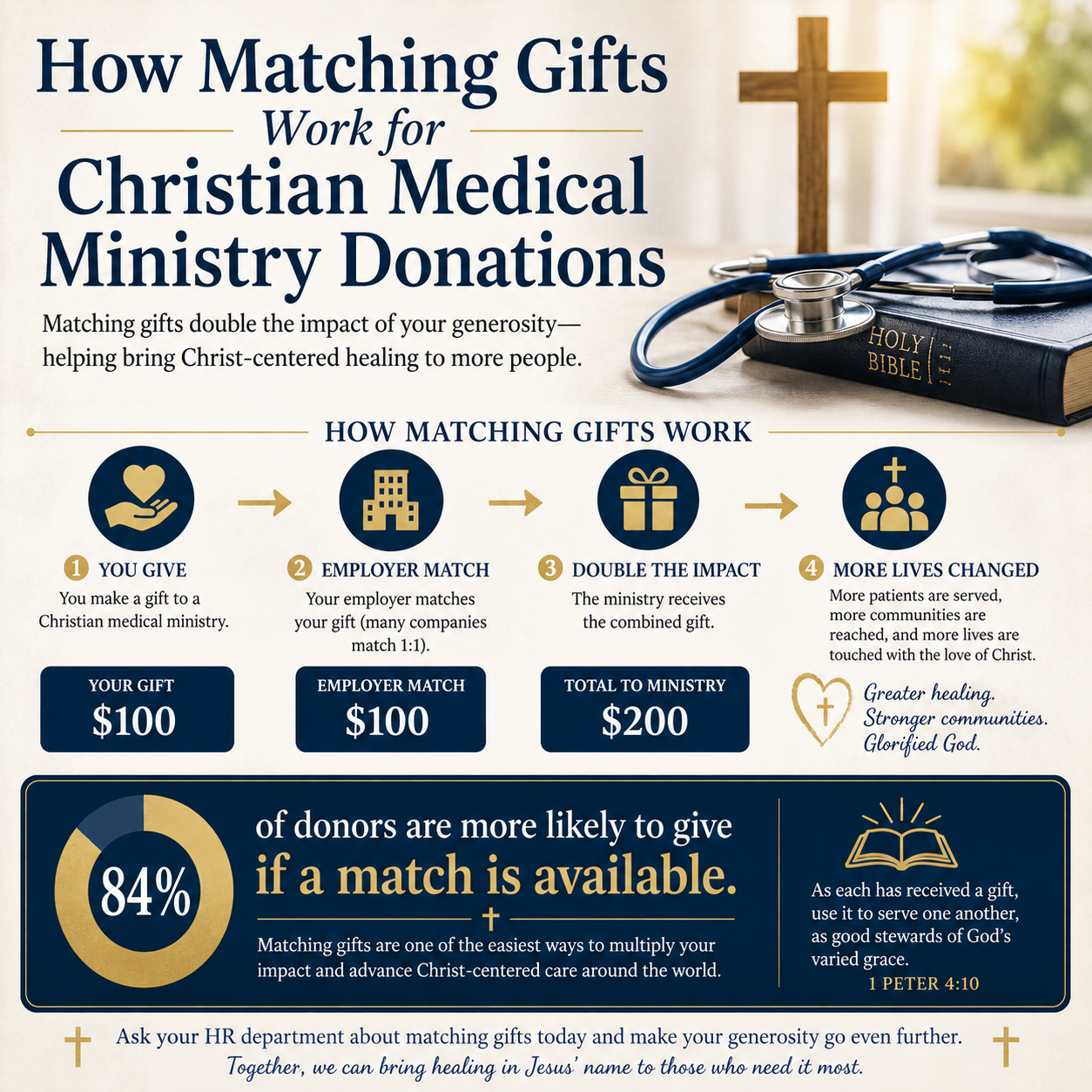
A matching gift does not increase your personal charitable deduction simply because the ministry receives more money. Your receipt should reflect the amount you gave and any goods or services you received. The employer’s contribution is separate and should not be included on your tax receipt. This separation protects both the donor and the ministry from accidental overstatement.
Why Christian medical ministries must be especially careful about goods and services
Medical ministries sometimes host fundraising banquets, provide books, offer conference registrations, or provide other donor benefits. Even when a benefit is spiritually edifying, it can still be a “good or service” for substantiation purposes. If a donor receives something of value, the deductible portion may be reduced, and many employer matching programs will match only the purely deductible component or may exclude event purchases entirely.
Christians genuinely disagree about how much donor recognition and benefit is appropriate in a ministry context. Scripture warns against practicing righteousness “to be seen by others” (Matthew 6), yet the New Testament also assumes accountability and orderly administration of funds (2 Corinthians 8:20–21). The compliance question is not merely technical. It is part of honest dealing before God and neighbor.
For readers looking more broadly at receipting and compliance patterns in this field, we maintain ongoing analysis within Tax Receipts and Compliance for Christian Medical Ministry Giving, including the recurring points where well-meaning ministries create unnecessary donor risk.
4 Matching gifts should strengthen stewardship without distorting discipleship
When matching incentives can subtly reshape giving priorities
Matching gifts can tempt donors to let corporate eligibility replace discernment. A donor may be inclined to give to the ministry that “matches” rather than the ministry that most faithfully fits the donor’s calling, theological convictions, and concern for measurable need. That is not a reason to reject matches; it is a reason to keep the ordering of loves intact.
Jesus’ teaching on money consistently presses beyond technique into allegiance. “Where your treasure is, there your heart will be also” (Matthew 6:21). Matching programs can be received as providential opportunities, but they should not become the hidden governor of generosity.
A disciplined way to decide when a match should matter
We recommend a simple hierarchy. First, determine the ministry you believe you should support based on mission fidelity, integrity, and effectiveness. Second, confirm whether your employer will match and whether your chosen giving method is eligible. Third, if you face a close decision between two faithful options, allowing the match to break a tie can be prudent stewardship.
Discernment is easier when a donor can trust the ministry’s reporting and oversight. Most Trusted exists because many donors have learned, sometimes painfully, that strong spiritual language is not the same as strong governance. Our evaluations against The Most Trusted Standard are designed to help donors give with confidence when they are supporting high-impact work such as charity hospitals, mobile medical clinics, maternal care, disability ministry, medical missions, and community health initiatives carried by the church.
5 What to verify before you give and before you submit a match
Confirm the ministry’s legal identity and match readiness
Before you give, confirm the ministry’s exact legal name and employer identification number as used in official documentation. Many ministries operate under a public-facing brand that differs from the underlying legal entity, which can cause match requests to fail. A reputable ministry will make this easy to find and will respond promptly when donors ask for match information.
Also confirm whether the ministry can respond to verification requests quickly. Corporate matching portals may send time-sensitive emails or forms. A ministry that is slow to respond can lose the match even when the donor did everything correctly.
Check your giving route for eligibility and avoid common disqualifiers
Employer rules vary, but some patterns repeat across programs. Donor-advised fund grants are frequently excluded because the employer cannot verify that an employee made a personal contribution; similarly, gifts made through certain crowdfunding pages may not qualify. The goal is not to treat generosity as a compliance exercise, but to remove avoidable obstacles to the ministry receiving the full intended support.
For donors who want to situate matching-gift decisions inside a broader view of credible Christian healthcare work, we track major issues and vetted organizations within Christian Medical Ministries, including the practical markers that distinguish accountable care from well-marketed ambiguity.
FAQs for How matching gifts work for Christian medical ministry donations
Can we claim a tax deduction for the employer match as well as our donation?
No. Your charitable deduction is generally limited to the amount you personally contributed, substantiated by your records and the ministry’s acknowledgment where required. The employer match is a separate corporate donation; it should not appear as part of your personal gift amount on your tax receipt. For substantiation requirements, see the IRS guidance on charitable contributions.IRS Publication 526
Do employer matching programs usually match gifts to explicitly Christian medical ministries?
Some do, some do not. Many programs match donations to 501(c)(3) organizations broadly, while others exclude religious organizations or restrict eligibility to certain categories. The decisive factor is the employer’s written policy and the way the ministry is classified in the employer’s system. If your employer’s portal lists the ministry as eligible, confirm the legal name and EIN, donate through an eligible method, and submit the request within the required time window.
A matched gift is strongest when it is also a truthful gift
Matching gifts can multiply Christian medical ministry donations, but they reward orderliness: clear documentation, clean separation between donor and employer giving, and prompt verification. When donors pursue matches with that discipline, the result is not merely administrative success. It is a form of stewardship that treats integrity as part of witness, and it increases the resources available for the works of mercy Jesus named without confusion about what was given and why.



