
Knowing how to compare statements of faith across apologetics ministries is not an exercise in fine print. For Christian donors, it is a primary way to test whether a ministry’s public teaching is anchored in the historic gospel, whether its methods are consistent with its confession, and whether its leadership is accountable to the church rather than to a platform.
Apologetics sits in a demanding place: it engages skeptics, addresses hard intellectual objections, and often operates in contested cultural territory. That pressure can push ministries toward either needless controversy or doctrinal minimalism. A careful donor learns to read a statement of faith not as a marketing artifact, but as a ministry’s theological “load-bearing wall.”
Start with what the statement is for
A statement of faith functions as a covenant document
A mature statement of faith is more than a list of beliefs. It should function as a covenant document that binds teachers, board members, and senior leaders to a defined body of doctrine. For donor discernment, the first question is not “Do we agree with every phrase?” but “Does this statement meaningfully constrain what the ministry may teach and practice?”
In Christian tradition, doctrine is not a decorative layer. Scripture repeatedly treats teaching as morally consequential, especially for those who teach publicly (James 3:1). A ministry’s doctrinal clarity is therefore not a preference; it is part of spiritual stewardship.
Apologetics ministries often need more specificity than other nonprofits
Many Christian nonprofits can do faithful work with relatively brief confessional language because their programs are primarily works of mercy. Apologetics ministries are teaching ministries. Their daily work is speech, argument, and interpretation. That makes the statement of faith central to mission alignment in a way that is closer to a church, seminary, or publisher than to a relief agency.
Across our verification work at Most Trusted, we observe that the strongest ministries treat doctrinal commitments as governance realities: hiring standards, board expectations, content review practices, and partnership boundaries are tied to the statement rather than to personal preference or donor sentiment.

Read for theological clarity, not just orthodox vocabulary
Watch for definitional substance on core doctrines
Many statements use broadly orthodox words while leaving the underlying claims undefined. Donors should read with a simple discipline: ask what each clause actually asserts. For most evangelical donors, a statement should clearly address at least the authority of Scripture, the Trinity, the person and work of Christ, salvation by grace through faith, and the bodily resurrection.
Pay close attention to how the ministry speaks about Scripture. “We believe the Bible is inspired” can mean many things. Does the statement specify the Bible’s authority for doctrine and life? Does it clarify how the ministry handles contested questions of interpretation? The aim is not to force uniformity across the church, but to ensure the ministry is not using ambiguity to avoid accountability.
Notice what is omitted and what is treated as optional
Omissions are not always red flags. Some ministries keep statements short because they serve across denominational lines. But donors should distinguish between charitable breadth and theological thinness. When a ministry’s mission is explicitly to defend Christianity, a statement that does not clearly confess the gospel can create an avoidable risk: the ministry may drift toward generic theism, moralism, or a therapeutic message that retains Christian language while losing Christian content.
Christians genuinely disagree about secondary matters such as charismatic gifts, baptismal practice, or end-times timelines. A statement can remain appropriately broad there. The concern is when first-order Christian claims are treated as negotiable or are expressed only in slogans.
Test for coherence between doctrine and method
Apologetics methods carry embedded theological assumptions
Statements of faith rarely describe method, but method can reveal theology. Classical apologetics, evidential approaches, presuppositional traditions, and narrative or cultural apologetics each carry assumptions about human reason, sin, revelation, and the work of the Holy Spirit. Donors need not adjudicate every methodological debate, but should ask whether the ministry’s approach coheres with its confession.
For example, a ministry might strongly affirm human depravity and the necessity of grace, yet communicate as though conversion is primarily an intellectual conquest. Another might affirm biblical authority, yet treat Scripture as a reservoir of religious insights rather than as the decisive norm for belief. When doctrine and method diverge, the ministry’s public fruit tends to follow method, not the statement.
Look for ethical commitments that protect the gospel’s credibility
Apologetics work often includes public debate, media appearances, and contested claims. Donors should look for commitments that guard against reputational shortcuts: truthfulness, fair representation of opponents, intellectual honesty about sources, and repentance when errors occur. Scripture’s command against bearing false witness is not suspended in polemical contexts.
In practice, the best sign is not a perfect record but a culture of correction. Ministries that publish retractions, clarify claims, and welcome peer review generally have governance systems that treat truth as an obligation before God, not merely a strategic asset.
Compare governance signals embedded in the statement
Who is bound by the statement and how is it enforced
Donors should ask basic governance questions that the statement of faith may answer directly or indirectly. Is the statement required for board members, executives, and teaching staff? Is there a process for revising it, and if so, who must approve changes? Can one founder alter the ministry’s doctrinal identity unilaterally?
These are not technicalities. They determine whether the ministry’s theology is stable over time. A strong statement with weak governance can still permit doctrinal drift, especially when leadership transitions or donor pressures emerge.
Accountability to the church is a material factor
Many apologetics ministries are not churches, and they should not pretend to be. Yet a healthy teaching ministry normally has meaningful ecclesial accountability: leadership who are active in a local church, theological advisors, denominational relationships, or formal partnerships that create real oversight. Independence is not inherently suspect, but unaccountable independence is rarely a long-term strength.
For donors evaluating a range of organizations, it is often useful to compare this alongside broader sector patterns and ministry models in Christian Apologetics Ministries, where differences in governance and doctrinal anchoring tend to show up in program decisions over time.
Use a disciplined comparison process that respects complexity
A practical set of questions for side by side review
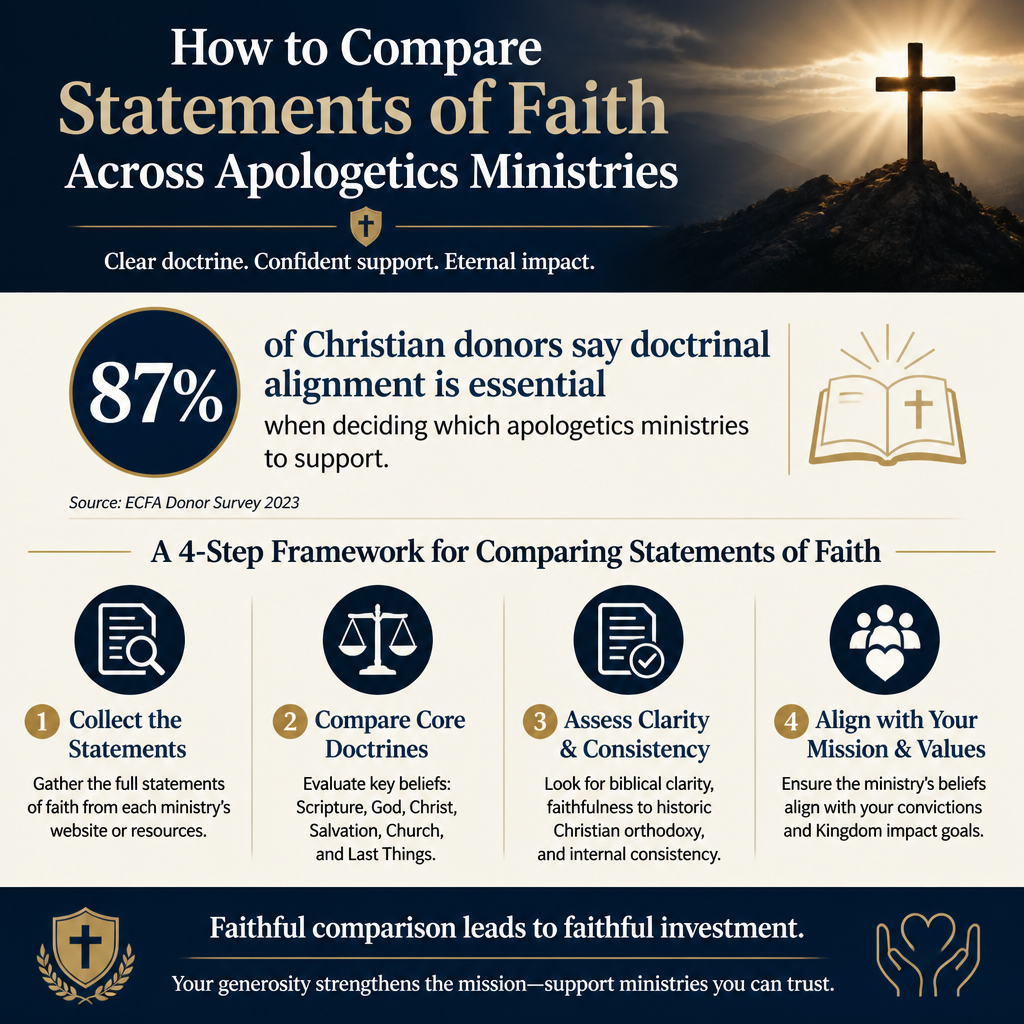
When donors compare statements of faith, the goal is not to find the most comprehensive document. The goal is to determine whether each ministry’s confession is clear, controlling, and consistent with its work. A disciplined review can be done in one sitting if the questions are concrete.
- Does the statement clearly confess the Trinity, the full deity and humanity of Christ, and the bodily resurrection?
- Does it define the authority of Scripture in a way that governs teaching and practice?
- Does it clearly articulate salvation by grace through faith, not by moral improvement or intellectual attainment?
- Who must affirm the statement, and what happens if a leader departs from it?
- Does the ministry’s published content and partnerships align with the stated boundaries?
Do not treat nonessential differences as a proxy for trustworthiness
Some donors unintentionally turn secondary distinctives into a blanket test of integrity. That approach can punish faithful ministries whose audience spans denominations, and it can reward ministries that are doctrinally detailed yet operationally unhealthy. A statement of faith is necessary for trust, but it is not sufficient. Financial integrity, board independence, conflict-of-interest discipline, and transparent reporting also bear directly on donor stewardship.
That is why our evaluations at Most Trusted use The Most Trusted Standard, a 15-criteria framework that examines faith commitments alongside governance, financial practices, and transparency. Many donor disappointments come not from overt heresy, but from avoidable leadership failure, opaque finances, or inflated claims of impact. A statement of faith cannot compensate for those defects.
FAQs for How to compare statements of faith across apologetics ministries
Should donors avoid apologetics ministries with short statements of faith?
Not automatically. Some ministries serve broad evangelical coalitions and keep statements concise to avoid unnecessary division. The more important test is whether the statement is clear on essential doctrines and whether it meaningfully binds leadership. If the statement is brief, donors should look for supporting documents that show how doctrine is applied: staff expectations, content standards, and governance policies.
How can donors verify that a ministry lives by its statement of faith?
Compare the statement to what the ministry actually publishes and funds: articles, videos, conference speakers, partnerships, and curriculum. If a ministry claims biblical authority but repeatedly platformes teaching that contradicts its own confession, that inconsistency matters. Donors should also examine governance and transparency practices through How to Give Wisely to Christian Apologetics Ministries, since enforceable doctrine typically correlates with accountable leadership and clear reporting.
A faithful comparison seeks both doctrinal integrity and institutional maturity
Comparing statements of faith across apologetics ministries is a way of honoring the seriousness of teaching in the church. Donors are not merely funding content; they are endorsing public witness. The ministries most worthy of support tend to confess the gospel plainly, apply that confession to method and partnerships, and build governance structures that keep the organization accountable when cultural pressure, platform incentives, or leadership transitions would otherwise weaken fidelity.



