
Why Christian apologetics ministries need monthly donors is not a fundraising slogan; it is a question about the kind of witness the church can sustain over time. Apologetics is often measured in books sold, debates won, or viral moments. But the actual work is slower: patient listening, careful scholarship, pastoral presence for doubting believers, and durable public credibility.
Monthly giving is not the only faithful way to support that work, and Christians genuinely disagree about how much formal apologetics should be emphasized compared to evangelism, discipleship, and works of mercy. Still, when apologetics is done responsibly, it serves the church by strengthening confidence in the gospel, removing unnecessary stumbling blocks, and helping believers love God with the mind as well as the heart.
Apologetics work is pastoral before it is public
Many donors encounter apologetics only at the surface
Public-facing apologetics is the visible tip of a larger pastoral reality. A university lecture, a podcast series on the resurrection, or a well-produced video on the reliability of Scripture can be genuinely useful. Yet many of the people helped by apologetics ministries are not spectators; they are quietly wavering church members, parents trying to answer a teenager’s questions, and pastors carrying a stack of complicated counseling situations where intellectual doubt and moral pain are tangled together.
The New Testament does not frame intellectual care as optional. Peter’s instruction to be prepared to give a reason for the hope within us is paired with a manner: “with gentleness and respect” (1 Peter 3:15). That combination—truthfulness and tenderness—requires more than content production. It requires people who can stay with hard questions without exploiting them.
Monthly support underwrites continuity of care
One-time gifts often fund events and launches. Monthly giving more often funds the unglamorous continuity: a trained staff member who can answer correspondence, a researcher who can check sources, a counselor-consultant who can help translate arguments into pastoral care, and an editor who can keep a ministry from trading credibility for clicks.
This continuity matters because doubt rarely resolves on a campaign timeline. If apologetics ministries exist partly to serve the local church, stability is not merely operational; it is moral. People who ask for help should not be treated as a seasonal audience.

Volatility distorts both message and methods
The temptation is not only financial, it is editorial
Revenue instability pressures ministries toward whatever draws attention quickly: outrage, tribal signaling, and simplified accounts of complex topics. The church has watched too many Christian communications ecosystems become performative, where the incentives reward heat over light. Apologetics, because it engages contested questions, can be especially vulnerable to this drift.
Monthly donors can help a ministry resist those incentives. A broad base of recurring support is not a guarantee of faithfulness, but it lowers the urgency that drives reactive content cycles. It can also give leadership the freedom to publish what is careful rather than what is instantly marketable.
The wider giving environment is already unstable
Most American households give in patterns shaped by economic uncertainty and fragmented attention. Even when Christians are eager to be generous, the predictability ministries once assumed is harder to find. For context on giving behavior, the National Philanthropic Trust reports that giving by individuals is the largest component of charitable giving in the United States in most years, which means ministries are directly exposed to household-level volatility (National Philanthropic Trust).
Apologetics ministries feel that exposure acutely because they often depend on media-driven reach, and reach itself is subject to platform changes. Monthly support, by contrast, is not governed by algorithms. It is governed by covenantal consistency: Christians choosing to bear a small portion of the work together.
Faithful apologetics requires long-horizon investment
Serious scholarship and careful communication take time
Some apologetics questions can be answered with a well-crafted explanation. Others require long-horizon investment: language study, historical research, careful engagement with philosophy of religion, and the patient work of reading across viewpoints. Responsible apologetics does not merely repeat talking points; it demonstrates intellectual honesty, accurate citation, and a willingness to distinguish between what Christians must confess and what Christians may debate.
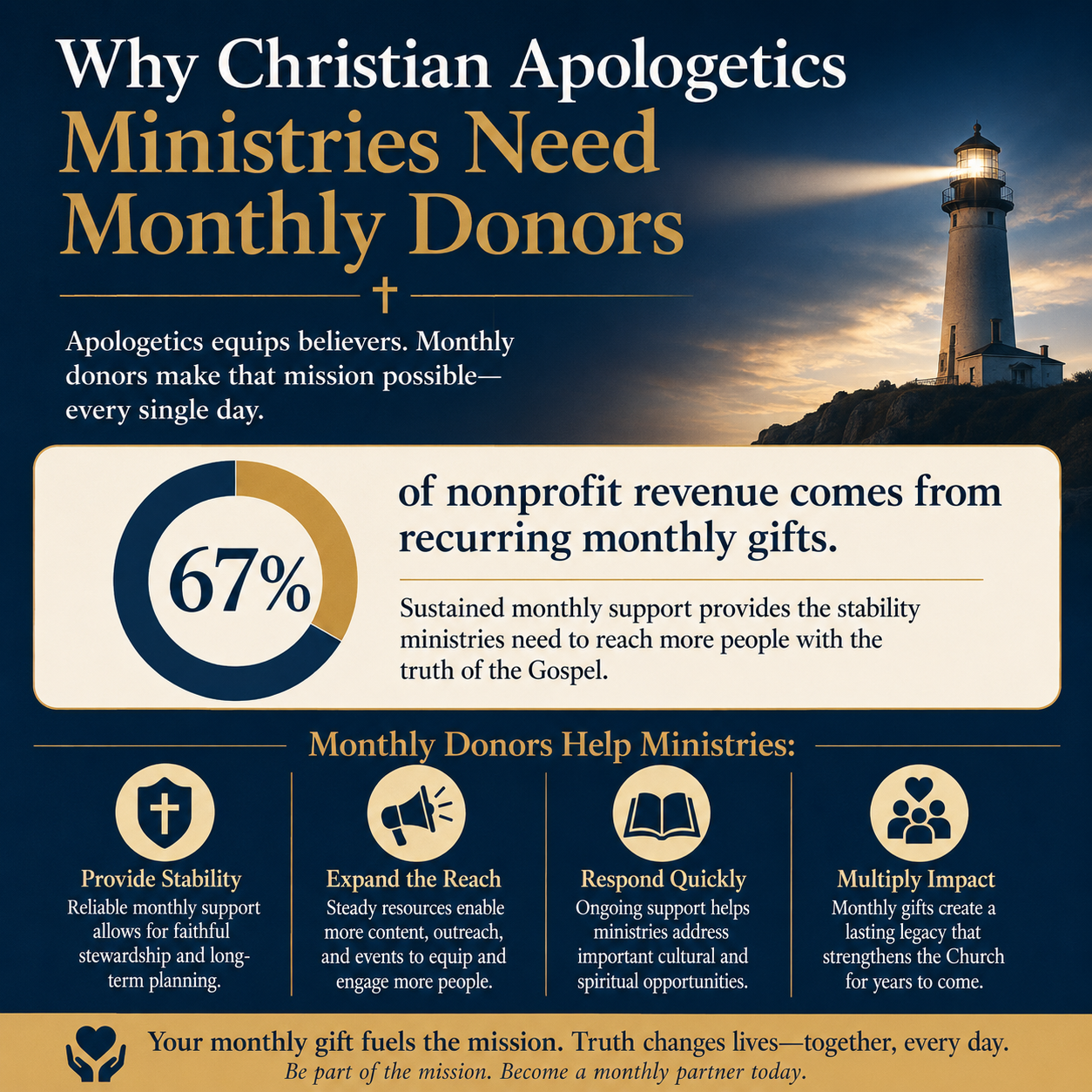
Monthly donors make that long-horizon investment more realistic. Recurring support is often what funds the hidden inputs: research time, peer review, editorial oversight, and the internal discipline to correct errors publicly when needed.
There is a moral dimension to intellectual credibility
Apologetics is not a contest to humiliate opponents. Scripture’s admonition against quarrelsome speech, paired with the call to truthfulness, makes the tone and conduct of apologetics a matter of discipleship. Many donors want to support ministries that defend the faith without abandoning the fruit of the Spirit in the process.
This is where verification becomes practical rather than abstract. Across our verification work at Most Trusted, we observe that ministries with consistent, values-aligned funding are more able to maintain disciplined governance, transparent reporting, and measured communications. The ministries that meet The Most Trusted Standard tend to show fewer signs of “crisis fundraising” and more signs of steady stewardship.
Monthly donors strengthen accountability and transparency
Recurring support can reduce unhealthy donor dynamics
Large, episodic gifts can be a blessing, but they can also concentrate influence. A ministry that relies heavily on a small number of major donors can be pressured—subtly or directly—toward the preferences of those donors. Monthly giving, when widely distributed, can protect a ministry’s integrity by broadening the base of accountability.
That accountability is not opposed to leadership. It is one expression of Christian stewardship: leaders serving with integrity, donors giving with discernment, and both refusing the transactional mentality that treats ministry as a product to be customized.
What prudent donors should expect
Monthly support should not be given on sentiment alone. Prudent donors can look for clear evidence that a ministry is governed well and communicates honestly about its impact and limits. What this means in practice is asking for documentation and patterns, not merely persuasive storytelling. A brief checklist is often sufficient:
- Clear doctrinal commitments and a public statement of faith that actually governs programming
- Accessible financial reporting, including audited statements when scale warrants it
- Independent board oversight and appropriate conflict-of-interest practices
- Transparent fundraising claims that do not exaggerate outcomes or vilify opponents
- Evidence of thoughtful pastoral posture, not merely adversarial rhetoric
Donors looking for how different ministries report governance and financial stewardship can also orient themselves within How Christian Apologetics Ministries Use Donations, where the central question is not merely efficiency, but faithfulness in how resources are stewarded.
Recurring giving aligns with formation, not just funding
Monthly generosity is a habit of discipleship
Christian giving is never only about keeping ministries open. It is also about shaping the giver. Jesus’ warnings about money and the heart remain among the most direct spiritual diagnostics in the Gospels. Regular generosity can function as a quiet, repeated act of trust—trust that God provides and that the church’s mission deserves material sacrifice.
That formation matters for apologetics donors in particular. Apologetics can unintentionally cultivate a posture of constant critique—always analyzing, always testing, always scoring arguments. Monthly giving can be a counter-practice: a decision not merely to evaluate ideas, but to sustain people doing careful work for the good of the church.
Monthly donors help apologetics serve the church rather than replace it
Apologetics ministries are healthiest when they see themselves as servants of the local church, not competitors with it. That posture is easier to maintain when financial pressures do not require constantly expanding an audience. Monthly donors can allow a ministry to build resources pastors can use, train leaders who can disciple doubters, and refer complex pastoral situations back to local shepherds rather than keeping them for brand loyalty.
Donors who want to compare approaches across the field can also consult Christian Apologetics Ministries, where the goal is to understand the range of missions and methods—and to give with eyes open rather than with momentary enthusiasm.
FAQs for Why Christian apologetics ministries need monthly donors
Is monthly giving better than a large one-time gift for apologetics ministries?
Not always. Large one-time gifts can fund translation projects, research initiatives, or technology investments that would be difficult to cover through operating revenue. Monthly giving is often better for funding the ongoing, less visible work: staff stability, pastoral correspondence, editorial oversight, and consistent training. Many ministries need both, but recurring support tends to reduce the volatility that can distort message and methods.
How can donors evaluate whether an apologetics ministry is trustworthy enough for monthly support?
Donors can look for public evidence of theological clarity, responsible governance, transparent financial reporting, and honest communication about outcomes and limitations. Because apologetics engages contested questions, donors should also watch for moral markers: gentleness, accuracy, fair representation of opponents, and a willingness to correct errors. At Most Trusted, we assess ministries against The Most Trusted Standard, a 15-criteria framework that examines faith foundation, financial integrity, governance and leadership, and transparency and effectiveness.
A durable witness requires durable support
Apologetics at its best is not a performance. It is a form of service to the church: helping believers endure seasons of doubt, equipping pastors for hard conversations, and commending the gospel with intellectual honesty and moral seriousness. Monthly donors make that service more stable, less reactive, and more accountable. For donors who want their generosity to strengthen both truth and love, recurring support is often one of the most strategic forms of stewardship available.



