
How to evaluate Christian apologetics ministries for doctrine is not an abstract exercise in theological preference. For Christian donors, it is a stewardship decision with ecclesial consequences, because apologetics does not merely defend the faith publicly; it also catechizes the church quietly through the arguments it normalizes and the authorities it treats as trustworthy.
Apologetics ministries often operate at the intersection of evangelism, teaching, and cultural engagement. That intersection creates genuine tensions: the desire to speak accessibly to skeptics can flatten doctrinal clarity; the desire to contend vigorously can drift into rhetorical excess; the desire to be broadly “mere Christian” can become doctrinal vagueness. Wise giving does not demand perfection, but it does demand clarity about what is being taught, what is being assumed, and what is being treated as negotiable.
Start with the ministry statement of faith and its functional boundaries
Doctrinal evaluation begins with what is affirmed and what is left undefined
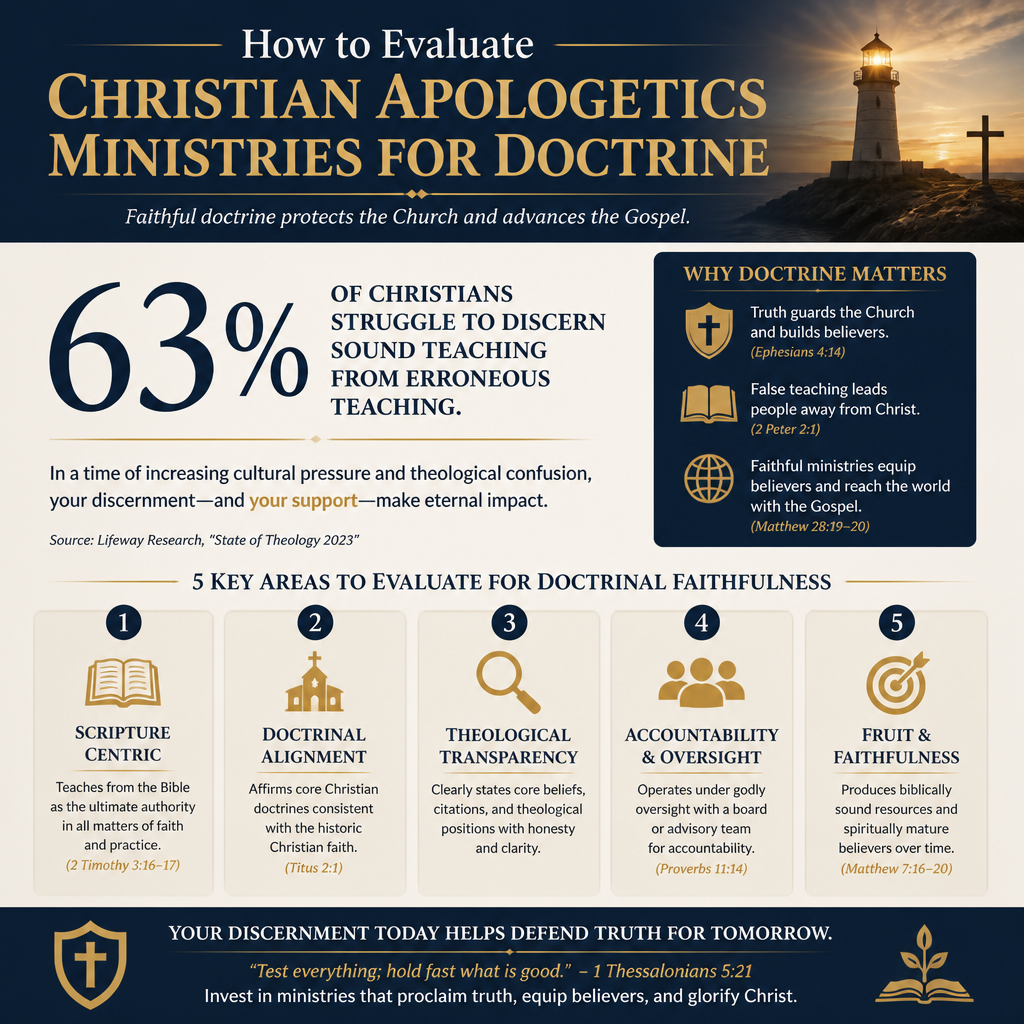
Many apologetics ministries publish a statement of faith that appears sound at first glance. The first test is whether it names the historic essentials with specificity: the Trinity, the full deity and humanity of Christ, the authority of Scripture, the reality of sin, the necessity of grace, the bodily resurrection, and the final judgment. A statement that only asserts “we believe the Bible” without specifying how the Bible is received and interpreted can mask serious divergence in practice.
The second test is the boundary question: what doctrines are treated as central versus peripheral? Christians genuinely disagree about baptism, spiritual gifts, and the timing of end-times events. Those differences can exist within orthodox Christianity. But when a ministry treats core Christian claims as optional for the sake of platform breadth, donors should pause.
Watch for “functional doctrine” in what is emphasized repeatedly
Doctrine is not only what a ministry affirms on paper; it is also what it teaches most often and most emphatically. If the public output consistently centers political identity, culture-war victory, or celebrity debate performance, the ministry may be forming donors and audiences into something adjacent to Christianity rather than into Christian maturity. Scripture does not separate truth from love or orthodoxy from holiness. Paul’s charge to “speak the truth in love” is a doctrinal instruction about how truth must be carried, not merely what is said (Ephesians 4:15).

Evaluate how Scripture functions in their apologetic method
Authority of Scripture should shape the argument, not serve as a closing slogan
Apologetics ministries understandably use philosophical reasoning, historical arguments, and scientific discussion. The question for donors is whether those tools operate under Scripture’s authority or whether Scripture is treated as a detachable add-on. A ministry may affirm biblical authority while consistently arguing as though Scripture is merely one authority among others. Over time, that posture forms audiences to treat the Bible as optional in the intellectual life of faith.
We recommend examining a representative sample of teaching, not only best-of clips: a series on the reliability of the Gospels, a lecture on ethics, a response to suffering, and a treatment of sexuality. In each, ask whether Scripture is handled with care: context, genre, canonical coherence, and humility before the text rather than proof-texting.
Be candid about contested questions without surrendering doctrinal clarity
Some questions that apologetics ministries address are genuinely contested among faithful Christians: creation timelines, certain questions of providence and freedom, the relationship between natural theology and special revelation. A responsible ministry will name the disagreement, represent opposing views fairly, and still speak clearly about what cannot be surrendered. The goal is not to win every intellectual dispute but to help seekers and believers submit their thinking to Christ.
Donors who want a broader view of the field can compare doctrinal posture across different organizations within Christian Apologetics Ministries rather than relying on a single brand’s self-description.
Assess Christology and the gospel with particular rigor
Apologetics can defend “theism” while obscuring the gospel
A recurring risk in apologetics is substituting generic theism for the Christian gospel. A ministry may build strong arguments for a Creator, objective morality, or the historicity of certain events, yet speak thinly about sin, repentance, substitutionary atonement, and the necessity of faith in Christ. Christian apologetics is not completed when someone believes “God exists.” The New Testament proclamation is Christ crucified and raised, calling sinners to repentance and reconciliation with God.
For donors, the diagnostic question is simple: when the ministry presents Christianity as true, does it also present the gospel as good news for sinners? If content consistently culminates in intellectual assent without the call to trust Christ, the ministry may be shaping hearers into admirers of Christianity rather than disciples of Jesus.
Test whether Christ is central in both content and tone
Christological clarity is not merely doctrinal precision about the hypostatic union; it is also whether Christ is treated as Lord rather than as an argument to be defended. An apologetics ministry can be orthodox on paper while exhibiting a tone of contempt toward opponents, constant suspicion toward the church, or an appetite for public humiliation. Those patterns are not small matters of personality. They are spiritual signals about what the ministry believes power is for.
James warns that teachers will be judged with greater strictness (James 3:1). Donors should treat that warning seriously when funding those who teach publicly at scale.
Look for accountable theological oversight and ecclesial connectedness
Independent platforms need real accountability, not symbolic advisers
Many apologetics leaders are gifted communicators with large reach. Reach can outpace accountability. A doctrinally reliable apologetics ministry typically has at least one of the following: formal church oversight, a governing board with theological competence, or a transparent relationship to a confession or denomination that meaningfully constrains teaching.
Advisory boards can be helpful, but donors should ask whether advisers have actual authority or merely lend credibility. If controversies arise, who has the power to correct, suspend, or remove a teacher? What public process governs doctrinal correction? Mature ministries do not treat accountability as a threat to independence; they treat it as a guardrail for faithfulness.
Pay attention to how they speak about the local church
Apologetics ministries exist to serve the church, not replace it. A steady posture of cynicism toward pastors, sacraments, and ordinary congregational life often signals that the ministry sees itself as the true guardian of doctrine rather than as a servant of Christ’s body. By contrast, ministries that honor local churches, encourage membership, and equip pastors tend to have healthier doctrinal instincts because their teaching remains tethered to real shepherding and real people.
In practice, donors can use a short set of questions to test whether oversight is substantive:
- Who is authorized to declare that the ministry has taught error, and what happens next?
- Is there a published statement of faith with meaningful specificity?
- Do leaders belong to and submit to a local church?
- Are theological disputes handled with transparent documentation and charitable argumentation?
- Does the board include members competent to evaluate doctrine, not only finance and marketing?
Integrate doctrinal assessment with verifiable integrity markers
Doctrine and integrity are not competing priorities in Christian giving
Some donors treat doctrinal evaluation as separate from financial and governance assessment. Scripture does not permit that separation. Teaching ministry is a moral activity; moral credibility and financial integrity are part of the witness. An apologetics ministry can teach orthodox doctrine and still disqualify itself through opaque finances, conflicts of interest, or manipulative fundraising.
We also recommend resisting simplistic heuristics such as judging faithfulness by low administrative spending alone. The nonprofit sector has had to correct that misconception explicitly. Charity Navigator, Candid, and the BBB Wise Giving Alliance jointly warned donors against using overhead ratios as a proxy for impact or integrity in their “Overhead Myth” letter (Charity Navigator). The question is not whether a ministry has overhead, but whether spending is honest, explained, and aligned with mission.
How Most Trusted applies The Most Trusted Standard to apologetics ministries
At Most Trusted, our verification work evaluates ministries against The Most Trusted Standard, a 15-criteria framework that includes theology alongside financial integrity, governance, and transparency. What this means in practice is that doctrinal claims are weighed with observable evidence: the published statement of faith, the ministry’s most representative teaching, the accountability structures that constrain leaders, and the transparency that allows donors to verify what they are supporting.
Ministries that meet The Most Trusted Standard tend to be clear about their theological commitments, careful in how they handle Scripture, and willing to submit public teaching to correction. They also tend to publish accessible financial reporting and governance information because they understand that trust is earned through light, not demanded through reputation.
For donors making decisions across a category, How to Give Wisely to Christian Apologetics Ministries is a helpful frame for weighing doctrine alongside the other responsibilities of Christian stewardship.
FAQs for How to evaluate Christian apologetics ministries for doctrine
Is a broad mere Christianity approach a doctrinal problem?
Not necessarily. A mere Christianity posture can be responsible when it clearly defines the historic essentials and refuses to blur them for the sake of audience size. The concern arises when “mere Christianity” becomes a way to avoid doctrinal accountability, minimize disputed issues without naming them, or treat core Christian claims as optional. Donors should look for explicit boundaries, not only inclusive language.
How can donors evaluate doctrine without having formal theological training?
Donors can start with concrete, verifiable signals: a specific statement of faith, consistent Christ-centered gospel proclamation, careful use of Scripture in context, and real accountability to church and board oversight. It is also reasonable to consult trusted pastors or elders when a ministry teaches on contested issues. Doctrinal evaluation is not reserved for specialists; it is part of ordinary Christian stewardship, guided by the church and grounded in Scripture.
A responsible donor posture toward apologetics ministries
Christian apologetics can serve the church with real power when it strengthens confidence in the truth and draws seekers toward Christ. Donors honor that calling best by supporting ministries whose doctrine is clear, whose handling of Scripture is careful, and whose leaders submit to accountable oversight. The goal is not to fund the loudest defender of Christianity, but to fund faithful witnesses whose truthfulness is evident in teaching, governance, and transparent stewardship.



