
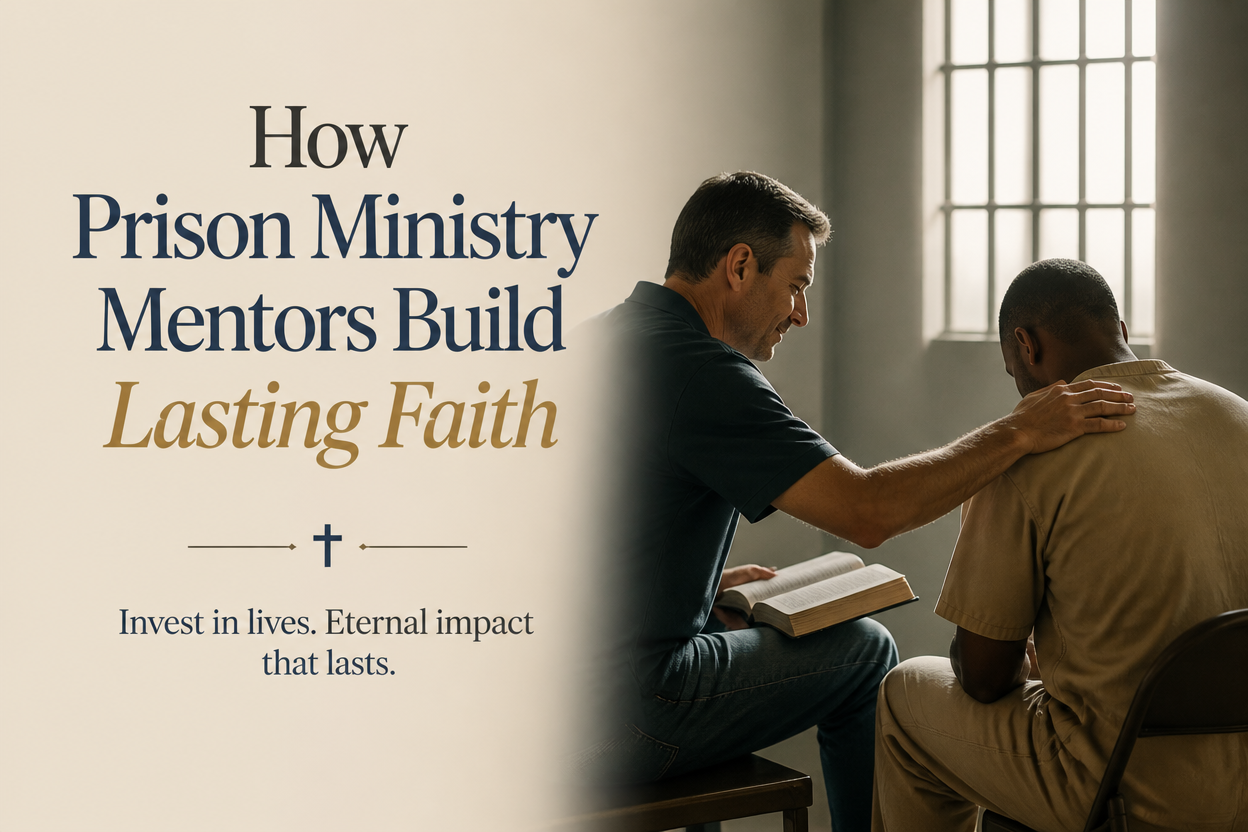
How prison ministry mentors build lasting faith is not primarily a question of charisma, curriculum, or a memorable testimony. It is a question of discipleship under pressure: whether the gospel is embodied consistently enough, long enough, and wisely enough to take root in a setting where trust has been violated, authority is suspect, and consequences are immediate.
For Christian donors, this is not an abstract concern. Many prison ministries can report decisions, attendance, or program completions. Fewer can demonstrate the slow formation of perseverance, repentance, reconciliation, and durable belonging in a local church. Scripture does not let us reduce prison visitation to inspiration. Jesus placed “in prison and you visited me” among the marks of fidelity in Matthew 25, alongside feeding, clothing, and welcoming (Matthew 25:36). That same passage presses donors toward a second question: what kind of ministry presence in prison actually strengthens faith over time, rather than briefly intensifying emotion.
Mentoring works when it is covenantal rather than transactional
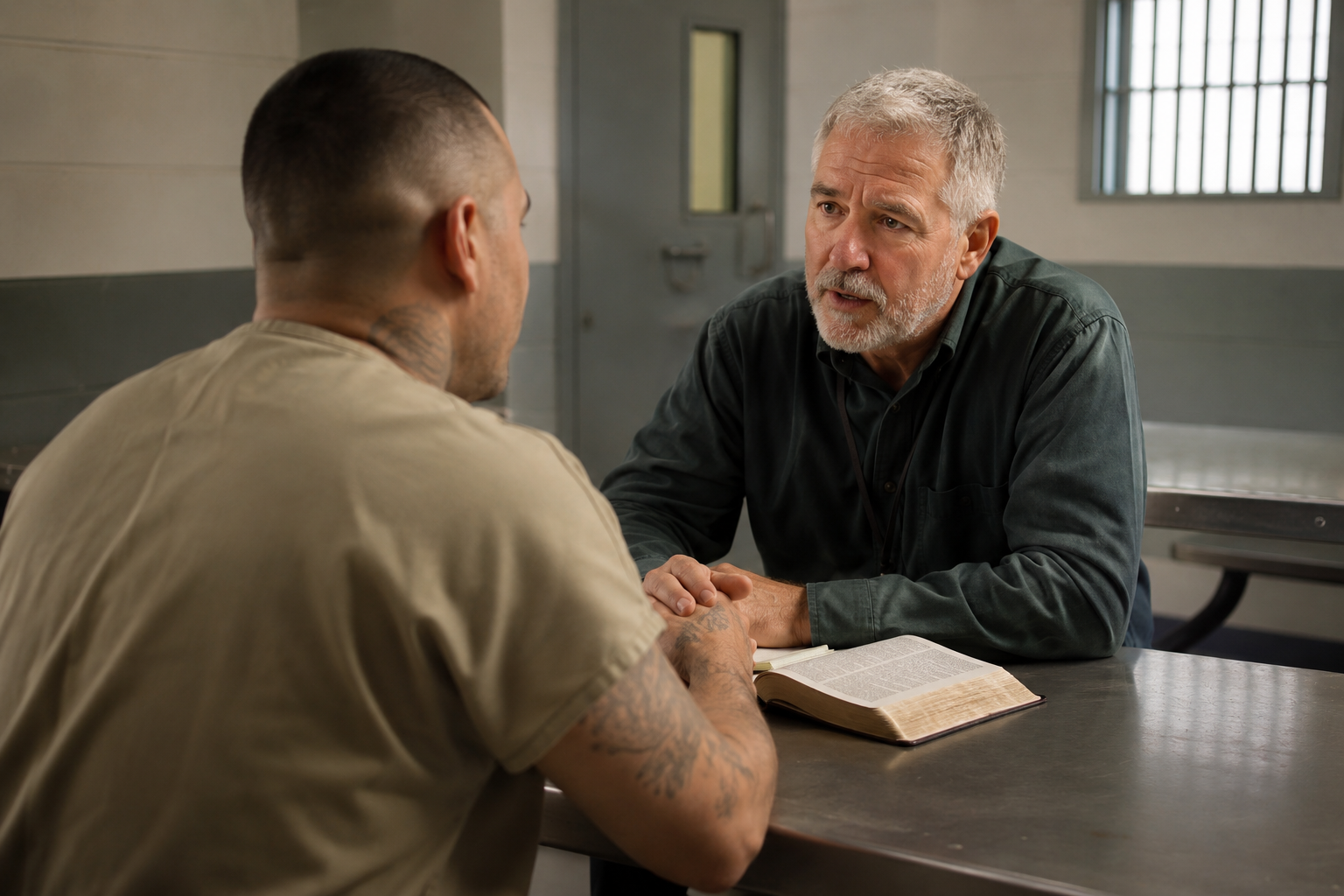
Mentoring in prison easily becomes a transaction: a weekly visit, a Bible study, a class completion, a certificate. Those are not meaningless. But discipleship in Scripture is relational fidelity that bears weight. Paul’s ministry language is familial—“we were gentle among you, like a nursing mother” and “like a father with his children” (1 Thessalonians 2:7–12). Prison mentoring that builds lasting faith tends to echo that pattern: steady presence, moral seriousness, and affection disciplined by truth.
Consistency is spiritual formation in a setting shaped by inconsistency
Incarcerated men and women often carry long histories of broken promises—by parents, partners, institutions, and themselves. In that context, a mentor’s non-dramatic faithfulness is not merely a relational preference; it is a theological witness. When a volunteer shows up week after week, communicates clearly, and refuses manipulation without withdrawing care, the mentee encounters a lived parable of steadfast love.
In practice, this means ministries must design mentoring with continuity in mind: backup plans for schedule disruptions, supervision for boundary violations, and clear expectations on both sides. Prison environments impose constraints—transfers, lockdowns, restricted movement—that can undo the best intentions. Effective programs anticipate those disruptions rather than romanticize mentoring as a pure relationship untouched by institutional realities.
Mentors must be formed before they can form others
Some ministries treat volunteer recruitment as the hard part and volunteer training as a formality. The field has learned that this is risky. Mentors can unintentionally reinforce shame, fuel savior dynamics, or confuse trauma responses for spiritual resistance. Mature ministries invest in theological formation and in basic competencies: listening, confidentiality, boundaries, and an understanding of addiction and trauma.
Across our verification work at Most Trusted, the ministries that meet The Most Trusted Standard tend to treat mentoring as an accountable ministry role, not a personal project. They document training expectations, provide supervision, and define what mentors can and cannot promise. This is not bureaucracy for its own sake; it is pastoral care with guardrails.
Lasting faith requires a moral framework that can survive the prison economy
Prison is not a neutral environment in which a generic spiritual message simply needs to be delivered. It is a tightly structured social ecosystem—status, protection, exchange, debt, and intimidation. Within that ecosystem, “faith” can be used instrumentally: as a cover story, a way to access safer spaces, or a means of gaining social capital. Mentoring that builds lasting faith must patiently distinguish between religious utility and genuine conversion.
Discipleship must address power, not only personal comfort
Scripture presents sin not only as private failure but as disordered love and misused power. Prison culture amplifies these realities. A mentor’s task is not to moralize from a distance, but to help the mentee interpret daily pressures through a biblical lens: truth-telling when deception pays, self-control when anger is rewarded, and humility when pride protects.
Christian donors sometimes expect measurable “behavior change” as the clearest evidence of spiritual health. Behavior matters, but mentors know the hidden battlegrounds: choices around contraband, gang affiliation, sexual exploitation, and retaliatory violence. The ministries that do this work well are explicit about the cost of obedience and do not confuse compliance with sanctification.
Scripture must be taught as a coherent story, not as slogans
Prison Bible teaching can drift toward proof-texting: a verse for anxiety, a verse for temptation, a verse for hope. Those can be helpful, but lasting faith is usually built by learning the storyline of redemption—creation, fall, covenant, Christ, church, new creation—and locating one’s life within it. Mentors reinforce this by returning repeatedly to repentance and faith as ongoing realities, not a single event.
Donors can support this kind of depth by funding programs that prioritize trained teachers, durable materials, and thoughtful curriculum rather than only large events. Within Prison and Post-Prison Ministries, the strongest mentoring models treat theological depth as a protective factor against both despair and spiritual manipulation.
Mentoring becomes durable when it is embedded in accountable relationships
Christian mentoring can become dangerously informal. The prison context raises the stakes: contraband risk, coercion, financial exploitation, and inappropriate emotional dependency are not theoretical. Accountability is not an administrative afterthought; it is a form of love for the mentee, the mentor, and the institution hosting the ministry.
Boundaries protect the gospel from being confused with access
In prison, access is currency. A volunteer has access to information, outside connections, sometimes resources, and always attention. Without clear boundaries, a mentee may test whether the mentor’s care can be bought, pressured, or shamed into favors. Wise ministries train mentors to say no without contempt and to interpret boundary testing not simply as defiance but as a diagnostic moment: will this relationship collapse like others have, or can truth and care coexist?
From a donor standpoint, governance matters here. Ministries should have policies for communication, gift-giving, financial assistance, and reporting concerns. The need is obvious, but donors still encounter organizations operating on vague norms and personal judgment. That is a red flag, not because we distrust every volunteer, but because Scripture assumes the necessity of structures that restrain harm (Romans 13:1–4).
Supervision and documentation are spiritual disciplines in this domain
Some donors hesitate when they hear about recordkeeping, mentor notes, or formal supervision. It can sound like corporate intrusion. In prison ministry, it is often the opposite: it is how ministries remember what they promised, notice patterns of manipulation or crisis, and ensure the mentee is not being abandoned when a volunteer burns out.
When ministries align with The Most Trusted Standard, we typically see clear lines of oversight: volunteer coordinators who check in, incident reporting procedures, and board-level awareness of risk. In this category of work, credibility is not established by passion. It is established by sober competence.
Faith endures when mentoring bridges the prison church and the local church
Prison-based discipleship is necessary, but it is not the whole aim. The New Testament assumes believers are gathered into accountable communities with elders, ordinances, and mutual burdens (Acts 2:42–47). A mentor can help someone learn Scripture and prayer, but cannot replace the church’s long-term work of belonging, correction, and vocation.
Reentry is a spiritual crisis as much as a logistical one
Many ministries acknowledge that housing and employment matter. They do. But the harder question is what happens to spiritual identity when the external structure of prison is removed. Temptations change shape; old relationships reappear; shame intensifies; and the sheer complexity of daily decision-making can overwhelm fragile resolve.
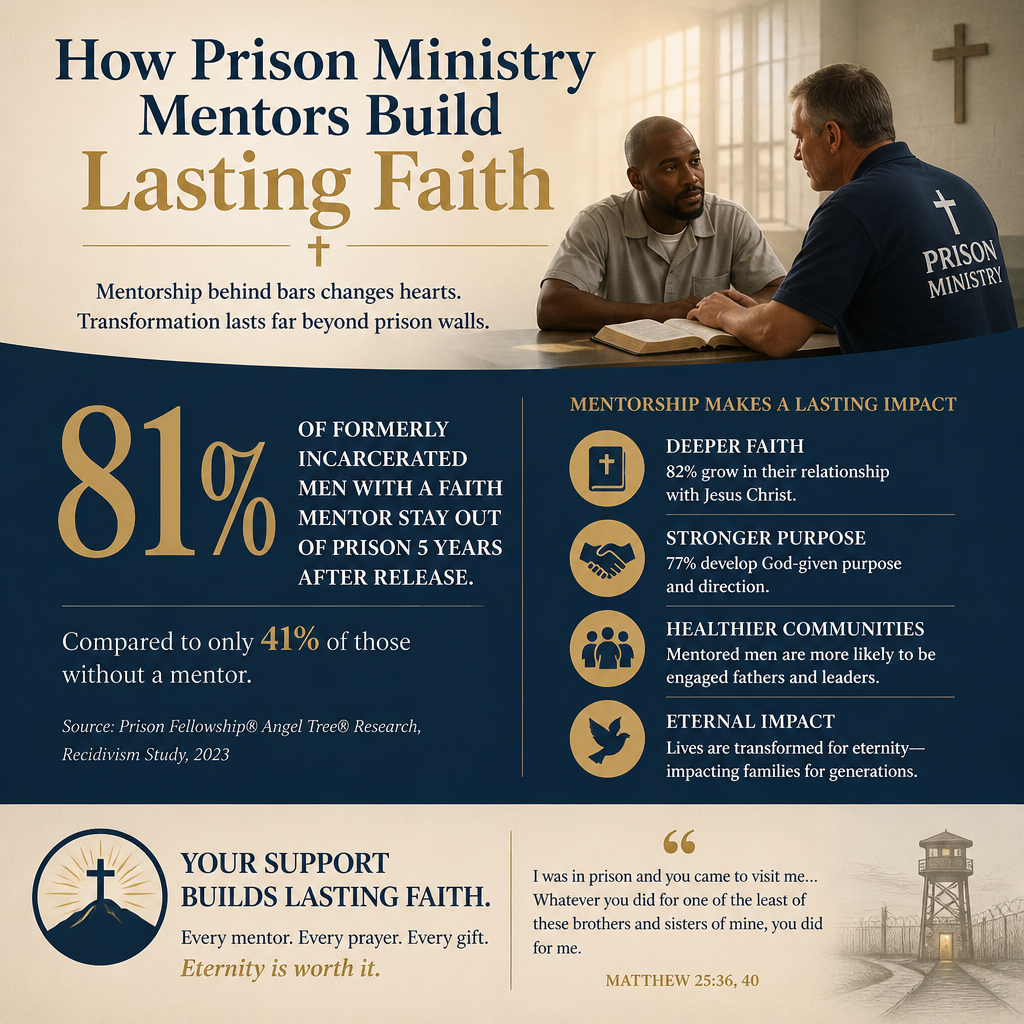
Nationally, recidivism patterns underscore why reentry support is not optional. The Bureau of Justice Statistics reported that among people released from state prisons in 2005 across 30 states, about 68% were arrested within three years and about 77% within five years of release (Bureau of Justice Statistics). Arrest is not the same as conviction, and recidivism statistics have methodological limits. Still, the scale of churn is a warning to donors: if mentoring ends at the gate, discipleship is being asked to survive in isolation.
Bridge-building requires partnerships and shared expectations
Connecting returning citizens to churches is more difficult than simply providing a list. Churches have legitimate safety concerns. Returning citizens have legitimate fears of stigma and surveillance. Christians genuinely disagree about how to balance risk, mercy, and prudence, especially when offenses involve sexual violence or harm to minors. The best ministries do not deny those tensions. They build relationships with churches that are willing to prepare, set clear participation expectations, and provide pastoral oversight rather than leaving the mentor as the sole relational anchor.
Within Faith-Based Prison Outreach and Evangelism, donors should look for ministries that can describe their church-connection process with specificity: who makes introductions, how they address background disclosures, what accountability looks like, and how they support churches when challenges arise.
What donors should fund when they want lasting faith, not temporary intensity
Donors are often pressured to fund what is visible: events, materials, and headcounts. Those have a place, but mentoring that builds lasting faith is usually funded through less dramatic line items: training, staff oversight, evaluation, and partnerships. This is where disciplined generosity becomes discerning stewardship.
Indicators that a mentoring model is spiritually serious and operationally credible
- Mentor screening, training, and ongoing supervision are documented, not implied.
- Clear boundary policies exist for gifts, money, communication, and crisis response.
- Curriculum is theologically coherent and connected to a doctrine of repentance and sanctification.
- Reentry planning is integrated, with defined partnerships for housing, employment, and church connection.
- Outcomes are framed with honesty: fruit is pursued, but manipulation of numbers is resisted.
How verification helps donors avoid predictable failures
Prison ministry attracts sincere believers, and it also attracts the vulnerabilities of any mission field: overpromising, under-accountability, charismatic leadership without governance, and programs that depend on a few heroic individuals. Donors who have seen ministries collapse understand that spiritual language can mask operational fragility.
Most Trusted exists to help donors give with confidence by evaluating Christian nonprofits against The Most Trusted Standard, a 15-criteria framework spanning faith foundation, financial integrity, governance and leadership, and transparency and effectiveness. In prison mentoring, these criteria are not abstract. They show up in volunteer risk management, board oversight of high-stakes programs, truthful communications about outcomes, and financial practices that protect restricted gifts and partner expectations.
Even where research is mixed on the causal impact of specific faith programs on recidivism, donors can still ask verifiable questions about ministry quality. The point is not to demand certainty where human hearts and complex systems are involved. The point is to fund ministries that are faithful, competent, and honest about what they can and cannot control.
FAQs for How prison ministry mentors build lasting faith
Do prison ministry mentors reduce recidivism?
Some programs report lower recidivism among participants, but causality is difficult to establish because participation is often voluntary and participants may differ in motivation and support. What donors can assess more reliably is whether a ministry’s mentoring model is accountable, sustained through reentry, and integrated with local churches. Recidivism rates themselves vary by jurisdiction, definitions, and time horizons; nationally, the scale of rearrest after release is substantial, as shown in Bureau of Justice Statistics reporting (Bureau of Justice Statistics).
What should donors ask a prison mentoring ministry before funding it?
Donors should ask how mentors are screened and trained, what boundaries govern communication and financial assistance, who supervises mentors, and how the ministry handles incidents. It is also prudent to ask how discipleship connects to a local church after release, and how the ministry reports outcomes without inflating claims. These are the questions that distinguish heartfelt intention from a model capable of sustaining faith under real-world pressure.
Why mentoring is one of the most strategic forms of prison ministry giving
Prison ministry mentors build lasting faith when they embody covenantal presence, teach Scripture as a coherent gospel, and operate within accountable structures that protect the vulnerable. Donors who fund this work are not merely underwriting programs; they are strengthening a chain of discipleship that can carry a believer from confinement to community without collapsing at the point of greatest pressure.



