
How prison outreach shares the Gospel within facility protocols is not a public-relations exercise. It is the practical question that decides whether Christian witness inside a jail or prison is faithful, lawful, and durable—whether it serves the spiritual good of incarcerated men and women without endangering them, the staff, or the ministry’s future presence.
For Christian donors, this question belongs to stewardship. A gift can fund sincere evangelism that is quietly effective for decades, or it can subsidize well-meaning improvisation that triggers suspension, damages relationships with wardens, or exposes volunteers to avoidable risk. The ministries most worthy of support do not treat policies as obstacles to overcome; they treat them as part of their neighbor-love and a boundary that clarifies how the Gospel is offered rather than coerced.
Facility protocols are not spiritual opposition but moral constraints
Security is part of the environment of witness
Correctional facilities exist to maintain safety, order, and lawful custody. That means every movement, conversation, and item entering a facility sits inside a security system that can be disrupted by small failures: contraband, informal “favor networks,” unvetted communications, or volunteer overreach. Christian prison outreach that ignores this environment does not become more prophetic; it becomes less trustworthy.
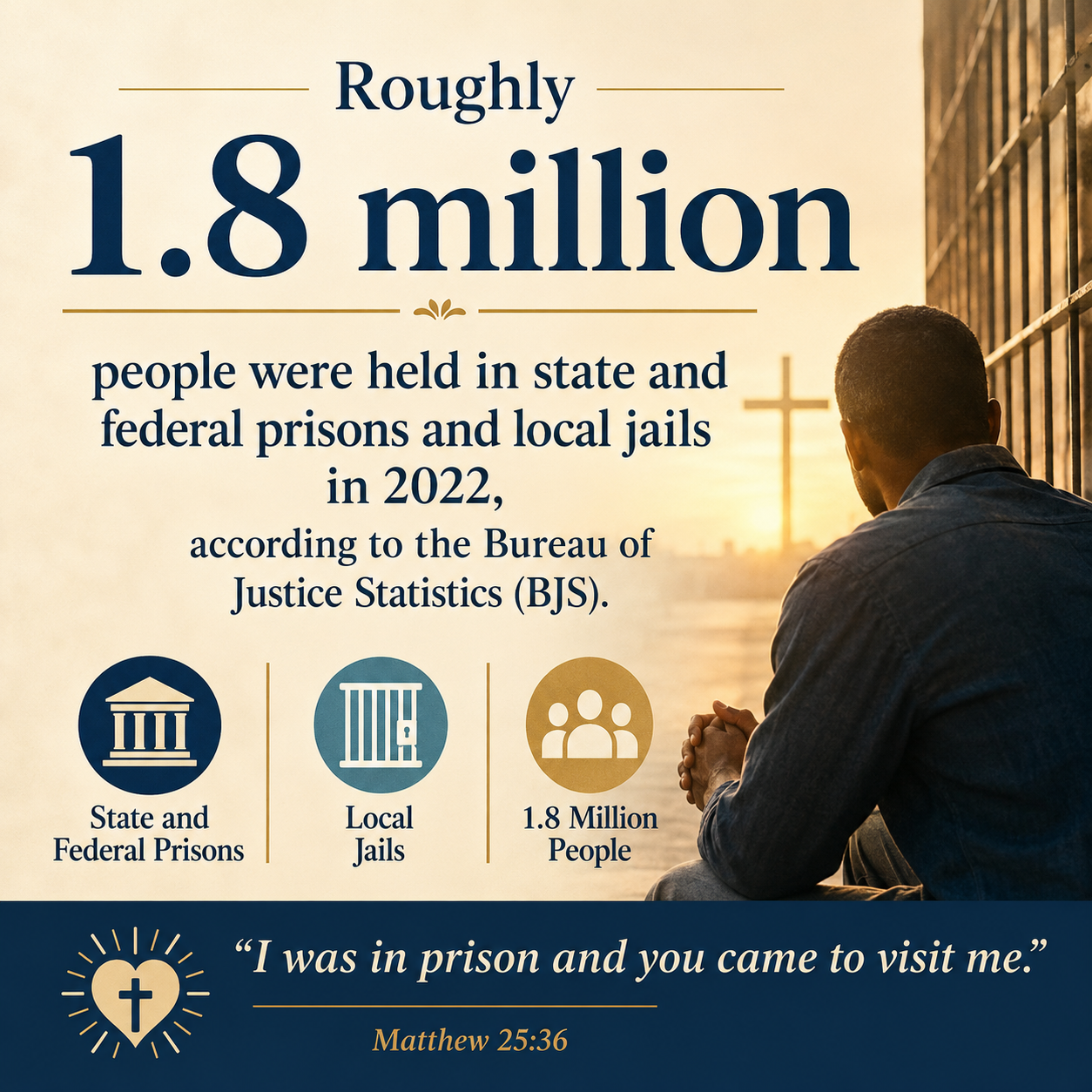
The scale of incarceration underscores why systems matter. Roughly 1.8 million people were held in state and federal prisons and local jails in 2022, according to the Bureau of Justice Statistics (BJS). A ministry may serve only a handful of units in one region, yet it operates inside a national enterprise where policy compliance is inseparable from access.
Protocols protect the incarcerated from religious coercion
Christians genuinely disagree about how to speak about conversion, repentance, and assurance in coercive environments. The tension is real: incarceration limits freedom, and that can complicate how any invitation is perceived. Facility protocols—sign-in rules, supervision requirements, restrictions on one-on-one contact, limits on gifts and favors—can function as guardrails that help ensure the Gospel is offered as good news, not as a pathway to privileges.
When prison ministries accept these constraints, they are not watering down evangelism. They are honoring the biblical insistence that shepherds must not exploit the vulnerable, and that Christian leaders must be “above reproach” in public credibility. A ministry that will not be transparent and disciplined about boundaries is rarely strong in the long obedience required for spiritual formation.

How the Gospel is shared under policy: the lawful channels of ministry
Approved programs, not informal access
In most facilities, access flows through approved programming: chaplaincy coordination, volunteer clearance, scheduled services, and defined curricula. The ministries that endure are patient with that pace. They submit volunteer rosters early, complete background checks, attend orientations, and accept that a lockdown can cancel an event with no explanation. This is not merely administrative. It is the cost of loving people in an environment where disorder can harm everyone.
Many facilities also maintain policies that regulate religious practice as part of institutional order and equal treatment. Federal guidance has been shaped by the Religious Land Use and Institutionalized Persons Act, administered in part through the U.S. Department of Justice (DOJ). For donors, this matters because mature prison outreach aligns with these frameworks rather than improvising around them.
Scripture, testimony, and invitation without manipulation
Facility protocols often restrict materials, limit physical contact, and require visible supervision. Effective ministries learn to communicate the heart of the Gospel within those limits: Scripture read aloud, faithful exposition, clear testimony, and an invitation to repent and believe that does not presume external pressure. In practice, that can mean structured Bible studies, chaplain-approved worship gatherings, and mentoring models that prioritize consistency over intensity.
What this means in practice is that the strongest evangelistic work inside facilities is often not the loudest. It is orderly, repeatable, and integrated with the institution’s schedule. It allows people to say “yes” to Christ without implying that access to the ministry—or to any benefit—depends on that “yes.”
Where protocols press hardest: books, mail, money, and relationships
Material support is morally complicated inside prisons
Donors naturally want to meet tangible needs: Bibles, study guides, hygiene items, postage, or support for families. Inside facilities, however, “help” can become currency. A book shipment can violate property rules. A gift can create debt or coercion. Direct financial assistance can unintentionally sponsor manipulation or conflict within a housing unit.
Protocols around property and mail often look strict because they are designed to reduce contraband and trading economies. The wisest ministries treat these rules as a theological issue: love does not create dependency or risk. They coordinate closely with chaplains, use approved vendors when required, and keep meticulous records so that support remains transparent and fair.
One-on-one contact requires exceptional restraint
Some of the deepest spiritual conversations happen in personal settings. Yet one-on-one access is where boundary failures become most destructive. Facilities frequently restrict private meetings, regulate communication after release, and prohibit volunteers from taking on roles that resemble counseling or legal advocacy unless properly credentialed.
A mature ministry will name the temptation plainly: volunteers can confuse compassion with rescue, and incarcerated people can feel pressured to perform spiritual interest to maintain a relationship. Guardrails—supervised meeting spaces, explicit communication policies, and regular volunteer debriefing—protect both parties.
- Written communication policies for mail, email, and phone contact
- Clear rules against handling money, commissary, or personal favors
- Approved curricula and limitations on outside materials
- Two-adult or supervised-space standards for sensitive conversations
- Escalation procedures when disclosures involve self-harm or threats
What donors should look for: verification signals of faithful and disciplined prison outreach
Doctrinal clarity with pastoral humility
Prison outreach is explicitly Christian, and donors should expect doctrinal clarity: the incarnation, the cross, the resurrection, repentance and faith, and the authority of Scripture. Yet donors should also look for pastoral humility about the complexities of trauma, addiction, and institutional life. Clear doctrine and careful practice belong together; neither is a substitute for the other.
Across our verification work at Most Trusted, we observe that ministries most aligned with The Most Trusted Standard tend to document their theology of ministry and their operational boundaries in the same place: volunteer handbooks, training modules, and program agreements with facilities. That integration is a meaningful indicator that leaders understand both the Gospel and the environment where it is proclaimed.
Governance, transparency, and measurable faithfulness
Donors often ask for “results,” and the harder question is what counts as a result in prison ministry. Counting attendance is easy; measuring repentance and perseverance is not. The answer is not to abandon evaluation, but to insist on honest categories: participation in programs, completion rates for discipleship courses, volunteer retention, follow-up pathways after release, and credible safeguards that reduce harm.
Strong ministries also disclose the basics donors need: audited or reviewed financials when feasible, clear allocation of restricted gifts, conflict-of-interest policies, and a board that is more than a signature line. Those signals are not bureaucratic niceties. They are part of loving truth, protecting the vulnerable, and keeping the ministry above reproach.
For donors comparing organizations within Faith-Based Prison Outreach and Evangelism, we recommend asking to see: the facility MOU or program approval letter, volunteer screening steps, incident reporting procedures, and a description of how the ministry coordinates with the chaplain’s office. When an organization cannot describe these plainly, it may not be ready for scale—or for the kinds of gifts that expand risk.
After release: continuity without boundary collapse
Reentry partnerships extend the Gospel through the local church
Many prison ministries now treat “inside” work and “after” work as a single discipleship continuum. That is often wise, because reentry is when temptation, isolation, and logistical barriers can overwhelm a new believer. Yet continuity can also collapse boundaries if a ministry becomes the only relational anchor and unintentionally replaces the local church.
The healthier pattern is partnership: coordination with churches, vetted reentry homes, employment networks, and peer mentors who understand both discipleship and accountability. Donors should listen for language that honors the church’s long-term role rather than building a parallel ecclesial structure around charismatic volunteers.
Privacy, safety, and power dynamics remain active concerns
Reentry also raises questions of privacy and safety. Public testimony can inspire donors, but it can expose a person to stigma, jeopardize employment, or compromise family relationships. Ministries that are careful about storytelling—obtaining informed consent, limiting identifying details, and avoiding emotional manipulation—demonstrate maturity.
These issues are not secondary to evangelism. They are part of how Christian love refuses to use people as means to an end, even for a good end. Donors can reinforce this by funding infrastructure: trained case management, secure data practices, and partnerships that reduce the pressure to publicize sensitive stories.
For donors seeking broader context within Prison and Post-Prison Ministries, it is worth remembering that prison outreach is not only about access; it is about faithful presence over time. Facility protocols are one of the primary tools that make that presence possible.
FAQs for How prison outreach shares the Gospel within facility protocols
Does following facility rules compromise evangelism?
No. Compliance can clarify evangelism by removing coercive dynamics and ensuring the ministry’s access remains stable. The Gospel does not require special privileges; it requires truthful proclamation, patient discipleship, and conduct that commends the message.
What are the clearest red flags for donors evaluating prison outreach?
Common red flags include informal access that bypasses chaplains or volunteer clearance, unclear policies about money and gifts, vague training expectations, and storytelling that treats incarcerated people as marketing material. Donors should also be cautious when a ministry cannot describe how it reports incidents, handles allegations, or maintains boundaries in volunteer-inmate relationships.
Faithful witness inside real constraints
Prison outreach is one of the explicit works of mercy Jesus named, and it carries its own moral risks because it takes place in a constrained and unequal environment. The ministries most worthy of donor trust do not treat facility protocols as an enemy of the Gospel. They treat them as a discipline that protects the vulnerable, honors lawful authority, and preserves long-term access so that the Word can be spoken, heard, and obeyed over years rather than moments.



