
How pregnancy resource centers work with healthcare providers is not a peripheral operational detail; it is one of the clearest indicators of whether a center is pursuing competent care for women and families or functioning in isolation. For Christian donors, this question sits at the intersection of mercy and truth: we are called to protect life, and we are also bound by the obligation to love our neighbors with the kind of care that withstands scrutiny.
Pregnancy resource centers do not replace the medical system. The strongest centers build structured relationships with physicians, clinics, hospitals, and mental health professionals so that clients receive appropriate medical evaluation, continuity of care, and credible counseling—especially in high-stakes moments like suspected ectopic pregnancy, miscarriage, sexual assault, or complex prenatal diagnoses. In our verification work at Most Trusted, the pattern is consistent: ministries that can demonstrate clear referral pathways, documented protocols, and accountable leadership tend to serve clients with greater safety and integrity.
Why healthcare partnerships are a stewardship issue
Christian compassion requires competence
Scripture presents mercy as concrete care. The Good Samaritan did not offer sentiment; he ensured the injured man received real treatment and ongoing provision. In the same spirit, pregnancy resource centers serve women well when they can connect clients to licensed clinical care promptly and responsibly—particularly when symptoms fall outside the center’s scope.
This is also where donors have legitimate questions. Some public controversies have alleged that pregnancy centers misrepresent services or provide medically inaccurate information. Christians genuinely disagree about how much regulation is appropriate, but sophisticated donors can agree on a baseline: the ministries we support should be truthful about what they do, disciplined about what they do not do, and serious about referral to qualified providers when needed.
Medical complexity is not hypothetical
Pregnancy can involve urgent conditions that require immediate medical attention. The risk of ectopic pregnancy, for example, is widely cited in clinical literature and is treated as a time-sensitive emergency because rupture can be life-threatening. Donors do not need inflated statistics to grasp the point; they should expect centers to have protocols that route urgent symptoms to emergency care rather than attempting to manage them internally.
Where centers offer limited medical services such as ultrasound, the operational demands increase. Ultrasound services should be properly supervised, staff should work within their licensure, and medical records should be handled with appropriate privacy safeguards. Competent partnership with healthcare providers is often what makes those safeguards durable.

What partnership looks like in practice
Referral networks that function under pressure
A referral list in a binder is not a partnership. Effective collaboration usually includes named points of contact at local practices, clear criteria for referral, and follow-up procedures that respect client consent. Many centers also build relationships with federally qualified health centers, OB-GYN practices willing to accept Medicaid, and hospitals that can handle high-risk pregnancies.
What this means in practice is that a client who needs prenatal care, STI testing, or a mental health evaluation is not left to navigate a fragmented system alone. She receives guidance that is timely, discreet, and realistic about barriers like transportation, insurance status, language, or prior trauma.
Clinical boundaries that protect clients and the ministry
Strong centers set and enforce boundaries. If the center is not a medical clinic, it should say so plainly. If it provides medical services under a medical director, it should document that relationship and clarify what medical services are offered and under what supervision. Where a center provides education on fetal development, sexual health, or abortion procedures, donors should look for alignment with reputable medical sources and careful language that avoids overclaiming.
For donors seeking a wider view of how centers embed themselves in local systems of care, our coverage of How Pregnancy Resource Centers Build Community Partnerships addresses the broader ecology: churches, social services, schools, and healthcare working together rather than competing for influence.
The harder questions centers and providers must address
Trust gaps and reputational risk
Some healthcare professionals remain hesitant to refer patients to pregnancy resource centers, especially where they fear ideological pressure or unclear medical standards. Centers, on the other hand, sometimes assume the medical establishment will be hostile to their mission. Both instincts can become self-fulfilling. A center that pursues trust must be willing to submit its claims and practices to external evaluation, including by clinicians who are not part of the center’s donor base.
That is one reason we emphasize independent verification. Most Trusted evaluates ministries against The Most Trusted Standard, looking for evidence of truthful communication, responsible governance, and demonstrable outcomes rather than reliance on reputation alone. For donors, independent evaluation can reduce the temptation to treat alignment on values as a substitute for accountability.
Client autonomy and informed consent
Healthcare ethics is anchored in informed consent and patient autonomy. A pregnancy resource center that wants productive clinical partnerships must take these principles seriously, not because they are fashionable, but because they reflect a commitment to truthfulness and respect for the person. Christians should not fear informed consent; it is the opposite of manipulation.
This includes clear explanation of what an ultrasound can and cannot determine, what a pregnancy test means and does not mean, and what services are available at the center versus at a clinic. It also includes how volunteers and staff discuss options without coercion—bearing witness to the dignity of unborn life while refusing to treat women as instruments in a moral argument.
What donors can verify before they fund
Signals of maturity and accountability
Donors do not need to be clinicians to ask good questions. The goal is not to micromanage a center’s operations, but to confirm that it operates with honesty, appropriate medical oversight, and transparent partnerships.
- Whether the center clearly distinguishes between medical services and non-medical support in public communications
- Whether there is documented medical oversight when medical services are offered
- Whether referral pathways include prenatal care, emergency care, and mental health support
- Whether staff training includes mandated reporting and trauma-informed care principles
- Whether privacy practices are aligned with applicable laws and stated plainly to clients
When donors ask these questions, wise leaders do not respond defensively. They respond with documentation, policies, and evidence of working relationships. That posture is especially important in an era of declining institutional trust. The broader landscape is documented in national surveys showing reduced confidence in institutions over time, including the medical system and churches; Pew Research Center has tracked these trends across multiple years (Pew Research Center).
How Most Trusted’s framework intersects with medical partnership
Healthcare collaboration touches multiple elements of The Most Trusted Standard. Honest representation of services is inseparable from a ministry’s Faith Foundation, because truth-telling is not optional for Christian witness. Proper oversight, clear decision-making, and documented policies fall under governance. Responsible handling of funds—especially when purchasing medical equipment or paying licensed staff—belongs to financial integrity. And transparent reporting of outcomes and client service boundaries is part of credible effectiveness.
Donors who want to understand pregnancy resource centers within the full range of pro-life ministry, material assistance, and community care can also situate this question within our broader coverage of Pregnancy Resource Centers, where we examine common program models and the standards that separate mature practice from informal good intentions.
How healthcare providers and pregnancy centers can serve the same patient well
Coordination across the continuum of care
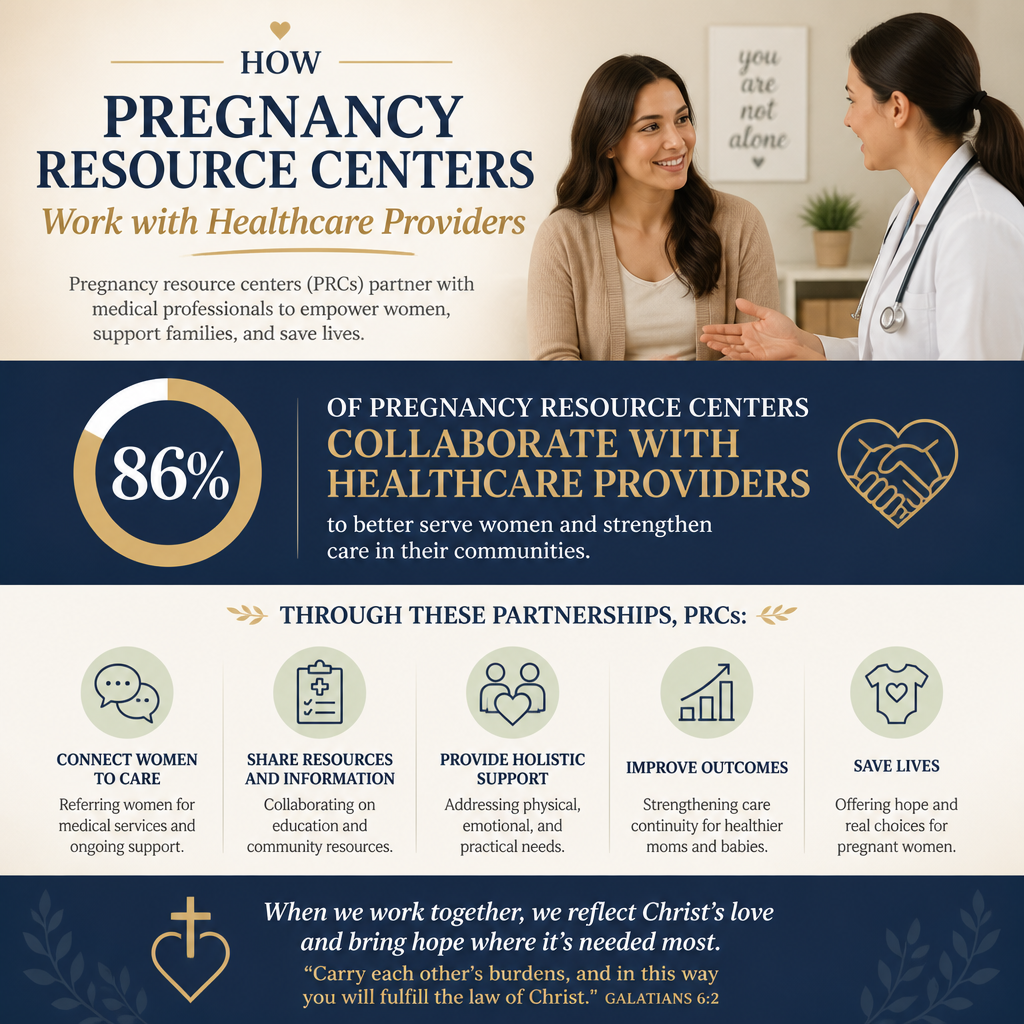
The strongest partnerships recognize that a woman’s needs are rarely limited to one appointment. A clinic may provide prenatal care but not housing stability. A hospital may treat acute medical issues but not address isolation, fear, or the practical realities of parenting. A pregnancy resource center often fills those gaps: diapers, parenting education, childbirth classes, mentorship, connections to social services, and spiritual care when requested.
When a center coordinates respectfully with healthcare providers, each party does what it is trained and authorized to do. That division of labor is not a compromise of mission; it is a form of humility. Christian ministry has always depended on the body’s varied gifts rather than insisting that one institution must do everything.
A candid word about contested terrain
We should name directly that some centers operate in a highly politicized environment where suspicion runs in every direction. Some critics assume pregnancy centers exist to deceive; some defenders assume any critique is persecution. Neither posture produces accountable compassion. Donors can insist on a better path: truthful communication, medical responsibility, transparent governance, and partnerships that prioritize the actual patient in front of the staff member, not an abstract argument.
For providers, it is reasonable to expect clear protocols, ethical boundaries, and respect for clinical judgment. For centers, it is reasonable to expect professional respect for their non-medical support and for the religious convictions that animate their service. Where that mutual respect exists, women and families are less likely to fall through gaps that neither the healthcare system nor charitable care can close alone.
FAQs for How pregnancy resource centers work with healthcare providers
Do pregnancy resource centers provide medical care or only counseling?
It varies by center. Some are non-medical and focus on counseling, material support, and referrals. Others offer limited medical services such as pregnancy testing and ultrasound under appropriate medical oversight. Donors should verify that the center clearly states what it does, what it does not do, and how medical services are supervised when offered.
What should a donor ask about a center’s relationship with local clinics and hospitals?
Donors should ask whether the center has named referral partners for prenatal care and emergency care, how it handles urgent symptoms, what follow-up procedures exist with client consent, and whether staff training includes privacy practices and mandated reporting. The goal is to confirm that partnerships are functional in real situations, not merely aspirational.
Funding care that is both compassionate and verifiable
Christian donors rightly want to support ministries that protect unborn life and strengthen families. But maturity in giving requires more than agreement with the cause; it requires attention to whether a pregnancy resource center works with healthcare providers in a way that is truthful, clinically responsible, and accountable. When those partnerships are real, women receive better care, providers see fewer gaps, and the church’s witness is less vulnerable to the charge that we value outcomes more than people.



