

Donor events pregnancy resource centers host are never merely fundraising tactics; at their best, they are public acts of witness and disciplined stewardship. They gather the people God has positioned to protect life, strengthen families, and serve women and men facing real pressure, often in isolation. For Christian donors, the practical question is not whether events “work,” but whether they align with the center’s mission, honor clients, and strengthen the local ecosystem of churches and care providers.
The field has also had to reckon with legitimate concerns: sensational storytelling, vague reporting, and donor experiences that feel more like brand-building than Christian service. Mature pregnancy resource centers can host donor events that are both compelling and restrained—where testimony is handled with pastoral care, outcomes are described with honesty, and finances are treated as sacred trust.
Why pregnancy resource center events matter for Christian stewardship
Christian giving is not a sentimental impulse; it is a stewardship obligation under the lordship of Christ. Scripture links money to discipleship with unusual frequency, because money reveals what we fear, what we trust, and what we love. When a pregnancy resource center invites donors into its work, it is asking more than “Will you give?” It is asking whether the local church will shoulder a share of the burdens carried by women, children, and families.
What this means in practice is that donor events should serve formation as much as funding. The strongest events help donors see the complexity of the work: medical and legal boundaries, trauma-informed care, the realities of poverty and coercion, and the long arc of parenting support. Done well, an event becomes a disciplined moment of communal accountability.
Events are a form of public accountability
Donors rightly expect evidence that a center is governed wisely, financially sound, and clear about what it does and does not do. Transparency is not a marketing preference; it is a moral posture. Across our verification work at Most Trusted, we observe that ministries that meet The Most Trusted Standard tend to treat events as opportunities to explain policies, metrics, and safeguards—not as occasions to blur lines for emotional effect.
Events shape the center’s relationship with the local church
Pregnancy resource centers often exist at the intersection of church life, public controversy, and human crisis. Donor events can either deepen trust with pastors and congregations or create distance if the center appears politically driven or theatrically confrontational. For donors who want to support effective mercy without corrosive partisanship, the event itself is often the clearest window into a center’s spiritual maturity.

The most common donor events centers host and what each is for
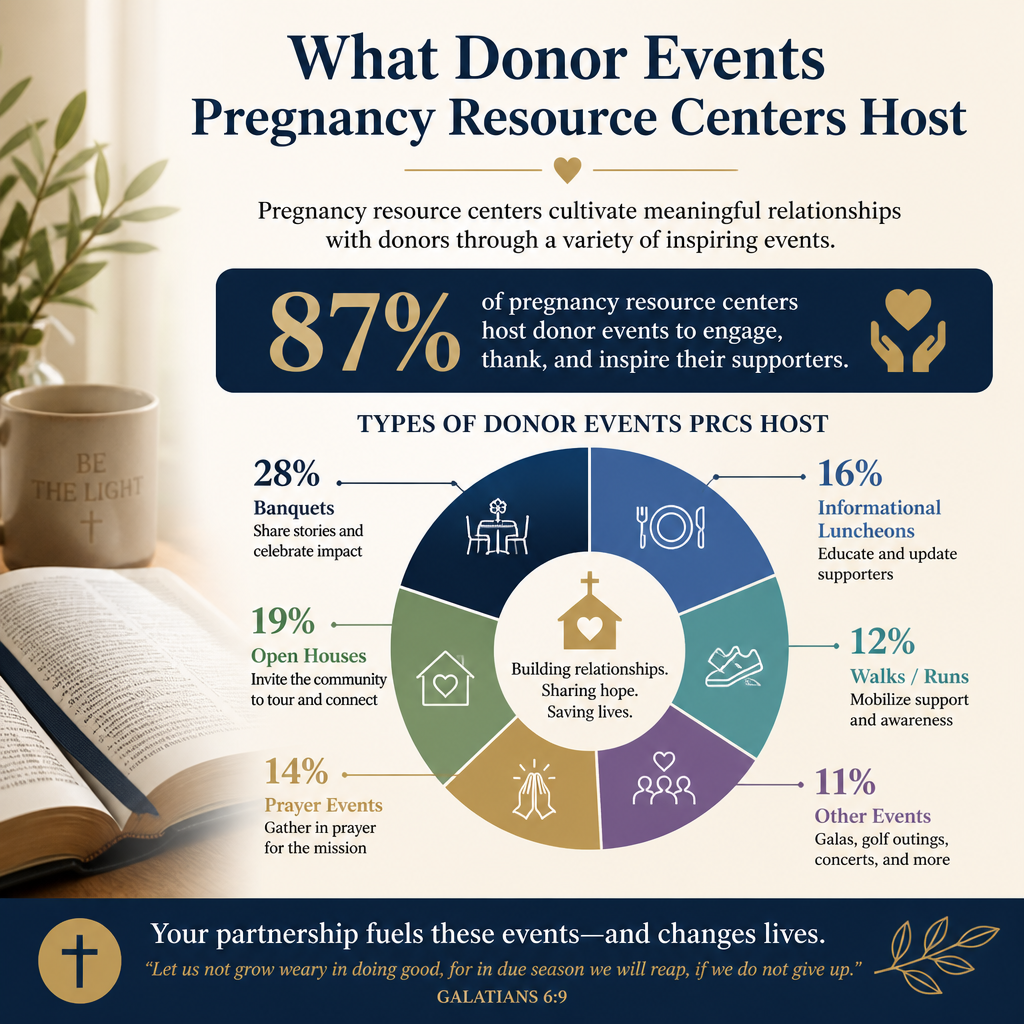
Most centers host a small set of event types because the operational needs are consistent: build a stable donor base, recruit volunteers, strengthen church partnerships, and educate the community. The differences are less about novelty and more about how well each event is governed.
Annual banquet or fundraising dinner
The banquet remains common because it is predictable, scalable, and relational. It is often where the center presents its annual impact narrative, invites financial commitments, and thanks volunteers. A well-run banquet also clarifies what services are provided (e.g., pregnancy testing, ultrasound, parenting education, material support) and what partnerships exist for services the center cannot responsibly deliver.
Breakfast briefing for pastors and key donors
Many centers host smaller, higher-trust gatherings for pastors, elders, and long-term donors. The goal is not spectacle but alignment: shared theology of mercy, clarity on what the center is seeing locally, and specific ways churches can respond. For Christian donors who value ecclesial accountability, these briefings can be a healthier setting for questions about governance, clinical oversight, and reporting.
Open house and ministry tour
Open houses are particularly useful in a contested cultural space. When donors and church leaders can see facilities, meet staff, and understand client flow, suspicion tends to decrease and partnership tends to grow. Tours should be carefully designed to protect client privacy and avoid any environment that feels like “human need as display.”

Baby bottle campaign kickoff and celebration
While baby bottle campaigns are often run through churches rather than as a public event, many centers host a kickoff or celebration night to connect the campaign to the center’s actual work. The most credible versions treat small gifts with the dignity of the widow’s mite—no pressure, no guilt, and clear explanations of how unrestricted funds stabilize services.
Volunteer and donor appreciation gathering
Some of the most spiritually healthy “donor events” do not ask for money at all. Centers that host appreciation gatherings communicate that people are not instruments for budgets. They also use the occasion to reinforce training expectations, confidentiality, and the shared ethic of gentleness toward clients.
How centers handle testimonies, privacy, and truthfulness
The most sensitive question in donor events is storytelling. Donors want to understand impact; clients deserve dignity. The church has a long history of telling testimonies for God’s glory, but Scripture also warns against bearing false witness and against exploiting the vulnerable. The event should embody both truths.
Client dignity is not optional
Centers may share stories when clients have given informed consent and when details are sufficiently anonymized to prevent identification in a local community. The discipline here is costly: the more authentic the story, the easier it is to triangulate a person’s identity. Restraint is often the most pro-life choice a center can make.
Avoiding the “starvation cycle” of fundraising
Fundraising communications can be pressured toward urgency and simplification. Nonprofit literature has described the “starvation cycle,” where organizations under-invest in capacity to satisfy donor expectations, ultimately reducing effectiveness; this concept is widely associated with nonprofit research discussions in venues like Stanford Social Innovation Review (Stanford Social Innovation Review). Pregnancy resource centers are not immune. When an event implies that overhead is suspect or that outcomes are easy, it signals immaturity rather than virtue.
Responsible events explain the real costs of care: licensed medical oversight where applicable, secure data systems, staff training, referral networks, and long-term mentoring. They name what is measurable and what is not, without treating human beings as metrics.
What sophisticated donors should look for at a donor event
A donor event is a governance moment. It reveals whether the center can tell the truth under pressure, whether it respects its clients, and whether it is accountable to the church and to sound nonprofit practice. Donors do not need perfection; they need integrity.
Signals of credibility and maturity
- Clear explanation of services, eligibility, and boundaries, including referral practices for needs the center cannot meet
- Appropriate handling of client stories: consent, anonymity, and a tone of dignity rather than spectacle
- Transparent financial language that distinguishes restricted and unrestricted giving and avoids “overhead shaming”
- Governance clarity: who leads, who oversees, and how decisions are made
- Specific next steps for churches and donors that include volunteering, prayer, and practical support—not only giving
Questions donors can ask without hostility
Serious donors can ask direct questions while maintaining Christian charity. How is medical oversight structured if ultrasounds are provided? What training is required for client-facing volunteers? How does the center handle mandatory reporting? What outcomes are tracked over time, and what does the center do when clients disengage? The answers, and the spirit in which they are given, are often more revealing than stage production.
Donors who want broader context on the work itself can situate events within the larger ecosystem of Pregnancy Resource Centers and how centers relate to churches, healthcare providers, and local social services.
How events build community partnerships without politicizing the mission
Pregnancy resource centers operate in a charged public arena. Christians genuinely disagree about the prudence of certain public tactics, even when they agree on the moral gravity of abortion and the sanctity of life. Donor events can either pull the ministry into culture-war performance or re-center it on neighbor love and concrete care.
Partnership-focused events
Many centers host events designed to strengthen cooperative care: pastor roundtables, continuing education gatherings for counselors, and community partner meetings with social workers and allied nonprofits. The goal is not to dilute conviction; it is to deliver more competent care by strengthening referral pathways and shared standards.
Church engagement that respects pastoral authority
Centers that build durable church partnerships avoid treating churches as mere distribution channels for campaigns. They provide pastors with clear materials, offer training on compassion-centered conversations, and invite oversight relationships that honor ecclesial leadership. Donors should be wary of events that seek to bypass pastors in order to reach congregations directly; that pattern tends to erode trust over time.
For donors assessing how well a center cultivates this kind of local credibility, it is helpful to compare practices across How Pregnancy Resource Centers Build Community Partnerships.
How Most Trusted evaluates event-related claims and donor-facing transparency
Donor events are often where ministries make their broadest public claims. That is precisely where verification matters. Most Trusted exists to help Christian donors give with confidence by evaluating ministries against The Most Trusted Standard, a 15-criteria framework spanning faith commitments, financial integrity, governance and leadership, and transparency and effectiveness.
We pay attention to how a ministry communicates under the spotlight: whether numbers are explained plainly, whether outcomes are overstated, whether restricted gifts are handled responsibly, and whether the board’s oversight is more than symbolic. We also consider whether the ministry’s faith foundation is reflected in its tone—truthful, humble, and firm—rather than merely displayed in slogans.
The Overhead Myth and what mature events communicate
Mature nonprofits avoid implying that low overhead is the primary indicator of virtue. The widely cited “Overhead Myth” letter—endorsed by Charity Navigator, GuideStar, and the Better Business Bureau—argues that overhead ratios alone do not measure impact and can mislead donors (Charity Navigator). Pregnancy resource center events that frame staffing, training, and systems as inherently suspect are not protecting donor dollars; they are undercutting the capacity required for careful care.
FAQs for What donor events pregnancy resource centers host
Do pregnancy resource center donor events typically ask for a pledge?
Many annual banquets do include a direct ask, sometimes with pledge cards or a giving moment. The more responsible approach is clear about what the funds support, avoids manipulative pressure, and provides a way to follow up privately for donors who prefer discretion.
Are center tours appropriate, given client confidentiality?
Tours can be appropriate when the center has strong privacy safeguards: no client presence in public areas, no visible records, and a clear policy against photographing sensitive spaces. Donors should expect a center to prioritize client dignity even when that limits what can be shown.
Conclusion
Donor events pregnancy resource centers host can either flatten the work into slogans or illuminate it with truth and charity. Christian donors should expect events to reflect the ministry’s theology in practice: reverence for persons made in God’s image, honesty about results and limitations, and stewardship that welcomes scrutiny. When those elements are present, an event becomes more than a fundraiser; it becomes a shared commitment to protect life through competent, accountable mercy.



