

How pregnancy resource centers handle donations ethically is not a side issue for Christian donors; it is a test of stewardship. Scripture treats money as a spiritual matter, not merely an administrative one, and ministries that serve women and families in crisis carry a particular obligation to be both compassionate and accountable. When donors fund pregnancy resource centers, they are not only supporting services; they are entrusting the ministry with a public witness.
The harder question is that ethical handling of donations is rarely reduced to a single metric. A center may be sincerely pro-life and still be careless with restricted gifts, unclear in fundraising claims, or thin in governance. Christians genuinely disagree about tactics and public messaging in this space, but there is far less disagreement about the moral requirement for truthfulness, prudence, and fidelity to donor intent.
Ethical donations begin with theological stewardship and truthful claims
Donor money is entrusted, not owned
Pregnancy resource centers operate within the same biblical stewardship framework that governs every Christian ministry. “Moreover, it is required of stewards that they be found faithful” (1 Corinthians 4:2). Faithfulness is practical: keeping promises, using funds as represented, and building systems that resist temptation. The goal is not merely to avoid scandal; it is to honor God by handling resources in a way that reflects his character.
In practice, the most consistent ethical failures we see across the nonprofit sector are not embezzlement. They are softer forms of unfaithfulness: imprecise fundraising language, casual treatment of restricted gifts, and inadequate documentation of impact claims. Those patterns are especially risky for pregnancy resource centers because their work sits at the intersection of medical-adjacent services, high emotional stakes, and public controversy.
Fundraising must be precise about what a gift does
Ethical fundraising does not require marketing austerity, but it does require accuracy. If a center says a gift “funds ultrasounds,” donors reasonably infer that the money will cover ultrasound equipment, licensed staffing, medical oversight, training, maintenance, and compliance costs—not simply “supports the mission.” If a center is not a licensed medical clinic, it must not imply that it is one. If it offers limited medical services through a partner clinic, it must say so plainly.
Donors also benefit from remembering that nonprofit financial health is not measured by a single ratio. The widely cited “Overhead Myth” letter—signed by GuideStar (now Candid), Charity Navigator, and the BBB Wise Giving Alliance—warned against treating overhead percentage as the primary measure of worthiness, because it can incentivize underinvestment in accountability and capacity.Candid

Gift restrictions and donor intent are where ethics become concrete
Restricted gifts must remain restricted
One of the clearest ethical lines is donor intent. If a donor designates a gift for a specific purpose—such as a building project, maternity housing, a specific program serving fathers, or a local outreach—those funds should be tracked separately and spent only for that purpose. When needs change, the ethical approach is not to quietly reclassify the gift but to seek donor consent for a revised use or return the funds if consent cannot be obtained.
Centers that handle this well typically maintain written gift acceptance policies, clear coding in their accounting system, and regular review by leadership and finance committees. They also train frontline staff and volunteer fundraisers, because the most common restriction problems begin with well-meaning conversations that make promises the organization cannot operationalize.
Designated compassion requires documented discretion
Pregnancy resource centers often receive gifts designated for urgent material support: diapers, formula, car seats, rent assistance, or emergency transportation. Ethical handling requires more than goodwill. It demands consistent eligibility criteria, documentation, and safeguards against favoritism. Compassion that lacks process can quietly become inequitable, especially in small communities where relationships overlap.
Many centers also provide long-term mentoring, parenting classes, or post-abortion support groups. When donors designate gifts to these services, the center should be able to show that the funds support the costs that actually make those services possible: trained facilitators, curriculum, background checks, secure records practices, and supervised volunteer care.
Financial integrity requires controls, not just character
Internal controls protect the ministry and the public witness
Christian donors are right to care about integrity of cash handling, receipting, and reporting. Scripture’s concern for honest weights and measures is not merely economic; it is moral (Proverbs 11:1). Ethical donation handling requires internal controls that assume people are fallible, even when they are sincere and spiritually mature.
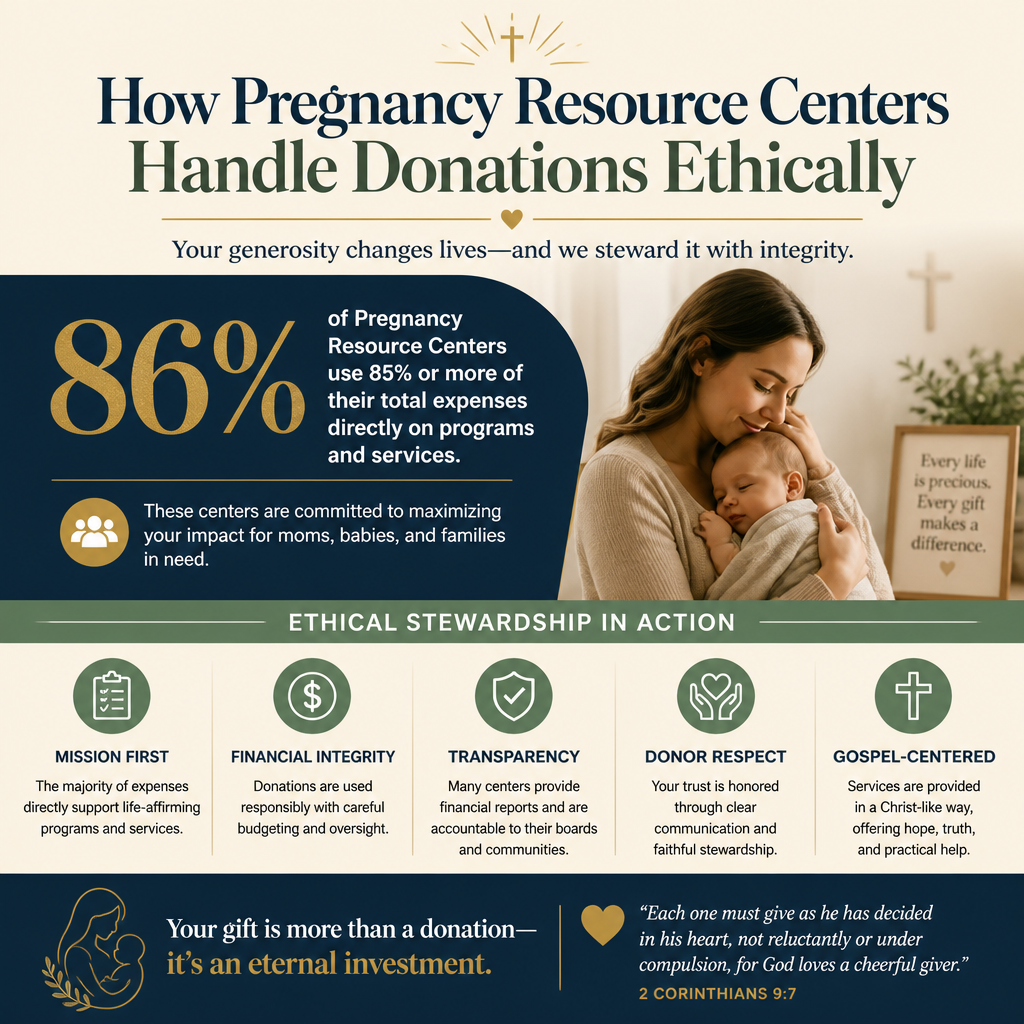
At minimum, a center should separate duties so that no single person controls the full cycle of receiving, depositing, recording, and reconciling donations. It should use secure giving platforms, maintain audit trails, and have documented procedures for counting cash and checks. These practices are not distrust; they are prudent protection of the ministry’s mission.
Independent review and transparent reporting are forms of accountability
Not every pregnancy resource center can afford a full financial audit each year, and sophisticated donors generally understand that size matters. But ethical handling of donations requires some level of independent financial review appropriate to scale, along with timely financial statements for board oversight. A board that never sees balance sheets, cash flow, and budget-to-actual reports is governing in the dark.
For centers large enough to file a Form 990, donors can and should review it as one input among many. The IRS requires most tax-exempt organizations to make Form 990 publicly available, which creates a baseline transparency expectation across the sector.IRS
Governance and leadership shape whether ethics endure under pressure
A real board does more than bless decisions
Pregnancy resource centers often begin with a few committed believers responding to local need. Over time, the ministry’s sustainability depends on whether governance matures. Ethical donation handling requires a board that is independent enough to ask difficult questions, qualified enough to read financial and program reports, and spiritually serious enough to resist mission drift.
Across our verification work at Most Trusted, the ministries that meet The Most Trusted Standard tend to show evidence of disciplined board practices: documented conflict-of-interest policies, regular executive evaluation, clear committee charters, and board minutes that reflect oversight rather than mere updates. These are not bureaucratic niceties. They are structures that keep leaders accountable when the ministry is tired, criticized, or tempted to overpromise.
Conflicts of interest must be disclosed and managed
Small ministries are especially susceptible to related-party transactions: renting a facility from a board member, hiring a relative, purchasing services from a volunteer’s business, or using a board member as a paid contractor. Some of these arrangements can be legitimate. None should be informal. Ethical handling of donations requires disclosure, documentation, competitive consideration where feasible, and recusal from votes.
Donors should not assume malice where there may be community overlap, but neither should they accept “everyone knows everyone” as a substitute for governance. The center’s witness is strengthened when it chooses clarity over convenience.
Transparency and effectiveness require measurable honesty, not promotional certainty
Impact claims should be careful and verifiable
Because pregnancy resource centers address crisis pregnancies, donors often want to know outcomes: how many clients were served, what services were delivered, how many women chose life, how many were connected to churches, how many received material support, and whether clients experienced stability over time. Some of these outcomes are difficult to measure without overstepping privacy and autonomy. Ethical reporting names those limits rather than disguising them.
Centers should be cautious about claiming “babies saved” as a direct conversion metric tied to a donation amount unless they can credibly substantiate the claim and explain the methodology. Where a ministry uses client-reported decision data, it should describe how data are collected, what counts as a decision, and what it does not claim to know. Truthfulness is not only about avoiding lies; it is about resisting the pressure to speak beyond the evidence.
What donors can reasonably ask before giving
Christian donors do not need to become forensic accountants to give faithfully, but we should treat due diligence as a form of love: love for the women served, love for the staff carrying heavy pastoral burdens, and love for the integrity of the Church’s public witness. For those engaging the broader ecosystem of Pregnancy Resource Centers, a few questions can clarify whether a center handles donations ethically:
- Do they provide clear, written descriptions of programs and what donations support?
- Do they have a gift acceptance policy and procedures for restricted gifts?
- Are basic internal controls in place for counting, depositing, and reconciling donations?
- Is the board independent and engaged, with conflict-of-interest disclosures?
- Do they publish financial summaries or a Form 990 when applicable, and will they answer donor questions?
Accountability is not an accusation. It is a protection. Mature centers welcome reasonable scrutiny because it helps them serve with endurance rather than with fragility.
FAQs for How pregnancy resource centers handle donations ethically
Should we avoid pregnancy resource centers with higher administrative costs?
Not automatically. Some administrative spending reflects necessary investments in compliance, training, secure data practices, and financial oversight—areas that directly protect clients and donor funds. The more reliable question is whether the spending is explained, governed, and aligned with mission. The sector’s leading evaluators have cautioned donors against making overhead ratios the primary measure of worthiness, because it can punish organizations that invest in accountability and long-term capacity.Charity Navigator
What is a practical way to assess a center’s transparency before making a significant gift?
Ask for three items: (1) a current budget or financial summary, (2) a description of how restricted gifts are tracked and approved, and (3) an outcomes report that distinguishes services delivered from decisions or long-term outcomes claimed. For donors who are especially attentive to governance and reporting discipline, reviewing the center within the context of Accountability and Transparency in Pregnancy Resource Centers can help frame those requests in a way that is fair, consistent, and focused on verifiable practices.
Stewardship that strengthens the ministry and the Church’s witness
Pregnancy resource centers serve women and families at points of acute vulnerability, and that work deserves both generosity and seriousness. Ethical donation handling is not merely about preventing misuse; it is about sustaining trust so that care can continue when headlines, political tides, or local pressures intensify. When a center treats donor intent as sacred, invests in controls, and tells the truth about both finances and outcomes, it models the kind of stewardship Scripture commends and mature Christian donors seek.



