
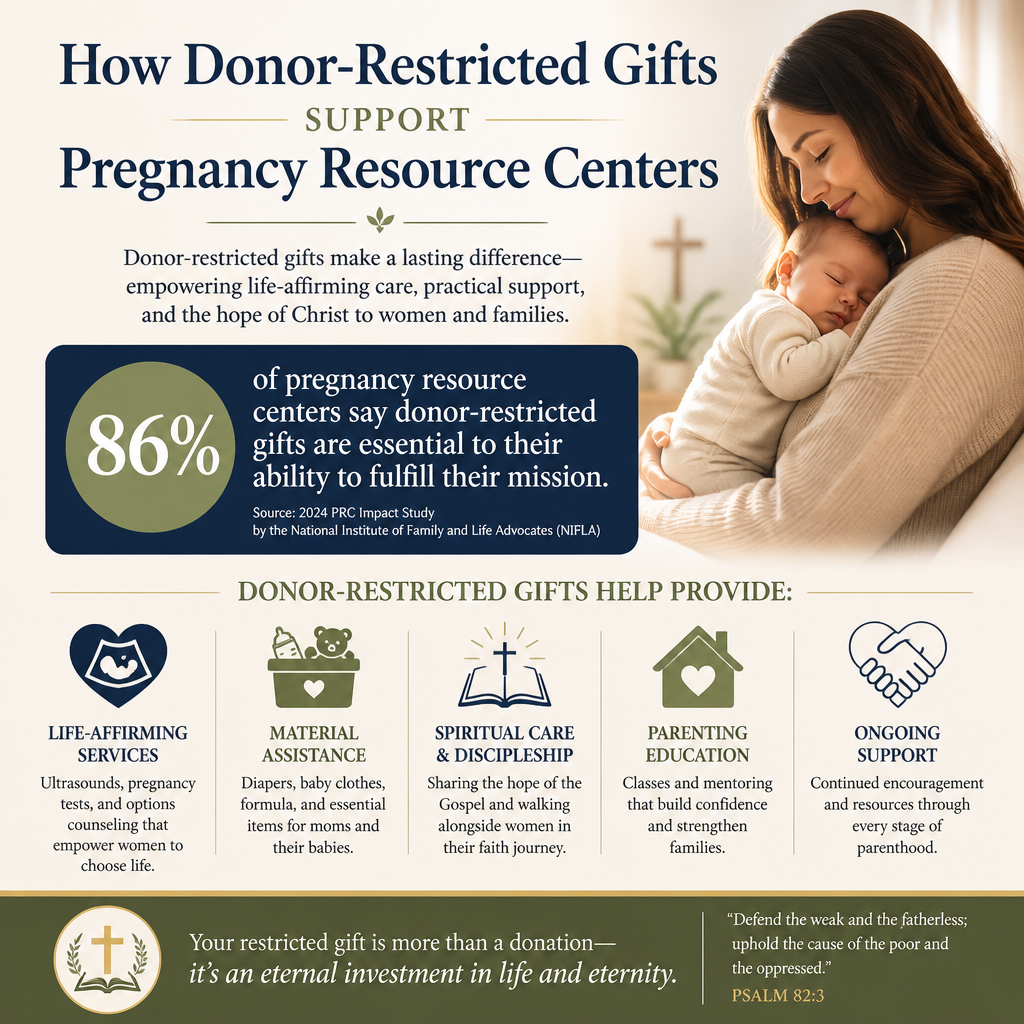
How donor-restricted gifts support pregnancy resource centers depends less on donor intent than on whether a center has the financial discipline and governance maturity to honor that intent without harming its mission. Christian donors often restrict gifts because they want their giving to be both compassionate and concrete: an ultrasound scheduled, a nurse trained, a rent payment covered, a mother connected to prenatal care. The question is whether restrictions become a tool for faithful stewardship or a substitute for trust.
Scripture treats money as a spiritual matter because it reveals whether we love the Kingdom more than control. “Moreover, it is required of stewards that they be found faithful” (1 Corinthians 4:2). Donor restrictions can be one expression of that stewardship. They can also create practical burdens that smaller ministries struggle to carry, especially when restrictions multiply faster than the organization’s ability to account for them.
Donor restrictions are a form of stewardship and a form of power
What a restricted gift is and what it is not
A donor-restricted gift is a contribution designated for a specific purpose, program, or time period. In accounting terms, it is typically treated as “without donor restrictions” or “with donor restrictions” under nonprofit reporting standards, with the restriction released when the purpose is fulfilled or the time period passes. The restriction is not simply a preference. It is an obligation the organization accepts when it receives the gift.
For Christian donors, restriction is often motivated by a desire to align giving with convictions: a commitment to protect unborn life, care for women in crisis, and extend tangible mercy without coercion. It can be a healthy impulse. It can also drift into micromanagement, especially when donors try to restrict gifts into operational details the ministry cannot sustainably segregate.
How restrictions can strengthen a ministry and how they can strain it
Restricted giving can strengthen a pregnancy resource center by funding a defined capacity increase: a new medical service line, additional client appointments, translation capacity, or a parenting education program. In those cases, restriction operates like a covenant: the donor commits resources for a purpose, and the ministry commits to measurable delivery.
The strain appears when restricted dollars accumulate in ways that do not match actual costs. A center may have generous restricted funding for baby supplies but limited flexibility to cover staff supervision, data security, facility maintenance, or insurance. Those “unrestricted” needs are not optional overhead; they are the infrastructure that keeps client care safe and lawful. The “Overhead Myth” letter signed by Charity Navigator, GuideStar, and the BBB Wise Giving Alliance cautions donors against treating administrative and fundraising costs as inherently suspect, because such fixation can distort outcomes and undermine effectiveness Charity Navigator.

Where restricted gifts typically go in pregnancy resource centers
Medical services and client care programs
When a pregnancy resource center provides medical services, restricted gifts often support ultrasound equipment, nurse training, medical oversight, and clinic readiness. These are high-trust categories for donors because they are visible and mission-proximate. They can also be high-liability categories, which means restrictions should be paired with questions about clinical protocols, professional coverage, and medical director responsibilities.
Even in non-medical centers, donors frequently restrict gifts to client care programs such as parenting classes, mentoring, material assistance, and referrals. These programs are tangible and compelling, but they also require ongoing staffing, volunteer screening, and documentation. Donors who restrict to “services” but exclude the systems that make services safe can unintentionally weaken the very programs they want to expand.
Capacity, facilities, and technology
Another common restriction is for facility improvements, relocation, or capital purchases. For some centers, this includes renovations for client privacy, security systems, or compliant medical space. A restricted capital gift can be an act of long-range stewardship when it reduces ongoing risk and positions the center to serve for years.
Technology is increasingly central. Secure client data handling, appointment systems, staff devices, and cybersecurity controls are not cosmetic expenditures. They are part of protecting vulnerable women. When donors restrict gifts for “direct ministry” but prohibit spending on data systems, they may be forcing staff to improvise with tools that expose clients and the ministry to avoidable harm.
How restrictions affect accountability, reporting, and trust
Restriction requires traceability, not just sincerity
Restricted giving raises the bar on internal controls. A center must be able to demonstrate that restricted dollars were received, recorded, segregated in reporting, spent for the intended purpose, and released appropriately. This is not primarily a paperwork exercise. It is the practical expression of truthful speech. “Therefore, having put away falsehood, let each one of you speak the truth with his neighbor” (Ephesians 4:25). Financial truthfulness includes the truth of how designated funds were handled.
Across our verification work at Most Trusted, ministries that consistently meet The Most Trusted Standard tend to treat restricted gifts with disciplined clarity: written gift acceptance practices, clean chart-of-accounts structure, timely financial reporting, and board-level visibility. They also communicate candidly when a restriction is unworkable, rather than quietly accepting the gift and hoping it can be made to fit later.
Clear restriction language prevents future conflict
Many disputes around restricted gifts are not moral failures; they are definitional failures. “Counsel plans, but it is the Lord who establishes his steps” (Proverbs 16:9). Ministries should not promise what they cannot control, and donors should not assume outcomes that were never specified. Restriction language should answer questions such as: What exactly is the purpose? What is the time frame? What counts as an eligible expense? What happens if the program changes, demand shifts, or regulations change?
Christian donors who want to explore broader patterns of disclosure and measurable reporting can review Accountability and Transparency in Pregnancy Resource Centers as a category, where we examine what credible transparency tends to include and why it matters for long-term trust.
Common pitfalls of restricted giving and how donors can avoid them
Restricted funds can accumulate while urgent needs go unmet
One of the most common patterns in nonprofits is the accumulation of restricted reserves alongside operational strain. This is not unique to pregnancy resource centers. When donors repeatedly restrict gifts to the most visible line items, ministries can end up with funded programs and unfunded infrastructure. That can lead to staff turnover, deferred maintenance, reduced training, and weaker client follow-up—costs that do not show up in a donor’s designation line but appear in client experience.
The healthier alternative is not to avoid restrictions altogether, but to restrict with realism. Many of the most sustainable gifts are restricted to a program while explicitly allowing an appropriate share of administrative costs necessary to deliver it safely, lawfully, and consistently.
A donor can accidentally substitute restriction for discernment
Restriction can feel like a safeguard: if we can specify the spending, we can ensure integrity. Yet restriction is not the same as verification. A ministry can spend restricted dollars exactly as labeled and still operate with weak governance, confused theology, or inadequate client safeguards. Conversely, a well-governed ministry may need flexibility to respond to shifting needs, especially as policies, community resources, and client demographics change.
Practical steps that tend to reduce these risks include:
- Ask for written clarification of what expenses qualify under the restriction.
- Confirm how the ministry tracks and reports restricted funds in its financial statements.
- Ensure the restriction allows the real costs of delivery, including appropriate supervision and compliance.
- Request a plan for what happens if the restricted program cannot proceed as expected.
- Prioritize ministries that publish clear program metrics and audited or reviewed financials when appropriate.
Donors also benefit from remembering a basic stewardship principle: control is not the same as faithfulness. Faithfulness includes prudence, but it also includes the humility to be taught by evidence.
What Most Trusted evaluates when restricted gifts are central
Faithful stewardship includes governance, not only outcomes
Pregnancy resource centers operate in a contested public environment. Christians genuinely disagree about strategy, messaging, and policy engagement. What tends to unify mature donors is a desire for ministries that do not merely “win arguments,” but demonstrate integrity, compassion, and competence. That requires governance structures that can withstand pressure—boards that understand their duties, leaders who document decisions, and policies that protect both clients and staff.
Most Trusted exists to help donors give with confidence by evaluating Christian nonprofits against The Most Trusted Standard, a 15-criteria framework spanning faith foundation, financial integrity, governance and leadership, and transparency and effectiveness. Restricted giving intersects with every one of those areas. A restriction touches theology when it expresses moral priorities; it touches financial integrity when it requires traceable accounting; it touches governance when the board must oversee restricted reserves and compliance; and it touches transparency when donors need credible reporting rather than promotional claims.
Evidence of maturity is often found in the unglamorous details
Donors sometimes expect trust to be proven primarily by a compelling client story. Stories matter, and they belong to the church’s ministry of testimony. But verifiable trust is frequently established through less visible practices: consistent reconciliation of restricted funds, clean separation of duties, written gift acceptance procedures, documented conflict-of-interest disclosures, and clear statements about the scope and limits of services.
Donors who want to situate restricted giving within the broader landscape of pregnancy resource center ministry can review Pregnancy Resource Centers, where we address how these ministries typically operate, what questions serious donors ask, and what credible accountability tends to require.
FAQs for How donor-restricted gifts support pregnancy resource centers
Should Christian donors always restrict gifts to pregnancy resource centers?
No. Restricting a gift can be wise when a donor has a clear purpose and the ministry has the accounting maturity to track and report it. Unrestricted gifts are often equally strategic because they fund staff training, security, compliance, and case management infrastructure that makes client care credible. Many donors choose a blended approach: a portion restricted to a program and a portion unrestricted to strengthen the ministry’s resilience.
What should a pregnancy resource center provide to show it honored a restricted gift?
A trustworthy center can provide a clear written description of the restricted purpose, basic financial reporting showing the receipt and use of designated funds, and program reporting appropriate to the gift’s size and time frame. The goal is traceability: the donor should be able to see that the ministry did what it said it would do, and that it did so in a manner consistent with truthful communication and prudent stewardship.
A restriction is only as strong as the ministry that carries it
Donor-restricted gifts can support pregnancy resource centers by funding tangible, mission-centered work with clarity and accountability. They can also unintentionally weaken a center when restrictions multiply without regard for the real costs of safe, durable ministry. Christian stewardship calls for both compassion and discernment: giving that honors life, serves women with dignity, and insists on truth in financial practice. The most fruitful restrictions are those that strengthen the whole ministry’s capacity to keep its promises.



