
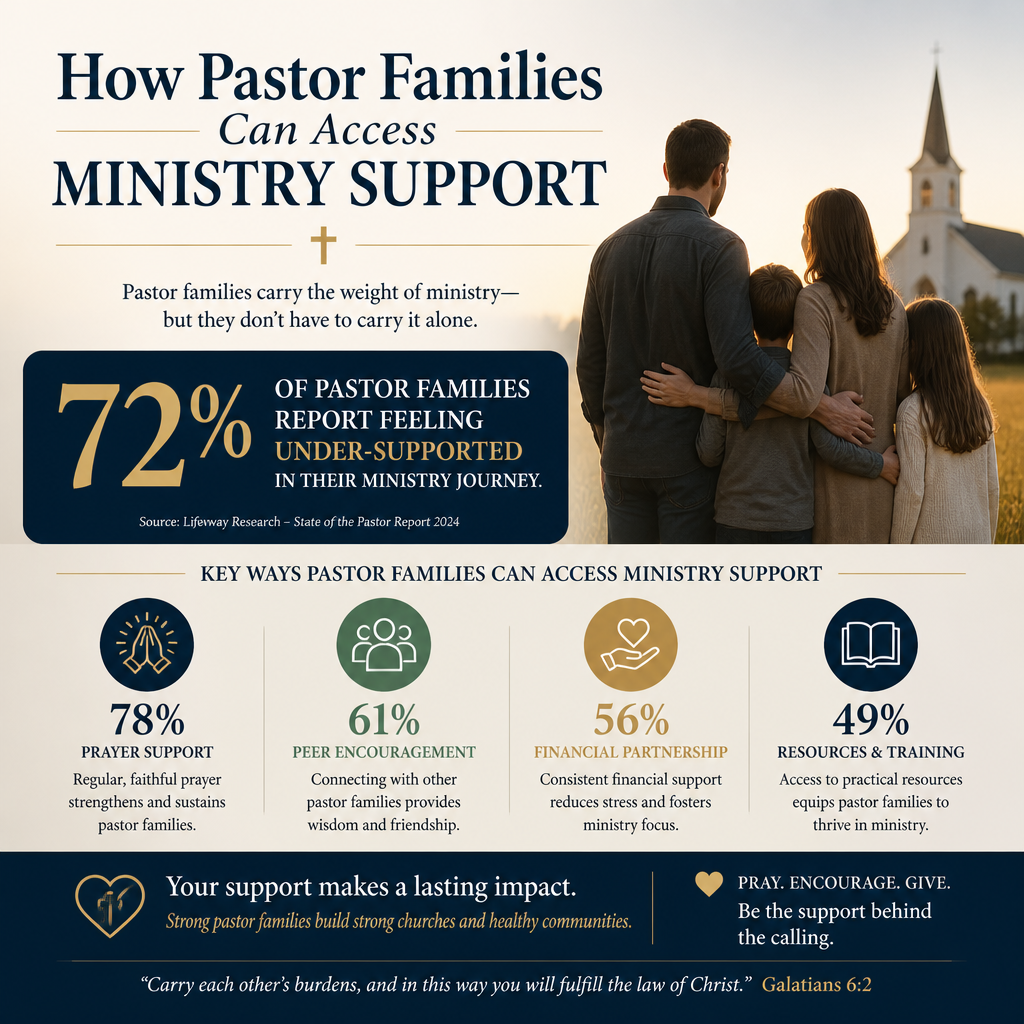
How pastor families can access ministry support is not a niche question. It is a stress test of whether the Church intends to “bear one another’s burdens” in concrete, accountable ways when the burdens fall on those who carry spiritual responsibility for others (Galatians 6:2). Donors often sense the urgency, but not always the pathway: where to send support, what kinds of care are genuinely helpful, and how to avoid well-funded efforts that are spiritually warm but operationally thin.
Pastor-family care is also complicated by legitimate concerns about privacy, stigma, and authority. Some pastor families hesitate to ask for help because disclosure can jeopardize credibility, employment, or relationships in a small community. Some churches avoid outside support because they fear “outsiders” will undermine local leadership. Wise ministry support recognizes these tensions and designs access points that protect dignity while pursuing real healing.
1. Start with the pastor family as a household, not a job description
Ministry pressure is rarely confined to the senior pastor
When donors think “pastoral support,” they often picture counseling for a pastor, sabbaticals, or leadership training. Those are valuable, but pastoral stress commonly touches the whole household: marriage strain, children navigating public scrutiny, financial anxiety, and the quiet fatigue that comes from living in a glass house. The New Testament’s vision of shepherding is deeply personal and embodied; the overseer’s life and home are part of what the church is called to recognize and steward (1 Timothy 3:4–5).
What this means in practice is that support ministries should be assessed for whether they can serve the family system rather than only the pastor. The strongest organizations have access pathways that include spouse support, age-appropriate care for children, and resources that address both spiritual formation and mental health.
The harder question is confidentiality with accountability
Pastor families need confidentiality to be honest. Donors rightly want accountability so support funds are stewarded well and not used to mask abuse or predatory leadership. Both are necessary. Mature pastoral support ministries do not treat confidentiality as secrecy; they treat it as a disciplined practice with clear limits, referral protocols, and governance structures that prevent the ministry from becoming a private refuge for unchecked power.
Across our verification work at Most Trusted, we observe that ministries that meet The Most Trusted Standard tend to formalize these boundaries: what can remain confidential, when outside authorities must be involved, and how pastoral care staff are supervised. These are not technicalities. They are the difference between a ministry that protects the vulnerable and one that accidentally enables harm.

2. Understand the main access points that pastor families actually use
Denominational pathways and independent ministries both matter
Pastor families typically access support through a short list of channels: denominational care structures, independent pastoral care ministries, professional counseling networks, and peer relationships (often informal, sometimes facilitated). Each channel has strengths and weaknesses. Denominations can provide continuity, theological alignment, and direct authorization, but they may struggle with perceived conflicts of interest if a pastor’s crisis implicates denominational leadership. Independent ministries may offer more privacy and specialized expertise, but they can drift without strong theological governance.
Donors serve pastor families best when they understand this ecology rather than treating every support ministry as interchangeable. For a broader view of the landscape, our ongoing coverage of Pastoral Support Ministries tracks the types of organizations serving pastor households and the standards that distinguish serious care from spiritualized improvisation.
Digital access expands reach but does not replace embodied care
Online counseling, telehealth referrals, and virtual cohorts have widened access for rural pastors and those with demanding schedules. Yet embodied pastoral care remains irreplaceable for many families, especially when crisis is acute. A video call can stabilize; it rarely rebuilds a marriage on its own or repair the relational damage that can happen after a public church conflict.
Donors should expect responsible ministries to use digital tools as on-ramps and continuity mechanisms, not as substitutes for durable care plans. This is especially important when children are involved, since minors require additional safeguarding policies and clinical competence.
3. Look for programs that address the predictable stressors of pastoral life
The stress is spiritual, relational, and financial at the same time
Pastor families often face layered pressure: spiritual demands, relational exposure, and financial constraints. The financial piece is frequently misunderstood by congregations. Clergy compensation varies widely, and many pastors carry extra employment, student debt, or unexpected medical expenses. The broader economic context is not neutral either; consumer debt and financial fragility are widespread in the United States. Roughly 6 in 10 adults say they would have difficulty covering a $1,000 emergency expense, according to the Federal Reserve’s Survey of Household Economics and Decisionmaking Federal Reserve.
That reality does not automatically translate into pastoral hardship, but it clarifies why benevolence funds, emergency grants, and practical assistance can be decisive. When a pastor family cannot absorb a car repair or a medical deductible, ministry stress is not merely “emotional.” It becomes existential.
Respite matters, but formation and repair matter more
Sabbaticals, retreats, and time away can be gifts of grace. They are also frequently oversold as solutions. A week at a retreat center may reduce symptoms of exhaustion; it may not address the patterns that produce it, including chronic boundary violations, unresolved conflict, unmanaged anxiety, or a church culture that rewards over-functioning.
When donors evaluate support ministries, we recommend looking for a continuum of care: triage in crisis, clinical or pastoral counseling where appropriate, and follow-through that includes coaching, peer support, and reintegration planning. The “When Helping Hurts” framework articulated by Steve Corbett and Brian Fikkert is often applied to poverty alleviation, but its caution is relevant here as well: short-term relief without long-term restoration can create dependency or avoidance rather than renewal Moody Publishers.
- Clear intake and assessment that distinguishes burnout, depression, trauma, and moral failure
- Qualified counseling pathways, including referral relationships when clinical care is needed
- Support for spouses and children, not only the identified leader
- Financial assistance that is bounded, documented, and paired with wisdom
- Aftercare plans that help a family return to healthy rhythms and accountable community
4. Evaluate support ministries with the same seriousness you bring to missions giving
Warm intent is not a substitute for governance and safeguards
Pastor-care ministries are sometimes treated as inherently trustworthy because they use biblical language and serve respected leaders. That assumption has not aged well. The last decade has been a sober reminder that spiritual authority can be used to conceal misconduct, and that institutions can mistake loyalty for faithfulness. Donors should not respond with cynicism, but with disciplined charity: love that “rejoices with the truth” (1 Corinthians 13:6).
At Most Trusted, we evaluate nonprofits against The Most Trusted Standard, a 15-criteria framework spanning Faith Foundation, Financial Integrity, Governance and Leadership, and Transparency and Effectiveness. The point is not to demand perfection. The point is to ask whether a ministry’s claims can be tested, whether power is accountable, and whether care for pastor families is delivered with competence rather than sentiment.
Transparency must be tailored to a sensitive ministry context
Pastoral support is a special case for transparency. Donors should not expect public case studies, identifying details, or anything that pressures families into disclosure. At the same time, “confidentiality” cannot become a blanket excuse for opacity about finances, leadership relationships, or program outcomes.
The best ministries practice “responsible transparency”: they publish audited or review-level financials where appropriate, describe their care model in concrete terms, disclose leadership and accountability structures, and report aggregate outcomes without exposing individuals. This is aligned with the broader philanthropic consensus that donors should not use simplistic overhead ratios as a proxy for effectiveness. The Overhead Myth letter, signed by GuideStar, Charity Navigator, and the BBB Wise Giving Alliance, cautioned donors against treating overhead as the central measure of worth Candid GuideStar.
5. Fund access, not just excellence, so pastor families can receive care early
Early intervention is often a matter of affordability and permission
Many pastor families wait until crisis because they cannot afford care, cannot find a trusted provider, or feel they lack permission to seek help. Donors can change that. Scholarships for counseling, subsidized retreats with a genuine care plan, and emergency assistance can move a family from silent deterioration to timely support. Just as importantly, donors can fund the quiet infrastructure that makes access possible: trained intake staff, vetted referral networks, and safeguarding protocols.
What this means is that donors should not only underwrite “best-in-class” experiences for a small number of leaders. They should also expand the on-ramps for ordinary pastor families in ordinary churches, including bivocational pastors, rural congregations, and those outside prominent networks.
Church-based support and nonprofit support should reinforce each other
A nonprofit cannot replace a local church’s responsibility to love its shepherds well. Conversely, many churches cannot provide specialized counseling, crisis response, or neutral mediation when conflict escalates. The healthiest ecosystem is mutual reinforcement: a church that provides ongoing relational care and appropriate financial support, and a nonprofit ministry that offers expertise, confidentiality, and structured interventions.
Within this wider conversation, our reporting on How Pastoral Support Ministries Serve Pastor Families examines how different models handle access, referral, family systems care, and accountability without sacrificing pastoral discretion.
FAQs for How pastor families can access ministry support
Should donors give directly to individual pastor families or to pastoral support ministries?
Both can be appropriate, but they serve different needs. Direct gifts can meet an immediate burden quickly, especially when a family faces an emergency expense. Pastoral support ministries can provide structured care: intake, counseling subsidies, vetted referrals, retreats with follow-through, and safeguards that reduce the risk of miscommunication or unhealthy dependence. For larger gifts, many donors find that supporting a well-governed ministry increases consistency, equity, and accountability while still preserving confidentiality for the family receiving care.
What should donors ask before funding a ministry that offers counseling or crisis care?
Donors should ask who provides care, how they are supervised, and what referral pathways exist for clinical needs. It is also prudent to ask how the ministry handles safeguarding, mandated reporting, conflicts of interest, and situations involving allegations of abuse or misconduct. A responsible ministry will be able to describe these policies clearly without disclosing personal information. In our view, clarity here is a sign of seriousness, not bureaucracy.
Why access to support is a theological and stewardship question
Pastor families can access ministry support when the Church treats their care as a matter of truth, love, and disciplined stewardship rather than crisis management or public relations. Donors have a particular role: to fund ministries that make help reachable early, provide competent care to the whole household, and submit their work to accountable governance. When that happens, support becomes more than relief. It becomes a credible witness that the Church intends to honor its shepherds without excusing sin, and to bind up the wounded without hiding the truth.



