
How pastoral counseling supports Christian addiction recovery is not an abstract question for donors; it is a question of whether Christian compassion will be joined to Christian truth in the places where shame, relapse, and despair concentrate. Addiction is not only a medical or legal problem, and it is not only a spiritual problem. It is a human problem that implicates the body, the heart, relationships, and worship.
The best ministries resist reductionism. They recognize that pastoral counseling is neither a substitute for clinical care nor a thin spiritual add-on to treatment. When rightly practiced, it becomes a disciplined form of shepherding that addresses sin and suffering honestly, connects people to the means of grace, and builds a durable recovery community rooted in the local church.
Pastoral counseling names addiction with biblical clarity and human realism
Sin and suffering are both in view
Scripture is candid about the enslaving power of sin. Paul describes a bondage that can feel bewilderingly internal: “I do not do the good I want, but the evil I do not want is what I keep on doing” (Romans 7). At the same time, Scripture is equally candid about suffering that is done to people, not only by them—trauma, betrayal, neglect, and oppression. Pastoral counseling that supports Christian addiction recovery holds both realities without collapsing one into the other.
This matters because addiction often sits at the intersection of culpability and injury. A counselor may need to speak directly about idolatry, deception, and the refusal of accountability. That same counselor may also need to grieve what was endured, help a person tell the truth without self-protection, and cultivate patience for slow change. Donors sometimes want “clear outcomes,” but clarity about the human condition must come first.
Shame is confronted with the gospel, not with sentiment
Addiction thrives in secrecy, and secrecy is sustained by shame. Pastoral counseling addresses shame by insisting on two truths at once: the seriousness of sin and the sufficiency of Christ. “If we confess our sins, he is faithful and just to forgive us our sins and to cleanse us from all unrighteousness” (1 John 1:9). That promise is not therapeutic positivity; it is covenant faithfulness anchored in the cross.
What this means in practice is that pastoral counseling aims for repentance with hope rather than remorse with despair. Ministries that can only speak in clinical categories may struggle to name guilt. Ministries that can only speak in moral categories may struggle to name grief. A mature pastoral approach can do both.

Pastoral counseling builds recovery on discipleship, not willpower
Formation is the long game
Christian addiction recovery ministries are sometimes tempted to measure effectiveness primarily by short-term sobriety. Sobriety matters. Yet pastoral counseling, at its best, pushes deeper: it asks what kind of person is being formed, what loves are being re-ordered, and what practices are shaping the soul over time. Jesus framed the human problem at the level of desire and worship: “Where your treasure is, there your heart will be also” (Matthew 6:21).
Recovery can involve withdrawal symptoms, psychiatric comorbidity, and social determinants that pastoral care cannot “fix.” Christians genuinely disagree about how to describe addiction—disease, disorder, sin pattern, or some combination. But theologically, all serious Christian approaches must still address worship, identity, and obedience. Pastoral counseling helps a person move from mere behavior management toward Spirit-enabled transformation.
Practices of grace become practices of recovery
When pastoral counseling is faithful, it draws people into concrete rhythms that are both spiritual and stabilizing: prayer that learns honesty, Scripture that corrects self-deception, corporate worship that re-centers desire, confession that breaks isolation, and community that does not romanticize independence. These are not generic religious activities. They are means by which God reshapes people.
For donors, this is a crucial interpretive lens. Funding “programming” is easy to picture; funding spiritual formation is harder to quantify. Yet pastoral counseling is often the connective tissue that helps a participant translate Christian teaching into daily choices, relational repair, and durable accountability.
Pastoral counseling coordinates care without confusing roles
Church-based care should not imitate a clinic
Pastors are not licensed therapists unless they are trained and credentialed as such, and most are not. Wise ministries state this plainly. Pastoral counseling supports Christian addiction recovery precisely because it is pastoral: it addresses doctrine, conscience, community, and shepherding under Scripture. It can coexist with evidence-based clinical treatment while remaining distinct from it.
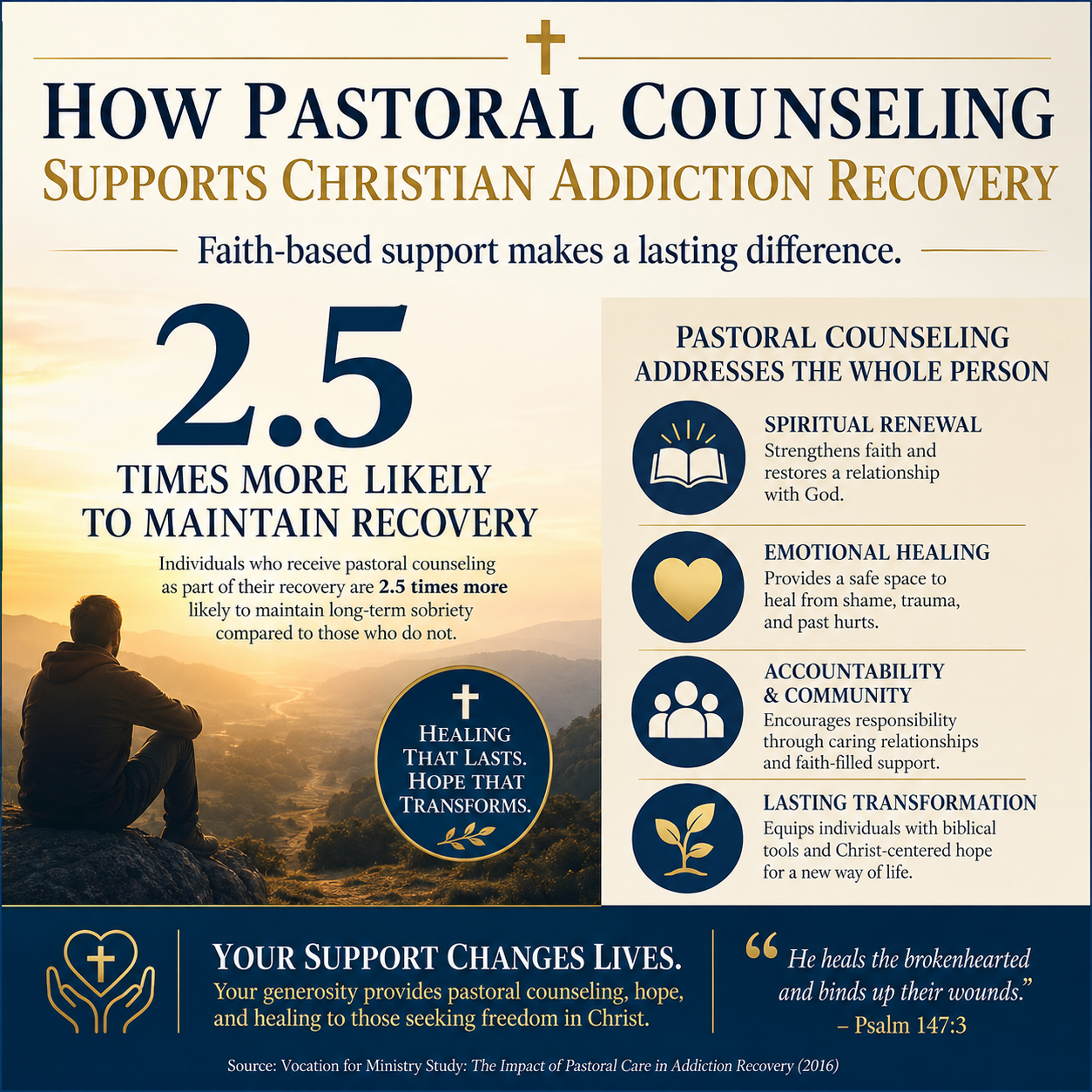
Many participants need higher levels of care at various points: detox, medication-assisted treatment, psychiatric evaluation, or trauma-informed therapy. A strong Christian recovery ministry does not compete with those interventions. It coordinates, refers, and stays involved spiritually and relationally. Donors should look for ministries that maintain clear boundaries and competent partnerships.
Family systems and the local church are not afterthoughts
Addiction rarely harms only the individual. Spouses, children, parents, employers, and congregations all absorb the fallout. Pastoral counseling can address the moral and relational wreckage that clinical treatment may not be positioned to repair: confession and restitution, reconciliation where appropriate, and the slow rebuilding of trust. That work requires prudence; reconciliation is not always safe or wise, and forgiveness does not eliminate the need for boundaries.
At the same time, pastoral counseling helps churches move beyond simplistic expectations. A congregation may proclaim grace yet react to relapse with either panic or permissiveness. Pastoral leaders can teach the church to walk in truthful compassion: protecting the vulnerable, holding people accountable, and making space for long obedience rather than quick fixes. Many donors already care deeply about local church health; recovery ministry is one of the most demanding tests of a church’s maturity.
What donors should verify in recovery ministries that use pastoral counseling
Spiritual seriousness should be matched by organizational seriousness
Christian donors often assume that good theology will naturally produce good governance. Scripture does not grant that assumption. The New Testament’s pastoral letters spend significant attention on leadership character, financial integrity, and public credibility precisely because spiritual language can be used to hide dysfunction. Donors who want to fund pastoral counseling as a part of addiction recovery should verify whether a ministry’s institutional life supports its stated mission.
Most Trusted exists to help donors give with confidence by evaluating Christian nonprofits against The Most Trusted Standard, a 15-criteria framework that examines theological clarity, financial integrity, governance quality, and public transparency. Across our verification work, we observe that ministries with compelling testimonies can still have fragile controls, unclear reporting, or weak oversight. Conversely, ministries with quiet competence often serve participants with steadiness that does not depend on charismatic personalities.
Questions that reveal maturity
When donors evaluate a Christian recovery ministry’s pastoral counseling component, a small set of questions tends to illuminate whether the work is both compassionate and disciplined:
- How does the ministry define pastoral counseling, and what training and supervision support it?
- What referral pathways exist for detox, psychiatry, trauma treatment, and emergency care?
- How does the ministry handle relapse in ways that are neither punitive nor enabling?
- What safeguarding policies protect participants, especially women and minors, from manipulation or coercion?
- How does the ministry measure progress beyond sobriety, including spiritual formation and relational repair?
These questions are not cynical. They are aligned with Christian stewardship. Jesus warned that “from everyone who has been given much, much will be demanded” (Luke 12:48). Donors have been given resources, and ministries have been given trust; both are accountable before God.
For donors who are discerning across multiple models and traditions, the larger field of Christian Addiction Recovery Ministries can be difficult to compare because methods vary widely. Verification does not replace spiritual discernment, but it can reduce preventable risk and clarify whether an organization’s stated practices are supported by its actual operations.
Pastoral counseling strengthens long-term outcomes through accountable community
Isolation is the enemy, the church is a medicine God uses
Many Christian recovery programs incorporate peer-support patterns similar to mutual-help groups, and many participants benefit from that structure. Yet pastoral counseling adds something distinct: a shepherding relationship oriented to doctrine, worship, and the care of souls within the body of Christ. “Bear one another’s burdens, and so fulfill the law of Christ” (Galatians 6:2). That command is not sentimental; it requires proximity, patience, and courage.
Research on addiction consistently identifies social support as a major factor in recovery persistence. The National Institute on Drug Abuse notes that recovery outcomes improve when people have access to supportive services addressing medical, mental, social, and legal needs over time, not only acute intervention.https://nida.nih.gov/ A healthy church community, when properly led and safeguarded, can be one of the most enduring support structures a person will ever have.
Accountability is not surveillance, it is discipleship with structure
Accountability is easy to praise and hard to practice. Pastoral counseling can operationalize accountability through clear commitments: honesty about use, participation in worship and community, restitution where appropriate, boundaries around money and technology, and support for family members who need safety and stability. The point is not control. The point is love that tells the truth.
Donors should also acknowledge the inherent tension: spiritual authority can be abused, especially when participants are vulnerable and eager for approval. Ministries that do this work well have transparent leadership, documented policies, outside oversight, and clear avenues for complaints. These concerns belong not only to risk management but to Christian ethics.
Those who want a deeper view into pastoral approaches specifically can also review ministries and practices associated with Biblical Counseling in Christian Addiction Recovery, where theological commitments, care models, and safeguarding standards are often most visible.
FAQs for How pastoral counseling supports Christian addiction recovery
Is pastoral counseling enough for addiction recovery?
Pastoral counseling is often necessary but not always sufficient. Many people also require clinical treatment, medical care, or psychiatric support, particularly in cases involving severe dependency, withdrawal risk, or co-occurring disorders. Pastoral counseling supports Christian addiction recovery by addressing worship, repentance, forgiveness, and community accountability—dimensions that clinical care may not address—while wise ministries coordinate with appropriate professional services.
What should donors look for to ensure pastoral counseling is safe and accountable?
Donors should look for clear role boundaries, training and supervision for counselors, safeguarding policies, documented referral relationships for higher levels of care, and transparent governance. Ministries that meet The Most Trusted Standard tend to treat spiritual care and organizational stewardship as inseparable obligations, with oversight structures that protect participants and honor donor trust.
A discerning confidence for Christian generosity
Pastoral counseling supports Christian addiction recovery when it is rooted in the gospel, practiced with competence, and embedded in accountable community. It helps people tell the truth about sin and suffering, receive grace without evasion, and rebuild life through discipleship rather than sheer resolve. For donors, the calling is to fund not only compassionate intent but credible practice—ministries whose spiritual claims are matched by governance, transparency, and the steady humility that protects the vulnerable.



