
How confession and accountability work in Christian recovery is not a therapeutic detail; it is a question about what the gospel means when sin has gained practical dominion over a person’s life. Donors often support recovery ministries because they have seen the devastation of addiction up close, and they want to fund work that is compassionate without being sentimental, truthful without being punitive, and spiritually serious without becoming coercive.
Christian recovery stands or falls on whether it holds together two biblical realities at once: sin is real and corrupting, and grace is real and liberating. Confession without grace becomes shame-management. Accountability without mercy becomes control. Yet grace without confession becomes a religious vocabulary for denial. The ministries worth supporting are those that resist these distortions in both doctrine and practice.
Confession is a gospel practice before it is a recovery tool
Confession names reality in the presence of God
Christian confession begins with God, not with a group. Scripture treats sin as more than a habit to be replaced; it is rebellion that must be exposed to the light. “If we confess our sins, he is faithful and just to forgive us our sins and to cleanse us from all unrighteousness” (1 John 1:9). The promise is not merely pardon but cleansing—moral renovation that addiction ministries must take seriously if they intend to do more than behavior management.
In recovery settings, confession functions as a form of truth-telling that breaks the isolation addiction depends on. Many addicts have spent years refining concealment: double lives, partial truths, spiritual language used as cover. Confession interrupts that pattern by forcing speech to match reality. When ministries treat confession as a sacrament of honesty rather than a performance of remorse, they make room for durable change.
Confession is personal and communal, but never theatrical
James 5:16 calls believers to “confess your sins to one another and pray for one another, that you may be healed.” That text is often quoted, and sometimes misused. It does not require public exposure of every detail to every person. It commends confession in the context of prayer, care, and the pursuit of healing—within relationships ordered by wisdom and love.
The field has had to reckon with the damage caused by forced disclosure: leaders demanding graphic specifics, groups confusing shock with honesty, and “transparency” becoming a kind of ritual humiliation. Serious ministries set boundaries: what is confessed, to whom, at what pace, and for what purpose. They understand that trauma history is common in addiction, and that unwise disclosure can retraumatize rather than heal.

Accountability is disciplined love, not surveillance
What accountability is and what it is not
Accountability in Christian recovery is a practical expression of discipleship. It answers a concrete question: who has permission to ask hard questions and expect truthful answers? Hebrews 3:13 warns believers to exhort one another “every day… that none of you may be hardened by the deceitfulness of sin.” Addiction is deceit multiplied, so recovery requires relationships structured to interrupt self-deception.
Accountability is not a substitute for the Holy Spirit, and it is not a programmatic way to control adults. The intent is to strengthen agency and repentance, not to create dependency on a leader’s approval. Ministries that rely on omnipresent monitoring often produce compliance in the short term and collapse later, because the person has not learned to live truthfully before God when no one is watching.
Healthy accountability has clear scope and real consequences
Accountability works when it is specific. A vague commitment to “do better” rarely survives cravings, loneliness, or shame. Effective recovery ministries define concrete practices: meeting attendance, sleep and work rhythms, technology boundaries, sobriety plans, and a relapse protocol that removes ambiguity. Consequences also matter. Not every failure requires expulsion, but every failure must be named honestly, assessed soberly, and met with appropriate care.

From a donor perspective, this is one place where theological seriousness becomes operational rigor. Good ministries distinguish between forgiveness and trust. Forgiveness is granted because Christ has borne guilt. Trust is rebuilt over time through consistent truthfulness. When a ministry conflates the two, it either enables destructive patterns or becomes harsh in the name of “standards.”
How confession and accountability operate in daily recovery practice
Patterns we commonly see in mature ministries
Across our verification work at Most Trusted, we observe that the strongest Christian recovery ministries build confession and accountability into ordinary rhythms rather than reserving them for crisis moments. They expect honesty early, not as a graduation requirement. They also structure accountability so that it remains relational and pastoral, not merely administrative.
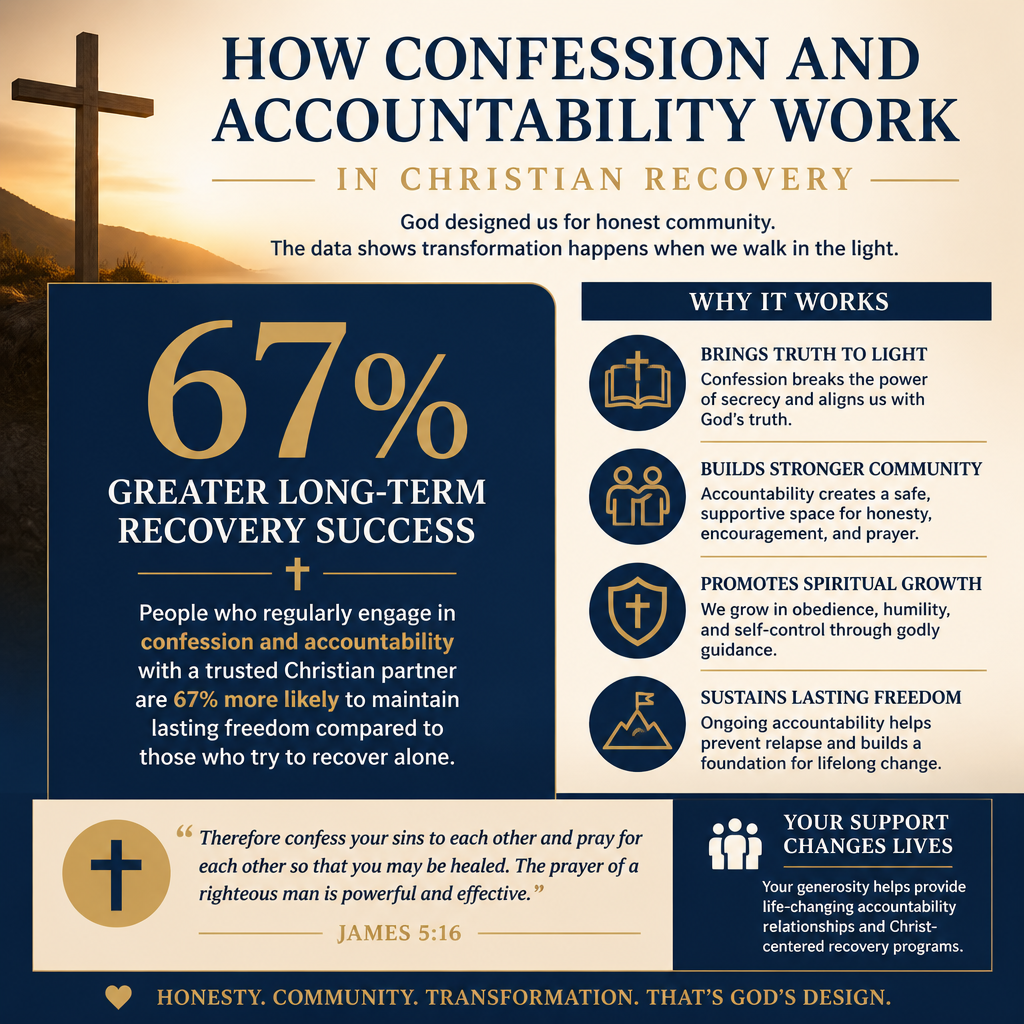
In practice, this often includes structured check-ins, sponsor or mentor relationships, and clear agreements about what happens after a lapse. Mature ministries also create multiple layers of care, recognizing that no single relationship can bear the full weight of a person’s recovery.
- Regular, scheduled confession and inventory with a trusted guide
- A written sobriety plan with triggers, escape routes, and emergency contacts
- Defined communication expectations after a relapse, including same-day disclosure
- Prayer and Scripture that address both guilt and desire, not merely consequences
- Appropriate involvement of family when safety or finances are at stake
Confession is strengthened by clarity about what addiction is
Christians genuinely disagree about the best language for addiction. Some emphasize disease categories; others stress moral agency and idolatry. Many ministries hold both: addiction involves embodied dependency and habituated desire, and it also involves choices for which a person is responsible. The disagreement is not merely academic; it shapes what “confession” means. If addiction is described only as disease, confession can become a vague lament over suffering. If it is described only as moral failure, confession can devolve into self-loathing and despair.
Effective ministries articulate a biblically grounded anthropology: humans are responsible creatures whose bodies and environments matter, whose desires are disordered, and whose hope is not self-mastery but union with Christ. For donors assessing programs within Biblical Counseling in Christian Addiction Recovery, the question is whether the ministry’s practice matches its theology—especially when relapse happens.
What donors should look for in recovery ministries that use confession and accountability
Governance and safeguards against spiritual abuse
Because confession involves vulnerable disclosure, it creates power. That power can be stewarded or exploited. Donors should assume that even orthodox ministries can mishandle authority, particularly when charismatic leaders are involved and outcomes are hard to measure. This is one reason independent verification matters: governance, training, reporting pathways, and safeguarding policies are not peripheral; they are part of Christian ethics.
We recommend asking whether a ministry has written policies that address confidentiality, mandated reporting, and the boundaries of pastoral authority. Confession should never be used as leverage for fundraising, volunteer recruitment, or public storytelling. Nor should “accountability” become an excuse to isolate participants from family, church, or dissenting counsel.
Financial integrity and transparency about outcomes
Addiction recovery is difficult to quantify, and ministries are often tempted to promise more than they can deliver. A sober view of relapse is part of truthful communication. The National Institute on Drug Abuse has described relapse as common in substance use disorders, comparable in some ways to relapse rates in other chronic conditions, while also emphasizing that relapse does not mean treatment has failed and that treatment should be adjusted accordingly https://nida.nih.gov/. That framing is not a biblical argument, but it does support a donor’s expectation that realistic ministries plan for setbacks rather than hiding them.
Financial transparency matters because vulnerable people can be monetized. Donors should look for clear reporting on how residential fees, scholarship funds, and designated gifts are handled. Ministries aligned with The Most Trusted Standard tend to publish accessible financials, clarify what participation costs, and avoid pressure tactics that turn recovery into a revenue stream.
How this fits within the broader ecosystem of Christian recovery ministry
Church, counseling, and community are not interchangeable
Confession and accountability function differently in different settings. A local church may provide spiritual family, worship, and pastoral care, but it may lack clinical expertise for co-occurring disorders or trauma. A counseling practice may provide excellent therapy, but it may not offer a durable community of discipleship. A residential program may provide structure and immediate containment, but it can also create artificial stability that must be translated into ordinary life.
Wise donors look for ministries that partner well: with churches, with licensed clinicians where appropriate, and with community resources. The goal is not to create a recovery subculture that competes with the church, but to cultivate saints who can live in the church with honesty and maturity. For donors evaluating the landscape of Christian Addiction Recovery Ministries, the question is whether the ministry is building bridges back to ordinary Christian life rather than replacing it.
Accountability should mature into self-governance under Christ
Accountability is not meant to be permanent dependency. In the New Testament, discipline aims at restoration, and restoration aims at stability. Over time, external accountability should train internal habits: truthful self-examination, timely confession, and wise avoidance of temptation. The recovery ministry that keeps participants indefinitely tethered to a controlling structure may prevent relapse for a season, but it may not form adults capable of faithful freedom.
This maturation is also where donors can encourage ministries to invest in aftercare: alumni groups, employment support, housing connections, and church integration. These are not add-ons. They are where confession and accountability move from program compliance to lifelong discipleship.
FAQs for How confession and accountability work in Christian recovery
Does Christian recovery require public confession to a group?
No. Scripture commends confession to God and confession to one another within the context of prayer and healing (1 John 1:9; James 5:16), but it does not require indiscriminate public disclosure. Healthy ministries use discretion: confession is shared with appropriate people, in appropriate detail, for the purpose of repentance, repair, and care rather than exposure.
How can donors tell whether accountability is healthy or controlling?
Healthy accountability is defined, relational, and ordered toward restoration. It includes clear boundaries, confidentiality practices, and pathways to report misconduct. Controlling accountability uses fear, isolation, or leader-dependent access to grace. Donors should look for governance safeguards, trained staff, documented policies, and transparent communication about how relapse, discipline, and restoration are handled.
Confession and accountability as stewardship of grace
Recovery ministries handle sacred material: guilt, shame, repentance, and the fragile beginnings of new obedience. Confession and accountability work in Christian recovery when they are tethered to the character of God—holy, truthful, merciful—and when they are practiced with safeguards worthy of that calling. Donors can serve this work best by supporting ministries whose theology is visible in their procedures, whose compassion is disciplined by truth, and whose pursuit of transformation is matched by integrity.



