
What training biblical counselors need for addiction recovery is not a marginal question for donors. It determines whether a ministry will offer repentant hope with competent care, or whether it will unintentionally deepen shame, enable relapse, or place vulnerable people at risk.
Addiction touches the body, the mind, relationships, and the worshiping heart. Scripture speaks directly to enslaving desires and deceptive loves, but it also requires sober-minded shepherding of complex suffering. Donors who fund Christian recovery work are not merely funding programming; they are funding a counsel of the Word applied to people whose lives may be at the edge of collapse.
Training must be explicitly biblical and clinically literate
Biblical counseling for addiction recovery begins with theological clarity: human beings are worshipers, the heart matters, sin enslaves, and grace liberates. Yet addiction ministry fails when it treats embodied realities as irrelevant, or when it adopts secular frameworks uncritically and pushes Scripture to the margins.
Effective training forms counselors to hold both together: a biblical anthropology that can name idolatry and repentance, and a basic clinical literacy that can recognize trauma, co-occurring disorders, withdrawal risk, and the limits of lay counseling. That combination is not capitulation to secularism. It is an application of Proverbs’ insistence on wise, truthful judgment and of Jesus’ pattern of compassionate, reality-based care for suffering people.
Core doctrinal competencies must be more than assumed
Many churches assume counselors already have the theological tools for addiction work, but training should make those tools explicit. Counselors need a coherent account of sanctification, union with Christ, and the means of grace; a careful doctrine of sin that distinguishes temptation from willful action; and a doctrine of suffering that does not moralize every symptom. Without this grounding, counselors will either excuse what Scripture calls sin or condemn what Scripture calls affliction.
Clinical literacy is a stewardship obligation
Training should include clear instruction on when a case requires medical evaluation, psychiatric assessment, or emergency intervention. Overdose risk, suicidal ideation, psychosis, severe withdrawal, and domestic violence are not matters of “counsel harder.” Counselors who do not know how to screen, document, and refer can place both the counselee and the ministry in serious danger.

Competent addiction counseling requires structured formation, not goodwill
Wealthy compassion can still be irresponsible compassion. Addiction ministry is full of earnest volunteers, but sustained recovery work demands formation under supervision. Donors should view training and supervision as frontline ministry, not overhead.
A credible program typically includes a defined training pathway, supervised practice, and ongoing continuing education. The goal is not professionalization for its own sake. The goal is consistent, theologically faithful care delivered with humility, accuracy, and accountability.
Supervision and case review protect the vulnerable
Across our verification work, we observe that ministries that take training seriously have a clear chain of responsibility for counseling decisions. They use case consultation to prevent counselor drift, boundary confusion, and individual “pet theories” from becoming a ministry’s unofficial method. In addiction recovery, where manipulation and self-deception can be present alongside genuine suffering, counselors need a structure that keeps care honest and consistent.
Training should include boundaries, documentation, and safeguarding
Addiction is often entangled with exploitation, homelessness, family instability, and criminal justice involvement. Training must address confidentiality, mandatory reporting, safe meeting practices, and appropriate documentation. Many churches are accustomed to informal pastoral conversations; addiction counseling requires a higher level of clarity about what is promised, what is recorded, and what happens when a counselee becomes unsafe.
Counselors must be trained to discern spiritual dynamics without simplistic explanations
Christians genuinely disagree about how to describe addiction: disease, sin, habit, bondage, disorder, or some combination. The field has had to reckon with the fact that these categories are not interchangeable, and that pastoral language shapes how people interpret responsibility and hope.
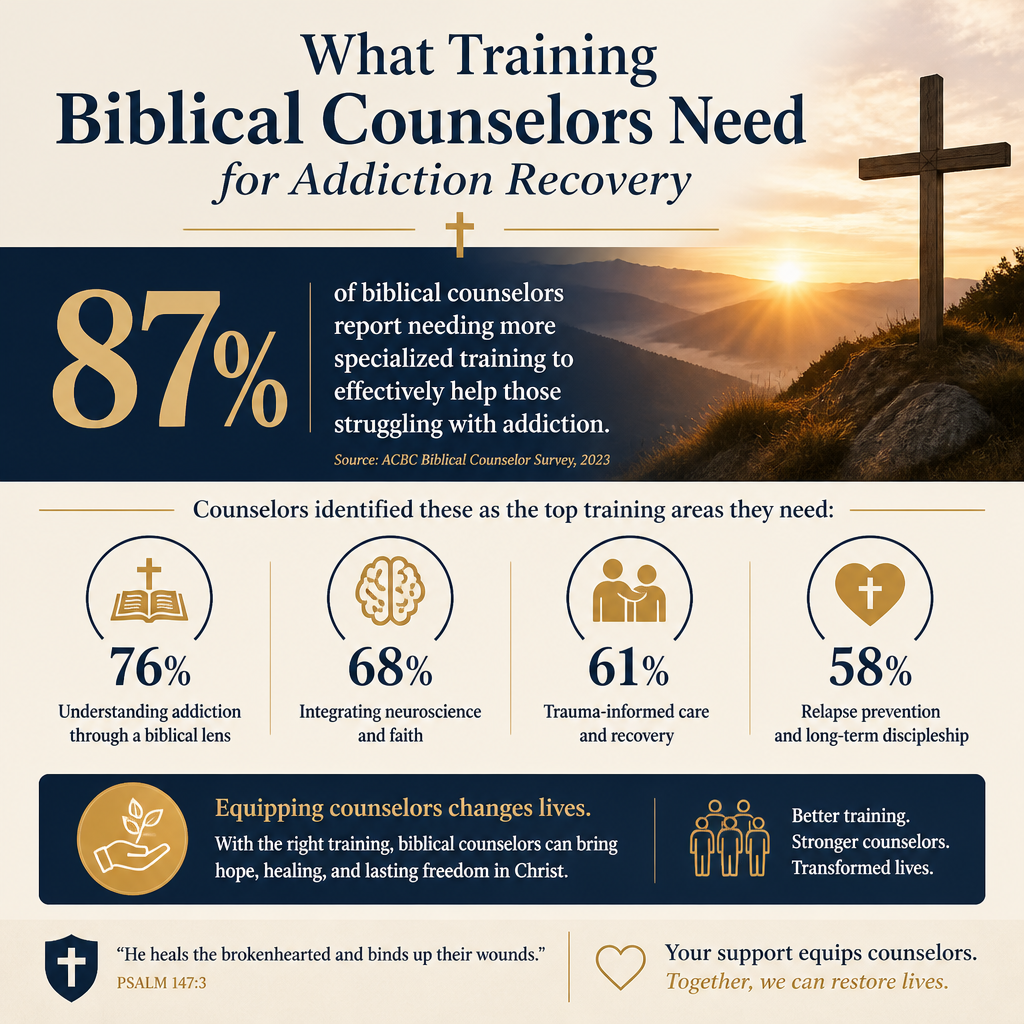
Training that serves donors and counselees well equips counselors to speak biblically about the heart while acknowledging complexity. A counselor can insist on repentance where Scripture insists on repentance, and still recognize that relapse can be connected to trauma triggers, impaired judgment, withdrawal, or unstable housing. The point is not to blur moral accountability. The point is to apply it with truth and mercy, so that “a bruised reed” is not broken and a smoldering wick is not extinguished.
A theology of worship and desire must be operationalized
It is easy to say, “Addiction is worship,” and then counsel at the level of slogans. Training should teach counselors to help a person identify patterns of desire, fear, and false refuge with specificity: what precedes use, what promises the substance makes, what beliefs justify it, and what the person is trying to manage or escape. Biblical counseling becomes credible when it can name the actual functional saviors competing with Christ, and then move toward concrete practices of repentance, repair, and renewed obedience.
Recovery care must address shame with gospel precision
Addiction produces shame, and shame often drives secrecy. Counselors need training to distinguish godly sorrow that leads to repentance from worldly grief that leads to despair. They should know how to speak of justification and adoption in ways that do not minimize consequences, while still offering a real path back into truthful community. Donors should listen for ministries that can say both: sin is real, and mercy is real.
Effective training integrates community, family systems, and long-term discipleship
Addiction rarely exists in isolation. It affects spouses, children, parents, employers, churches, and small groups. Training that focuses only on the individual counselee will miss patterns of enabling, codependency, and intergenerational trauma. It will also miss opportunities for church-based support that secular programs cannot provide.
For donors funding Christian Addiction Recovery Ministries, a key question is whether counselors are trained to build a recovery environment that is both spiritually serious and socially durable. Many people can white-knuckle abstinence for a month. Fewer can rebuild trust, habits, and relationships over years.
Family involvement must be wise, not automatic
Training should help counselors discern when family participation is stabilizing and when it is unsafe or manipulative. In some cases, family systems reinforce addiction through denial, financial rescue, or shared substance use. In other cases, families need support to set boundaries without abandoning their loved one. A ministry should be able to explain how it trains counselors to navigate these realities with pastoral courage.
Peer support and church integration should be intentional
Recovery work benefits from community, but community can also become a substitute savior or a pressure cooker. Training should address how to use peer groups responsibly, how to prevent unhealthy dependency on a counselor or leader, and how to integrate a person into ordinary church life without forcing premature leadership or public testimony.
- Clear expectations for attendance, sobriety commitments, and relapse disclosure
- Policies for financial assistance that avoid reinforcing addiction
- Pathways for restitution, reconciliation, and practical life rebuilding
- Accountability structures that are supportive rather than punitive
- Guidelines for sponsorship, mentoring, and boundaries in mixed-gender settings
Donors should fund training that aligns with verifiable integrity
Training is not only a counseling question; it is a governance and accountability question. Donors have learned, in many ministry contexts, that outcomes depend on systems. Addiction recovery work is no exception. A ministry can be doctrinally sound and still be operationally unsafe, financially opaque, or led without sufficient oversight.
This is one reason our team at Most Trusted evaluates ministries against The Most Trusted Standard, a 15-criteria framework spanning Faith Foundation, Financial Integrity, Governance and Leadership, and Transparency and Effectiveness. For donors, the question is not whether a ministry uses the right vocabulary. The question is whether it can demonstrate a mature approach to training, supervision, safeguarding, and truthful reporting.
What credible evidence often looks like
Donors do not need to be clinicians to ask good questions. A ministry that is serious about addiction counseling training can usually provide written training outlines, supervision rhythms, safeguarding policies, and referral relationships with medical and mental health professionals. It can explain how it handles relapse and crisis situations, and what accountability exists when staff or volunteers violate boundaries.
Transparency matters because recovery work is high-trust work
In the nonprofit sector, leaders across philanthropy have warned against simplistic efficiency metrics that starve essential infrastructure. The “Overhead Myth” statement—signed by GuideStar, Charity Navigator, and BBB Wise Giving Alliance—argued that nonprofit effectiveness cannot be reduced to overhead ratios, and that donors should consider governance, transparency, and results instead GuideStar. That logic applies with particular force in addiction recovery, where training and supervision are core to both safety and effectiveness.
Donors who want to support Biblical Counseling in Christian Addiction Recovery should prioritize ministries that treat training as an essential ministry input, not as an optional enhancement. Strong training is one of the clearest signals that a ministry expects to be held accountable for how it handles vulnerable people.
FAQs for What training biblical counselors need for addiction recovery
Should biblical counselors be licensed clinicians to counsel addiction?
Not always. Many effective addiction recovery ministries rely on trained lay counselors and pastors who counsel within clearly defined limits and refer appropriately. What matters is whether counselors are trained to recognize medical and psychiatric red flags, whether they receive supervision, and whether the ministry has credible referral pathways for cases beyond its competence.
What should donors ask a recovery ministry about counselor training?
Donors can ask for the ministry’s training curriculum, supervision practices, safeguarding policies, and referral relationships. It is also reasonable to ask how relapse is handled, how outcomes are tracked without exaggeration, and what governance structures provide oversight when difficult decisions arise. Serious ministries will welcome these questions because they strengthen trust and protect the people they serve.
Training is where compassion becomes responsible care
Donors are right to care about theology in addiction recovery, because the gospel addresses bondage at its roots and offers a hope that is not merely therapeutic. Donors should care just as much about training, because wise ministry requires more than good intentions. When counselors are formed with biblical depth, supervised practice, and operational safeguards, a ministry is better positioned to offer the kind of steady, truthful care that honors Christ and protects the vulnerable.



