
How naming opportunities work at biblical museum ministries is not mainly a question of donor recognition; it is a question of stewardship, theological clarity, and institutional integrity. A name fixed to a gallery, artifact lab, or educational center signals who underwrote the work, but it also signals what the ministry believes it is doing before God and the public.
Christian donors often sense two competing instincts here. On one hand, Scripture commends giving that seeks the Father’s reward rather than human applause (Matthew 6:1–4). On the other hand, Scripture also records named benefaction for God’s purposes, from patrons of Jesus’ earthly ministry (Luke 8:1–3) to specific co-laborers whose tangible support strengthened the church. A biblical museum ministry has to hold both truths: resisting vanity while practicing transparent, accountable fundraising.
The spiritual and institutional logic behind a name on a wall
Naming is a form of underwriting, not purchasing
In well-governed ministries, a naming opportunity functions as a restricted gift tied to a defined scope: a conservation lab, a children’s education wing, an immersive exhibit, a digitization initiative, or a collection endowment. The donor is not purchasing an artifact, controlling curatorial conclusions, or acquiring private rights. The name is a public marker of underwriting mission work—work that remains accountable to the ministry’s stated doctrinal commitments and its fiduciary duties.
This distinction matters for Christian conscience. A museum devoted to the historicity and context of Scripture operates in a contested intellectual environment. The donor’s role is to strengthen institutional capacity to serve the church and the public, not to dictate results. When a naming package begins to blur into quid pro quo influence, the ministry is no longer simply fundraising; it is risking its witness.
The ministry’s theology of recognition shapes the practice
Christian organizations genuinely disagree about the appropriateness of prominent donor recognition. Some interpret Matthew 6 as a broad caution against public acknowledgment; others interpret it as a warning against self-seeking performance rather than against institutional gratitude. Mature biblical museum ministries tend to make the question explicit in policy: what kinds of recognition serve the mission, and what kinds distort it.
What this means in practice is that a donor should expect clear guardrails: names placed for institutional memory and accountability, not to baptize personal brand-building. A ministry that can articulate this without defensiveness is usually a ministry that has thought carefully about the spiritual formation of its fundraising.
What naming opportunities usually cover in biblical museum ministries
Spaces, programs, and collections require different agreements
Naming a physical space is the most visible category: galleries, theaters, lecture halls, lobbies, and educational rooms. These gifts often support capital projects, renovations, accessibility improvements, and exhibit buildouts. The cost is typically tied to project budgets and the philanthropic market in the region rather than to a universal rule.
Naming a program is often less about a building and more about ongoing impact: field research support, docent training, teacher resources, youth education, traveling exhibits, or scholarship programs for pastoral leaders. Program naming should prompt a donor to ask a different set of questions: what happens when the initial funding ends, and what portion of the gift is intended as an endowment versus annual operations?
Naming related to collections is the most complex. Many museums avoid naming individual artifacts, both for ethical reasons and for donor-management reasons, while allowing naming of a collection fund, an acquisition fund, or a conservation initiative. The donor should expect strong provenance standards, policies for restricted gifts, and a clear posture toward academic credibility.
Endowments are often the most mission-protective form of naming
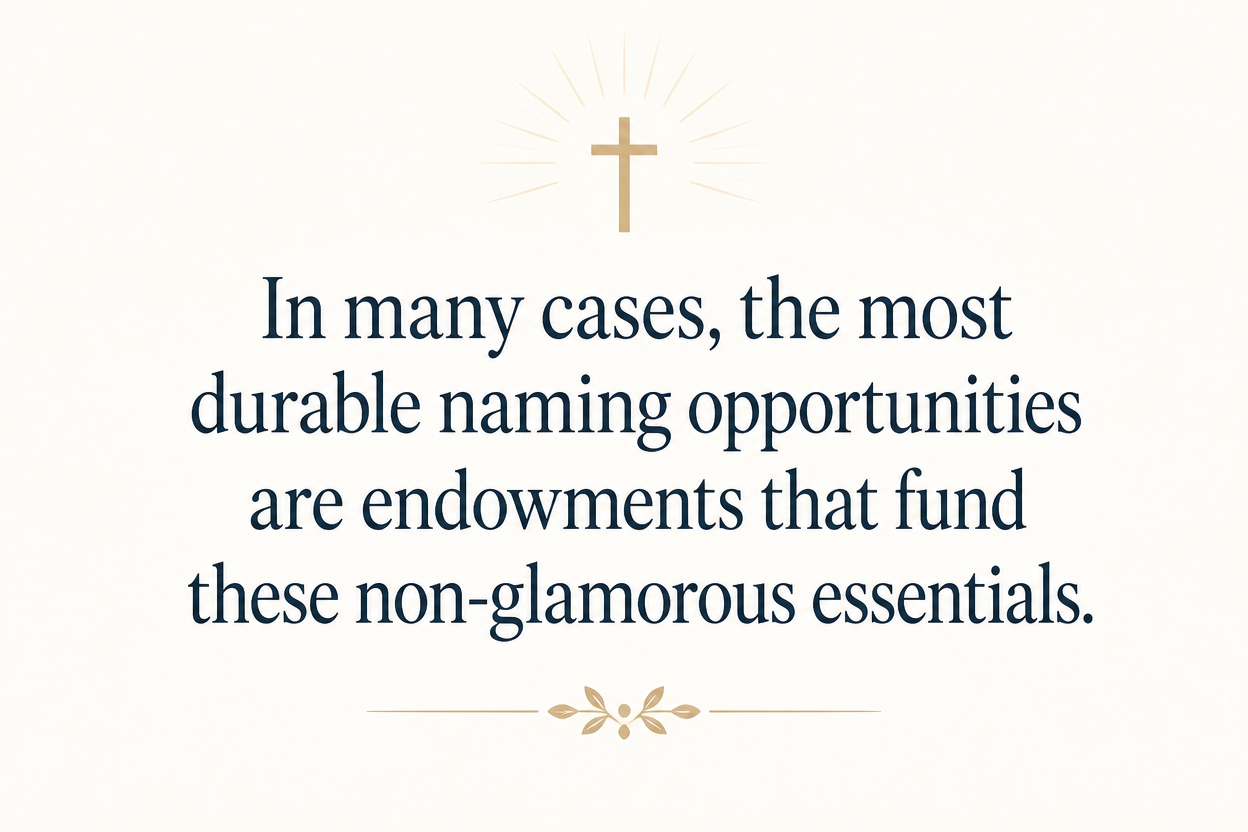
A biblical museum ministry that intends to serve the church for decades must plan for long-term care: climate control, conservation expertise, digital preservation, insurance, and scholarly cataloging. In many cases, the most durable naming opportunities are endowments that fund these non-glamorous essentials.
Endowed support is also one of the clearest ways to avoid the “starvation cycle” dynamic described in nonprofit literature, where organizations underinvest in the capacity required to deliver meaningful outcomes. Stanford Social Innovation Review has documented how chronic underfunding of infrastructure can degrade mission performance and distort organizational behavior (Stanford Social Innovation Review).
The terms donors should insist on before accepting a naming offer
A written agreement that protects both mission and conscience
Naming discussions can feel relational and pastoral, but the stakes are institutional. A mature ministry will put the terms in writing, and a mature donor will want that. The agreement should define the scope, the gift amount and schedule, the duration of the name, the ministry’s obligations, and the limits of donor influence.
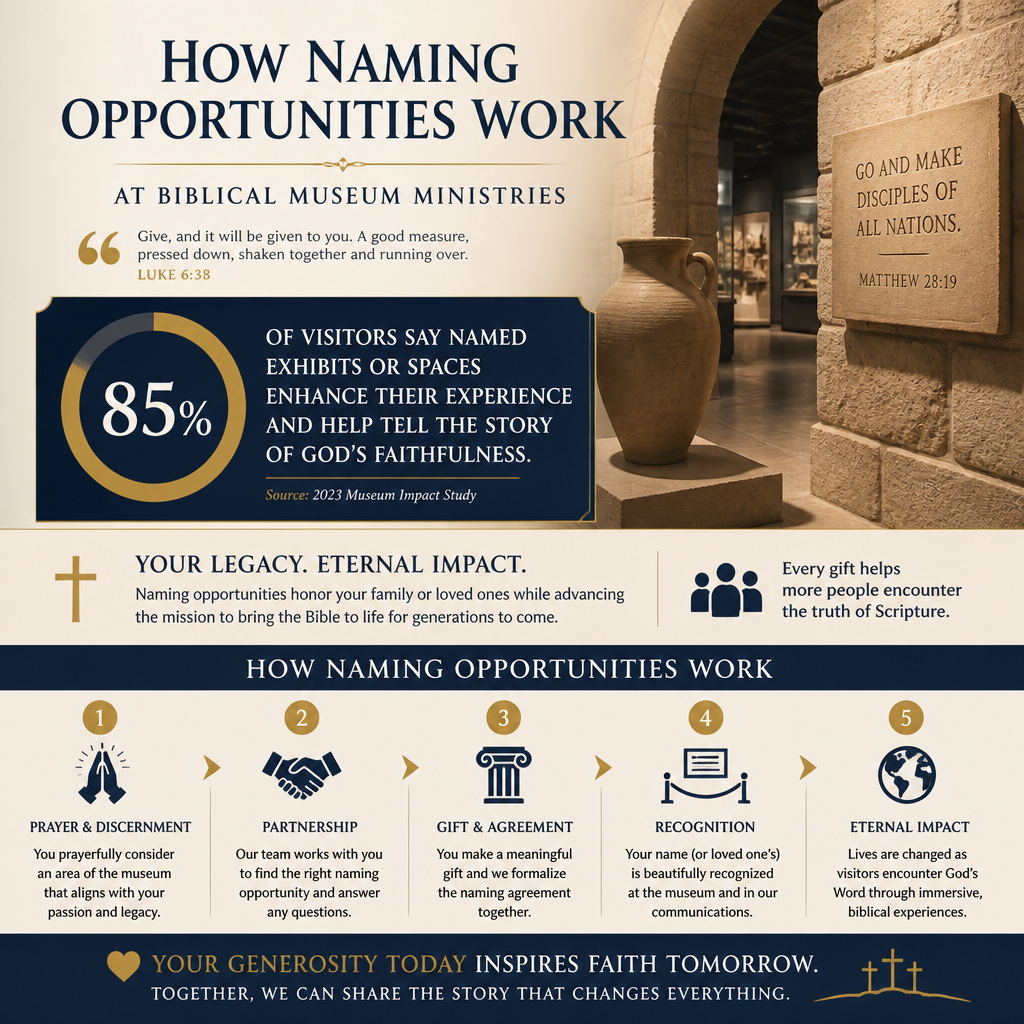
Across our verification work at Most Trusted, the ministries that meet The Most Trusted Standard tend to treat these agreements as a governance and accountability matter, not merely a development matter. They do not improvise under donor pressure, and they avoid vague promises that future leadership cannot honor.
Key provisions that signal seriousness
The following items are not exhaustive, but they are common indicators that a naming opportunity has been designed with integrity:
- Clear purpose and restriction language describing what the gift funds and what it does not fund
- Duration of naming, including what happens after renovations, expansions, or relocations
- A moral-clauses framework that allows the ministry to remove a name if public association becomes materially harmful to mission
- A noninterference clause affirming that curatorial decisions, scholarship, and educational content remain under institutional oversight
- Contingency language if the project is delayed, redesigned, or canceled, including whether funds can be reallocated or must be returned
Donors sometimes hesitate at moral clauses, fearing reputational overreach by institutional leadership. The harder question is whether the ministry has the governance maturity to apply such clauses narrowly, consistently, and with due process. The clause itself is not the virtue; the governance environment behind it is.
How to evaluate a biblical museum ministry before attaching your name
The credibility question is not peripheral for biblical museums
Biblical museums operate at the intersection of faith formation, public history, and contested claims. A donor’s name can become part of that public conversation. For that reason, donors should look beyond aesthetic excellence and ask about provenance, scholarship, and transparency. Ministries that handle artifacts and ancient materials should be prepared to speak responsibly about acquisition ethics, documentation, and curatorial standards.
This is one place where due diligence is an act of love for the church. When a museum overstates claims, mishandles provenance, or lacks clear correction practices, it does not merely risk institutional embarrassment; it risks confusing the faithful and hardening the cynicism of skeptics.
What The Most Trusted Standard helps donors verify
Most Trusted exists to help Christian donors give with confidence by evaluating ministries against The Most Trusted Standard, a 15-criteria framework across Faith Foundation, Financial Integrity, Governance and Leadership, and Transparency and Effectiveness. For naming opportunities, this kind of verification is particularly relevant because recognition gifts are often large, multi-year, and reputationally binding.
Donors commonly ask whether “overhead” is being kept low in capital or program initiatives. The sector has had to correct simplistic overhead thinking; the Overhead Myth letter, signed by major evaluators, argues that overhead ratios alone do not measure nonprofit performance (Charity Navigator). The more reliable questions are whether the ministry’s financial reporting is clear, its board oversight is active, and its claims about impact are substantively supported.
For readers assessing the broader field, our coverage of Biblical Museum Ministries describes common patterns of strength and risk donors should expect to encounter.
Common tensions donors should name directly
Public recognition and the discipline of hidden faithfulness
Matthew 6 warns against practicing righteousness “to be seen by them,” and Jesus’ point is not minor. A naming opportunity can become spiritually corrosive if it nurtures pride, rivalry, or the quiet belief that one’s standing in the Christian community is confirmed by prominence. Donors can respond with intentional practices: declining certain forms of recognition, ensuring that the gift does not reduce ordinary generosity, and approaching the ministry as a partner rather than a patron.
At the same time, public recognition can serve legitimate ends. It can encourage others toward generosity, anchor institutional memory, and provide straightforward accountability about who funded major initiatives. The moral question is not whether a name is visible; it is whether the donor and ministry are treating the work as worship or as self-assertion.
Donor influence and curatorial independence
Donors sometimes desire assurance that a museum will not drift theologically, especially in areas where scholarship and popular skepticism collide. That concern is understandable. Yet a donor’s remedy should be governance and doctrinal clarity, not content control. A ministry with a clear statement of faith, credible leadership, accountable board structures, and transparent correction processes is a safer long-term partner than a ministry that promises a donor veto.
Donors exploring relationship-based support will often find helpful context in Donor Partnership with Biblical Museum Ministries, where we examine how healthy accountability can coexist with deep donor commitment.
FAQs for How naming opportunities work at biblical museum ministries
Is a naming opportunity compatible with Jesus’ teaching about giving in secret?
It can be, but only with sober attention to motive and structure. Jesus condemns giving aimed at human applause (Matthew 6:1–4), not institutional gratitude as such. A donor can pursue hidden faithfulness by letting recognition remain modest, declining publicity beyond what the institution requires, and ensuring the gift serves mission rather than personal platform. A ministry can honor donors without building a culture where prominence becomes a proxy for spiritual maturity.
What should a donor do if the ministry later changes the exhibit or repurposes the named space?
This is why the written naming agreement matters. Donors should expect clear language about duration, renovation, relocation, and contingency plans if the original project changes. A reputable biblical museum ministry will avoid vague assurances and will explain how it handles evolving educational needs while keeping faith with donors. When terms are clear, change does not have to become conflict; it becomes a managed responsibility.
A faithful name is one that strengthens the work and protects the witness
Naming opportunities are neither automatically virtuous nor automatically suspect. They can represent disciplined generosity that underwrites durable Christian education, or they can become a subtle transaction that trades money for influence and esteem. The mature path is demanding: a clear agreement, a governance environment worthy of trust, and donors who treat recognition as secondary to worshipful stewardship. When those elements are present, a name can serve as a quiet testimony that the work of Scripture’s transmission and understanding is worth sustaining for the next generation.



