
How Christian relief ministries coordinate with local churches is not a secondary operational question. It is a theological and moral question about authority, neighbor love, and whether Christian compassion strengthens the church’s witness or quietly displaces it. Donors rightly ask where a ministry’s effectiveness begins and ends: at the distribution line, or in the long, local work of restoration that only a rooted congregation can sustain.
Christian disaster response also exposes recurring tensions. Speed can conflict with careful listening. External funding can unintentionally reorder local priorities. A well-equipped ministry can be tempted to function as a parallel institution rather than a servant to the Body of Christ. Mature relief work does not deny those tensions; it disciplines them under Scripture’s call to act justly, love mercy, and walk humbly with God (Micah 6:8).
Coordination begins with a biblical account of the church
Relief ministries often speak the language of partnership, but partnership is only as strong as the underlying doctrine of the church. The New Testament assumes local, identifiable congregations with elders and recognized responsibilities for care and discipline. When a relief ministry coordinates with a local church, it is not merely arranging logistics; it is acknowledging God’s ordinary means of shepherding people through known leaders in a known place.
That conviction matters to donors because it is a safeguard against both paternalism and celebrity humanitarianism. A ministry that can enter, serve, and depart without weakening local pastoral authority is usually operating with a healthier ecclesiology than one that must control the story, the distribution, and the credit.
Relief is not the church, and the church is not only relief
Christians genuinely disagree about how much local churches should directly run relief programming versus supporting specialized ministries. What Scripture makes clearer is that mercy ministry is not optional for the people of God, and that the church’s compassion must be accountable to truth. When coordination is faithful, a relief organization brings technical competence and surge capacity, while the local church brings spiritual care, community trust, and long-term presence.
Coordination also protects the church from being reduced to a mere “distribution partner.” If a ministry treats the local church only as a venue for supplies, it will eventually erode the church’s credibility. If it honors the church as a shepherding institution, relief can become a credible witness to the gospel rather than a competing brand.
The goal is durable neighbor love, not a momentary intervention
The immediate crisis is real, and rapid aid can save lives. Yet the question donors must keep asking is what happens after the cameras and surge teams leave. A local congregation will still be there to bury the dead, reconcile estranged families, and walk with people whose trauma will not resolve in a week. Coordination should therefore aim at strengthening a community’s capacity for durable neighbor love, not only meeting urgent material needs.
Operational coordination has a disciplined sequence
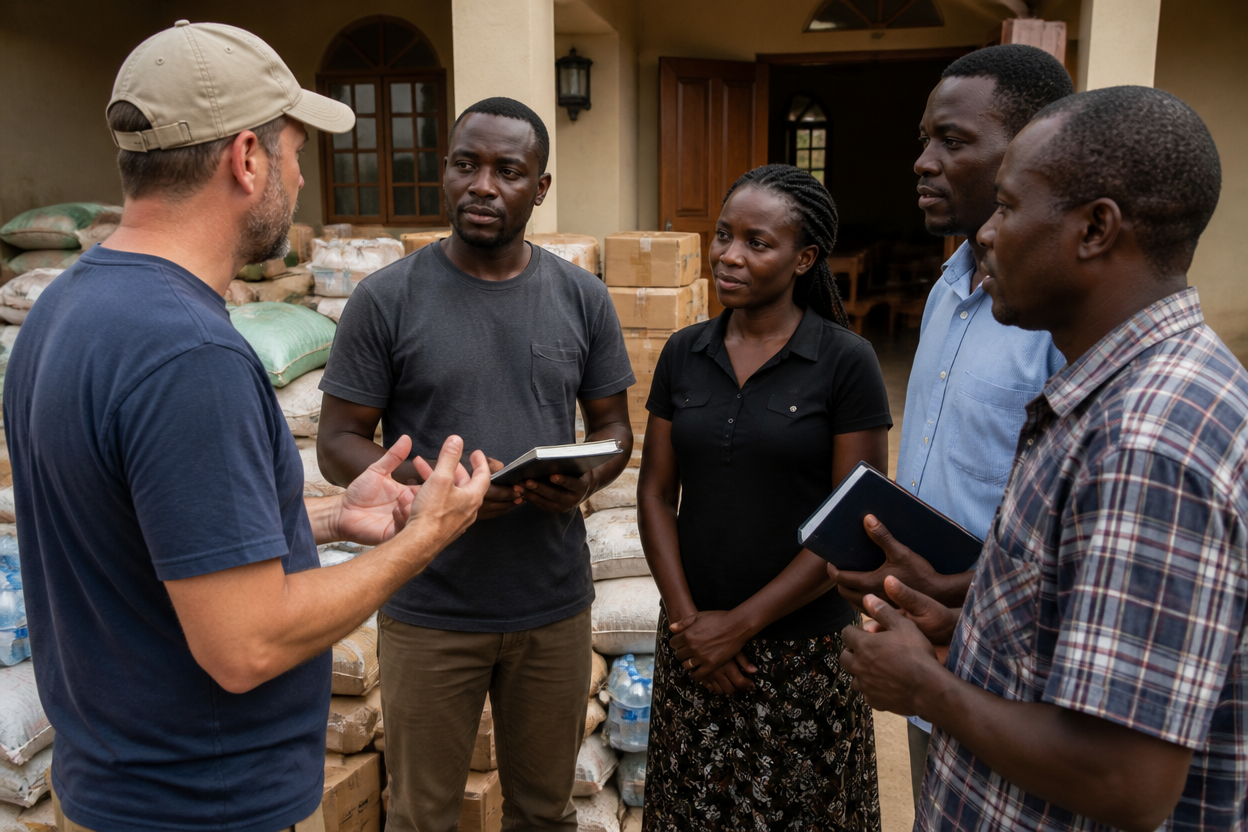
Coordination is often described as relationship-based, and it is. But in crisis settings, relationship without clear sequence produces confusion. The strongest relief ministries tend to follow a disciplined pattern: assess, align, mobilize, and hand off, with the local church integrated at each stage rather than appended at the end.
Assessment that respects local knowledge
In responsible models, assessment begins by listening to local leaders who understand both the physical geography and the social landscape: which neighborhoods are accessible, which families are vulnerable, and which requests are credible. Local churches are often among the most reliable sources of that knowledge because they already keep informal “maps” of need through pastoral care and diaconal ministry.
Good assessment also includes humility about what outsiders do not see. Relief teams can unintentionally reinforce local power imbalances by relying only on prominent voices. Churches can have their own blind spots. Mature ministries build assessment processes that triangulate information and treat local leaders as partners in discernment rather than informants.

Alignment on scope, standards, and decision rights
After assessment comes alignment: what will be done, by whom, and under what standards. This is where coordination either becomes accountable or becomes performative. The practical questions are straightforward: Who authorizes distributions? Who handles beneficiary selection and appeals? What safeguarding standards apply for children and vulnerable adults? What accounting controls govern cash, vouchers, and inventory? How will prayer, pastoral care, and follow-up be offered without coercion?
For donors, the presence of written agreements is not bureaucracy for its own sake. It is a form of moral clarity. It makes exploitation harder and correction easier.
Local churches provide what relief systems cannot
Even highly professional humanitarian systems struggle to produce three assets that local churches can offer at scale: trusted presence, moral formation, and long memory. Relief ministries coordinate well when they treat those assets as essential rather than sentimental.
Trust and access in fragile contexts
After disasters, communities often experience a surge of opportunism: fraudulent claims, theft, and predatory lending. Local congregations are not immune to sin, but they do often possess relational accountability that can deter abuse. A pastor or deacon who has visited a home for years can often distinguish between an opportunistic request and a genuine crisis in ways that no intake form can replicate.
Church-based trust is also relevant because disasters frequently intersect with local conflict. Christian donors should not assume a context is socially neutral. In some settings, aid can inflame resentment if it appears captured by one group. Ministries that coordinate with multiple congregations across a community, and not only the most visible one, are often better positioned to serve impartially.
Spiritual care without manipulation
Christians expect distinctly Christian compassion, but they also fear a transactional “aid for attendance” dynamic. Credible coordination honors both convictions: it offers prayer, Scripture, and pastoral presence freely, while maintaining clear policies that material aid is not conditioned on conversion, church attendance, or public religious participation.
This is one area where donors should ask pointed questions. The healthiest ministries can describe their evangelism posture plainly and can show evidence of safeguarding policies. Coordination with a local church can be an asset here because a congregation can offer spiritual care through established pastoral relationships rather than through coercive crisis pressure.
Common coordination models and the risks donors should weigh
Coordination with local churches takes several forms, each with trade-offs. Donors should not assume one model is always superior; context matters. The critical question is whether the model clarifies accountability and protects the vulnerable while still enabling rapid, competent response.
Five models donors will encounter
- Church-led with ministry support: the church leads distributions and care, the relief ministry provides funding, training, and procurement.
- Ministry-led with church partnership: the relief ministry leads operations, while churches provide volunteers, facilities, and follow-up care.
- Consortium approach: several churches coordinate together with one or more relief organizations to reduce duplication and improve coverage.
- Embedded liaisons: relief ministries place trained staff or volunteers within local churches to coordinate assessments and referrals.
- Referral and case management: churches identify needs; the relief ministry handles specialized services such as housing repair or trauma counseling.
Where coordination can quietly fail
Three failure modes recur across the sector. First, beneficiary selection can become politicized or nepotistic when rules are unclear. Second, the flow of money and goods can become opaque, especially when in-kind donations are valued inconsistently or when cash assistance lacks strong controls. Third, “handoff” can become abandonment: a surge response ends, but no one is clearly responsible for recovery-phase case management.
These risks are not hypothetical. The broader humanitarian field has documented persistent challenges in accountability to affected populations. The ALNAP State of the Humanitarian System report has repeatedly highlighted gaps between commitments to accountability and what crisis-affected people report experiencing in practice ALNAP.
What we evaluate at Most Trusted when ministries claim church partnership
For donors, coordination claims are easy to make and difficult to verify from a distance. This is one reason Most Trusted exists: to help Christian givers distinguish between reassuring language and accountable practice. When we evaluate ministries against The Most Trusted Standard, we look for evidence that church partnership is not merely a fundraising theme but a governance and field-operating reality.
Evidence that partnership is real
The most credible ministries can show, without breaching privacy, how decisions are made in the field and how local churches are integrated into those decisions. They can name the boundary lines: what is controlled centrally, what is delegated locally, and what is jointly decided. They can also explain how they prevent local gatekeeping from becoming exclusion, especially for marginalized families who may be less connected to church leadership.
We also pay attention to whether the ministry’s faith commitments are coherent rather than cosmetic. Do they articulate a theology of mercy that respects human dignity and avoids dependence? Do they train volunteers and staff to serve without condescension? The When Helping Hurts framework, articulated by Steve Corbett and Brian Fikkert, has shaped much of the Christian development conversation by naming how unexamined assumptions can harm the communities we intend to help Moody Publishers.
Financial integrity and transparency in joint work
Joint operations increase complexity: multiple entities, multiple bank accounts, multiple reporting lines. Mature ministries plan for that complexity rather than improvising through it. Donors should expect clear financial reporting, strong internal controls, and transparent communication about what a designated disaster gift will and will not fund.
We also encourage donors to resist simplistic “overhead” thinking. The nonprofit sector has repeatedly warned that fixation on overhead can incentivize underinvestment in the very systems that prevent fraud and improve outcomes. The Overhead Myth statement from Charity Navigator, GuideStar, and the BBB Wise Giving Alliance remains a useful corrective for donors who want effectiveness rather than a low administrative ratio Charity Navigator.
Donors who want a wider view of how this work fits within the broader field can engage Christian Relief and Development Ministries as a category of giving, including the governance and theological questions that serious compassion requires.
FAQs for How Christian relief ministries coordinate with local churches
Should donors prioritize ministries that only work through local churches?
Not always. Some crises require specialized capacity that a local church may not have, such as debris-removal equipment, logistics for large-scale food supply, medical response, or complex shelter operations. The better question is whether a ministry’s model strengthens local pastoral care and community trust over time, and whether its operating decisions respect local authority without surrendering safeguarding and financial controls.
What questions should donors ask to verify church coordination is accountable?
Ask who decides beneficiary criteria, how complaints are handled, what safeguarding policies apply, and how funds and in-kind gifts are tracked in joint operations. Also ask how the ministry transitions from relief to recovery and who owns that handoff. For donors evaluating organizations within How Christian Disaster Relief Ministries Respond, these questions often clarify whether “partnership” is substantive or merely rhetorical.
Coordination worthy of Christian trust
When Christian relief ministries coordinate well with local churches, donors are not merely funding a response; they are strengthening the church’s faithful presence in a community under pressure. The work is complex and sometimes contested, but the direction is clear: compassion that honors Christ should be competent, accountable, and ordered toward long-term restoration. Giving with confidence requires more than compelling stories. It requires verifiable evidence that partnership is real, that authority is respected, and that the vulnerable are protected.



