

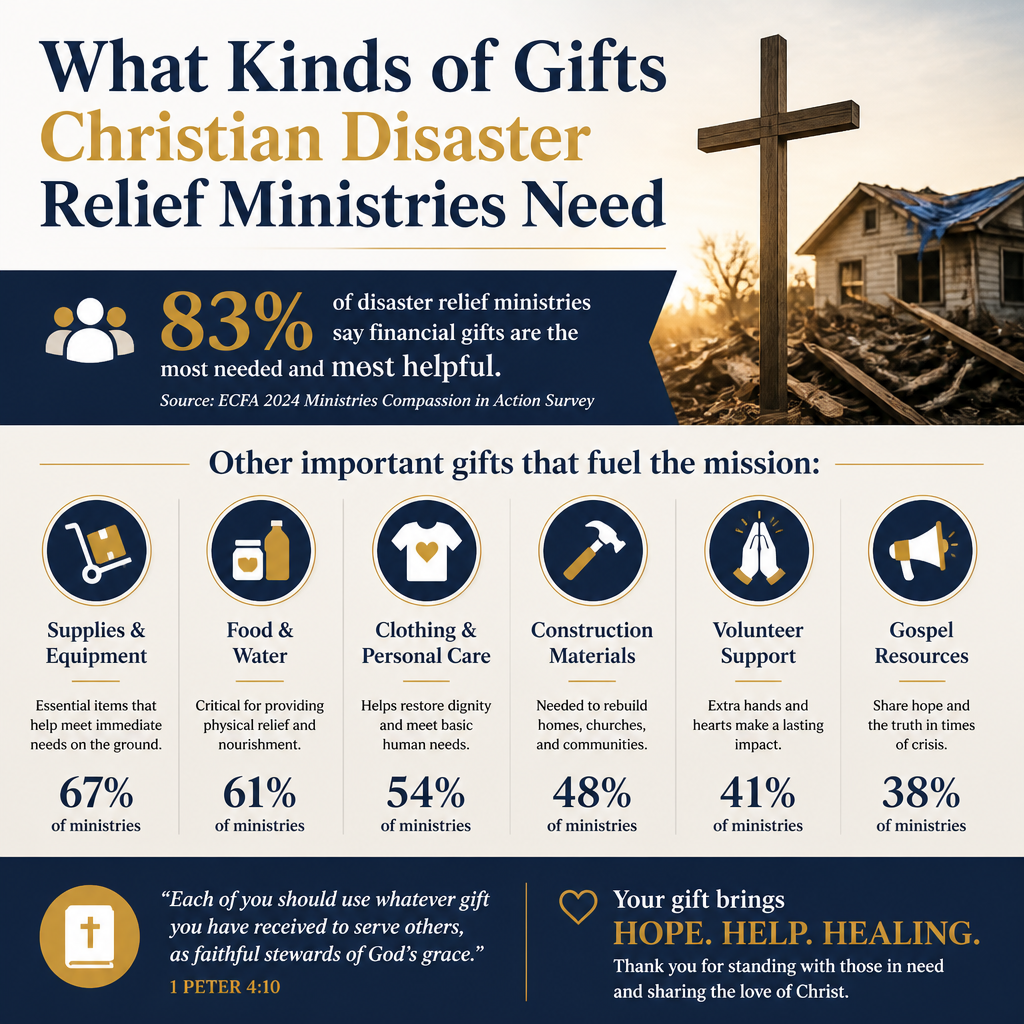
What kinds of gifts Christian disaster relief ministries need is a stewardship question before it is a logistics question. In the earliest hours after a storm or earthquake, donors often assume the greatest need is “stuff.” In practice, the most effective relief work depends on a disciplined mix of cash, specialized in-kind goods, skilled labor, and long-term support that can move at the pace of real recovery.
Christians are right to feel urgency when neighbors suffer. Scripture commends swift mercy and steady faithfulness: “Let us not love in word or talk but in deed and in truth” (1 John 3:18). Yet the same moral seriousness requires donors to ask what actually helps, what inadvertently burdens local systems, and what strengthens the church’s witness rather than weakening it through waste or paternalism.
Relief moves at the speed of logistics and trust
The first constraint is not compassion
Disaster response is governed by constraints donors rarely see: damaged roads, disrupted supply chains, overwhelmed local authorities, and fragile communications. A well-meaning truckload of mixed donations can consume scarce volunteer hours for sorting and disposal, or clog a distribution site that should be moving medicine, clean water, and tarps.
The international humanitarian sector has been blunt about this problem. The American Red Cross explicitly asks donors not to send material goods after disasters and instead to give money because unsolicited items are difficult to manage and often do not match needs on the ground. See the Red Cross guidance at American Red Cross.
The second constraint is legitimacy with local leaders
Christian disaster relief ministries operate inside a web of relationships: pastors, municipal officials, emergency management teams, and local nonprofits. If a ministry cannot coordinate credibly, it may duplicate services, undermine local capacity, or confuse survivors who need clear information and consistent care. This is why mature ministries emphasize local partnerships, careful assessment, and a refusal to promise what they cannot deliver.
Across our verification work at Most Trusted, we observe that ministries that meet The Most Trusted Standard tend to treat trust as a measurable asset. They document partnerships, define decision rights, and maintain controls that protect both survivors and donors—especially when the pressure to move quickly is intense.
Cash gifts are often the most effective gift
Cash buys what is needed when it is needed
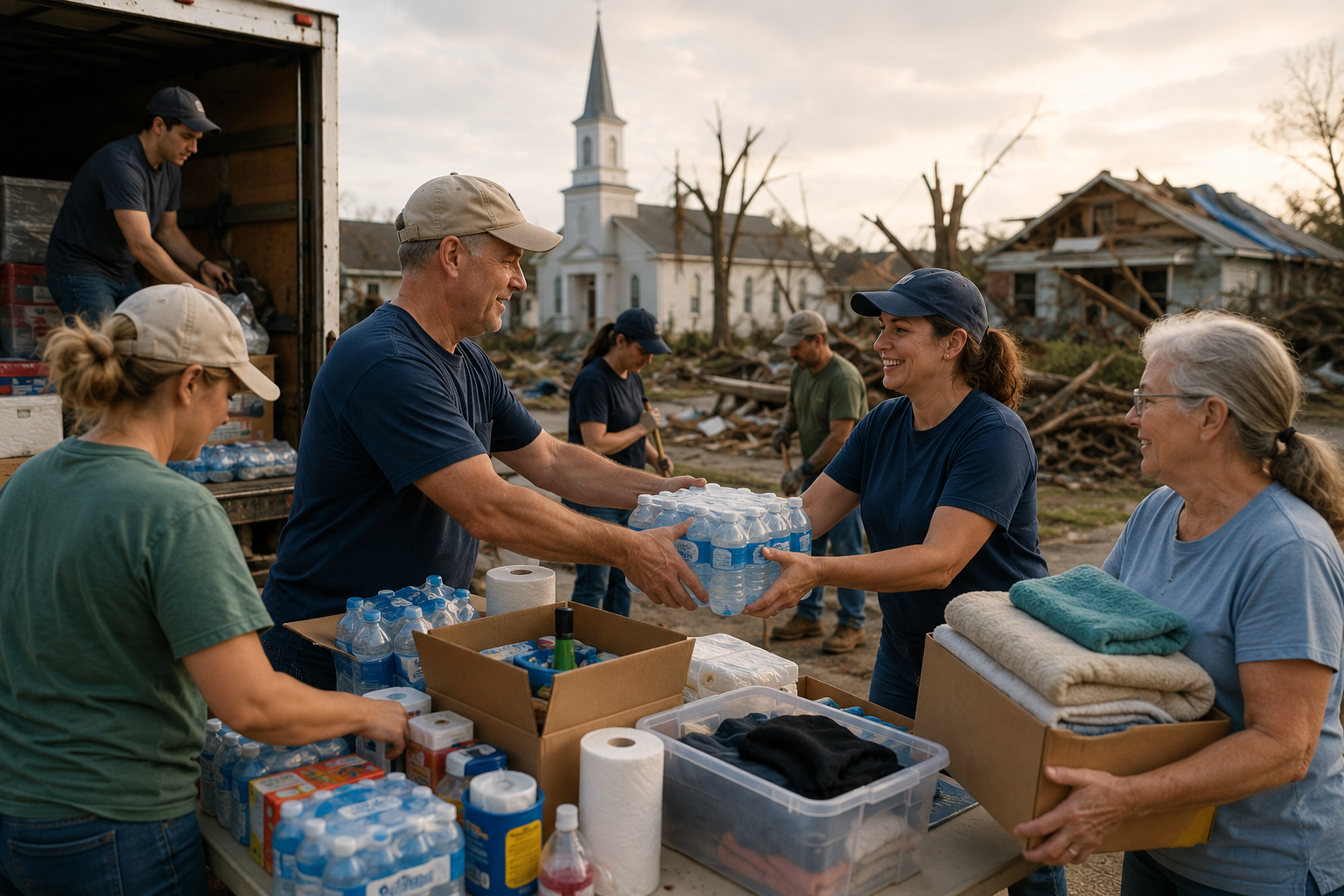
Cash is not glamorous, but it is flexible and accountable when handled well. It allows ministries to purchase regionally appropriate supplies, pay for fuel, hire local labor, and adapt as needs change from immediate relief to stabilization and rebuilding. Cash also reduces the “mismatch” problem—sending what donors have rather than what survivors require.
This is not merely a preference of Christian ministries. The broader humanitarian field has increasingly recognized cash and voucher assistance as a primary tool because it can restore choice and dignity to affected households and strengthen local markets when markets are functioning. For an accessible overview, see the UNHCR explanation of cash assistance at UNHCR.
Restricted gifts can help, but only if the restriction matches reality
Donors often want to restrict gifts to a named disaster. Sometimes that is appropriate; sometimes it creates operational friction. The harder question is whether a ministry can responsibly accept restricted funds and still deploy them within the time horizon donors assume. A disaster may fade from headlines while survivors face months of debris removal, mold remediation, legal paperwork, and housing gaps.
We recommend asking ministries how they define “disaster-specific,” what happens if funds exceed immediate need, and how they report outcomes over time. A well-governed ministry will have a clear gift acceptance policy and a transparent approach to re-designation when circumstances change.
In-kind gifts can help when they are specific, sourced wisely, and coordinated
The right in-kind gift is usually the one requested
In-kind donations are most useful when they are (1) explicitly requested by the responding ministry, (2) standardized for distribution, and (3) appropriate to local conditions. Examples include pallets of identical hygiene kits, specific medical supplies routed through licensed channels, or building materials sourced to local code requirements.
What this means in practice is that donors should resist the impulse to clean out closets and call it relief. A box of assorted items represents love, but it can also represent hours of sorting, storage, and disposal—costs borne by responders rather than by donors.
Gifts of goods require a ministry that can manage them responsibly
In-kind giving introduces integrity risks: valuation games, weak inventory controls, and the temptation to publicize “millions in donated goods” without clarifying what was usable. Sophisticated donors should expect a ministry to track procurement, custody, distribution, and remaining stock with the same seriousness they apply to cash.
For donors evaluating such capacity, it helps to look for documented policies, segregation of duties, and audited financial statements that address in-kind revenue and expense recognition. Those are ordinary governance disciplines, but in disaster environments they are also pastoral disciplines: they protect the ministry’s testimony and the survivor’s dignity.
Skilled people and specialized services are often the scarce resource
Volunteer labor helps most when it is trained and supervised
Volunteer teams can be decisive in debris removal, muck-outs, temporary roof repairs, and rebuilding—provided they are trained, insured, and coordinated with local authorities. The goal is not simply to “send people,” but to send people who arrive as learners, follow safety protocols, and strengthen local leadership rather than displacing it.
The National Voluntary Organizations Active in Disaster, a long-standing coalition coordinating many faith-based and community responders, emphasizes coordination and the effective management of volunteer and donated goods. See their overview at NVOAD.
Professional expertise can be a decisive gift
Some of the most needed gifts are professional services donors can underwrite: trauma-informed counseling, case management, construction management, legal aid for insurance and title issues, and medical services delivered through appropriate clinical oversight. These costs do not photograph well, but they often determine whether a family returns home safely or remains in prolonged instability.
Christians genuinely disagree about how much disaster ministry should prioritize evangelism in the moment versus long-term accompaniment through the local church. We find that the healthiest ministries refuse the false choice. They serve without coercion, speak plainly when asked about their hope, and commit to recovery pathways that honor the whole person.
Long-term recovery gifts are where Christian witness often matures
The news cycle ends before recovery does
Disasters create an initial surge of attention, then a long season of quiet complexity. Housing shortages, contractor fraud, bureaucratic hurdles, and trauma can persist for years. The Federal Emergency Management Agency notes that recovery is a long-term process requiring coordinated efforts across sectors; their resources repeatedly emphasize the length and complexity of recovery at FEMA.
Donors who want to love neighbors steadily should consider gifts that fund long-term recovery offices, local church partnerships, and case management systems that stay after the cameras leave.
Consider a disciplined mix of gifts
Many donors are deciding not only what to give, but how to give in a way that is faithful and measurable. A balanced approach often includes:
- Unrestricted cash for immediate deployment and operational agility
- Designated disaster funds when a ministry has clear policies and reporting
- Pre-approved in-kind goods that match requested specifications
- Support for trained volunteer deployments including supervision and insurance
- Long-term recovery funding for case management, rebuilding, and pastoral care
Donors seeking to understand how ministries coordinate these elements across different contexts may find it helpful to review Christian Relief and Development Ministries, where we track common models, risks, and indicators of faithful practice.
We also encourage donors to compare ministries working specifically in disaster settings through How Christian Disaster Relief Ministries Respond, since the operational demands and integrity risks differ from other forms of poverty alleviation and development.
FAQs for What kinds of gifts Christian disaster relief ministries need
Should Christian donors avoid giving “things” after a disaster?
Not always, but unsolicited goods are frequently inefficient and sometimes harmful to relief operations. The safer default is cash, unless a ministry has explicitly requested specific items with clear specifications and a defined distribution plan. When a ministry invites in-kind giving, donors should expect evidence of inventory controls and reporting that treats donated goods with the same seriousness as donated dollars.
Is it better to give to immediate relief or long-term recovery?
Both can be faithful, but they serve different needs. Immediate relief funds urgent essentials—water, shelter, sanitation, and stabilization—while long-term recovery addresses housing, trauma, legal complexity, and durable community repair. Many mature Christian donors choose a blended approach: a first gift for early response and a second gift months later when the recovery burden becomes clearer and public attention has moved on.
A gift that truly helps is a gift that can be carried responsibly
Christian donors often want their giving to be both compassionate and careful. Disaster relief ministry tests that desire because urgency amplifies both the possibilities for mercy and the risks of misdirected generosity. The best gifts are those a ministry can steward with integrity: cash that can move quickly, goods that are requested and controlled, people who are trained and accountable, and recovery funding that remains when suffering becomes less visible. When donors align their giving with that reality, the church’s compassion becomes not only immediate, but trustworthy.



