

How Christian peacemaking ministries serve in family conflict is not primarily a question of technique. It is a question of discipleship, truth-telling, and the costly work of reconciliation in places where love is supposed to be safest. For Christian donors, the challenge is that family breakdown is both common and hidden, and the ministries doing faithful work in it are often difficult to evaluate from a distance.
Scripture does not sentimentalize conflict. It names anger, partiality, harsh speech, and hardened hearts as spiritual realities with relational consequences. Yet Scripture also treats reconciliation as a central fruit of the gospel: “God… gave us the ministry of reconciliation” (2 Corinthians 5). When peacemaking ministries enter family conflict, they are entering one of the most contested moral spaces in modern life, where trauma language, legal systems, and competing narratives of harm all collide.
Family conflict is a discipleship crisis before it is a communication problem
Many families arrive at crisis with a vocabulary of “boundaries” and “communication,” but without shared moral commitments about truth, repentance, forgiveness, or authority. Christian peacemaking ministries serve best when they do not reduce conflict to personality differences or poor listening. They treat sin seriously without turning every disagreement into a moral indictment.
What Scripture requires and what it does not
Jesus’ instruction in Matthew 18 is clear about the ordinary pathway: go privately, take witnesses, involve the church. The aim is restoration, not winning. At the same time, Scripture does not command reconciliation at the price of enabling ongoing violence, deception, or predation. Donors should expect mature ministries to speak carefully about forgiveness and safety in the same breath, especially where domestic abuse is alleged or substantiated.
Christians genuinely disagree about how quickly reconciliation should be pursued in high-conflict situations, and even about what reconciliation requires. Some emphasize immediate relational repair; others emphasize extended seasons of accountability and distance. The ministries that serve families well tend to clarify definitions early: forgiveness is not the same as restored access; repentance is not the same as regret; peacemaking is not the same as silence.
Why families often need a third party
Family systems are closed loops. Long histories create predictable roles: the peacekeeper, the scapegoat, the absent father, the volatile sibling, the appeaser. When conflict escalates, these roles intensify and each person becomes less credible in the eyes of the others. A trained third party can slow the process, name patterns, and insist on agreed-upon ground rules about honesty and respect.
Many peacemaking ministries operate in the space between pastoral care and clinical therapy. That boundary matters. The presence of trauma, mental illness, addiction, or legal action can require professional interventions that are outside a ministry’s competence. Responsible organizations refer appropriately rather than treating every case as a spiritual problem with a spiritual-only remedy.

What effective peacemaking looks like inside real families
Donors often picture mediation as a single meeting. In family conflict, effective peacemaking is usually a process with stages: intake, assessment, preparation, structured conversation, and follow-through. The work is painstaking because trust is fragile and narratives are competing.
Case types ministries commonly face
Across our verification work at Most Trusted, we see several recurring categories where Christian peacemaking ministries are most active. The details vary, but the underlying dynamics are consistent: shame, fear, and the desire to control the story.
- Estrangement between adult children and parents, often involving competing accounts of harm
- Blended-family conflict after remarriage, especially around loyalty binds and parenting authority
- Inheritance disputes and caregiving tensions as parents age
- Church-involved conflicts that spill into the home, such as pastoral loyalty disputes and social-media escalation
- Divorce-related parenting conflict, including communication breakdowns and gatekeeping
Why the process must be structured
Unstructured conversation in high-conflict families often produces more injury. A ministry’s value is frequently in its insistence on structure: separate pre-meetings, written issue lists, expectations about confidentiality, and carefully moderated sessions. A mature ministry also expects participants to do spiritual homework: confession where appropriate, willingness to listen without rebuttal, and concrete plans for restitution when wrongdoing is acknowledged.
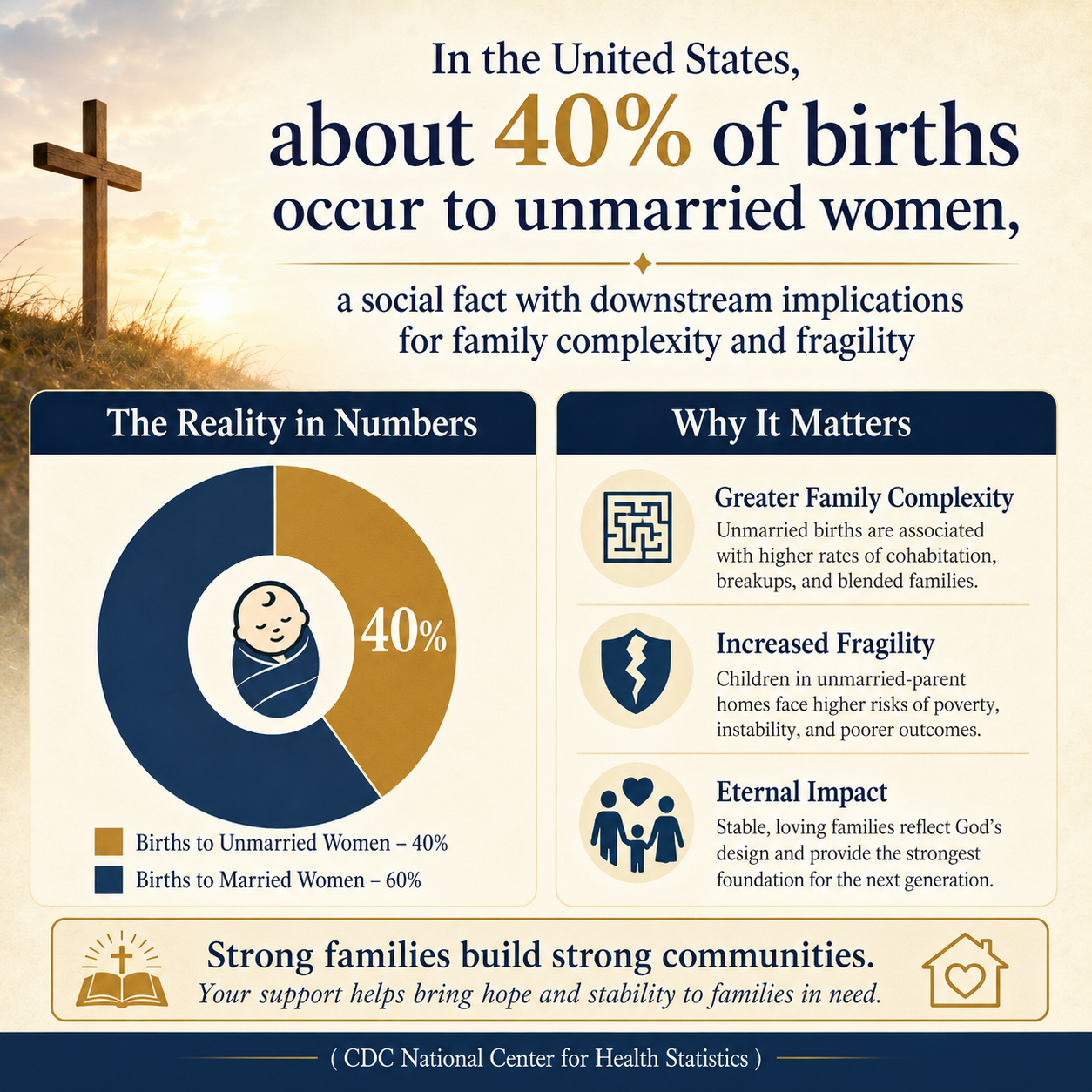
Research on marriage and family stability is complex, but donors should not ignore the scale of what ministries are addressing. In the United States, about 40% of births occur to unmarried women, a social fact with downstream implications for family complexity and fragility (CDC National Center for Health Statistics).
Safety, power, and truth are the hard questions
The harder question in family peacemaking is not whether reconciliation is good. It is how a ministry handles power imbalances, coercion, and contested claims of abuse. Donors should expect ministries to be explicit: peacemaking is never a pretext for forcing victims into proximity with ongoing harm.
Peacemaking is not neutral about righteousness
Christian peacemaking is not simply conflict management. It is ordered toward truth and justice. Scripture warns against “peace, peace” where there is no peace (Jeremiah 6:14). That warning applies in families where one person controls money, access to children, immigration status, or reputation. A ministry that rushes to “mutualize” blame can unintentionally shield an abuser and deepen a victim’s isolation.
This is where donors should probe training and protocols. Does the ministry screen for domestic violence? Does it have written policies about mandated reporting where applicable? Does it have referral relationships with trauma-informed counselors and legal aid when cases exceed pastoral mediation? The answers are not optional details; they are central to faithful practice.
Why confidentiality has limits
Many donors assume Christian mediation is private by definition. In practice, confidentiality must be carefully bounded. Some information cannot remain private if a child is at risk. Some information must be documented if legal proceedings are active. Some information must be disclosed internally for accountability, even if it is not shared publicly. Ministries that state these limits plainly tend to be safer for families and more trustworthy for donors.
Public conversations about abuse have also exposed a real tension: confidentiality can protect repentance, but it can also protect predators. Donors should reward ministries that refuse simplistic slogans and instead build clear, theologically coherent policies that honor both mercy and protection.
How to evaluate a peacemaking ministry as a donor
Family-conflict ministries can appear effective because the work is emotionally compelling. Verification requires more than compelling stories. Donors need evidence of faithful theology, ethical practice, and institutional health.
Questions that reveal maturity
At Most Trusted, we evaluate ministries against The Most Trusted Standard, a 15-criteria framework across Faith Foundation, Financial Integrity, Governance and Leadership, and Transparency and Effectiveness. In family conflict work, several indicators deserve special attention.
Consider asking ministries:
- What training do mediators have in domestic abuse dynamics, trauma, and power imbalances?
- What is the ministry’s theology of forgiveness, repentance, and reconciliation, and how does it shape practice?
- How are cases screened, documented, and supervised for safety and quality?
- What is the referral pathway when clinical therapy, legal counsel, or child protection is needed?
- How does the ministry measure outcomes beyond immediate agreement, such as reduced escalation or sustained co-parenting cooperation?
Why financial and governance discipline matters in relational work
Relational ministries are sometimes excused from institutional rigor because their outputs are hard to quantify. That is precisely why governance and financial discipline matter. Weak boards, charismatic founder control, or opaque spending can create incentives to take cases beyond competence, promise more than can be delivered, or suppress bad news.
Donors also benefit from the philanthropic consensus captured in the “Overhead Myth” statement: administrative spending is not a moral category; it can be necessary for strong systems, evaluation, and accountability (Charity Navigator). In peacemaking ministries, those systems can include supervision, case review, training, safeguarding policies, and secure recordkeeping.
For donors seeking a wider view of the field, our coverage of Christian Conflict Resolution Programs Donors Can Support compares how different models are structured and what donors should look for when giving at scale.
Where peacemaking fits within the church and the wider ecosystem
Healthy peacemaking ministries do not compete with pastors, counselors, attorneys, or the courts. They occupy a specific role: helping Christians pursue truth and reconciliation with spiritual seriousness, practical skill, and procedural fairness. The ecosystem is larger than any single ministry, and donors should support organizations that understand their lane.
Partnering with churches without becoming a church court
Matthew 18 assumes a church community with moral authority, but many families in conflict have weak church attachment or are divided across churches. Peacemaking ministries often serve as a bridge: resourcing pastors, training lay mediators, and offering neutral facilitation when local leadership is entangled. The risk is that a ministry can become a parallel authority structure with insufficient accountability. Strong ministries formalize relationships with churches, clarify decision rights, and avoid becoming the final arbiter of contested facts.
Recognizing when legal realities shape the possibilities
Family conflict frequently includes legal elements: custody orders, protective orders, financial obligations, or mandated counseling. A Christian peacemaking ministry cannot simply spiritualize those realities away. It should respect the law while still calling parties to integrity. Donors should be attentive to whether a ministry’s communications imply that participation can replace legal counsel or court compliance.
For a broader map of the space and how ministries differ in approach, see our work on Christian Conflict Resolution Ministries, including the theological and organizational features that tend to produce durable outcomes.
FAQs for How Christian peacemaking ministries serve in family conflict
Do Christian peacemaking ministries pressure families to reconcile no matter what?
Responsible ministries should not. Christian reconciliation is ordered toward truth and righteousness, not the preservation of appearances. Mature peacemaking ministries distinguish forgiveness from restored access, screen for domestic abuse and coercion, and build safety protocols that prioritize protection of the vulnerable while still holding out hope for repentance and, where possible, restoration.
What outcomes should donors reasonably expect from family peacemaking work?
In many cases, the most realistic outcomes are reduced escalation, clearer communication structures, documented agreements, and a pathway for ongoing accountability. Some situations do lead to relational restoration, but others require sustained boundaries and third-party support. Donors should be wary of ministries that promise rapid reconciliation without naming the complexity of trauma, entrenched patterns, and legal constraints.
The work donors are actually funding
Family peacemaking is often slow, hidden labor: careful intake calls, preparation meetings that surface painful histories, structured conversations that insist on truth, and follow-up that keeps agreements from collapsing under old habits. Christian donors who fund this work are not merely supporting “conflict resolution.” They are underwriting a practical expression of the gospel’s claim that truth can be told, sin can be named, and relationships can be repaired without sacrificing justice or safety.



