
Christian conflict resolution programs donors can support sit near the center of Christian witness. Scripture treats reconciliation not as a soft virtue but as a command grounded in the character of God: “God… reconciled us to himself through Christ and gave us the ministry of reconciliation” (2 Corinthians 5:18). Yet donors also know the harder truth: conflict can become entrenched, institutionalized, and financially incentivized, even in Christian settings. Giving in this category requires both theological conviction and sober due diligence.
The question is not whether conflict exists in churches, families, and Christian organizations; it does, and it will. The question is whether Christian ministries address conflict in ways that are biblically faithful, ethically responsible, and operationally credible. What this means for donors is learning to distinguish between programs that merely manage disputes and those that pursue truth, repentance, and durable peace—without confusing “peace” with avoidance.
Why Christian conflict resolution is a donor concern, not a niche ministry
Conflict is rarely contained to the people in the room. Church disputes can fracture congregations, undermine pastoral credibility, and create long-term distrust of Christian institutions. Family conflict can spill into legal battles, child custody arrangements, and generational alienation. Community conflict can entangle public witness, race and ethnicity, and the credibility of justice claims. Donors who care about discipleship, church health, and Christian public integrity are already implicated.
Scripture’s logic is uncompromising. Jesus places reconciliation adjacent to worship: “First go and be reconciled to your brother; then come and offer your gift” (Matthew 5:24). Paul ties unity to the gospel itself, urging the church to “maintain the unity of the Spirit in the bond of peace” (Ephesians 4:3). Conflict resolution ministries are not replacing the ordinary work of pastors and elders; at their best, they strengthen that work by providing specialized training, process, and external credibility when internal trust has been damaged.
There is also a practical donor reality: conflict is costly. It consumes leadership time, burns through legal fees, and can hollow out a congregation’s mission focus for years. In the broader civil sphere, conflict-related litigation has become a significant expense category; the U.S. Courts publish annual judiciary caseload statistics that show the scale and persistence of federal civil filings (United States Courts). Churches and ministries operate in that same legal environment, often with fewer safeguards.
Christians genuinely disagree about how “justice,” “peace,” and “unity” relate in complex disputes. Some traditions emphasize reconciliation as restoration of relationship; others emphasize truth-telling and accountability before restored relationship is possible. A donor’s task is not to eliminate these tensions but to fund programs that name them honestly, operate transparently, and submit their methods to Scripture rather than to therapeutic fashion or institutional self-protection.

Program types donors can fund and what each is designed to accomplish
“Conflict resolution” covers distinct interventions. Strong ministries are explicit about their scope and claims. They do not promise outcomes they cannot control, and they clarify what success looks like: repentance where needed, repaired trust where possible, and fair process even when parties cannot reconcile.
Mediation programs rooted in Christian peacemaking
Mediation programs facilitate voluntary agreement between parties. In Christian settings, mediation often aims for more than settlement: confession, forgiveness, and constructive future commitments. Donors should expect mediators to be trained in established mediation competencies—intake, confidentiality, power dynamics, and agreement drafting—while also being theologically grounded about sin, accountability, and restoration.
Better programs acknowledge that “forgiveness” cannot be coerced and that reconciliation is not always safe or prudent. They will have explicit protocols for domestic abuse, coercive control, and situations where a party cannot negotiate freely. A ministry that treats “peace” as the highest good regardless of truth is not practicing biblical peacemaking; it is practicing avoidance.
Church dispute consulting and elder-board support
Some programs specialize in disputes inside churches: staff conflict, congregational division, leadership transitions, and allegations of misconduct. The most credible ministries understand polity realities (elder-led, congregational, denominational) and can serve without undermining lawful governance. They offer process design—listening sessions, facilitated elder work, congregational communication planning—without becoming shadow decision-makers.
Donors should look for clarity on authority. Consultants should not promise to “fix” a church without the church’s accountable leaders owning the hard decisions. And they should not treat spiritual authority as a tool for control. In high-conflict systems, the temptation is always to centralize authority in the “expert.” Biblical leadership, by contrast, remains accountable and transparent (1 Peter 5:2–3).
Training and certification for Christian mediators
Many donors instinctively fund direct services. In conflict resolution, training can be equally strategic. Churches often lack skilled facilitators who can handle emotionally charged meetings, interpret policies fairly, and keep parties from weaponizing Scripture. Training programs that prepare church leaders, lay mediators, and reconciliation teams can create durable capacity rather than episodic intervention.
When evaluating training, donors should ask what is actually taught. Does the curriculum cover Matthew 18 and pastoral theology, but also trauma awareness, documentation, and ethical standards? Does it prepare trainees to recognize cases they must refer out—especially when safety, criminal conduct, or fiduciary wrongdoing is at stake?
Arbitration and formal adjudication processes
Some Christian conflict resolution ministries administer arbitration. Arbitration is not mediation: it yields a binding decision. Donors should understand the trade-off. Arbitration can reduce litigation costs and preserve privacy, but it also concentrates power in the arbitrator and can be abused if parties do not give informed consent. The U.S. Supreme Court has repeatedly affirmed the enforceability of arbitration agreements under the Federal Arbitration Act (Supreme Court of the United States), which is why ethical safeguards matter.
Stronger Christian arbitration programs are explicit about due process, conflicts of interest, and the rights parties retain. They do not present arbitration as a spiritual shortcut. They also acknowledge the real controversies in the church: whether mandatory arbitration clauses are appropriate for congregants, employees, or abuse survivors. Donors should not fund systems that treat moral complexity as an inconvenience.
How to evaluate a conflict resolution ministry with theological and operational rigor
Across our verification work at Most Trusted, we observe that conflict resolution ministries are often judged by outcomes they cannot guarantee: whether a pastor keeps his job, whether a congregation reunites, whether a family reconciles. A more faithful approach evaluates a ministry’s integrity of method—its commitments, its safeguards, and the quality of its accountability—because those factors are verifiable and predictive of long-term fruit.
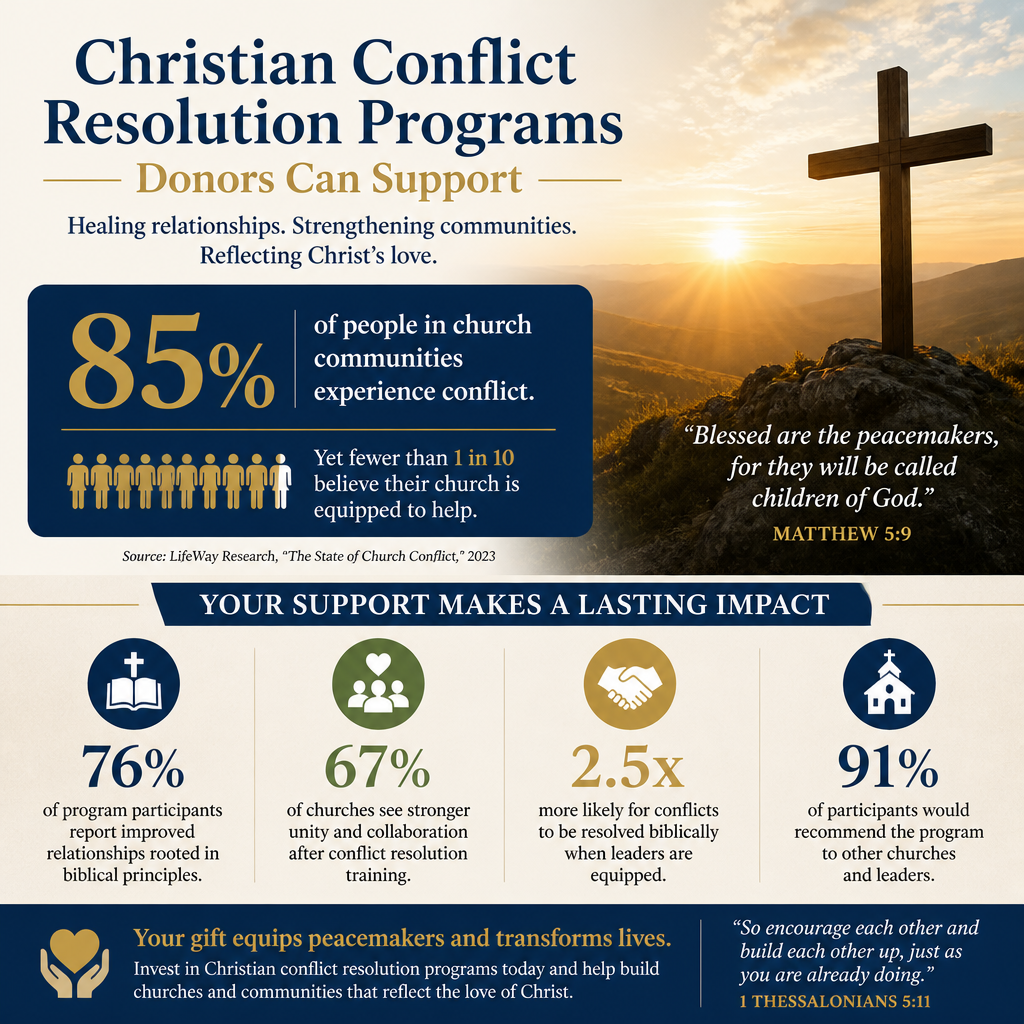
The Most Trusted Standard is designed for exactly this kind of category, where good intentions are common and hidden failures are costly. Donors should ask questions aligned to faith foundation, financial integrity, governance and leadership, and transparency and effectiveness—not as a bureaucratic exercise, but as stewardship before God.
Faithfulness to Scripture without using Scripture as a weapon
Matthew 18 is frequently invoked in church conflict, and often misused. Mature ministries teach the passage in context: it is a pathway toward repentance and restoration among brothers, not a tool to silence victims or bypass legal reporting. Donors should look for ministries that articulate how they apply Matthew 18 alongside other biblical imperatives, including the demands of justice, truthful testimony, and protection of the vulnerable (Proverbs 31:8–9).
Ask whether the ministry has written guidelines for cases involving abuse, criminal behavior, or safeguarding failures. If the answer is vague—“we handle those carefully”—that is not enough. Responsible ministries have explicit referral protocols and report when legally required.
Competence, ethics, and supervision
Conflict resolution is a practice discipline. Training hours, supervision, continuing education, and ethical codes matter. Donors should ask how mediators are vetted, how complaints are handled, and whether there is independent oversight. A ministry that makes significant claims about trauma, mental health, or abuse dynamics without appropriate competence is a risk to everyone involved.
It is also reasonable to ask what “success” is measured. Some ministries report simple counts of cases served. Better ones track durable indicators: participant satisfaction, compliance with agreements, recurrence rates, and time-to-resolution, while protecting confidentiality. When metrics are absent, donors are left with narratives, and narratives are easy to curate.
Governance practices that prevent capture by one leader or one network
High-conflict work attracts strong personalities. That can be a gift, but it can also turn a ministry into a personality-driven enterprise with weak accountability. Donors should ask about board independence, conflict-of-interest policies, and whether key decisions are documented. A ministry serving churches must itself model the governance it encourages in others.
Financial practices matter as well. Fee-for-service models can be appropriate, but they can also create subtle incentives to prolong cases or to promise more than is realistic. Transparent pricing, clear engagement letters, and published financial reporting are indicators of integrity.
Where donor funding can do the most good, and where it can do harm
Donors often prefer funding direct intervention in acute crises. Acute cases matter, but the deeper opportunity is to fund the conditions that make reconciliation more likely: competent training, wise policies, safeguarding systems, and leaders who can handle disagreement without fear. Prevention is less visible, but it is frequently more faithful.
Strategic giving that strengthens church capacity
Churches routinely face conflict around money, leadership, worship preferences, and moral discipline. A donor-funded scholarship pool for mediator training, elder-board facilitation coaching, or denominational reconciliation teams can strengthen whole networks. These investments are especially valuable in smaller churches that cannot afford specialized help.
Donors can also fund high-quality resources: model policies, case triage tools, and training materials that churches can adopt. The best resources avoid simplistic “three-step peace” formulas. They treat conflict as both spiritual and structural, shaped by power, incentives, and institutional memory.
Giving that supports victims and protects the vulnerable
Some disputes are not symmetrical. When a case involves coercion, retaliation, or credible allegations of abuse, the category changes. A ministry that insists on “both sides” without discerning power dynamics may harm the very people Scripture commands the church to protect. Donors should prioritize programs with clear safeguarding commitments, partnerships with qualified professionals when needed, and a demonstrated willingness to say “this is not a mediation case.”
Christians have learned in recent years that institutional reputation management can masquerade as reconciliation. Public reporting on church and nonprofit failures has made that plain. Careful donors will ask how a ministry handles whistleblowers, whether it maintains confidentiality appropriately without secrecy, and whether it cooperates with lawful investigations.
Common red flags donors should treat as disqualifying
- Guaranteed outcomes. Reconciliation cannot be promised. Ministries can promise process integrity, not changed hearts.
- Opaque authority. If it is unclear who decides what, donors should assume the vulnerable will bear the cost.
- Scripture used to suppress reporting. Any hint that Matthew 18 is used to block lawful reporting or due process is a serious warning.
- No written ethics and complaint process. High-conflict work without documented accountability is an invitation to harm.
- Financial and relational conflicts of interest. Ministries embedded in a single network may struggle to act independently when leaders are implicated.
Giving that honors Christ and serves peace with truth
Christian conflict resolution programs donors can support are most credible when they pursue peace the way Scripture does: through truth, repentance, forgiveness, and justice rightly ordered. The church’s witness depends not on the absence of conflict, but on the presence of integrity when conflict arrives.

Donors looking for a wider context on this field can begin with Christian Conflict Resolution Ministries. At Most Trusted, we encourage giving that is both compassionate and verifiable, because reconciliation work done carelessly can deepen wounds, while reconciliation work done faithfully can become a quiet form of gospel credibility in a skeptical age.



