

How Christian donors can involve their families in giving is not primarily a technique question. It is a discipleship question about what our children and heirs will love, trust, and serve when we are no longer there to curate their instincts. Scripture treats money as spiritual formation because it exposes allegiance; Jesus makes that plain in the Sermon on the Mount when he ties treasure to the heart.
Family giving also carries real tensions. Parents want to cultivate compassion without raising patrons. Adult children may not share the same convictions, or they may share the convictions but distrust institutions. Some families have experienced ministry failure at close range and now hesitate to commit. The work is to form durable, truthful habits: generosity rooted in worship, guided by wisdom, and protected by verification.
Begin with shared theology before shared strategy
Teach giving as worship and stewardship
Christian families often begin with budgets and end with arguments. The more stable order is worship first, then practice. The biblical frame is not that we “support causes,” but that we receive resources as stewards and return them as an act of obedience and love. The parable of the talents (Matthew 25) assumes accountability; the widow’s offering (Mark 12) assumes sacrifice; Zacchaeus (Luke 19) assumes repentance that becomes materially concrete.
What this means in practice is that family giving conversations should start with simple, shared convictions: God owns, we steward; the neighbor has claims on our attention; the gospel shapes both means and ends. Without that foundation, giving can become a contest between preferences, politics, or personality.
Name the formation goal with precision
Families benefit from articulating what giving is meant to form. Some households want to form gratitude; others want to form courage in the face of need; others want to form discernment in a skeptical age. Many need all three. The point is not to force uniformity but to put words to the desired kind of Christian maturity.
Across our verification work at Most Trusted, we observe that donor families who stay engaged over decades typically treat discernment as part of discipleship, not as a cynical posture. They want to love ministries well, which includes asking hard questions without withdrawing into suspicion.

Make giving a family practice, not a private transaction
Build a simple rhythm that children can see
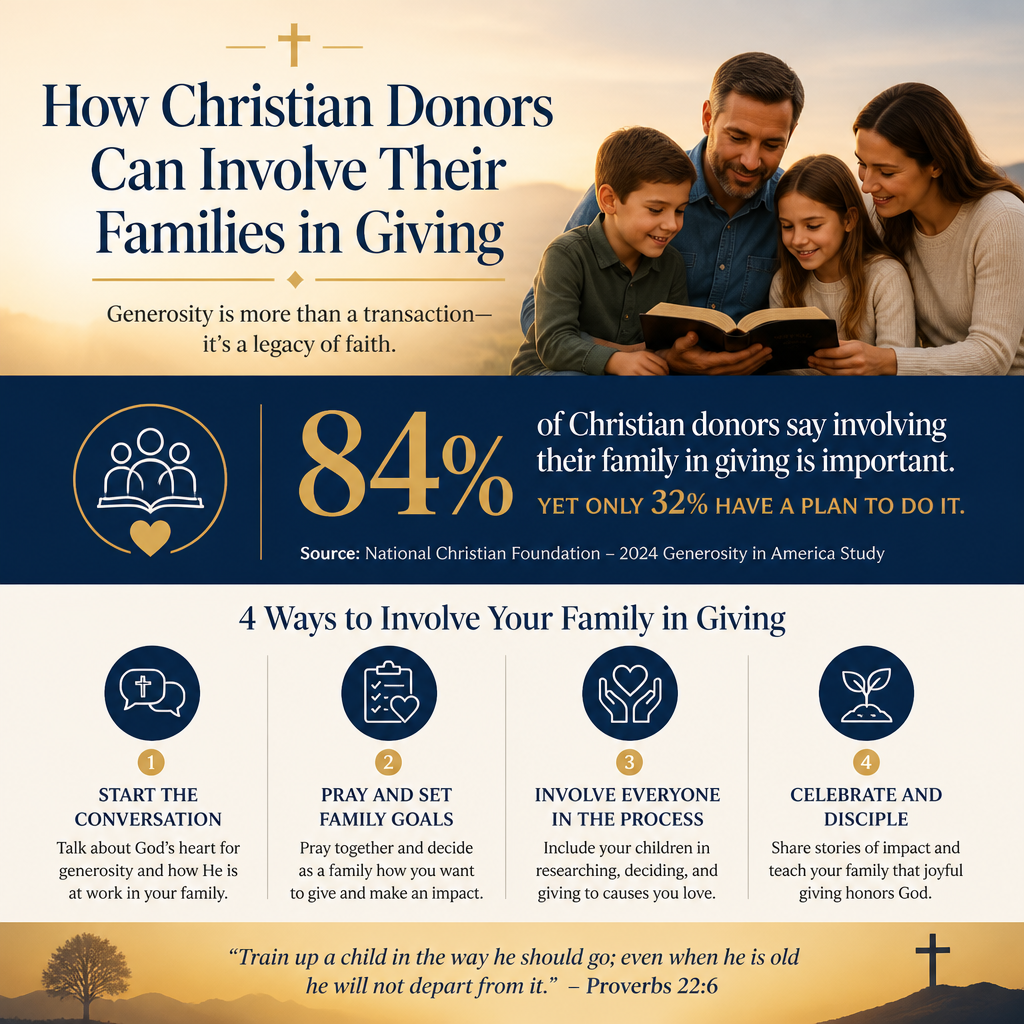
Children learn what a family honors by what they can observe, not by what they overhear once a year. A rhythm can be modest: a quarterly family meeting, a Sunday afternoon review, or a set moment during Advent and Lent. The aim is consistency without performance. When giving is invisible, it becomes abstract; when it is regular and calm, it becomes normal.
It also helps to assign roles by age. Younger children can help choose a local mercy ministry and write a note of encouragement. Teens can research a ministry’s reporting and talk through what evidence would increase confidence. Adult children can participate in higher-stakes decisions like multi-year commitments or legacy plans.
Use constraints to reduce conflict and increase clarity
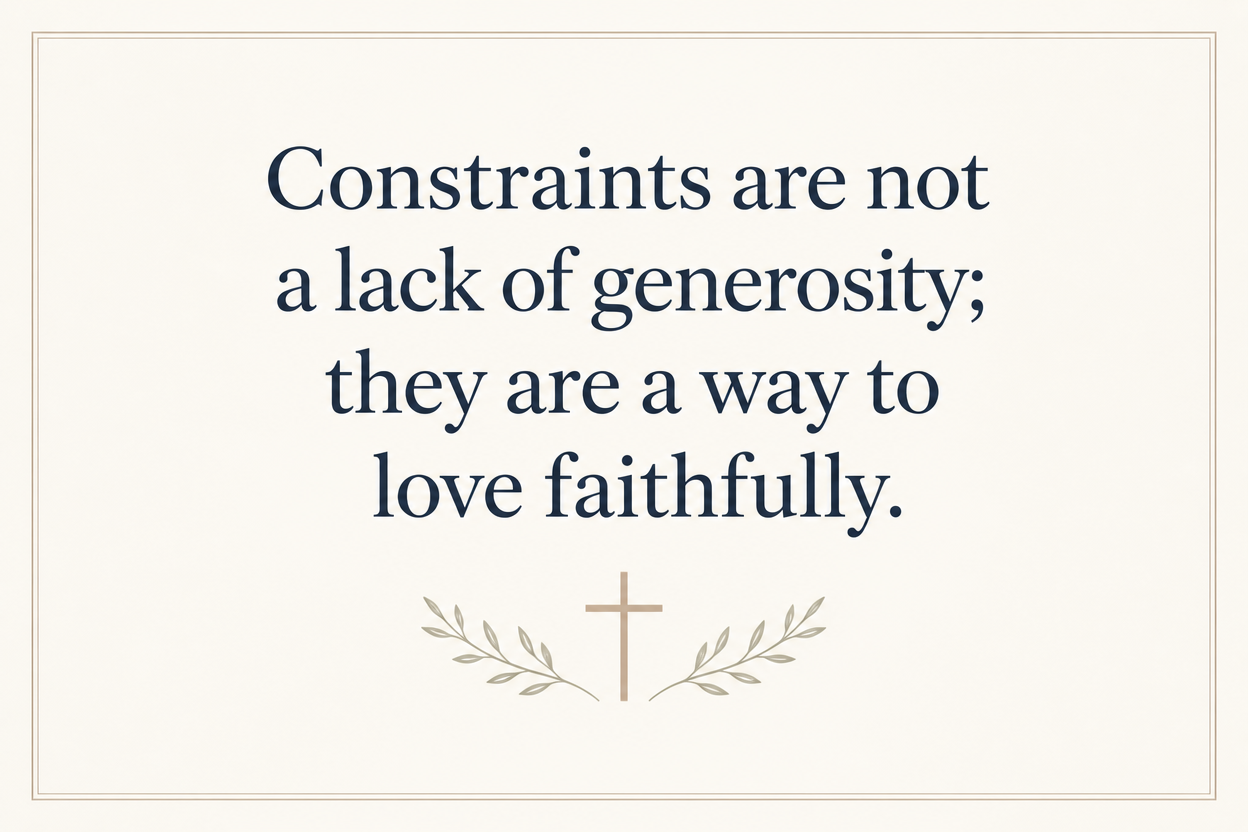
Constraints are not a lack of generosity; they are a way to love faithfully. Many families find peace by deciding in advance what portion of giving is “convictional” (core commitments that do not change often), what portion is “responsive” (disaster relief, emergent needs), and what portion is “formational” (smaller gifts chosen by children for learning). Christians genuinely disagree about whether giving should prioritize local church, local mercy, global mission, or policy-adjacent work, but pre-committed constraints keep disagreements from becoming personal.
A short set of household guidelines can also prevent whiplash. For example, a family might agree that they will not give to any organization that refuses basic financial disclosure, that they will avoid manipulative fundraising, and that they will favor ministries with evidence of outcomes appropriate to their mission.
Teach discernment as an act of love, not suspicion
Explain why verification matters in Christian giving
Christian donors often feel an understandable tension: charity should be simple, yet the modern nonprofit environment is complex. Scripture calls us to generosity, and it also calls us to wisdom. The book of Proverbs commends diligence and foresight; Paul insists on honorable administration of funds (2 Corinthians 8:20–21). Discernment is not a retreat from compassion. It is one way to protect the vulnerable and honor the giver’s stewardship.
Most Trusted exists because donors should not have to choose between warmhearted giving and responsible diligence. We evaluate ministries against The Most Trusted Standard, a 15-criteria framework that examines faith foundation, financial integrity, governance and leadership, and transparency and effectiveness. Families can use a verification framework as a shared vocabulary: not “Do we like them?” but “Do they meet credible standards of doctrine, oversight, and reporting?”
Address the overhead question with mature nuance
Many families still inherit the idea that the “best” ministries have the lowest overhead. The field has had to reckon with the fact that this is often a misleading proxy. A coalition letter signed by GuideStar, Charity Navigator, and the BBB Wise Giving Alliance warned donors against using overhead ratios as the sole or primary measure of nonprofit performance because it can punish necessary investments in staff, systems, and evaluation Charity Navigator.
What this means for family formation is that we should teach children to ask better questions: How is the ministry governed? What is the theory of change? What evidence suggests it is faithful and effective? Are financial statements accessible and timely? A family that learns to ask those questions together is far less likely to be manipulated by sentiment or branding.
- Do we understand what the ministry actually does, not only what it claims?
- Is there clear doctrinal alignment and a coherent faith foundation?
- Are leaders accountable through a functioning board and transparent policies?
- Are finances disclosed in a way that a donor can reasonably evaluate?
- Is impact reported with appropriate humility and specificity?
Invite children and heirs into real decisions with real stakes
Move from token participation to meaningful responsibility
Many families intend to include children, but the participation remains symbolic: a small gift chosen by the child while the serious decisions stay private. Symbolic involvement can be an appropriate starting point, but it cannot be the endpoint if the goal is lasting formation. Responsibility must increase with maturity. When adult children are excluded from meaningful decisions, they often infer that giving is either a private hobby or a parental control mechanism.
A more durable approach is progressive delegation. Parents might begin by inviting children to allocate a defined “formational” portion of the family’s annual giving. Later, they can invite teens and young adults into site visits, donor calls, and conversations about risk. Eventually, they can co-author a family giving statement that names priorities and guardrails.
Pair giving with proximity and prayer
Giving should not be reduced to financial transfer, especially for children who have not yet learned to see the world beyond their immediate environment. Proximity is not always possible, but it is often available: meeting local ministry leaders, serving alongside staff, writing letters to missionaries, or attending briefings where ministries explain their work with candor.
Prayer is the other discipline that keeps giving from becoming mere philanthropy. Families can pray for the people served, for the integrity of leaders, and for the family’s own hearts. This is also where children can voice questions and concerns without fear of being corrected too quickly.
Strengthen legacy giving with clarity and accountability
Plan for continuity without coercion
Legacy and family giving becomes complicated because it touches identity, inheritance, and authority. Parents may want continuity in values. Adult children may want agency. Both desires are understandable. The goal is not coercion; it is clarity. A well-constructed plan communicates priorities, explains the theological rationale, and establishes structures that keep generosity from dissolving under pressure.
Many families find it helpful to articulate a small number of primary commitments, then allow for discretionary giving within those boundaries. For families exploring this territory in more depth, the conversation often intersects with Legacy and Family Giving Through Christian Stewardship Services as a category of decisions that includes charitable trusts, donor-advised funds, bequests, and governance of family philanthropy.
Use independent standards to protect heirs and ministries
Legacy giving magnifies consequences. A single large bequest can bless a ministry for decades, or it can entangle a family in regret if the organization later proves unstable or unaccountable. Independent verification provides a layer of protection for both donors and recipients, especially when heirs did not build the original relationships.
Across our work, ministries that meet The Most Trusted Standard tend to treat transparency as part of discipleship rather than a compliance chore. They make it easier for families to remain united because they provide the information and governance signals that reduce speculation. This is one practical reason family donors benefit from staying connected to Christian Stewardship Services that emphasize both conviction and credible evaluation.
FAQs for How Christian donors can involve their families in giving
What if our adult children do not share our convictions about Christian giving?
Families should not pretend away theological difference, and they should not weaponize inheritance to force agreement. A steadier approach is to be explicit about what the family is funding and why, to set clear boundaries around any shared charitable vehicles, and to preserve some discretionary space for adult children to participate without violating conscience. Where convictions diverge sharply, separate giving lanes can reduce conflict while still modeling generosity and integrity.
How do we teach children to evaluate ministries without making them cynical?
We recommend framing evaluation as a form of love: love for donors who must steward well, love for recipients who are harmed by dysfunction, and love for faithful ministries that deserve confidence. Teach a few concrete questions about governance, financial disclosure, and truthful reporting, then pair those questions with prayer and real exposure to ministry work. Verification tools such as The Most Trusted Standard can help families replace vague suspicion with disciplined discernment.
A faithful family culture of giving is built, not inherited
Involving families in giving requires more than inviting children to pick a charity once a year. It asks for a shared theology of stewardship, a visible household rhythm, and a mature understanding that wise evaluation protects both ministry and mission. When families treat generosity as discipleship and pair it with accountable verification, they hand down more than resources. They hand down a way of seeing the world under God.



