
Why Christian donors use designated giving accounts is not primarily a question of financial technique. It is a question of stewardship under God: how to give with clarity of purpose, integrity of process, and faithfulness to both conscience and Scripture. For many mature donors, designated giving accounts exist because ordinary patterns of generosity do not easily handle complex callings, multi-year commitments, and the need for verifiable trust.
Christians also live with a real tension. We want our giving to be responsive to the Spirit and to immediate needs, yet we also want our giving to be disciplined, accountable, and durable. A designated giving account is one way donors reconcile those demands without pretending they do not compete.
Designated giving accounts translate conviction into disciplined stewardship
Giving is worship, but it still requires planning
Scripture treats money as spiritual territory, not neutral material. Jesus taught that where our treasure is, our heart follows (Matthew 6:21). Paul assumed that Christians would prepare giving in advance, not improvising under emotional pressure: “On the first day of every week, each of you is to put something aside and store it up” (1 Corinthians 16:2). A designated giving account operationalizes that practice. It separates intention from impulse, and it makes generosity a matter of habit rather than mood.
This is particularly important for donors whose income is irregular, whose expenses fluctuate, or whose major gifts are seasonal. A designated account can create a steady pattern of “setting aside,” so that large commitments are funded without destabilizing household responsibilities. That steadiness matters because Christian generosity is meant to be faithful, not merely enthusiastic.
Designation clarifies what the gift is for
Many donors use designated accounts because they do not want their giving to dissolve into a vague sense of “support.” They want to name the purpose: Bible translation, pastoral training, church planting, crisis relief, foster care, pro-life pregnancy support, prison ministry, or global missions partnerships. Designation forces the donor to articulate what they are actually trying to accomplish before the funds leave their hands.
What this means in practice is that designation can guard against a common pattern: reactive giving that feels compassionate but is not aligned with a coherent theology of calling. It also makes it easier for a donor family to teach children that generosity has content and intention, not merely sentiment.

Designated giving accounts help donors honor both mission and accountability
Trust is earned, and designated giving assumes that
Christian donors often give to ministries they love, but love is not the same as due diligence. Scripture commends both generosity and prudence. Proverbs repeatedly praises wise planning and sober discernment (for example, Proverbs 21:5). A designated account is frequently paired with a verification discipline: donors choose their designated recipients because they have evaluated whether the ministry’s doctrine, governance, finances, and reporting are worthy of trust.
At Most Trusted, our role is to make that evaluation more verifiable. We assess Christian nonprofits against The Most Trusted Standard, a 15-criteria framework across faith foundation, financial integrity, governance and leadership, and transparency and effectiveness. Donors use designated giving accounts because they want their giving to be more than well-intentioned; they want it to be accountable to reality.
Designation can protect against the pressure of institutional momentum
Even healthy ministries can drift. Leadership changes. Strategies shift. A program that was once central can become marginal, or a budget can grow in ways that are not matched by reporting clarity. Designation does not solve these risks, but it does create a decision point: donors must periodically reaffirm the purpose for which funds are set aside and whether the recipient still aligns with that purpose.
Christians genuinely disagree about how much control a donor should exercise over outcomes. Some emphasize donor humility and the freedom of a local ministry to decide. Others emphasize the moral responsibility of a giver to ensure that funds are used as promised. A designated giving account is often a middle path: donors do not attempt to micromanage, but they do insist on faithful use and transparent communication.
Designated giving accounts reduce friction for complex, multi-year generosity
Major commitments require a mechanism, not merely goodwill
Many Christian donors are navigating commitments that do not fit neatly into a weekly offering: a multi-year pledge to a capital campaign, recurring support for missionaries, a scholarship fund for theological education, or a targeted grant to strengthen a ministry’s internal controls. A designated giving account reduces the administrative friction of these commitments. It keeps the purpose visible and the funds segregated so that a donor can fulfill commitments without repeatedly re-deciding the same gift.
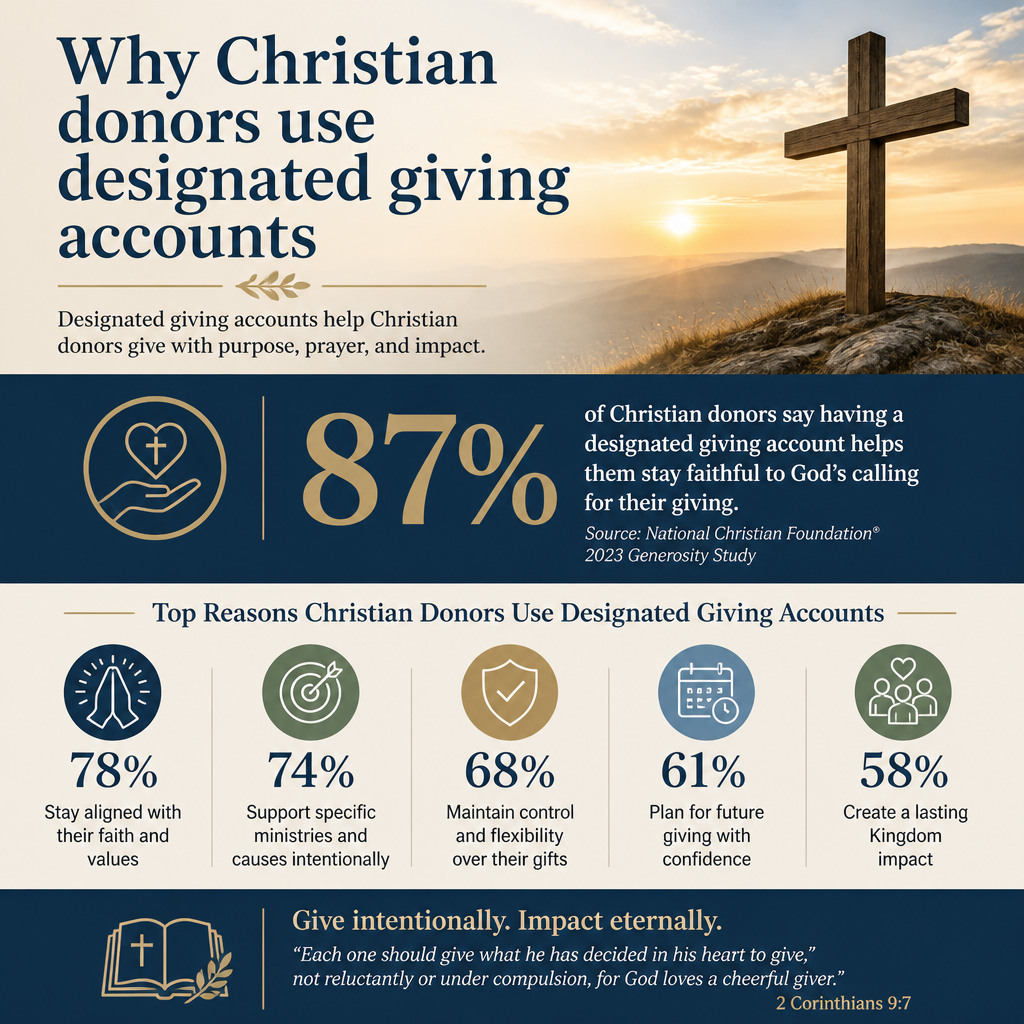
The harder question is how to balance flexibility with faithfulness when circumstances change. A designated account can allow a donor to pause, redirect, or increase a commitment without scrambling for records. It becomes a tool for keeping promises with integrity rather than relying on memory.
Donor-advised funds and ministry-specific accounts are not the same
Some donors use donor-advised funds for their designated giving because of tax timing and grantmaking flexibility. Others prefer a ministry-managed designated account because it keeps the relationship closer to the ministry’s work. The difference matters. A donor-advised fund typically introduces another institution between donor and recipient, which can add accountability but also delay. A ministry-managed account can be faster but may require stronger confidence in the ministry’s internal governance and reporting.
For donors who are actively grantmaking across multiple causes, it is often helpful to situate designated accounts within a wider stewardship framework. We address that broader context in Christian Stewardship Services, where donors can think more carefully about how tools and convictions align.
Designated giving accounts support better grantmaking practices
Designation can encourage restricted giving with proper caution
Restricted gifts can be a gift to a ministry when they are well-communicated and aligned with actual capacity. They can also become a burden when restrictions are vague, unrealistic, or disconnected from how the ministry operates. Wise donors tend to use designated accounts to be specific without being naïve: they define purpose in plain language, they confirm that the ministry can accept and track the restriction, and they ask what reporting will be provided.
A sober caution is necessary here. The nonprofit sector has long warned about the “starvation cycle,” a pattern in which donors underfund core capacity while expecting increasing results, described by Ann Goggins Gregory and Don Howard in Stanford Social Innovation Review. Christian donors sometimes replicate this cycle by designating gifts only to visible programs while neglecting governance, financial controls, staff development, and evaluation. Strong ministries typically require support for both mission delivery and the infrastructure that keeps mission delivery honest.
A designated account can operationalize a grantmaking policy
Mature donors often create a simple internal policy for designated giving, especially when multiple family members participate. The aim is not bureaucracy; it is faithfulness. A designated giving account provides the “container” for that policy so it can be executed consistently.
- Cause clarity: which callings we will prioritize this year and why.
- Eligibility criteria: what we require from ministries in doctrine, governance, and reporting.
- Gift types: when we will fund programs, capacity, emergency needs, or matching challenges.
- Review cadence: how often we reassess designated recipients and outcomes.
- Documentation: what receipts, reports, and impact updates we will retain.
For donors who want to connect these disciplines to broader patterns of Christian grantmaking, How Christian Stewardship Services Support Grantmaking provides context on how stewardship tools can strengthen both prudence and generosity.
Designated giving accounts can guard the conscience without hardening the heart
Designation is often about moral clarity, not control
Some donors use designated accounts because they are trying to avoid complicity in practices they cannot affirm. A donor may support a ministry’s evangelism and discipleship work but hesitate to fund lobbying activities, foreign partnerships without clear safeguards, or programs that raise child-protection questions. In such cases, a designated account can become a way of giving generously while staying within the boundaries of conscience.
That said, designation can be misused. It can become a way to demand outcomes that are not realistic, or to treat ministries as vendors rather than as Christian institutions with their own responsibilities before God. The corrective is not to abandon designation, but to approach it with humility and clarity: we designate what we mean, we listen to how a ministry actually operates, and we fund what we can responsibly stand behind.
Healthy designation depends on transparent ministries
Designation works best when ministries report clearly on how restricted funds are tracked, how results are measured, and how leadership is governed. Where ministries are opaque, designation can create false confidence. A donor may feel protected because a gift was “for a program,” while the ministry’s overall integrity remains unexamined.
This is one reason verification matters. Donors need more than compelling stories; they need evidence of faithful governance, clean financial practices, and truthful reporting. Ministries that meet The Most Trusted Standard tend to treat donor intent as a serious obligation, not a marketing preference.
FAQs for Why Christian donors use designated giving accounts
Are designated giving accounts unbiblical because they restrict ministry leadership?
Designation is not inherently unbiblical. Scripture affirms both generosity and order. Paul’s instructions for planned giving (1 Corinthians 16:2) assume intentionality, and the early church handled designated relief for specific needs (for example, famine relief). The question is posture and clarity. When designation is communicated plainly, accepted knowingly by the ministry, and held with humility rather than control, it can serve stewardship rather than undermine leadership.
Does designation reduce a ministry’s flexibility to meet real needs?
It can. Restricted giving can limit a ministry’s ability to fund core operations or respond to changing conditions, especially when donors over-designate toward visible programs. Wise donors ask ministries what their actual constraints are, and many choose a blend: some gifts designated to a clear purpose, and some unrestricted to strengthen the whole institution. Mature stewardship keeps mission focus without starving the capacity that makes faithful mission possible.
Giving with intention is not the opposite of giving with faith
Christian donors use designated giving accounts because they are trying to practice generosity that is both warm-hearted and well-governed. Designation helps translate conviction into repeatable discipline, sustain multi-year commitments, and keep accountability close to donor intent. When paired with serious verification and transparent ministry reporting, designated giving can be a form of worship that honors both the giver’s conscience and the recipient’s calling.



