
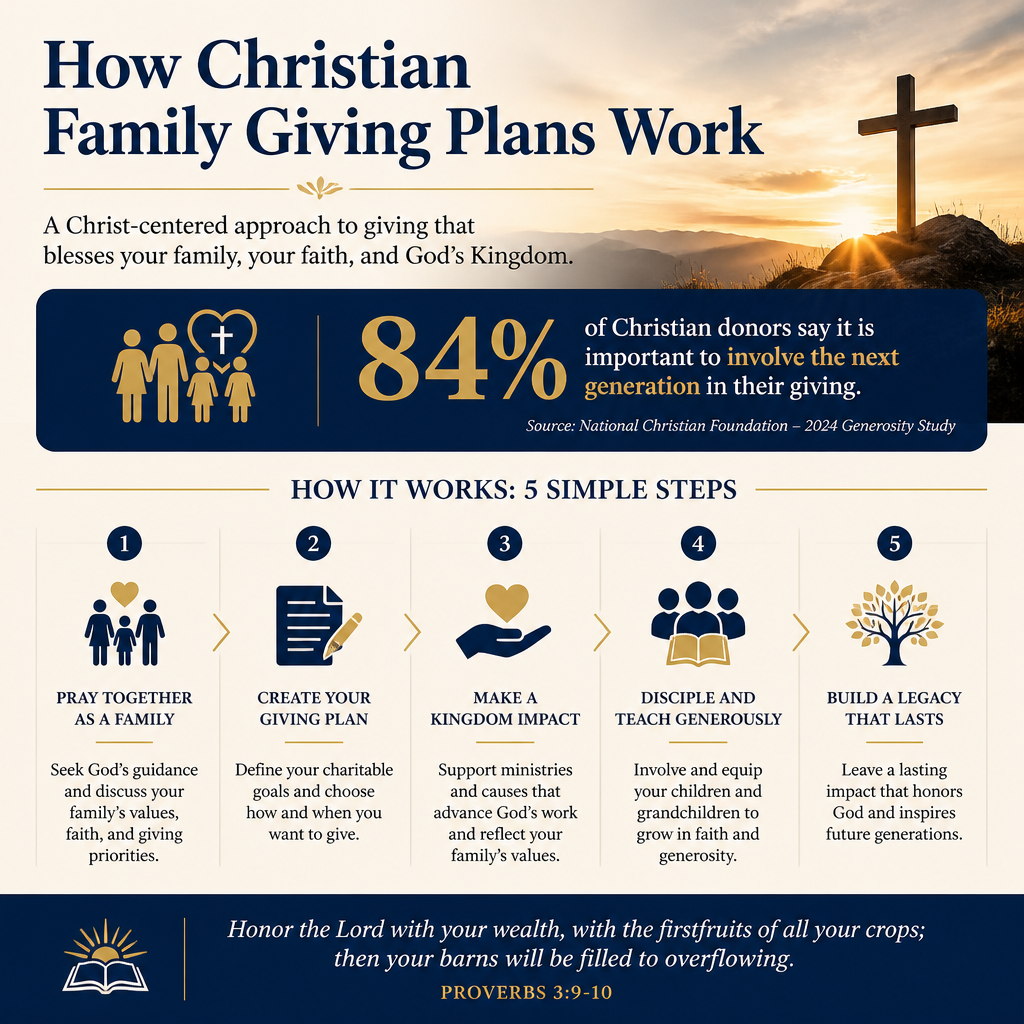
How Christian family giving plans work is less about a clever financial mechanism and more about disciplined discipleship across generations. The plan itself is simply a set of shared commitments—grounded in Scripture, aligned with a family’s callings, and implemented through practical tools—so that generosity becomes a pattern rather than a periodic impulse.
Many Christian donors feel the tension acutely: family members share a last name but not always a theology of money, a set of convictions about impact, or even basic trust in institutions. A giving plan does not remove that tension. It can, however, name it, order it, and keep the family’s stewardship from being ruled by urgency, guilt, or inertia.
Christian family giving begins with shared theology not shared preferences
Start where Scripture starts
Christian giving is never merely philanthropic. Scripture frames wealth as entrusted, not possessed: “Moreover, it is required of stewards that they be found faithful” (1 Corinthians 4:2). That premise changes the question from “What do we feel like supporting?” to “What faithfulness requires of us in this season, with these resources, for these neighbors.” A family giving plan works when it makes those foundational commitments explicit and revisitable.
Christians genuinely disagree about application. Some families emphasize the local church as the primary channel for giving; others feel a particular responsibility toward global missions, crisis relief, or justice work. A plan does not have to force uniformity. It can set a shared center—worship, accountability, love of neighbor—while allowing distinct callings at the edges.
Define the giving you are trying to form
Across our verification work, we observe that the healthiest family givers distinguish formation goals from grant goals. Formation goals answer questions such as: Are we training humility, courage, and truthfulness? Are we learning to resist manipulation? Are we willing to fund the unglamorous work of administration, safeguarding, and evaluation when it is warranted? Grant goals answer: Which outcomes, communities, or ministry categories are we prioritizing this year?
Families often assume these are the same conversation. They are related, but not identical. A family can fund good work and still form shallow habits—reactive giving, prestige giving, or giving that is more about self-protection than love.

Most family giving plans are an annual rhythm with clear roles and guardrails
A workable cadence beats a perfect one
In practice, how Christian family giving plans work is typically an annual cycle with a few predictable meetings: one meeting to reaffirm convictions and boundaries, one to review opportunities and due diligence, and one to decide and communicate grants. The cadence matters because families change. Children become adults. Adult children marry. Parents age. A plan that cannot absorb change without crisis is not a plan; it is a temporary alignment.
Even in spiritually mature families, “fairness” becomes a hidden pressure. Equal voice is not always the same as equal influence. A family plan works better when it states who decides what, and why. Some decisions may belong to parents while they are living; others may be delegated to a committee; others may be reserved for unanimous agreement because the stakes are high.
Guardrails prevent conflict from becoming a moral referendum
Families often interpret disagreement as a sign of faithlessness. That is an avoidable mistake. The more durable approach is to agree in advance on guardrails that keep debate from becoming personal.
- Scope: what types of ministries are in view (local church, missions, mercy, advocacy, education).
- Geography: local, national, global, or a deliberate mix.
- Time horizon: short-term relief versus long-term development, and how you balance both.
- Risk posture: how you treat new initiatives versus proven operators.
- Evidence expectations: what you require in reporting, safeguarding, and measurable outcomes.
The field has had to reckon with the damage that can be done by well-intentioned generosity. The When Helping Hurts framework, articulated by Steve Corbett and Brian Fikkert, has sharpened Christian thinking about dependency, dignity, and the difference between relief and development in poverty alleviation (When Helping Hurts). A family giving plan works when it embeds those distinctions into decision-making rather than treating them as optional reading.
Tools serve the plan and the plan serves formation
The common tools and what they actually do
Families sometimes begin with a tool—donor-advised fund, charitable trust, a private foundation—before they have clarity about purpose. That order often produces confusion. Tools are servants; they are not vision. In Christian stewardship, the most sophisticated structure is still subordinate to faithfulness.
Common tools include:
Donor-advised funds for organized giving with administrative simplicity, often well suited to families who want a shared account and a regular decision process. Private foundations for families who want a formal institution, staffing, and a stronger public profile, with more regulatory complexity. Planned gifts (such as bequests) for donors who want generosity to continue beyond their lifetime. Each tool has tax and governance implications; competent counsel is a gift to the family, not a sign of spiritual compromise.
Where verification fits when trust is not assumed
Christian donors increasingly understand that “ministry” is not a magic word that removes the need for oversight. Families are right to insist on clarity about governance, financial integrity, and measurable fruit. Most Trusted exists to help donors give with confidence by evaluating ministries against The Most Trusted Standard, a 15-criteria framework across Faith Foundation, Financial Integrity, Governance and Leadership, and Transparency and Effectiveness.
What this means in practice is that a family giving plan can assign due diligence to a small team and require objective standards for the ministries under consideration. That approach lowers the temperature of internal debate. It replaces “We like them” with “They meet stated requirements.” It also protects the family from the common pattern of being pressured by charismatic appeals and thin documentation.
Families who want the broader landscape of stewardship resources often begin with Christian Stewardship Services as a reference point for the kinds of practices and safeguards that support long-term faithfulness.
Due diligence is a spiritual discipline because it refuses both cynicism and naivete
Transparency is not hostility
Some donors worry that asking hard questions signals distrust. Scripture gives a different posture: “Beloved, do not believe every spirit, but test the spirits” (1 John 4:1). Testing is not cynicism; it is discernment. It is also a form of respect for the people a ministry serves. When a ministry cannot explain its finances, governance, or safeguarding, the people at the margins carry the risk.
Evidence suggests that confidence in institutions has weakened broadly in American life, including in religious communities. Gallup has tracked declining confidence in major institutions over decades, a pattern that affects donors’ willingness to give without verification (Gallup). A family giving plan works when it acknowledges this reality without surrendering to suspicion as a worldview.
Move beyond the overhead fixation without abandoning accountability
Christian donors frequently inherit the assumption that “low overhead” equals faithfulness. The sector has repeatedly challenged that assumption. The Overhead Myth letter, signed by GuideStar (now Candid), Charity Navigator, and BBB Wise Giving Alliance, argued that overhead ratios are a poor proxy for effectiveness and can pressure organizations into underinvesting in systems that protect beneficiaries and ensure quality (Candid GuideStar). The letter does not remove the need to evaluate spending; it clarifies that the right question is whether spending is justified by mission, outcomes, and integrity.
A mature family plan therefore asks for audited financials when appropriate, clear conflict-of-interest policies, independent board oversight, safeguarding policies, and credible reporting on outcomes. It also recognizes that the level of due diligence should fit the size and risk of the gift. Families do not need a forensic investigation for every small donation. They do need a consistent standard for major commitments.
Passing generosity to the next generation requires more than leaving money
Formation happens through participation not instruction
Many parents can articulate a theology of generosity; fewer can pass on the practices that sustain it. A family giving plan works when children and grandchildren participate in real decisions, with real consequences, under real accountability. That participation should be age-appropriate, but it should be meaningful. The goal is not merely to create informed donors; it is to cultivate Christian stewards who can resist the idols that attach to money—status, control, safety, and self-justification.
The harder question is how to engage family members who do not share the same convictions. Wisdom here is rarely dramatic. Some families create parallel tracks: a portion of giving that reflects the founding convictions and another portion that allows broader participation. Others require that shared family funds align with a defined statement of faith and practice, while personal funds remain unconstrained. Both approaches involve trade-offs. The point is to choose openly rather than defaulting to a silent power struggle.
Legacy is not only what you fund but what you normalize
Families sometimes treat legacy planning as a legal act: documents completed, assets directed, intentions secured. Yet the deeper legacy is cultural. What a family normalizes—truth-telling, careful listening to those served, refusal to romanticize impact, insistence on integrity—will shape giving long after the original donors are gone. This is why governance matters inside the family as much as governance matters inside the ministries you support.
Donors who are specifically considering long-term structures, succession, and intergenerational alignment often find relevant context in Legacy and Family Giving Through Christian Stewardship Services, especially where the questions are as relational as they are financial.
FAQs for How Christian family giving plans work
Do Christian family giving plans require a donor-advised fund or foundation?
No. Many families begin with a written statement of convictions, a budgeted annual amount, and a disciplined decision process, then add structures as complexity grows. The tool should follow the family’s goals, not replace them. For some families, a donor-advised fund provides sufficient order; for others, a foundation or trust is appropriate because of size, governance needs, or legacy aims.
How do we choose ministries without turning family meetings into debates about politics and personalities?
Families reduce friction by deciding standards before they decide recipients. Clear guardrails, a defined risk posture, and an agreed due diligence process keep disagreement from becoming a referendum on someone’s faithfulness. Many families also use independent verification to ground discussions in evidence about governance, financial integrity, and transparency, rather than impressions or social pressure.
A giving plan works when it trains faithfulness over time
How Christian family giving plans work, at their best, is simple and demanding: shared theological commitments, a repeatable rhythm, appropriate tools, and disciplined discernment about who is worthy of trust. Families will still face disagreement, generational change, and competing needs. A plan does not eliminate those pressures; it orders them so that generosity remains a form of worship rather than a reaction to the loudest appeal.



