
How Christian donor-advised funds vet recipient charities is not a procedural curiosity; it is a question of moral responsibility. When donors recommend a grant, they are not merely moving money efficiently. They are bearing witness to what they believe is true and worthy in the world, and that witness is compromised when funds reach ministries that distort the gospel, mishandle power, or treat financial accountability as optional.
Donor-advised funds sit at a critical intersection: they must honor a donor’s intent while maintaining legal compliance, guarding against fraud, and making prudent judgments about whether a prospective recipient can receive charitable dollars responsibly. Christian donors often add another layer: faithfulness to historic Christian teaching and a concern that giving supports real ministry rather than religious branding.
What a donor-advised fund is required to do and what it chooses to do
A donor-advised fund sponsor has formal obligations that are not negotiable. At minimum, it must confirm that a recipient is a qualified charitable organization under federal law, that the grant is for charitable purposes, and that the donor receives no impermissible benefit. These requirements form a baseline of compliance, not a full moral or theological evaluation.
What differentiates Christian donor-advised fund sponsors is the additional diligence they choose to apply. Some treat “Christian” as a branding cue and stop after IRS eligibility. Others view Christian identity as a stewardship claim that must be tested.
Baseline vetting is primarily legal and risk-based
Most DAF vetting begins with eligibility checks: whether the recipient is recognized as a public charity, whether it is in good standing, and whether the grant creates private benefit. The IRS rules around donor-advised funds make clear that the sponsor must exercise “expenditure responsibility” in specific contexts and must avoid grants that confer more than incidental benefit to donors or related parties; donors should recognize that these constraints exist to protect the integrity of charitable giving, not to frustrate generosity. The underlying regulatory framework is described by the IRS on its donor-advised funds resources page at IRS.
Christian sponsors add faith and mission questions that law does not address
The harder question is whether a ministry’s stated faith is substantive or merely ornamental. A DAF sponsor may ask about doctrinal commitments, church relationships, hiring and leadership standards, and whether the ministry’s public communications reflect Christian truthfulness and humility. Christians genuinely disagree about how much doctrinal precision a giving vehicle should require, but there is wide agreement that donors should not be asked to fund ministries whose faith claims are unaccountable or opportunistic.
Donors comparing sponsors often benefit from reading within the broader category of How to Choose a Christian Donor-Advised Fund Sponsor, since vetting is only one part of how a sponsor protects donors and recipients alike.

How sponsors confirm Christian identity without turning the DAF into a denomination
A Christian donor-advised fund sponsor cannot adjudicate every theological dispute, and it should not pretend to. But it can establish clear, public standards for Christian identity that are neither vague nor sectarian. Responsible sponsors typically focus on core commitments, governance accountability, and the ministry’s lived posture toward the local church.
Doctrinal baseline and accountability structures
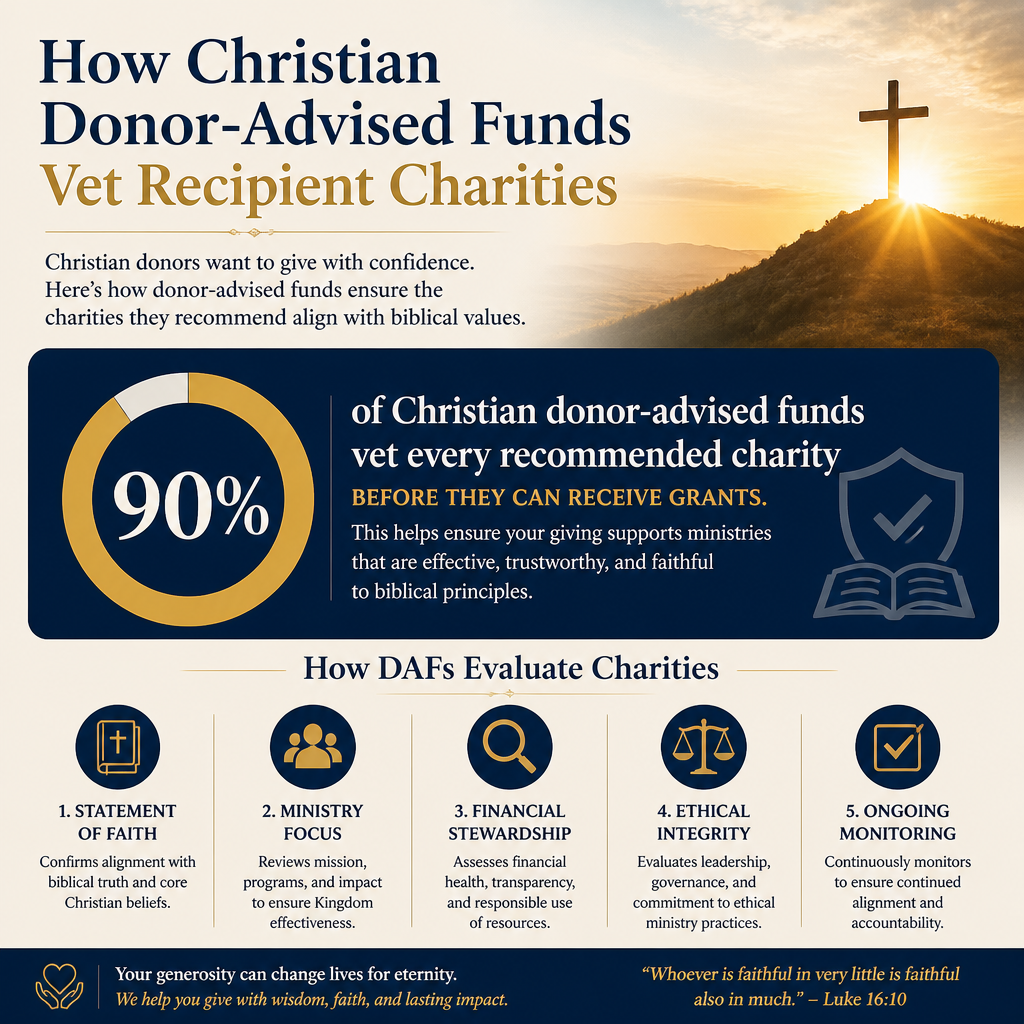
Common signals include a statement of faith aligned with historic orthodoxy, evidence that leaders are accountable to a board that understands Christian doctrine, and a meaningful relationship to a church or recognized Christian network. The goal is not perfection but coherence: a ministry should be able to explain what it believes, how leaders are held accountable, and how that belief shapes decisions under pressure.
Across our verification work at Most Trusted, we observe that ministries able to articulate their theological commitments plainly are usually also more transparent in other areas. Evasion in doctrine often correlates with evasion in governance and reporting. That is not a rule without exception, but it is a recurring pattern.
Mission alignment and the problem of religious marketing
Christian branding is easy to purchase. Faithful operations are not. Sponsors therefore look for operational evidence: how staff are formed, what program practices communicate about God and neighbor, how fundraising tells the truth about impact, and how the ministry responds when outsiders raise concerns.
Scripture does not treat truth-telling as a secondary virtue. “We refuse to practice cunning or to tamper with God’s word” is an apostolic standard of ministry integrity (2 Corinthians 4:2). A sponsor’s faith vetting should be understood as a practical application of that principle: Christian money should not subsidize manipulation, exaggeration, or spiritual coercion.
Financial and legal diligence that protects donors and ministries
Once Christian identity is credibly established, the next question is whether the organization is financially sound and legally compliant. Mature donors recognize that under-resourced ministries can be faithful but fragile, and that well-funded ministries can drift into entitlement. Financial diligence is not a substitute for spiritual discernment, but it is a necessary form of neighbor-love toward both donors and beneficiaries.
What documents typically get reviewed
Sponsors commonly request or review IRS filings, audited financial statements when available, and governance documents. They may screen for sanctions and anti-terrorism compliance, check for good standing with state charity regulators, and review whether the organization has credible internal controls.
Thoughtful sponsors have also learned to avoid simplistic “overhead ratio” judgments. The sector’s leading charity evaluators and oversight bodies have repeatedly warned that overhead ratios are a poor proxy for effectiveness and can create harmful incentives; the joint statement known as the “Overhead Myth” is hosted by BBB Wise Giving Alliance at BBB Wise Giving Alliance. A Christian sponsor may still ask about administrative and fundraising costs, but it should ask in a way that rewards honesty and maturity rather than cosmetic budgeting.
Private benefit, inurement, and donor control
DAF sponsors must ensure that grants do not provide a donor with more than incidental benefit, and that they do not simply function as pass-throughs where a donor directs spending as if the funds were still personal assets. This protects donors from avoidable legal exposure and protects the charitable sector from becoming a tax-sheltered checking account.
In practice, that means sponsors may restrict grants to individuals, limit grants that pay for event tables that confer benefits, and require separation between donors and vendor relationships. These guardrails can feel restrictive, but they are also part of keeping Christian giving credible in the public square.
Governance and leadership vetting where many failures begin
High-profile ministry collapses rarely start with theology statements. They usually begin with unaccountable leadership, captured boards, weak controls, and a culture where results excuse conduct. Christian donors have become understandably wary of charisma without accountability.
Board independence and real oversight
Responsible sponsors assess whether a board exists in more than name. Do board members have independence from the founder? Do they meet regularly, review budgets, and document decisions? Are conflicts of interest disclosed and managed? Even in small ministries, the presence of basic governance discipline is a meaningful indicator of whether the organization is teachable.
Our team also pays attention to whether spiritual authority is used to short-circuit legitimate questions. When donors are told that scrutiny is “lack of faith,” the ministry is already in a dangerous posture. Scripture commends tested character and public integrity, not exemption from evaluation (1 Timothy 3:1–13).
Safeguarding, abuse prevention, and reporting culture
Many Christian donors now expect sponsors to ask about child protection, counseling boundaries, reporting mechanisms, and how allegations are handled. This is not cynicism. It is a sober response to documented patterns of harm inside both churches and parachurch ministries.
Where donors want a research-informed understanding of abuse dynamics, the Department of Justice’s National Institute of Justice provides extensive resources on abuse prevention and reporting at National Institute of Justice. A DAF sponsor is not an investigative agency, but it can require basic safeguarding policies and decline support for organizations that treat abuse prevention as an afterthought.
What strong vetting looks like in practice and what donors should ask for
Vetting is never a single moment. The best sponsors treat it as an ongoing responsibility, revisiting approved recipients, responding to credible concerns, and clarifying what kinds of grants they will and will not process. Donors should evaluate sponsors not only by what they claim to screen, but by how they make judgments when trade-offs are real.
A disciplined process with defined standards
At Most Trusted, we evaluate ministries against The Most Trusted Standard, a 15-criteria framework spanning Faith Foundation, Financial Integrity, Governance and Leadership, and Transparency and Effectiveness. Not every DAF sponsor will use that framework, but donors can still look for the same conceptual elements: clear faith commitments, credible financial controls, accountable leadership, and honest reporting.
What this means in practice is that donors should prefer sponsors that can articulate their screening criteria publicly, explain how exceptions are handled, and describe how concerns are escalated. A sponsor that cannot explain its process is asking donors to substitute trust in a brand for trust in verifiable practices.
Donor questions that reveal whether vetting is substantive
Before opening or funding an account, donors should request concrete answers. A short list of questions usually separates serious diligence from marketing language:
- What standards do you use to determine whether a recipient is meaningfully Christian, and are those standards published?
- Which documents do you review for new recipients, and how often do you re-check existing recipients?
- How do you evaluate governance, conflicts of interest, and leadership accountability?
- What safeguarding policies do you require for ministries working with children or vulnerable adults?
- What triggers a pause or removal from your approved recipient list, and do you notify donors?
Donors also benefit from stepping back into the broader landscape of Christian Donor-Advised Funds to understand how sponsor structures, policies, and incentives shape these answers over time.
FAQs for How Christian donor-advised funds vet recipient charities
Do Christian donor-advised funds only give to 501c3 organizations?
In general, a DAF sponsor’s grants go to organizations that are legally qualified charitable recipients under U.S. tax law, most commonly 501(c)(3) public charities. Some sponsors can support certain international activities through approved intermediaries or equivalency determinations, but the sponsor must still ensure the grant is used for charitable purposes and complies with applicable regulations. Donors should ask the sponsor to explain its specific policies for international giving and nontraditional recipients.
If a charity is approved by a Christian DAF, does that mean it is trustworthy?
Approval usually means the charity meets the sponsor’s eligibility and risk thresholds, not that it has been comprehensively verified on theology, governance, finances, and effectiveness. Vetting depth varies widely among sponsors. Donors seeking higher confidence should ask for the sponsor’s written criteria, look for ongoing monitoring practices, and consider independent verification against a defined framework such as The Most Trusted Standard.
Vetting is stewardship, not suspicion
Christian donors are not called to cynicism, but neither are they called to naiveté. A Christian donor-advised fund sponsor that vets with clarity and conviction helps donors practice stewardship with a clean conscience, honoring both the gospel’s demands for truth and the neighbor’s need for competent, accountable ministry. Giving with confidence is rarely the fruit of sentiment; it is usually the fruit of disciplined love.



