

Choosing a Christian donor-advised fund sponsor is not a branding exercise. It is a governance decision about who will hold charitable assets in trust, apply theological and ethical constraints, and mediate your giving to the ministries you care about. For Christian donors, the question is not only whether the sponsor is efficient, but whether its structure and practices help you pursue obedience without confusion of loyalties.
Scripture treats wealth as morally weighty: “Moreover, it is required of stewards that they be found faithful” (1 Corinthians 4:2). A donor-advised fund sponsor becomes part of that stewardship chain. The right sponsor can support clarity, consistency, and accountability. The wrong sponsor can introduce drift: unclear screening, weak governance, or a theological posture that is vague enough to accommodate almost anything.
Begin with the sponsor’s fiduciary and theological obligations
A donor-advised fund is a public charity. When you contribute, the assets legally belong to the sponsor, and you retain advisory privileges. That legal reality is not a technicality; it determines what the sponsor can require, what it can refuse, and how it resolves disputes. Christian donors should begin by asking what obligations the sponsor believes it has before God and before the law, and how those obligations are codified.
Confirm who holds final authority and how it is exercised
Every sponsor reserves the right to approve or deny a grant recommendation. The practical difference is how that authority is governed. A mature sponsor will have a clear grants policy, documented compliance steps, and defined escalation for edge cases. This matters when a recipient ministry is facing allegations, when a project changes midstream, or when a church partner lacks the documentation that a sponsor reasonably needs.
Ask for the sponsor’s written policy on restricted gifts, fiscal sponsorship, international grants, and grants to individuals (generally prohibited). These categories are where confusion and disappointment most often occur, and clarity at the policy level is usually a sign of operational integrity.
Clarify the sponsor’s statement of faith and functional orthodoxy
Christian donors genuinely disagree about secondary questions—charismatic practice, denominational distinctives, or schooling choices. But a sponsor’s theological baseline should be more than aspirational language. We recommend asking whether the sponsor’s statement of faith is binding on its board and leadership, whether it is used in due diligence, and what happens when a grantee’s public teaching contradicts it.
The harder question is “functional orthodoxy”: not what a sponsor says, but what it funds, platforms, and treats as compatible with Christian witness. If the sponsor cannot explain how it handles contested moral issues with principled consistency, donors should expect inconsistency in practice.
Understand the boundaries of “Christian” in the sponsor’s grantmaking
Some explicitly Christian sponsors allow grants only to ministries with a doctrinal statement and Christian leadership. Others permit grants to any IRS-qualified charity, including secular institutions, as long as the donor recommends them. Neither posture is automatically unfaithful; each reflects a view of vocation, common grace, and public good. The key is alignment. Donors should know whether a sponsor’s Christian identity governs the entire platform or functions primarily as a culture marker.

Evaluate financial integrity and fee practices with sober realism
DAFs are often described as “simple.” The accounting behind them is not. A sponsor aggregates donor accounts, invests pooled assets, charges fees, discloses results, and maintains compliance across thousands of grants. Christian donors should examine whether the sponsor’s economics are understandable and whether incentives are aligned with faithful service rather than asset accumulation.
Read the audited financials and verify where revenue comes from
A credible sponsor will provide audited financial statements and a current Form 990. Those documents show whether the organization is solvent, whether it depends on unusually concentrated funding, and how much it spends on administration relative to program services. They also disclose related-party transactions and executive compensation practices, which can signal governance quality.
We caution donors against simplistic overhead judgments. The sector has long recognized that overhead ratios can be misleading, a point Charity Navigator, Candid (formerly GuideStar), and the BBB Wise Giving Alliance emphasized in their joint “Overhead Myth” letter (Charity Navigator). A well-run sponsor will still be able to explain why its fees are what they are, what those fees fund, and what service standards donors should expect in return.
Compare fee schedules and investment options without false precision
Fee schedules vary: administrative fees, investment management fees, and sometimes additional charges for complex grants. Investment menus vary as well: passive index options, faith-screened funds, or bespoke portfolios for larger accounts. A sponsor can be inexpensive and poorly governed; it can also be more expensive and genuinely careful.
We recommend focusing on three realities: (1) whether fees are clearly disclosed and predictable, (2) whether investment performance reporting is transparent and net of fees, and (3) whether faith-screening claims are documented. “Biblical investing” can mean anything from modest exclusions to comprehensive screens. Donors should insist on specificity.
Know the tax and payout dynamics that shape donor behavior
DAFs can be tax-efficient, but they also create a temptation to treat generosity as a planning tool rather than a spiritual discipline. The National Philanthropic Trust’s annual DAF report documents the scale and growth of donor-advised funds and includes sector-level data on grants and assets (National Philanthropic Trust). Even when aggregate payout rates appear healthy, donors should still examine their own patterns: whether the DAF increases faithful giving or simply warehouses intent.
For many Christian households, the most important “financial question” is not the sponsor’s payout statistics but whether the sponsor’s tools and counsel encourage timely, thoughtful distribution to ministries doing real work in the world.
Scrutinize how the sponsor vets grantees and protects witness
Most DAF grantmaking is routine. The cases that test a sponsor’s integrity are the ones involving controversy, incomplete information, or real-time crisis. Christian donors should ask not only what the sponsor permits, but what it investigates, documents, and declines.
Separate basic IRS compliance from ministry credibility
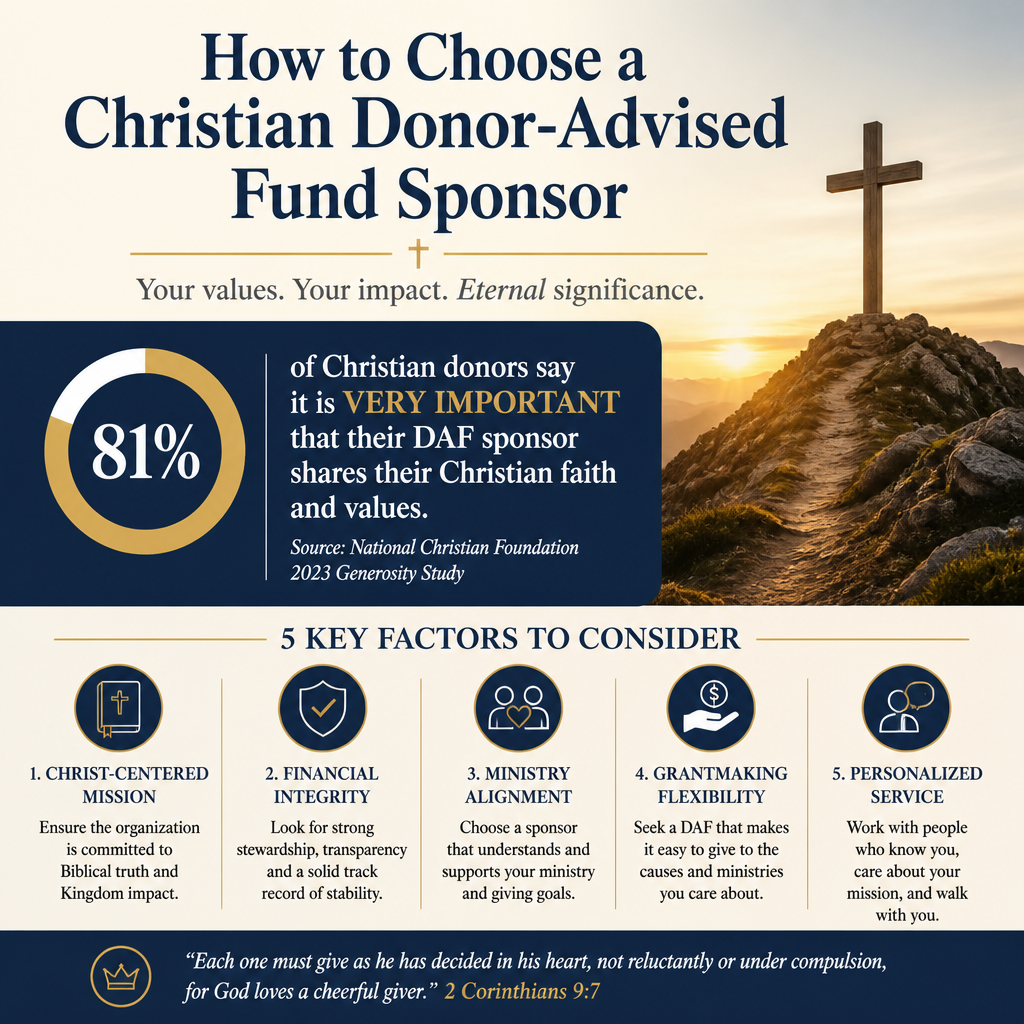
At minimum, a sponsor must confirm that a recipient is a qualified charitable organization and that a grant is not providing impermissible private benefit. That is necessary, but it is not the same as verifying that a ministry is truthful, governed well, and effective. Many donors assume a “Christian sponsor” performs ministry due diligence. Some do; many do not beyond basic compliance.
This is where independent verification becomes particularly useful. At Most Trusted, we evaluate ministries against The Most Trusted Standard, a 15-criteria framework across Faith Foundation, Financial Integrity, Governance and Leadership, and Transparency and Effectiveness. A sponsor may be strong as an administrator and still lack a rigorous method for assessing a recipient’s integrity. Donors can close that gap by using independent assessments for key relationships and high-impact grants.
Ask how the sponsor handles restricted gifts and project grants
Donors often want to fund a specific project: a translation initiative, a church plant residency, a refugee legal clinic, a missionary support budget. Restricted giving can be faithful and strategic, but it also increases administrative burden and increases the risk of miscommunication.
A careful sponsor will require clear grant letters, confirm that restrictions are charitable and feasible, and document how funds may be reallocated if a project changes. If a sponsor treats restrictions casually, donors should expect future friction with recipients and greater risk of unmet expectations.
Probe how the sponsor evaluates risk and responds to allegations
Christian donors do not need a sponsor to be omniscient. They do need a sponsor that treats allegations of financial misconduct, abuse, or deception as serious moral matters, not merely public relations issues. Ask what triggers enhanced due diligence, whether the sponsor pauses grants during credible investigations, and how it communicates with donors when a recipient’s status changes.
These questions are uncomfortable, but they are not cynical. They are consistent with the New Testament’s insistence that leaders must be “above reproach” (1 Timothy 3:2) and that the church should not be naïve about power and money.
Prioritize governance, transparency, and donor experience that serves discipleship
Operational excellence is not spiritually neutral. A sponsor’s governance and transparency shape how donors perceive accountability and how ministries experience partnership. The donor experience also shapes habits: whether giving becomes prayerful and deliberate or merely transactional.
Inspect board oversight and conflicts of interest
Request the sponsor’s board list, conflict-of-interest policy, and a description of how the board oversees investments, grants, and executive compensation. Good governance is not only about preventing fraud; it is about ensuring that decisions are made for the organization’s mission, not for insiders’ preferences.
DAF sponsors often have relationships with asset managers, affiliated ministries, or denominational structures. Affiliation is not automatically a problem. The question is whether relationships are disclosed, governed, and reviewed with independence.
Expect transparent reporting that respects donors and recipients
At a minimum, donors should receive timely statements, fee disclosures, and clear grant confirmations. For complex grants—international work, equivalency determinations, or disaster response—donors should also expect documented compliance steps and realistic timelines. Transparency is partly a customer-service issue, but it is also a trust issue. When reporting is evasive, donors should assume other parts of the organization may be similarly opaque.
If you are assessing several options, it can help to compare not only costs but the sponsor’s posture toward questions. A sponsor that welcomes scrutiny and answers precisely is typically one that can sustain trust under pressure.
Ensure the sponsor can support the ministries you actually fund
Some sponsors are excellent for local church giving and standard 501(c)(3) grants but limited for global missions or smaller indigenous ministries. Others excel at international grantmaking but require higher minimums or more complex onboarding. Donors should ask practical questions early: minimum contribution levels, minimum grant sizes, turnaround times, and whether the sponsor can handle recurring support for missionaries in ways that are compliant and administratively humane.
For donors whose giving includes sensitive contexts—persecuted church work, security concerns, or cross-border relief—ask how the sponsor protects data, how it verifies recipients without endangering them, and what it will and will not communicate on public receipts.
For additional context on the wider landscape, we maintain a central resource on Christian Donor-Advised Funds that frames common models and donor considerations across the category.
Choose a sponsor you can remain accountable to over time
The best Christian donor-advised fund sponsor is not the one with the most marketing or the most agreeable language. It is the one whose fiduciary structure, theology, governance, and operational practices can bear the weight of long obedience in stewardship. Donors should expect to reassess periodically: leadership changes, policies evolve, and the ministries you support may face new risks and opportunities.
Christian giving is not only about moving money efficiently. It is part of how we “excel in this act of grace also” (2 Corinthians 8:7). A sponsor should strengthen that grace with clarity, truthful reporting, and principled restraint, so that generosity remains both faithful and credible.



