

How Christian donor-advised funds support missionaries depends less on novelty and more on disciplined stewardship: clear designation, accountable disbursement, and a governance posture that protects both the giver and the work on the field. For many Christian donors, the question is practical and pastoral at once. Missionaries need steady support, but donors also carry a biblical obligation to give with discernment and integrity (Prov. 21:5).
A donor-advised fund can serve that obligation well when it is treated as a tool rather than a substitute for relationship, prayer, and ongoing oversight. The harder question is not whether DAFs can send money to missionaries; it is whether the DAF sponsor, the sending structures, and the recipient ministry together form a trustworthy chain of stewardship from donor to field.
How a Christian donor-advised fund actually supports missionaries
DAFs separate the timing of giving from the timing of granting
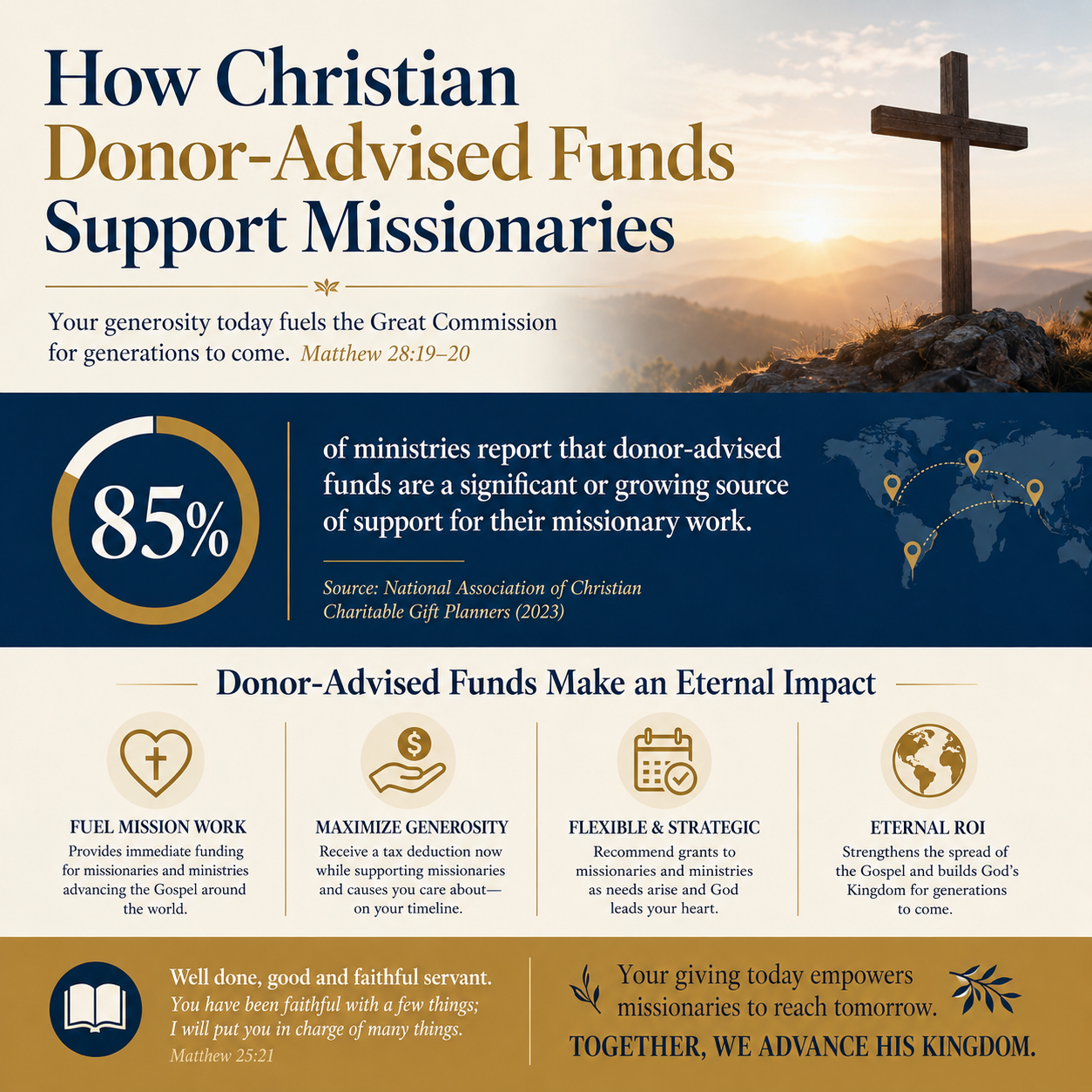
A donor-advised fund allows a donor to contribute assets to a sponsoring organization and then recommend grants over time. That structure can stabilize missionary support in seasons when a household’s giving capacity fluctuates. It also enables more thoughtful funding decisions, because contributions can be made during high-liquidity moments while grants can follow the rhythms of ministry need.
Many donors first encounter DAFs through the wider philanthropic market. Fidelity Charitable, one of the largest DAF sponsors in the U.S., reports that it granted $11.8 billion to charities in 2023, a figure that signals how mainstream DAFs have become for serious givers. Fidelity Charitable
DAFs introduce an intermediary that must be worthy of trust
That intermediary matters. A DAF sponsor is not merely a payments processor; it is a steward with legal control of the assets and discretion over whether a recommended grant aligns with its policies and charitable purpose. Christian donors should therefore evaluate the sponsor’s theology, grant policy, governance, and transparency with the same seriousness they apply to any ministry handling consecrated resources.
Across our verification work at Most Trusted, we observe that donors often underestimate intermediary risk. A mission field may be distant, but the accountability chain begins close to home: the sponsor’s oversight, the sending ministry’s controls, and the recipient’s reporting practices. Those links determine whether a DAF strengthens missionary support or simply adds complexity.

Why many donors choose DAFs for missionary support
Non-cash giving can materially increase what reaches the field
Christian missions has always depended on sacrificial generosity, but modern asset complexity can either hinder or help that generosity. Donor-advised funds are often used to contribute appreciated securities and other non-cash assets, potentially avoiding capital gains tax and increasing the amount available for grantmaking. The IRS explicitly recognizes that contributions of appreciated property to qualified charitable organizations can carry significant tax advantages compared to selling and then giving cash. Internal Revenue Service
For donors supporting missionaries, this can mean the difference between maintaining support through economic volatility and reducing commitments when markets tighten. The point is not maximizing tax benefit as an end in itself. It is treating tax planning as a means of increasing faithful generosity without compromising prudence.
Centralized granting can reduce administrative friction for missionaries
Missionaries often carry a hidden burden: recurring administrative work tied to small, fragmented gifts. A DAF can consolidate donor giving into fewer, larger grants—sometimes monthly or quarterly—reducing the complexity of receipting and back-office reconciliation. That time is not morally neutral; it competes with language learning, pastoral care, discipleship, and family resilience in demanding contexts.
Christians genuinely disagree about how much administrative “efficiency” should shape giving decisions, especially given the Overhead Myth concerns raised by charity evaluators. Nonetheless, reducing unnecessary friction is a legitimate stewardship aim when it does not weaken accountability or diminish relational support.
Key grant pathways and what they imply for accountability
Supporting a sending organization versus supporting an individual
Missionary support commonly flows through a sending organization, whether a denomination, a mission agency, or a church-based structure. This is often the most straightforward route for DAF grants because the recipient is a recognized charitable organization with defined governance. Donors can still designate a particular missionary, but the legal recipient is the organization, which retains responsibility for oversight.
Direct support to an individual is a different category. Many DAF sponsors will not make grants to individuals, and for sound reasons: it creates heightened risk of private benefit, diminished reporting, and blurred lines between charitable giving and personal assistance. A mature approach is to ask not only what is permitted, but what creates the clearest stewardship trail.
Domestic versus cross-border support
International missions adds complexity. In many cases, a U.S.-based 501(c)(3) receives funds and then supports work abroad through its own programs or through vetted foreign partners. Donors should understand how “expenditure responsibility” and grant equivalency function in practice, and whether the receiving ministry can demonstrate control and accountability over funds used outside the United States.
At the policy level, the IRS requires U.S. charities to maintain adequate records and exercise discretion and control over funds used overseas in order for contributions to remain charitable. Internal Revenue Service
What this means in practice is that donors should not treat international missions giving as inherently less accountable, but they should require stronger evidence: written agreements, documented monitoring, and clear reporting that connects dollars to ministry outcomes and integrity safeguards.
Choosing a DAF sponsor with missionary support in mind
The sponsor’s faith commitments and grant policy shape what is possible
Not all DAF sponsors interpret “Christian” in the same way, and not all sponsors treat faith-based grants as equally central to their identity. Some maintain broad philanthropic platforms that include faith-based giving but do not provide distinct theological guardrails. Others are explicitly Christian and structure their grantmaking policies around doctrinal commitments and a particular view of ministry partnership.
Donors who want their giving to be consonant with Christian conviction should examine the sponsor’s statement of faith, governance posture, and grant restrictions. The question is not whether the sponsor agrees with every donor preference; it is whether the sponsor’s public commitments and internal practices create a coherent environment for funding missionaries responsibly.
For donors comparing options, our coverage of How to Choose a Christian Donor-Advised Fund Sponsor addresses the practical factors that tend to matter most: eligibility rules, grant turnaround, foreign mission policies, anonymity controls, and how disputes are handled when a recommended grant raises questions.
Verification criteria donors should insist on
Missionaries deserve more than sentiment; they deserve faithful systems. When donors evaluate a sponsor or a mission agency, the most important questions are often not about enthusiasm but about controls. The ministries that meet The Most Trusted Standard tend to document decisions, separate duties, and communicate plainly about both fruitfulness and risk.
The following indicators are not exhaustive, but they are a dependable starting point for donors funding missionary work through a DAF:
- Clear grant policies that prohibit private benefit and articulate how designated missionary support is handled
- Evidence of governance oversight, including board engagement and conflict-of-interest discipline
- Financial statements that show transparency about restricted funds and program allocation
- Published safeguarding practices for vulnerable populations in the mission context
- Credible reporting that ties expenses to activities and outcomes without exaggeration
Some donors resist this level of scrutiny out of a desire to “trust the work.” Scripture commends trust, but not credulity. The apostolic pattern includes both generosity and accountability (2 Cor. 8:20–21), especially when resources are being carried across distance and through multiple hands.
Common tensions and how to handle them with integrity
Designation, control, and the temptation to treat a DAF like a checking account
One recurring tension is control. A donor can recommend grants, but the DAF sponsor must retain legal discretion. If the sponsor functions as a mere conduit—granting automatically to a preselected individual or acting as an agent for personal benefit—the arrangement can violate both policy and the spirit of charitable giving.
This matters for missionaries because donors often want to support a friend, family member, or a missionary they know personally. That is not inherently improper, but it increases the need for clear boundaries: support should flow through a legitimate ministry structure with real oversight, and any benefits to the individual should be consistent with the ministry’s compensation and expense policies.
Speed versus diligence
Mission needs can be urgent: unexpected medical care, evacuation, security incidents, or rapid response to a local crisis. Donors sometimes experience DAF grant timing as frustrating, especially when compared with direct giving. Yet speed without diligence is not a Christian virtue. A sponsor’s review process can protect the donor, the missionary, and the credibility of the gospel where accusations of financial impropriety can quickly undermine witness.
The appropriate question is whether a sponsor’s processes are proportionate. Excessive delay can harm ministry; insufficient review can expose everyone to misuse. Mature sponsors explain their timelines clearly and publish escalation processes for urgent situations.
Measuring faithfulness without reducing ministry to metrics
Missionary work resists simplistic measurement. Discipleship, church formation, translation work, and pastoral endurance cannot be reduced to quarterly output. At the same time, donors should not accept a false choice between “metrics” and “faith.” Responsible ministries can report on activities, expenditures, safeguards, and observable outcomes while still honoring the spiritual nature of the work.
When Helping Hurts, articulated by Steve Corbett and Brian Fikkert, has helped the Christian sector reckon with the ways well-intended support can inadvertently distort local economies, displace local leadership, or create dependency. When Helping Hurts
For missionary funding, that framework prompts donors to ask better questions: Does outside funding empower local believers and institutions, or quietly replace them? Are short-term objectives aligned with long-term church health? Is the missionary accountable to local partners, not only to distant donors?
FAQs for How Christian donor-advised funds support missionaries
Can a donor-advised fund grant directly to a missionary or missionary family?
In most cases, DAF grants go to qualified charitable organizations, not individuals. Many sponsors prohibit grants to individuals because of private benefit risk and because charitable funds must remain under the recipient organization’s discretion and control. When donors want to support a particular missionary, the common approach is to grant to the missionary’s sending organization with a designation, trusting that the organization retains appropriate oversight and can document how funds are used.
Are DAF grants to international mission work allowed?
DAF grants typically can support international mission work when the grant is made to a qualified U.S. charity that exercises discretion and control over how funds are used overseas, including through vetted partners. Policies vary by sponsor, and donors should expect additional review for cross-border activity. The stewardship goal is not merely compliance; it is maintaining an accountable chain from donor to field, especially where distance and legal complexity can obscure misuse.
Giving to missionaries through a DAF with confidence
Christian donor-advised funds support missionaries most faithfully when donors insist on coherent structures: a trustworthy sponsor, a responsible sending ministry, and reporting that treats stewardship as part of discipleship. Most Trusted exists to help donors evaluate those structures through The Most Trusted Standard, so that missionary support is not only generous, but worthy of the gospel it seeks to advance. For donors who want a broader grounding in this category, our work on Christian Donor-Advised Funds frames the central questions that separate convenience from accountable generosity.



