
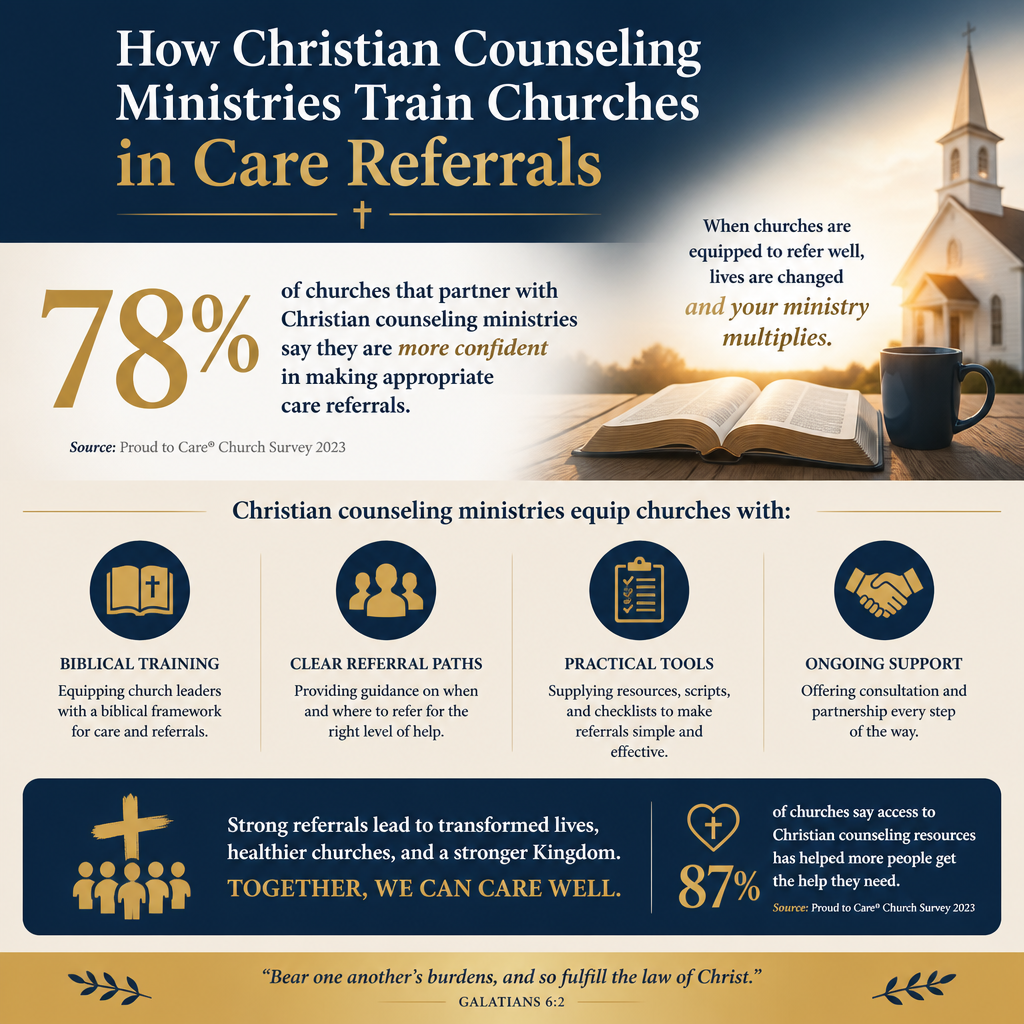
How Christian counseling ministries train churches in care referrals is not a peripheral operational question. It is a theological and pastoral question about how a congregation bears one another’s burdens without presuming that good intentions are the same as competent care.
Donors often fund counseling ministries because they want local churches to become safer places for suffering people to speak honestly and receive wise help. Yet the referral moment—when a pastor, small-group leader, or women’s ministry director decides whether and where to send someone—can either protect the vulnerable or expose them to further harm. Mature counseling ministries treat referrals as a ministry of truth-telling: naming what the church can faithfully provide, what requires clinical expertise, and how to keep the counselee’s dignity and agency intact.
Why the referral moment carries spiritual and practical weight
Care referrals are a form of pastoral judgment
A referral is not only a logistical handoff. It is a judgment about what kind of help is needed, who is qualified to provide it, and what risks are present if the church misreads the situation. Scripture commends both compassion and wisdom; zeal without knowledge can wound. When Proverbs describes wisdom as protection, it is not describing a vague virtue but a concrete safeguard for the vulnerable.
Christian counseling ministries that serve churches well train leaders to resist two opposite errors. The first is over-spiritualizing: assuming that repentance, prayer, or Bible reading alone will address trauma symptoms, suicidal ideation, psychosis, or addiction physiology. The second is outsourcing discipleship: assuming that a counselor will replace the church’s long-term ministry of presence, sacrament, and community.
Guardrails are necessary because churches are not clinics
Many churches provide counseling informally through pastors and lay leaders. That can be a strength when it stays within competence and is integrated into spiritual care. But a church is typically not structured to deliver clinical assessment, crisis intervention, or mandated reporting frameworks. Counseling ministries therefore train churches to treat the referral path as part of their duty of care, not an optional add-on for unusually complicated cases.
What this means in practice is that healthy referral systems are written down, practiced, and understood by more than one person. The goal is not bureaucratic control; it is faithful stewardship of the people God entrusts to a local body.

What strong training actually covers and what it refuses to shortcut
Intake triage and red-flag recognition
Effective training begins with triage: helping church leaders discern urgency, severity, and safety risks. The best counseling ministries teach non-clinicians to recognize “red flags” that require immediate escalation, including suicidal thoughts, credible threats of harm to others, suspected abuse, severe eating disorder behaviors, psychotic symptoms, and impairment from substance use.
Training also addresses how to ask clarifying questions without turning pastoral conversations into amateur assessments. Churches do not need leaders who can diagnose; they need leaders who can recognize when a situation exceeds their competence and requires a higher level of care.
Clear boundaries for pastoral counseling and lay care
Christians genuinely disagree about how formal a church’s counseling ministry should be. Some traditions emphasize pastoral counsel as a central vocation; others lean on professional counselors as a parallel support. Whatever the model, strong training defines boundaries: what pastors and trained lay caregivers can do responsibly, what they must not promise, and how confidentiality works in a congregational setting.
A common failure point is vague confidentiality language that either overpromises privacy or underprotects the counselee. Counseling ministries that train well help churches use plain words: who will know what, under what circumstances information must be shared, and how disclosures related to safety and abuse are handled.
How ministries build a referral network without compromising Christian conviction
Referral lists are theological documents as well as practical tools
A referral list is never neutral. It reflects convictions about the human person, suffering, sin, embodiment, and hope. Strong Christian counseling ministries help churches build networks that respect the church’s doctrinal commitments while also acknowledging that competence matters. Some cases require a psychiatrist, a trauma-trained therapist, a medically supervised detox program, or a domestic violence advocate. If a church cannot name those resources clearly, counselees will either drift toward the loudest online voice or remain stuck.
For donors, this is a key measure of seriousness: whether a ministry is willing to do the unglamorous work of vetting providers, updating lists, and acknowledging when a community lacks sufficient care options.
Vetting includes clinical competence, ethics, and alignment
Training often includes a practical rubric for evaluating referral partners: licensure status, relevant specialties, supervision practices, crisis protocols, and approach to faith integration. It also includes ethical questions: informed consent, documentation standards, dual relationships, and policies that reduce the risk of spiritual coercion.
When counseling ministries work with churches across regions, they also train leaders to ask about state laws and local reporting requirements. These details are morally significant. The church’s desire to preserve confidentiality must never become an excuse for failing to protect the vulnerable.
What donors should look for in church-counseling partnerships
Training that produces repeatable systems, not heroic individuals
Some churches depend on a single unusually wise pastor or counselor to make referrals work. That fragility is a risk to the congregation and to the person carrying the burden. Strong counseling ministries train churches to create repeatable systems: written pathways, named roles, escalation steps, and ongoing review.
Across our verification work at Most Trusted, we observe that the healthiest ministries do not treat “training” as a one-time seminar. They provide refreshers, consultative support, and materials that can be used when staff turnover occurs or when a crisis exposes gaps.
Signals of integrity and accountability donors can verify
Donors are rarely in a position to assess counseling quality directly, and outcome measurement in counseling is complex. Even within evidence-based practice, results can be difficult to quantify without violating privacy or oversimplifying human change. Still, donors can look for verifiable commitments that correlate with trustworthy care.
- Documented safeguarding policies for working with minors and vulnerable adults
- Clear qualifications and supervision expectations for counselors and trainees
- Defined crisis protocols, including referral steps for higher levels of care
- Transparent financial reporting and governance appropriate to the ministry’s size
- Evidence that referral partners are vetted and periodically reviewed
When we evaluate ministries against The Most Trusted Standard, we pay attention to how faith commitments shape practice, how leadership is held accountable, how finances are handled, and how openly a ministry communicates about limitations. For donors seeking a broader view of the landscape, the parent topic page on Christian Counseling Ministries provides context for the range of models donors encounter.
Training churches to refer well in the hardest cases
Abuse, coercion, and the church’s duty to protect
Training is most tested in cases involving abuse—child abuse, sexual assault, domestic violence, and spiritual coercion. These situations demand more than compassion; they demand competence and moral clarity. Counseling ministries that serve churches well train leaders to distinguish reconciliation from safety, forgiveness from exposure to ongoing harm, and pastoral care from investigative responsibility.
They also train churches to work appropriately with civil authorities when required and to partner with specialized advocates. The church’s witness is not strengthened by secrecy. It is strengthened by truth, repentance, and the protection of the vulnerable.
Complex mental illness and the limits of ecclesial care
Some suffering is not resolved by better community or stronger spiritual disciplines, even though both are essential. Severe mood disorders, schizophrenia spectrum disorders, and certain trauma presentations can require medical oversight and coordinated care. Churches should not feel ashamed of those limits. They should feel responsible to name them.
What this means in practice is that training includes language for pastoral conversations that neither stigmatize nor trivialize: the counselee is not reduced to a diagnosis, and the church does not imply that seeking medical or clinical help is a failure of faith. Christians have long affirmed that God’s common grace operates through ordinary means, including medicine and skilled care.
Churches exploring these partnerships often begin through broader networks. The parent category on Church Partnerships with Christian Counseling Ministries reflects how ministries and congregations formalize relationships, share responsibility, and clarify expectations.
FAQs for How Christian counseling ministries train churches in care referrals
Do churches risk abandoning discipleship when they refer people to professional counselors?
Referral does not have to mean abdication. Strong training frames counseling as one component of care while the church continues its distinct responsibilities: worship, sacramental life, spiritual formation, and embodied community. The healthiest models coordinate care with appropriate consent, so the counselee receives both competent clinical help and faithful pastoral presence without confusing the two roles.
How can donors evaluate a counseling ministry’s referral training without violating privacy?
Donors should not seek confidential case details. Instead, donors can look for verifiable indicators: safeguarding and reporting policies, counselor qualifications and supervision standards, written crisis protocols, governance oversight, and transparent financial reporting. Ministries that welcome serious questions about their training curriculum, boundaries, and referral criteria generally demonstrate a posture of accountability consistent with trustworthy care.
Faithful referrals are part of faithful stewardship
Care referral training is a quiet form of leadership formation. It teaches churches to practice humility about competence, courage about hard truths, and clarity about responsibility. When Christian counseling ministries do this work well, they help congregations become places where people can speak honestly, be protected when risk is real, and receive help that honors both the soul and the body.



