

How Christian aviation ministries handle weather decisions is one of the clearest windows into whether a ministry is practicing courageous service or drifting into presumption. The same flight can be framed as sacrificial urgency or as unnecessary exposure, and donors are right to ask which story is true.
Weather is not a mere operational inconvenience in mission aviation. It is an ethical variable. In a sector where pilots and mechanics serve under spiritual conviction, the discipline to delay, divert, or cancel becomes a form of integrity. Scripture commends faith that acts, but it also condemns arrogance that baptizes risk as faithfulness: “You do not know what tomorrow will bring… you ought to say, ‘If the Lord wills’” (James 4:14–15). The hard question is how that posture becomes an actual decision at an actual runway.
Weather is a governance issue, not only a pilot issue
Pressure exists even in well led ministries
Flight decisions are rarely made in a vacuum. There is a patient waiting at a clinic, a translator expecting a delivery, a national church partner counting on a visit, and a donor who gave for “access.” None of those pressures are sinful, and many are evidence of real need. But they can quietly shape what a pilot believes is “acceptable.”
Christian donors often assume the opposite problem—that missionaries are too cautious and that delays represent inefficiency. Across our verification work, we find the more common temptation is the spiritualized version of deadline pressure: “If we do not go now, we failed.” Mature ministries treat that as a leadership and culture question, not simply airmanship. The board’s job is to ensure the ministry’s incentives reward sound decisions, not only heroic stories.
Healthy ministries separate authority from urgency
In aviation, authority has to be explicit. The pilot in command carries legal responsibility for the safety of the flight. But Christian organizations add layers of spiritual and relational authority that can blur that line. In strong ministries, the line is sharpened: a pilot may be asked to serve urgently, but never to comply against judgment.
This is where donor support can either help or harm. When a ministry’s communications implicitly treat cancellations as failures, staff absorb that. When donors celebrate disciplined no-go decisions as evidence of stewardship, a ministry is freer to honor limits. That freedom is not weakness. It is moral clarity.

Sound weather decisions begin long before the flight
Preflight planning is a spiritual discipline of truth telling
Most weather accidents are not caused by ignorance that storms exist. They are caused by continuing into conditions that exceed aircraft capability or pilot proficiency. General aviation accident reviews repeatedly show that “continued VFR into IMC” remains a deadly pattern—pilots flying under visual rules into instrument weather. The FAA’s Airplane Flying Handbook directly warns that “VFR into IMC” can lead to spatial disorientation and loss of control, and it is explicit that the best mitigation is avoiding the situation entirely rather than trying to “push through.” Federal Aviation Administration
Christian aviation ministries that handle weather decisions well treat weather briefing as more than checking a box. They require a disciplined pattern of looking for disconfirming evidence: ceilings trending down, convective forecasts building, terrain effects, and the reality that remote reporting is limited. This is not fear. It is truth telling about creation as it is, not as we wish it to be.
Capability is about more than the airplane
Donors sometimes focus on equipment because it is tangible: turbine upgrades, GPS, radar, satellite tracking. Those tools can be genuinely life-preserving. Yet capability is also human: recurrent training, rest, mentorship, and the courage to refuse a mission that is beyond current proficiency. A ministry can own a capable aircraft and still cultivate an unsafe culture.
The ministries that meet The Most Trusted Standard tend to treat training and safety systems as mission essentials, not overhead. The donor’s question is not simply “Does the ministry have a good airplane?” but “Does the ministry have a mature system that makes prudent decisions normal, even when the stakes feel high?” That is a governance and leadership question as much as a technical one.
Go no go decisions are shaped by culture, not only meteorology
Faith and risk are not the same category
Christians genuinely disagree about how much risk is acceptable in ministry. Some traditions emphasize sacrificial boldness; others emphasize ordered prudence. Scripture honors courage, but it does not canonize recklessness. Jesus rejected spectacle masquerading as trust when tempted to throw himself from the temple (Matthew 4:5–7). That episode is not an aviation lesson, but it is a timeless warning against manufacturing danger and calling it faith.
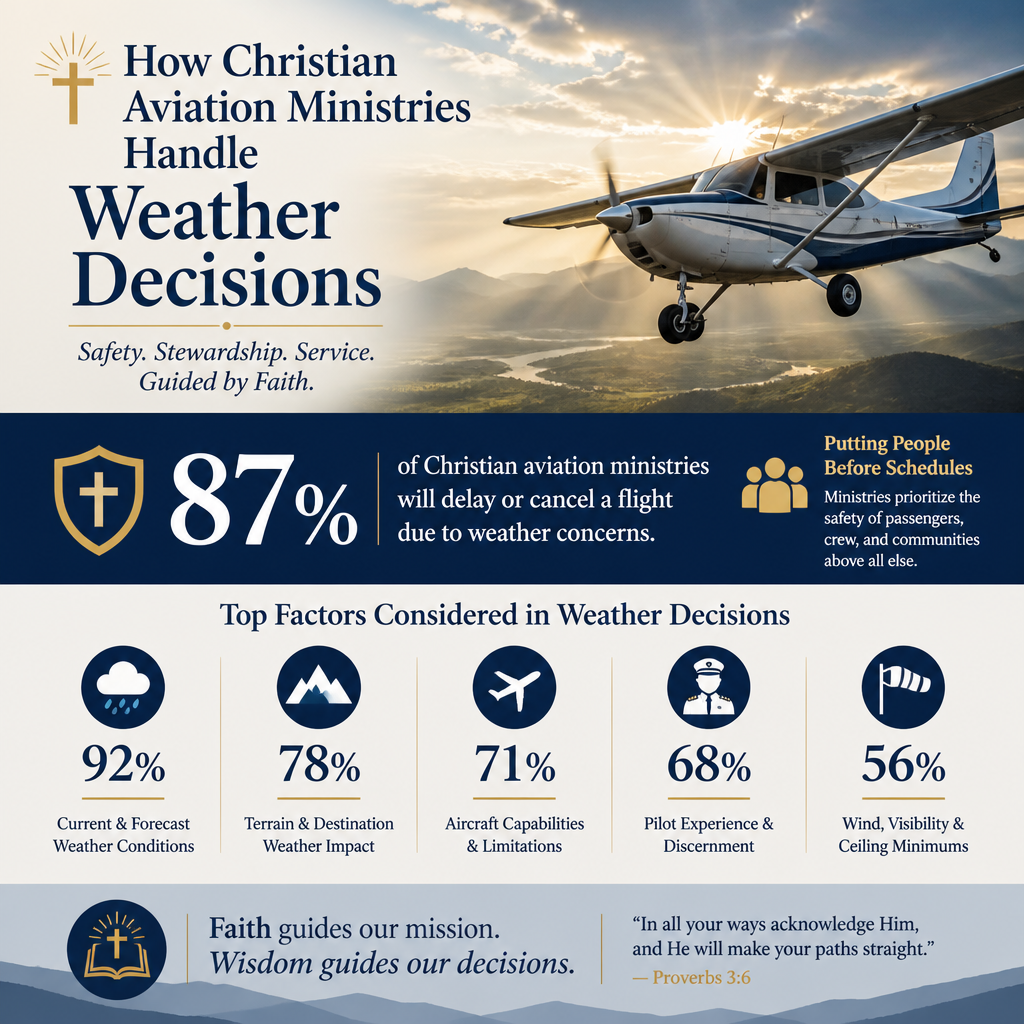
In practice, weather decisions reveal what a ministry believes about God’s providence and human responsibility. Mature ministries do not talk as if safety is ultimate; they talk as if obedience is ultimate. But they also refuse the false spirituality that treats preventable accidents as inevitable costs of ministry.
What donors should listen for in ministry language
Language is a leading indicator. When ministries tell stories about “beating the storm,” donors should be cautious. When ministries tell stories about diverting, waiting, and choosing a safer route—even when it cost time and money—donors are hearing an organization that understands stewardship in the biblical sense.
A simple test is whether a ministry can describe a cancelled flight without embarrassment. If cancellations are framed as failure, the organization is likely training its people to hide risk and to normalize pushing limits. If cancellations are framed as prudent stewardship, the organization is training its people to tell the truth.
Systems that keep weather decisions honest
Documented policies and real accountability
Weather is dynamic, but decision-making should not be improvised. Strong aviation ministries rely on written operational policies: weather minimums, crosswind limits, fuel reserves, alternate requirements, and clear authority to decline. What varies is not whether policies exist, but whether they are enforced when the “important” flight is on the schedule.
We recommend donors ask whether a ministry has a functioning safety management approach: incident reporting without retaliation, recurring safety reviews, and leadership that treats near-misses as gifts of warning rather than as reputational threats. The ICAO framework for Safety Management Systems describes core components such as safety policy, risk management, assurance, and promotion, and it has shaped modern safety practice across aviation. International Civil Aviation Organization
Practical indicators donors can verify
Donors do not need to become meteorologists to fund responsibly. But donors can ask for verifiable evidence that the ministry has built guardrails that withstand pressure. Here are signals worth requesting in annual reporting or direct conversation:
- Clear weather minimums by aircraft type and mission profile, and evidence they are reviewed and updated.
- Recurrent training cadence for pilots, including instrument proficiency where relevant and decision-making scenarios.
- Maintenance discipline that treats dispatch reliability as a stewardship issue, not a public relations metric.
- Incident reporting processes that allow anonymous or protected reporting and track corrective actions.
- Authority clarity that the pilot in command can cancel without fear of penalty or shame.
These are the kinds of questions our team asks when evaluating ministries against The Most Trusted Standard. They touch multiple criteria at once: faith foundation expressed as humility, governance expressed as accountability, financial integrity expressed as disciplined spending, and transparency expressed as reporting that includes hard realities rather than only victories.
Weather decisions shape how donors should evaluate impact
Success metrics can unintentionally reward unsafe behavior
Many aviation ministries report impact in flight hours, passengers carried, miles flown, or cargo delivered. These can be legitimate indicators of service. They can also become incentives to fly when it would be wiser not to. A ministry that publicly celebrates only volume may privately pressure staff to sustain that volume through marginal conditions.
More mature reporting includes a category for safety and reliability: training completed, audits performed, maintenance cycles, and the number of times flights were delayed or rerouted for weather. This is not romantic. It is credible. It is also closer to how Scripture speaks about stewardship—faithfulness with what has been entrusted, including lives.
Where Most Trusted fits for donors seeking confidence
Christian donors rightly want to fund access to remote communities without funding a culture of risk escalation. The integrity test is not whether a ministry ever flies in challenging weather; mission aviation will often operate in complex environments. The test is whether the ministry can articulate its decision framework, demonstrate it is enforced, and report transparently when plans change.
Within Christian Aviation Ministries, weather decision-making is one of the most revealing indicators of organizational maturity. It intersects with leadership, training, communications, and the ministry’s theology of providence. Donors should expect the same seriousness a responsible board would demand.
For donors evaluating safety more specifically, Aircraft Safety and Pilot Training in Christian Aviation is where we focus on the operational practices that tend to separate sustainable ministries from those that rely on hero narratives and thin margins.
FAQs for How Christian aviation ministries handle weather decisions
Should donors be concerned when a ministry cancels flights frequently due to weather?
Not automatically. In many regions, cancellations can reflect a disciplined commitment to defined minimums and an honest appraisal of local limitations such as sparse reporting, terrain effects, and rapid weather shifts. The prudent question is whether the ministry can explain its standards, show that cancellations are tracked and reviewed, and demonstrate that leadership supports pilots who make conservative calls.
What is an appropriate way to ask a ministry about weather-related accidents or incidents?
Directly and respectfully. Donors may ask whether the ministry has had weather-related incidents, what was learned, and what policy or training changes followed. Mature ministries will not treat the question as hostile. They will treat it as a stewardship inquiry and will be prepared to discuss safety culture, accountability, and how they balance urgency with responsibility.
Weather decisions reveal the ministry’s theology of stewardship
Christian aviation is often undertaken at the edge of human control, where the created order reminds us of our limits. The ministries that handle weather decisions well do not confuse limitation with lack of faith. They practice humility, tell the truth about risk, and protect people even when doing so is costly.
For Christian donors, the goal is not to fund fear or to fund bravado. It is to fund faithful service shaped by disciplined judgment. In weather decisions, that faithfulness becomes visible.



