

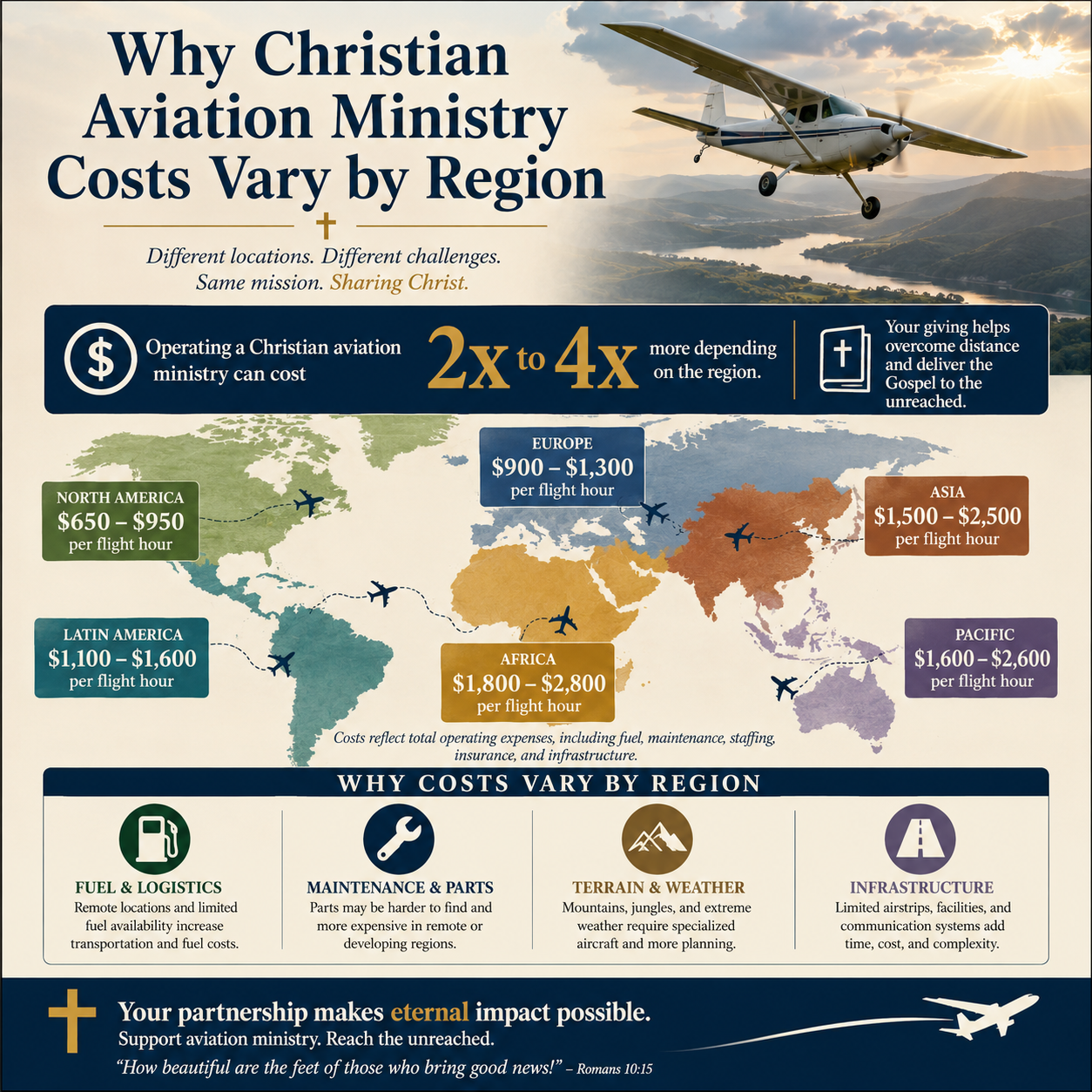
Why Christian aviation ministry costs vary by region is not a peripheral budgeting question. For Christian donors, it is a stewardship question: whether the price of a flight reflects faithful service in difficult conditions or avoidable inefficiency that should be corrected before more funds are raised.
Christian aviation sits at the intersection of mercy, mission, and risk. It moves pastors, surgeons, Bible translators, and relief supplies where roads do not exist or where insecurity makes travel by land morally and practically untenable. Yet a single line item called “flight operations” can look radically different depending on whether the aircraft is based in Alaska, Papua New Guinea, the Sahel, or the Amazon basin. Mature donors should expect regional variance, but they should also insist on intelligible explanations and verifiable controls.
Geography is not a backdrop but a cost driver
Most nonprofit budgets assume infrastructure is stable and distance is predictable. Aviation ministries operate where infrastructure is the constraint. Mountain ridges, jungle canopy, permafrost, seasonal flooding, and the absence of reliable fuel supply turn geography into a direct operating cost.
Terrain determines the aircraft and the maintenance profile
Short, sloped, or unimproved runways often require STOL aircraft, specialized tires, and more aggressive inspection intervals. Salt air corrodes airframes near coasts. Dust and volcanic ash accelerate engine wear. Cold weather increases preflight time and affects battery and oil performance. None of this is romantic; it is maintenance economics.
Even within the United States, the operating environment can be materially different. The FAA’s Alaska Region contains a uniquely high concentration of remote communities dependent on aviation, and weather and terrain raise both operational complexity and risk management requirements. The FAA’s public materials on Alaska aviation conditions and safety priorities help explain why aviation in remote regions tends to carry distinctive cost and oversight burdens Federal Aviation Administration.
Distance is not only miles but access
A “short” flight on a map can be expensive if it requires repositioning an aircraft from a distant base, waiting out weather windows, or staging fuel. Donors should listen for ministries describing access constraints plainly: how often flights are canceled, how they plan contingencies, and how they avoid the temptation to overpromise impact when geography will not cooperate.

Regulation and compliance vary, and they should
Christians genuinely disagree about how much administrative structure is “too much.” Aviation is one arena where structure is frequently a form of love of neighbor. The regulatory environment, insurance market, and safety culture in a region can change cost significantly, and not all variance is a sign of waste.
Certification, operations rules, and oversight
Some ministries operate under U.S. FAA rules; others are governed by a national civil aviation authority with different certification processes, inspection cadence, and documentation expectations. Cross-border operations add complexity: flight permissions, customs requirements, security protocols, and, in some contexts, anti-bribery controls that must be explicit and enforced.
Donors should not reward ministries for “getting around” oversight. In aviation, shortcuts predictably become incidents. A mature ministry will be able to name the rule set it operates under, describe its safety management practices, and show how compliance costs are budgeted rather than hidden.
Insurance is a theological and fiduciary question
Insurance pricing reflects accident history, aircraft type, pilot hours, medical evacuation exposure, and regional risk. In some places, insurance is expensive because the data signals higher risk; in other places, insurance is expensive because markets are thin. Either way, underinsuring is not faith; it is shifting risk onto communities, staff families, and donors who may later be asked to fund a crisis.
Supply chains and currency instability do real financial damage
Regional cost variance is often less about labor cost and more about the fragility of supply. Aviation depends on parts, fuel, and qualified labor. When any of these must be imported, costs can spike and timelines stretch.
Parts, fuel, and the tyranny of the last mile
An alternator in North America may be a straightforward purchase and shipment. In a landlocked country with limited cargo routes, it can become a weeks-long chain involving customs clearance, special handling, and transport from an international airport to a remote hangar. Fuel can be similarly complex, with quality control risks that require testing and filtration.
Currency volatility adds another layer. A ministry may raise in U.S. dollars but spend in local currency, or it may need to purchase fuel and parts in dollars while paying local staff in local currency. The harder question for donors is not whether this creates budget variance—it will—but whether the ministry has sober financial controls: treasury practices, board oversight of foreign exchange exposure, and clear thresholds for when service levels must be reduced rather than funded by opaque transfers.
What transparent cost explanation sounds like
Across our verification work at Most Trusted, clearer ministries avoid both defensiveness and vagueness. They explain cost changes with concrete drivers: fuel availability, parts backorders, changes in insurance underwriting, required airfield repairs, or new compliance mandates. They also distinguish between one-time capital expenses and recurring operating costs, which prevents donors from being surprised when a “hangar project” becomes ongoing facility maintenance.
When donors want a framework for what faithful financial integrity and disclosure should look like across aviation programs, many begin with Accountability and Transparency in Christian Aviation Ministries. The point is not to force uniform budgets, but to insist on intelligible budgets.
Staffing realities differ, and “cheap” is not always righteous
Aviation ministries depend on specialized labor: pilots, mechanics, avionics technicians, dispatch and safety officers, and local operations staff who manage everything from weather reporting to passenger screening. Regional labor markets shape costs, but they also shape risk.
Expatriate models and nationalization models
Some regions still rely heavily on expatriate pilots and mechanics, often supported through raising personal ministry funds. Other regions have invested in national staff development, which can be more sustainable but may require significant upfront training expense and retention strategies. Neither model is automatically superior. The question is whether the ministry has a coherent plan that honors local leadership, avoids dependency, and maintains safety standards.
Donors should be cautious about narratives that treat low compensation as virtue. Scripture commends generosity and warns against muzzling the ox while it treads the grain. Ministries that pay unfair wages or rely on chronic overwork frequently experience turnover, training gaps, and safety incidents. The human cost eventually becomes a financial cost, and the spiritual cost can be worse.
Safety culture costs money and saves lives
Recurrent training, simulator time when available, standardized checkrides, incident reporting systems, and fatigue management practices all have costs. They also protect people made in the image of God—passengers, crew, and communities below flight paths. Donors should not pressure aviation ministries into “more flights at any cost.” They should fund the disciplines that keep service faithful over decades.
How donors can evaluate regional variance without punishing complexity
Donors sometimes default to a single ratio or a single number—cost per flight hour, overhead percentage, or administrative spend. Aviation makes that approach unreliable. Flight-hour cost in an accessible region with abundant parts and consistent weather will almost always be lower than flight-hour cost in a remote region with poor infrastructure, even if the second ministry is more disciplined.
Ask for drivers, not slogans
When ministries explain costs, the best explanations connect money to mission without sentimentality. They name constraints, quantify them where possible, and describe the decisions leadership is making in response. A donor’s task is not to micromanage operations but to test whether leaders understand their own economics and are willing to be held accountable.
- Segmented reporting that separates aviation operations from non-aviation programs so cross-subsidies are visible.
- Unit economics such as cost per flight hour or cost per passenger-mile, presented with regional context and multi-year trends.
- Maintenance reserves and capital replacement planning, so aircraft overhauls are not treated as emergencies.
- Safety management evidence such as training cadence, incident reporting practices, and board-level safety oversight.
- Supply chain contingencies that describe how parts, fuel, and currency risks are handled without improvised fundraising crises.
Do not weaponize the overhead conversation
The field has had to reckon with the damage done by simplistic overhead scoring. Charity Navigator, Candid (formerly GuideStar), and the BBB Wise Giving Alliance publicly warned donors against equating low overhead with high effectiveness, emphasizing that overhead investment can be essential for results and accountability Charity Navigator. Aviation intensifies that reality because compliance, safety, and maintenance systems are not optional “administration”; they are part of delivering the service responsibly.
At Most Trusted, we assess ministries against The Most Trusted Standard, a 15-criteria framework across Faith Foundation, Financial Integrity, Governance and Leadership, and Transparency and Effectiveness. In aviation, this means donors should expect to see not only clear doctrine and credible mission alignment, but also board governance that understands operational risk, audited financials where appropriate, meaningful disclosure, and evidence that programs are evaluated honestly.
For donors who want a broader view of the sector’s operating patterns and how to interpret them, Christian Aviation Ministries is often the most direct starting point.
FAQs for Why Christian aviation ministry costs vary by region
Does higher cost per flight hour mean a ministry is inefficient?
Not necessarily. Higher costs can reflect unavoidable regional constraints: imported fuel and parts, limited maintenance capacity, weather delays, insurance pricing, and regulatory compliance. The donor’s question should be whether leadership can explain the drivers clearly, show multi-year trends, and demonstrate disciplined controls. Vague explanations, frequent emergency appeals for predictable expenses, or reluctance to disclose segmented program costs are more concerning than a high number by itself.
What disclosures should Christian donors expect from an aviation ministry operating in high-risk regions?
At minimum, donors should expect clear financial statements, transparent allocation methods for shared costs, and straightforward reporting on safety and operational capacity. Mature ministries typically disclose how they budget for major maintenance events, how they manage currency and supply chain disruptions, and what governance structures oversee safety and risk. Where security limits public detail, they should still provide bounded, verifiable information to appropriate reviewers and major donors rather than substituting secrecy for accountability.
A faithful interpretation of variance
Regional variance in Christian aviation ministry costs is often the price of serving communities that are genuinely difficult to reach. Yet Christian stewardship is not satisfied by difficulty alone. Donors should fund the work with eyes open: honoring the constraints of geography and regulation while requiring clarity, governance, and truthfulness about what each dollar can accomplish. That combination—compassion with verification—serves both the mission field and the church that sends.



