
How Christian aviation ministries maintain aircraft safety is not a secondary operational concern; it is a moral and theological obligation. When a ministry puts a pilot, a mechanic, and a passenger in the air—often over remote terrain with limited alternates—it is placing lives in a chain of trust that must be earned, documented, and continually renewed.
For Christian donors, the question is not merely whether flights happen, but whether they happen with disciplined stewardship. Scripture binds love of neighbor to tangible duty, not sentiment. “Whoever is faithful in very little is also faithful in much” (Luke 16:10) is not an abstract principle when the “very little” includes a torque value on a critical fastener or a decision to delay a flight when weather margins tighten.
Safety is a ministry ethic before it is a technical system
Stewardship in aviation has consequences that cannot be outsourced
Aviation is unforgiving of shortcuts because it concentrates risk. Unlike many ministry programs, aircraft operations compress complex decision-making into minutes, and small lapses can propagate quickly. Christian aviation leaders who treat safety as a “back-office” function usually discover that it will eventually become a front-page crisis.
What this means for donors is straightforward: safety is not a line item to minimize, but an integrity test. Maintenance delays, training costs, and conservative weather decisions can be frustrating when needs are urgent. Yet urgency is not a biblical excuse for presumption. The consistent pattern of wisdom literature is that prudence honors life (Proverbs 14:16), and aviation requires prudence institutionalized.
Accountability must be visible, not merely asserted
Many Christian aviation ministries work in contexts where local aviation regulation is uneven. That reality increases, rather than decreases, the need for transparent internal standards. In our verification work at Most Trusted, the ministries that meet The Most Trusted Standard tend to treat safety documentation as part of their public accountability: clear policies, clear reporting lines, and clear evidence that decisions are governed by more than personality or tradition.
Donors should expect a ministry to articulate how it thinks about risk, not only how it celebrates outcomes. Counting “villages served” without describing how the ministry protects passengers, crews, and communities beneath the flight path is an incomplete story.

Aircraft safety is built on maintenance discipline and traceable records
Airworthiness depends on scheduled maintenance and parts integrity
At its core, aircraft safety is an airworthiness question: is this aircraft fit to fly today under the conditions planned? That question is answered through disciplined inspection intervals, reliable parts sourcing, and mechanics empowered to ground an airplane without retaliation or stigma.
In U.S.-registered operations, the regulatory framework is exacting. Even where a ministry flies under another civil aviation authority, mature organizations often align their internal practice with widely recognized norms such as FAA maintenance documentation and inspection logic, because the physics do not change across borders. The FAA’s maintenance and preventive maintenance guidance underscores that properly performed and documented maintenance is integral to safe operation, not optional administration (Federal Aviation Administration).
Records are not bureaucracy; they are a safety instrument
Maintenance records serve two purposes: they protect the next flight, and they protect the ministry’s credibility when questions arise. Traceable logbooks, work orders, inspection sign-offs, and parts traceability help ensure that “what should have been done” was actually done, by qualified personnel, on the correct schedule.
The harder question is funding. Aviation ministries often face donor expectations that treat maintenance as overhead rather than mission. The field of charitable evaluation has had to correct that instinct. The “Overhead Myth” statement—endorsed by major charity evaluators—argues that minimizing administrative and overhead spending can undermine effectiveness and outcomes, because infrastructure is frequently what sustains quality (BBB Wise Giving Alliance). For aviation, maintenance is not an efficiency tax; it is the mechanism by which compassion remains safe.
Competent pilots and safety culture matter more than heroic stories
Training is ongoing, standardized, and evaluated
Christian aviation attracts donors partly because its stories are vivid: short runways, mountain weather, medical evacuations, isolated communities. Those narratives can unintentionally reward the wrong instincts—celebrating bravery when the deeper virtue is judgment.
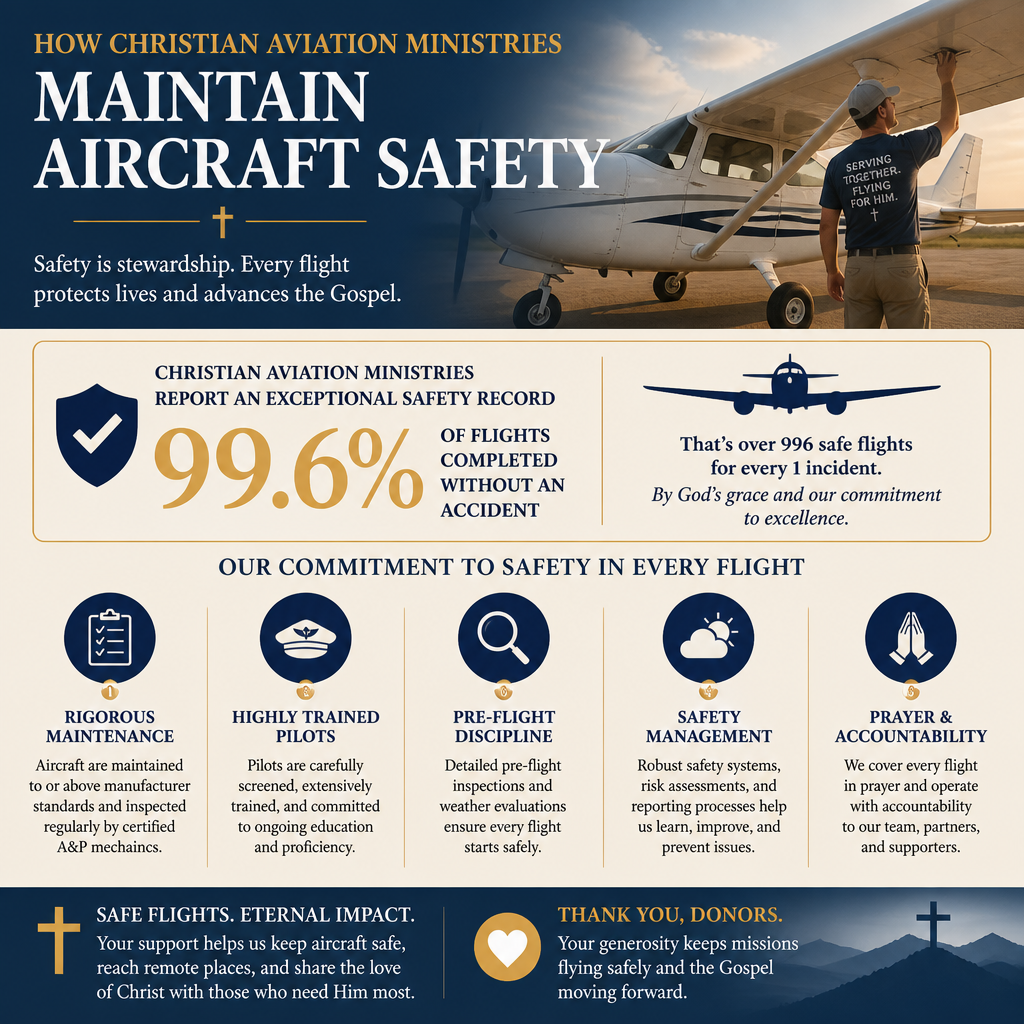
Strong ministries insist on recurrent training, standard operating procedures, and evaluation that is candid about limitations. They maintain clear minimums for weather, visibility, fuel reserves, duty time, and aircraft performance—then they enforce those minimums even when ministry demand is intense. The aviation safety community has long emphasized that sound decision-making and standardized procedures reduce accidents across diverse operating environments (International Civil Aviation Organization).
A healthy safety culture allows any crew member to stop a flight
A ministry’s culture is often more predictive of safety than its equipment. A safety culture is present when:
- Mechanics can ground an aircraft without fearing donor pressure or leadership displeasure.
- Pilots can cancel for weather without being treated as unspiritual or uncommitted.
- Incidents and near-misses are reported and reviewed without scapegoating.
- Training and check rides are standardized, not improvised.
- Leadership measures faithfulness by obedience and prudence, not by risk tolerance.
These practices reflect a theological realism about human limits. Christian ministry does not sanctify avoidable danger. It disciplines desire with wisdom, because the goal is not daring but service that endures.
Operational risk management is where integrity becomes measurable
Safety management is a system, not a slogan
Many mature aviation organizations use a formal Safety Management System (SMS) or a comparable internal framework: hazard identification, risk assessment, mitigation, and continuous improvement. The logic is simple: aviation risk cannot be eliminated, but it can be managed deliberately, documented transparently, and improved through learning loops.
SMS is not only a best practice; it is increasingly a normative expectation in the global aviation ecosystem. ICAO provides SMS standards and guidance intended to reduce risk through structured management rather than reactive correction (International Civil Aviation Organization Safety Management).
The field faces real tensions donors should not ignore
Christian aviation ministries operate in contexts that make safety harder: limited maintenance infrastructure, scarce avgas or jet fuel, short or unimproved airstrips, language and regulatory complexity, and urgent humanitarian timelines. Christians genuinely disagree about what level of risk is acceptable when lives are at stake and alternatives are scarce.
Yet mature leadership distinguishes between unavoidable risk and avoidable risk. Weather is unavoidable. Poor record-keeping is avoidable. Remote terrain is unavoidable. Cutting recurrent training is avoidable. Donors serve ministries well by funding the disciplines that reduce avoidable risk, even when those disciplines produce fewer dramatic stories.
For a broader view of how these ministries operate and how to evaluate them, we encourage donors to engage the larger landscape of Christian Aviation Ministries with an eye toward practices that remain consistent under pressure.
What donors should ask when evaluating aviation safety
Transparency is the donor’s protection and the ministry’s witness
Because aviation is technical, donors can be tempted to defer entirely to the ministry’s assurances. Deference is understandable, but it is not stewardship. A credible ministry should be able to explain its safety approach in plain language, provide documentation when appropriate, and show governance practices that prevent safety decisions from being captured by fundraising pressure.
Across our work at Most Trusted, the organizations that align with The Most Trusted Standard tend to connect safety to governance: board-level oversight of risk, clear leadership accountability, and transparent communication with supporters when operations change due to safety considerations.
Questions that reveal whether safety is funded and governed
Donors do not need to become aviation experts to ask responsible questions. These are the kinds of inquiries that meaningfully differentiate safety culture from safety branding:
Maintenance and airworthiness: Who oversees maintenance, what standards govern inspections, and how are parts sourced and tracked?
Pilot training: What recurrent training is required, how often are proficiency checks conducted, and who is authorized to sign pilots off for specific aircraft and mission profiles?
Safety reporting: How are incidents and near-misses recorded, reviewed, and used for training improvements?
Go or no-go authority: Who can cancel a flight, and what protections exist to prevent second-guessing that decision?
Financial integrity: Is there designated funding for maintenance, training, and reserves, or are these treated as discretionary spending?
Donors looking specifically at standards and training often benefit from reviewing how a ministry frames Aircraft Safety and Pilot Training in Christian Aviation, because the answers tend to reveal whether the organization’s operational discipline matches its spiritual ambition.
FAQs for How Christian aviation ministries maintain aircraft safety
Should donors prefer ministries that fly only newer aircraft?
Not necessarily. Aircraft age is less determinative than maintenance quality, parts integrity, inspection discipline, and a culture that empowers conservative decisions. Many aircraft models with long service histories remain safe when maintained to standard and operated within clear limits. Donors should focus on evidence of airworthiness practices, recurrent training, and transparent reporting rather than assuming newer is automatically safer.
What is a credible sign that a ministry will cancel flights when needed?
Credibility shows up in policy and governance: written weather minimums, clear go or no-go authority, routine documentation of cancellations, and leadership that publicly affirms conservative decisions. A ministry that treats cancellations as faithlessness tends to drift toward unsafe normalization. A ministry that treats cancellations as stewardship tends to preserve life, credibility, and long-term capacity to serve.
Safety is how aviation ministries keep faith with the people they serve
Christian aviation is compelling because it often reaches communities that roads and conventional systems do not. That calling does not reduce the obligation to operate safely; it intensifies it. When ministries maintain aircraft safety through disciplined maintenance, recurrent training, structured risk management, and transparent governance, they bear witness to a God who values truthfulness, prudence, and the protection of life.
Donors participate in that witness when they fund safety as mission-critical stewardship and when they ask questions that reward integrity rather than spectacle. In aviation, love of neighbor is expressed in decisions that are documented, accountable, and repeatable—flight after flight, year after year.



