
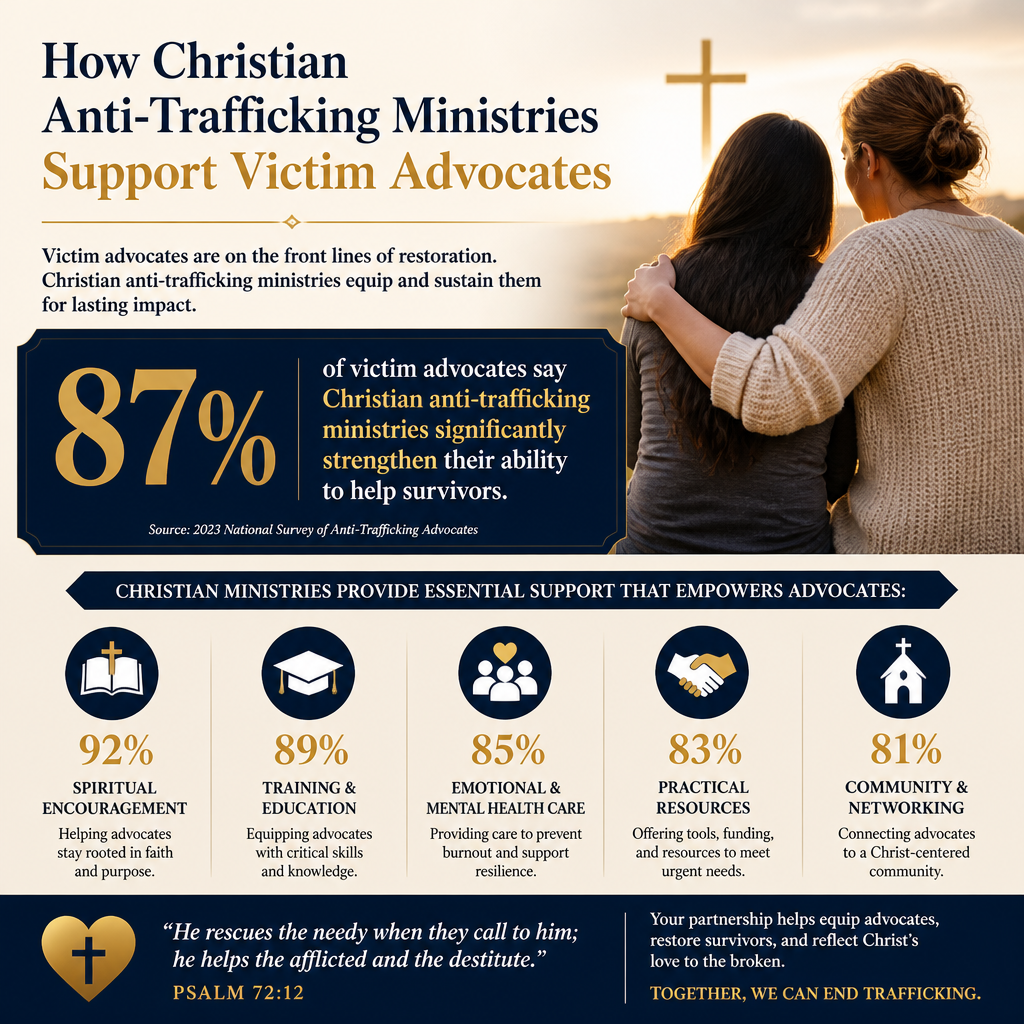
How Christian anti-trafficking ministries support victim advocates is one of the most practical questions a donor can ask, because advocacy is where compassion meets systems, and where good intentions can either protect a survivor or unintentionally expose them. The work is rarely dramatic in the way fundraising stories imply. It is often slow, legally complex, and shaped by the survivor’s choices, court timelines, and the limits of public resources.
For Christian donors, the moral frame is not difficult to name: the Lord “executes justice for the oppressed” (Psalm 146:7), and Christ identifies himself with the vulnerable in unmistakably concrete ways (Matthew 25:40). The difficulty is not whether the Church should respond, but whether our giving strengthens the people tasked with walking beside victims through law enforcement, courts, healthcare, immigration, housing, and long-term restoration. Victim advocates stand in that gap, and faithful anti-trafficking ministries treat them as partners, not props.
Victim advocacy is a protection role before it is a program
Advocates reduce harm in systems that can retraumatize
Many trafficking victims encounter institutions at their most overwhelmed: police responding at night, emergency departments under strain, shelters at capacity, and court dockets that do not pause for trauma. In that environment, an advocate’s presence can prevent avoidable harm: protecting privacy, clarifying options, slowing decisions, and ensuring that “help” does not become coercion in another form.
Christian ministries that support advocates well tend to recognize a theological and ethical boundary: survivors are not projects. Scripture’s call to justice is never permission to control another person’s story. The advocate’s work is frequently to defend agency, including the right to decline services or to choose a path that is not ideal from a ministry’s perspective. That posture aligns with a Christian understanding of the imago Dei that treats a person’s will and dignity as real, not symbolic.
Trauma-informed practice is not optional in this field
Trafficking frequently involves chronic trauma, manipulation, and threats against family members. A ministry can be earnest and still destabilize a survivor if staff are not trained to recognize trauma responses, safety planning needs, and the ways spiritual language can be weaponized by traffickers. The U.S. Department of Health and Human Services has formalized trauma-informed approaches as a standard expectation in victim services, not a niche preference; see SAMHSA.
For donors, this is a first test of seriousness. Ministries that support victim advocates invest in training, supervision, and clinical partnerships rather than relying on zeal. Compassion is not less Christian when it is disciplined.

Effective support begins with shared protocols and clear boundaries
Memorandums of understanding prevent mission drift and confusion
Victim advocates often work inside government systems or contracted service networks where confidentiality rules, reporting obligations, and eligibility criteria are not negotiable. Ministries that enter this environment without defined roles can create confusion for survivors and friction for professionals. The mature approach is to establish memorandums of understanding, referral protocols, and after-hours contact procedures that respect both legal requirements and survivor safety.
This is one reason donors should pay attention to governance and leadership maturity. Across our verification work at Most Trusted, we observe that ministries with strong boards and disciplined leadership are more likely to formalize partnerships rather than operating on informal relationships that collapse under stress. That is part of why our assessments against The Most Trusted Standard examine decision rights, risk management, and documented policies, not only heart and vision.
Healthy boundaries protect survivors and staff alike
Advocacy can become a 24/7 calling in the worst sense, where staff carry impossible caseloads and donors reward exhaustion as heroism. Christian ministries serve the Church better when they resist that culture. Clear boundaries—who holds the crisis phone, when law enforcement is contacted, what transportation is permitted, what financial help is appropriate—reduce the risk of dependency, favoritism, and burnout.
The harder question is spiritual care. Some survivors want prayer and pastoral counsel; others have been harmed under religious pretexts. Christian ministries support victim advocates well when they offer spiritual care as an available good, not a condition of services, and when they train staff to recognize spiritual trauma as a real category of harm.
Partnership with law enforcement and attorneys is where advocacy becomes concrete
Advocates translate systems and protect survivor choice
In trafficking cases, the justice process can extend for months or years. Survivors may be asked to recount events repeatedly, to navigate discovery and testimony, and to tolerate the public pace of proceedings. A well-supported advocate helps a survivor understand what is being asked and what options exist, including the right to say no. That is not obstruction; it is ethical accompaniment.
What this means in practice is that ministries often support advocates through relationships with pro bono counsel, immigration attorneys, civil litigators, and victim-witness coordinators. This is especially important for foreign national survivors whose safety may depend on immigration relief pathways. The legal terrain is specialized and changes over time; ministries that treat it casually tend to overpromise.
Coordination matters because trafficking is both a crime and a pattern of coercion
Public understanding often reduces trafficking to abduction. The evidence base points to a broader reality in which coercion, fraud, and exploitation are central, and vulnerabilities are routinely targeted. The U.S. State Department’s annual Trafficking in Persons Report has long emphasized this wider pattern and the importance of victim-centered responses; see U.S. Department of State.
Christian donors sometimes ask whether funding advocacy “duplicates” what government already funds. The field has had to reckon with a more sobering truth: public systems are necessary but often insufficient, and they vary widely by jurisdiction. Ministries that support victim advocates well do not compete for credit. They fill gaps that public funding cannot reliably cover: flexible emergency housing, transportation protocols that meet safety standards, phone replacement for secure communication, and long-term case management after a prosecution ends.
Responsible funding strengthens capacity, not dependence
General operating support often serves advocates better than restricted gifts
Advocacy work is difficult to package into neat outcomes, and it is frequently constrained by unpredictable caseloads. Donor restrictions can unintentionally force ministries to fund what photographs well rather than what stabilizes survivors. In contrast, flexible support allows leaders to staff appropriately, retain trained advocates, and maintain partnerships over time.
Christians genuinely disagree about overhead ratios and what “efficiency” should mean in human services. The more responsible conversation is whether an organization is honest, well-governed, and demonstrably effective for its context. The “Overhead Myth” letter signed by GuideStar, BBB Wise Giving Alliance, and Charity Navigator remains a useful corrective: overhead percentages alone do not measure performance; see Candid GuideStar.
What donors should look for in an advocacy-supporting ministry
Donors cannot inspect every case file, nor should they. But donors can look for verifiable signals that a ministry is structured to strengthen victim advocates and safeguard survivors:
- Documented referral protocols and confidentiality practices, aligned with professional standards
- Formal partnerships with legal services, healthcare providers, and vetted shelters
- Training expectations for staff and volunteers, including trauma-informed care and boundaries
- Clear financial controls for emergency assistance and client support expenditures
- Outcome reporting that does not sensationalize, expose identifying details, or inflate rescues
These are the kinds of markers we examine through Most Trusted’s verification process, because they connect donor intent to real-world protection. Our aim is not to replace a donor’s prayerful judgment, but to help donors give with confidence by evaluating ministries against The Most Trusted Standard across faith commitments, finances, governance, and credible reporting.
How verification helps donors fund advocacy without funding harm
Anti-trafficking work attracts money and misinformation
Trafficking is a cause area where emotion can outrun evidence. That is not a cynical observation; it is a pastoral one. Christians want to defend the vulnerable, and traffickers’ cruelty rightly provokes anger. But a movement driven by outrage is easily manipulated—by inflated claims, sensational storytelling, and simplistic solutions that do not survive contact with courts and social services.
Donors serve survivors best when they fund work that is quiet, coordinated, and accountable. That often includes supporting the professionals who are already doing the advocacy work—state victim advocates, nonprofit case managers, legal aid attorneys—through ministry partnerships that reduce friction and increase safety. For a wider context on the broader field, see Christian Anti-Trafficking Ministries.
Verification asks the questions a survivor would ask if they could
Survivors rarely have the power to audit an organization that offers them help. Donors can, and that stewardship matters. A verification lens does not treat ministries as guilty until proven innocent; it treats vulnerability as real, incentives as powerful, and transparency as a Christian obligation. Strong ministries welcome scrutiny because it protects their mission and honors those they serve.
In anti-trafficking partnerships involving legal matters, donors should pay attention to how a ministry relates to victim advocates specifically: does it respect confidentiality, coordinate with professionals, and refrain from pressuring survivors into public narratives? Many of these questions arise most clearly in the legal and partnership dimension of this work; see Legal Support and Partnerships in Christian Anti-Trafficking Work.
FAQs for How Christian anti-trafficking ministries support victim advocates
What is the difference between a victim advocate and a case manager in trafficking response?
Titles vary by jurisdiction and organization. In general, a victim advocate focuses on rights, safety planning, accompaniment, and navigation of legal and institutional processes, often alongside law enforcement and courts. A case manager typically coordinates services across housing, healthcare, counseling, employment, and longer-term stability. Many organizations blend these functions, which is workable when boundaries, training, and supervision are clear.
Should Christian donors prioritize funding rescues or funding advocacy and aftercare?
Most donors are drawn to “rescue” because it feels immediate. Yet trafficking response that lacks survivor-centered advocacy and long-term support can collapse into short-lived interventions that do not hold under pressure. Funding advocacy and aftercare often strengthens the full continuum of care: it helps survivors make informed choices, access legal protections, and remain safe when public attention moves on.
Conclusion
Christian anti-trafficking ministries support victim advocates best when they treat advocacy as a protection ministry: structured, accountable, trauma-informed, and deeply respectful of survivor agency. Donors who want their giving to endure beyond headlines should look for organizations that partner well, fund responsibly, and submit to meaningful verification. That is how Christian compassion becomes lasting justice rather than momentary intensity.



