
Why child sponsorship is faithful Christian stewardship is not a sentimental question; it is a biblical one. Child sponsorship asks whether our giving can be both personal and disciplined, compassionate and accountable, in a way that resembles the character of God rather than the impulses of the moment.
Christian donors often feel the pressure of competing claims: emergency appeals, local needs, global poverty, and the quiet awareness that some giving models have been misused. Faithful stewardship is not merely whether we give, but whether we give in ways that honor truth, protect the vulnerable, and strengthen what is good over time.
Child sponsorship fits the biblical pattern of personal responsibility
Stewardship is accountable love, not abstract concern
Scripture does not commend a vague benevolence that never takes form. The parable of the talents frames stewardship as entrusted resources deployed with accountability before God (Matthew 25:14–30). Likewise, 1 John does not allow us to substitute warm feelings for concrete mercy: “let us not love in word or talk but in deed and in truth” (1 John 3:18). Child sponsorship, at its best, is deed and truth joined together: a defined commitment, sustained over time, directed toward a particular child and the systems that make a child’s life more stable.
The Christian tradition has long recognized that “neighbor” is not only a category but a claim on us. We are finite people; we cannot bear the full burden of every need. Sponsorship is one way donors express bounded responsibility without shrinking compassion. It is a form of giving that resists both paralysis and performative generosity.
Scripture prioritizes the vulnerable without romanticizing solutions
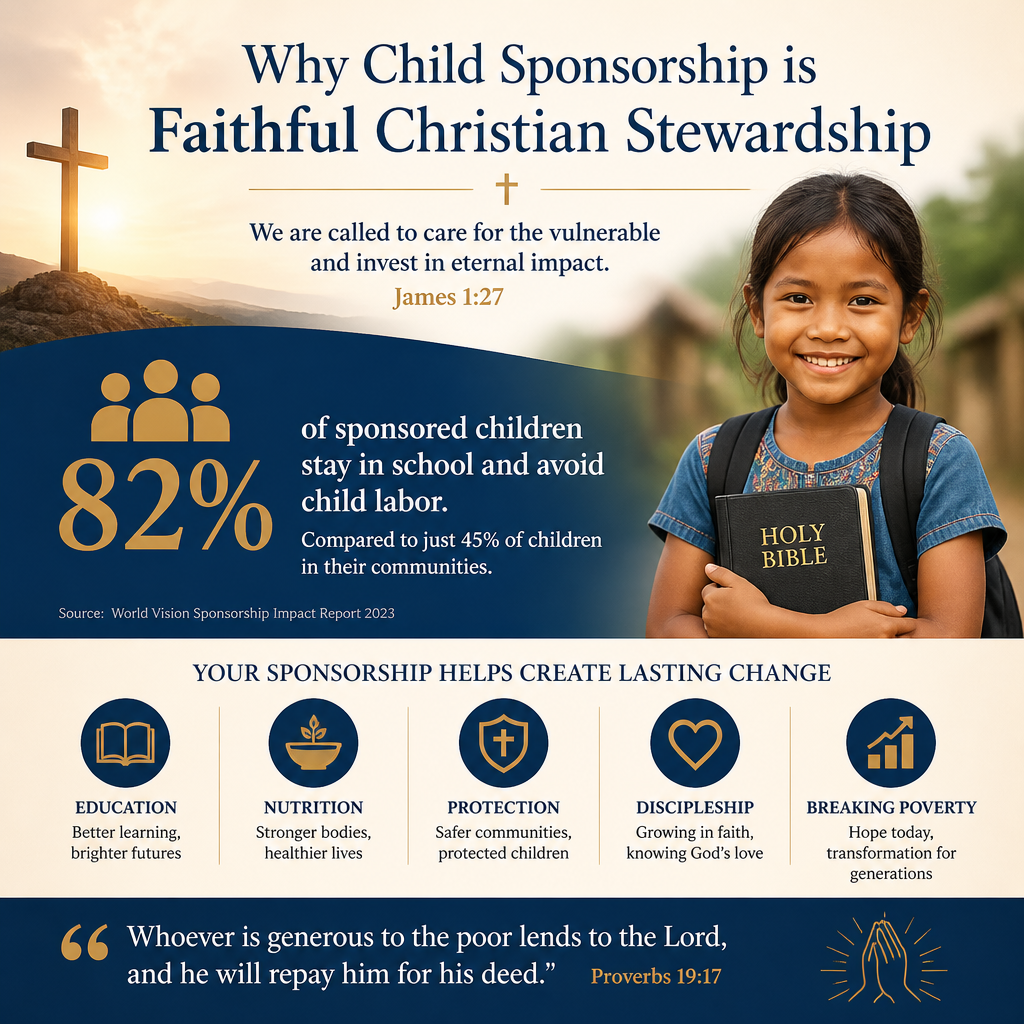
God repeatedly identifies with those who are most exposed to exploitation: the fatherless, the widow, and the sojourner (Deuteronomy 10:18). James goes so far as to name care for orphans and widows as “pure and undefiled religion” (James 1:27). These commands do not prescribe a single modern funding mechanism. They do, however, establish a moral center of gravity: Christians are responsible to protect and provide for those with the least power to protect and provide for themselves.
Child sponsorship can serve that biblical priority when it is designed to strengthen families and communities rather than replace them. The most mature sponsorship models aim to keep children in safe family settings, support schooling and health, and address household economic fragility—because vulnerability is often not a single crisis, but a web of constraints.

Faithful stewardship requires truthfulness about how sponsorship works
Christians genuinely disagree about how direct the link should be
Some donors want sponsorship dollars to be “one-to-one,” directed narrowly to the named child. Others accept pooled funding if it supports the child’s well-being through community programs. The field has had to reckon with misleading marketing in earlier decades, where “sponsoring a child” was sometimes presented as a direct payment to a child or family when it functioned more like designated giving to a program. That history matters because Christian stewardship is a truth-telling vocation.
The ethical question is not whether a ministry uses pooled funding. The ethical question is whether the ministry describes its model accurately, tracks outcomes with integrity, and can show that the sponsored child is actually benefiting in verifiable ways. Donors should expect ministries to explain how funds are allocated, what portion supports shared services, and what safeguards prevent harm or dependency.
Good sponsorship protects dignity and agency
Stewardship is not only about efficiency; it is about neighbor-love ordered by justice. Sponsorship can drift into paternalism when it treats children as props for donor inspiration or reduces complex lives to simplistic before-and-after narratives. It can also harm families when it creates incentives to misrepresent a child’s status or to separate children from relatives in order to qualify for aid.
More responsible programs build in child protection policies, consent practices, and communications standards that avoid exploiting images or stories. They strengthen caregivers rather than bypassing them. They take seriously that a child’s dignity is not a fundraising asset. It is an image-bearing reality.
Child sponsorship can be a disciplined way to pursue long-term formation
Stewardship is measured in endurance, not only in intensity
Many donors are fatigued by crisis giving. Some are wary that recurring monthly gifts become “out of sight,” disconnected from actual impact. Yet Scripture repeatedly commends steadfastness: “let us not grow weary of doing good” (Galatians 6:9). Child sponsorship, structurally, rewards endurance. It builds a predictable stream of support that allows ministries to plan, retain staff, maintain child safeguarding systems, and keep programs stable when headlines shift.
That discipline can be spiritually meaningful for donors as well. Sponsorship habituates a kind of generosity that is less reactive and more covenantal in character. It is not a vow, but it resembles a promise: a small, repeated act that accumulates into real provision.
What this means in practice for donors
Across our verification work at Most Trusted, we observe that the healthiest sponsorship ministries tend to treat sponsorship not as a product but as a relationship of responsibility—bounded, ethically managed, and supported by strong governance. Donors can reinforce that health by asking sober questions before committing. A short checklist often clarifies whether a program understands stewardship as Scripture does:
- Does the ministry explain clearly how sponsorship funds are used and what “sponsorship” means operationally?
- Are child protection policies public, specific, and enforced?
- Is the ministry committed to family preservation where possible and safe?
- Does reporting emphasize verifiable outcomes, not only emotional stories?
- Are financial statements, leadership, and governance practices accessible for review?
When donors evaluate child sponsorship ministries with this level of clarity, they are acting in line with the wisdom tradition: “The prudent gives thought to his steps” (Proverbs 14:15).
Wise sponsorship learns from the broader development conversation
The field has learned that help can harm
Christian donors do not need to be development specialists to act wisely, but we should be aware of the critiques that have shaped more responsible practice. The “When Helping Hurts” framework, articulated by Steve Corbett and Brian Fikkert, has helped many churches and ministries recognize how interventions can unintentionally undermine local agency, create dependency, or distort relationships between helpers and those helped. The point is not to retreat from generosity; it is to practice generosity that strengthens rather than supplants.
This is where sponsorship can be either a liability or an asset. A poorly designed program may create perverse incentives or elevate donor preferences over child well-being. A well-designed program can provide consistent support while keeping decision-making close to local staff who understand cultural context, risk factors, and the realities families face.
Church-based giving is strongest when it is informed, not merely moved
American Christians remain remarkably generous compared to many populations, yet the gap between aspiration and practice is real. Research from the Lilly Family School of Philanthropy reports that U.S. households give about 2% of income on average to charity in a typical year, a figure often cited to show how far many families are from sustained, proportionate generosity (Indiana University Lilly Family School of Philanthropy).
That context matters because sponsorship is often positioned as “an amount you can manage.” The spiritual risk is not the monthly amount; it is the temptation to treat the commitment as moral cover while remaining unformed in broader stewardship. The opportunity is that sponsorship can become a first disciplined practice that grows into deeper generosity, informed by Scripture and constrained by truth.
Verification protects donors and children from predictable failures
Good intentions do not replace governance
Child sponsorship is emotionally resonant by design. A name, a face, a birthday, a letter—these create human connection. That is not wrong. It is often a means God uses to enlarge compassion. But it also means sponsorship programs are vulnerable to predictable temptations: exaggerated claims, blurred accounting, weak safeguarding, and leadership structures that cannot withstand scrutiny. Donors who want to practice faithful stewardship should not confuse emotional engagement with organizational trustworthiness.
This is one reason independent verification exists. Most Trusted evaluates Christian nonprofits against The Most Trusted Standard, a 15-criteria framework that examines faith commitments, financial integrity, governance practices, and transparency and effectiveness. Verification cannot eliminate every risk in ministry, but it can identify whether a sponsorship organization has the structures that make integrity likely rather than accidental.
Where donors should apply particular scrutiny
Across sponsorship ministries, several areas consistently determine whether the model is faithful and sustainable:
First, child safeguarding is non-negotiable. Donors should expect a public child protection policy, staff training, reporting mechanisms, and limits on communications that could expose children to risk.
Second, financial transparency must be intelligible. The overhead conversation is often mishandled, as if “low overhead” were the same thing as faithful stewardship. In reality, administrative capacity can be a moral necessity when it supports safeguarding, monitoring, and accountability. The widely endorsed “Overhead Myth” statement—signed by Charity Navigator, Candid (formerly GuideStar), and the BBB Wise Giving Alliance—argues that donors should focus on results and transparency rather than a single overhead ratio (Charity Navigator).
Third, governance matters because power concentrates easily in ministries built on strong personalities and compelling stories. Responsible boards, clear conflict-of-interest practices, and audited financials are not secular intrusions; they are instruments of truthfulness.
Donors seeking to evaluate the broader landscape of Child Sponsorship Ministries should weigh these factors as seriously as they weigh theological alignment. Stewardship is not less than orthodoxy, but it is more than brand familiarity.
FAQs for Why child sponsorship is faithful Christian stewardship
Is child sponsorship biblical, or is it just a modern fundraising idea?
Scripture does not command “child sponsorship” as a named practice, but it does command concrete, accountable care for the vulnerable (James 1:27) and commends stewardship that is faithful over time (Matthew 25:14–30). Sponsorship can be a faithful application of those principles when it is truthful about how funds are used, protects children from harm, and strengthens families and communities rather than displacing them.
Should donors avoid sponsorship because pooled funding is not truly one-to-one?
Pooled funding is not automatically unfaithful; many effective programs require shared costs such as social workers, teacher support, safeguarding systems, monitoring, and community infrastructure. The stewardship question is whether the ministry describes its model honestly and can show that sponsored children benefit in real, measurable ways. Donors who want deeper grounding in the biblical themes at stake can also review Biblical Foundations for Child Sponsorship.
Stewardship that resembles the Father’s care
Child sponsorship becomes faithful Christian stewardship when it reflects God’s character: truthful, protective of the vulnerable, patient in doing good, and unwilling to confuse sentiment with righteousness. The task for donors is not to find a perfect model, but to practice discernment that honors both compassion and truth, so that our giving strengthens children without compromising the integrity that Christian love requires.



