

How Bible distribution ministries measure gospel impact is not a marketing question. It is a stewardship question for donors who believe the Word of God is living and active, and who also know that numbers can be manipulated. The harder tension is that the most important fruit of Scripture often resists tidy measurement, even as wise governance demands evidence that resources are used faithfully.
Christian donors generally want more than distribution volume. We want to know whether Bibles are reaching people who can read them, whether local churches are strengthened rather than displaced, whether persecution risks are treated with sobriety, and whether ministry claims are disciplined by verifiable methods. The most credible ministries have learned to measure what can be measured, to narrate what must be narrated, and to refuse the false certainty that turns spiritual realities into dashboards.
Begin with theology and define impact with care
Scripture sets the goal and the limits of measurement
The New Testament does not treat the Word as a commodity to be shipped; it treats the Word as the means by which God creates and sustains faith. Paul is clear that “faith comes from hearing, and hearing through the word of Christ” (Romans 10). Yet Paul is equally clear that growth is God’s work: “I planted, Apollos watered, but God gave the growth” (1 Corinthians 3). Measurement belongs in the space between these two truths: we can account for faithful planting and watering, but we cannot claim sovereignty over the harvest.
What this means in practice is that credible Bible distribution ministries distinguish outputs, outcomes, and spiritual fruit. Outputs include shipments, print runs, and deliveries. Outcomes include access, engagement, comprehension, and integration into church life. Spiritual fruit includes repentance, perseverance, reconciliation, vocational faithfulness, and the long obedience of discipleship. The first two categories can often be measured with reasonable confidence; the third must be handled with reverent caution.
Donors should listen for disciplined language
Across our verification work at Most Trusted, we observe that the ministries most worthy of confidence avoid inflated causal claims. They do not imply that a certain number of Bibles automatically produces a certain number of conversions. They describe their role honestly within the larger work of God, and they credit local churches, translators, and partners rather than collapsing the story into their own brand.
Christians genuinely disagree about what counts as “impact” in different contexts. In some places, the central gap is Scripture access. In others, the gap is discipleship, theological training, or literacy. Mature measurement begins by naming the actual constraint in the field rather than assuming the constraint is always “not enough Bibles.”

Measure distribution integrity before counting outcomes
Distribution volume is not impact if the supply chain is weak
A ministry can report impressive numbers and still fail the test of stewardship if the Bibles do not arrive, arrive late, arrive in the wrong language, or arrive through channels that create dependency or corruption. For donors, the first question is whether the ministry can prove that distribution occurred as claimed. That requires basic supply chain controls: inventory systems, third-party shipping documentation, partner confirmations, and audits where risk warrants.
In closed or high-risk countries, the details cannot always be public, and donors should not demand operational disclosure that endangers believers. But even there, ministries can provide verifiable assurance to an independent reviewer: documentation, anonymized partner validations, and risk protocols that show the ministry is not improvising with people’s lives.
Access is more than presence
Most ministries now recognize that “one Bible delivered” does not equal “one Bible accessible.” Literacy, cost, language comprehension, disability, and social restrictions all shape whether people can actually read. Bible distribution ministries that measure gospel impact well track access factors such as local language fit, readability level, and whether women and marginalized groups can obtain Scripture without coercion.
Where literacy is a barrier, credible ministries measure audio Scripture distribution and usage rather than treating it as an inferior substitute. They also measure training and accompaniment, because Scripture engagement is often mediated through the local church, not through isolated reading.
Use mixed methods that respect both data and discipleship
Quantitative indicators that remain honest
Some indicators can be measured without pretending that the Holy Spirit is a variable in a spreadsheet. Examples include distribution verification rates, percentage of recipients in the intended language group, Scripture engagement metrics in digital channels, participation in facilitated Bible studies, and retention of small groups over time. A donor should expect a ministry to define these metrics carefully and to report limitations directly.
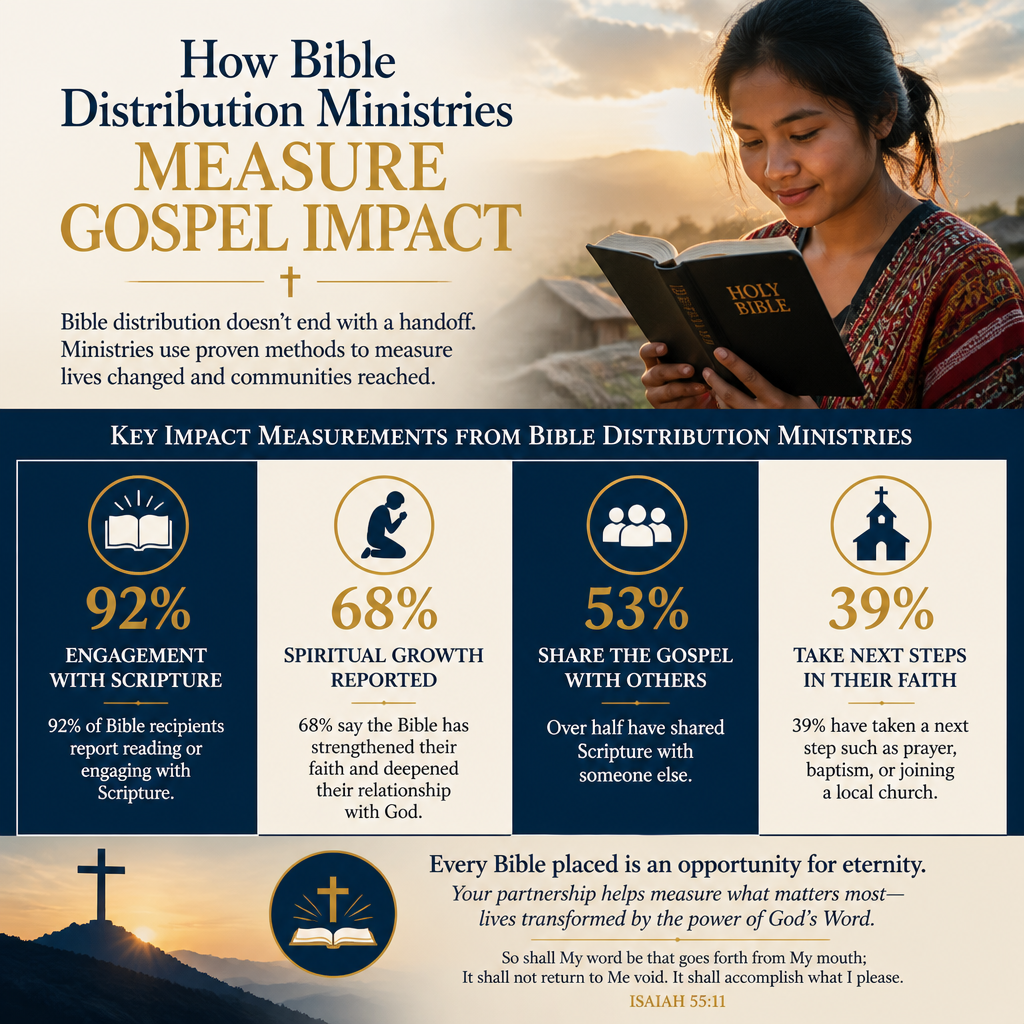
Digital Scripture platforms can offer helpful engagement data, but donors should read it with discernment. “App downloads” can be purchased; “time in text” can be inflated; and “registrations” can represent curiosity rather than commitment. The most credible ministries treat digital analytics as one witness among several, not as a stand-alone proof of gospel fruit.
Qualitative evidence that is not sentimental
Narratives matter, but they are easy to curate. Mature ministries use structured qualitative methods: interviews with consistent questions, focus groups facilitated by trained local leaders, and case studies that include context, costs, risks, and outcomes over time. They also seek disconfirming evidence by asking what did not work, where distribution created unintended conflict, or why certain communities did not engage.
For donors exploring the wider landscape of Bible Distribution Ministries, this distinction between curated testimony and disciplined qualitative research is one of the clearest markers of maturity. Testimony is Christianly appropriate, but it should not be the entire accountability system.
Evaluate local church integration and long-term formation
Impact is compromised when the church is bypassed
Bible distribution can unintentionally mimic a consumer model: Scripture delivered to individuals without durable connection to pastoral care. In many contexts, that is not merely inefficient; it can be spiritually dangerous, especially where false teaching is prevalent. Ministries that measure gospel impact well ask whether distribution strengthens the local church’s capacity to teach Scripture faithfully.
Indicators may include the percentage of distributions conducted through church networks, the presence of training for local leaders, the production of study tools aligned with orthodox doctrine, and follow-up pathways into discipleship communities. These are not glamorous numbers, but they often tell the truth about long-term fruit.
Persecution and safeguarding change what measurement should look like
In persecuted settings, “follow-up” can endanger people. A mature ministry will not pressure partners to gather identifying data simply to satisfy donor curiosity. Instead, donors should look for evidence of careful risk management: secure data practices, minimal-necessary information collection, trauma-informed approaches, and partner-led decisions about what can be tracked safely.
Where children are involved, the expectation should be explicit safeguarding standards and training. Measurement is not only about outcomes; it is also about ensuring that the methods used to pursue outcomes are righteous. A ministry can distribute Scripture widely and still disqualify itself through negligence toward the vulnerable.
What strong reporting looks like under The Most Trusted Standard
Transparency without endangering partners
Donors often face a false choice: either accept glossy claims with no evidence, or demand operational details that could compromise security. Under The Most Trusted Standard, we look for a third way: ministries that provide enough verifiable documentation to substantiate claims, while using appropriate redaction and aggregation to protect people on the ground. This includes governance oversight, clear financial reporting, and credible monitoring and evaluation practices tied to the ministry’s theory of change.
Verifiable evidence suggests that the healthiest organizations treat monitoring as part of discipleship and stewardship, not as a donor requirement to be satisfied. They budget for evaluation, train staff and partners, and respond to findings with visible program adjustments rather than defensive messaging.
Questions donors can ask without becoming cynical
Accountability is not suspicion; it is love ordered by truth. Donors who want to support Scripture distribution with confidence can ask for clear answers to a short set of questions:
- How do you verify delivery and prevent diversion or resale in the markets you serve?
- How do you determine that the language, translation, and format are appropriate for the recipients?
- What follow-up exists through local churches or trusted partners, and what is not possible for safety reasons?
- Which metrics do you report regularly, and what are their known limitations?
- Can you provide examples of program changes made because the data or partner feedback exposed a weakness?
In the category of Accountability and Transparency in Bible Distribution Ministries, we consistently find that the best answers are both concrete and bounded. They name what is known, how it is known, and what cannot be known without pretending that uncertainty is failure.
FAQs for How Bible distribution ministries measure gospel impact
Should we expect Bible distribution ministries to report conversions?
We should expect humility and clarity. In some contexts, a ministry may receive credible reports of professions of faith or baptisms connected to Scripture engagement, usually through local churches. But conversion counts are inherently difficult to verify, culturally variable, and vulnerable to inflation when incentives are misaligned. The most trustworthy ministries avoid making conversions the primary proof of impact, and they place any such reports within a wider account of discipleship, church integration, and long-term perseverance.
What metrics are most meaningful for donors who care about faithful stewardship?
Meaningful metrics are those that test whether Scripture is actually accessible and used in ways that strengthen the church. Delivery verification, language and format fit, engagement indicators tied to real ministry pathways, partner and church feedback gathered systematically, and evidence of learning over time are usually more reliable than headline numbers. Donors should also weigh whether the ministry’s measurement practices align with Christian ethics: safeguarding, honesty in reporting, and restraint where data collection would increase risk.
Stewardship that honors both truth and mystery
Faithful Bible distribution aims at more than circulation; it aims at Scripture received, understood, and lived within the body of Christ. That kind of impact can be measured partially and described more fully, but it cannot be reduced to a single score. The ministries most worthy of donor confidence combine rigorous verification with theological restraint, telling the truth about what they can prove and refusing to claim what belongs to God alone.



