

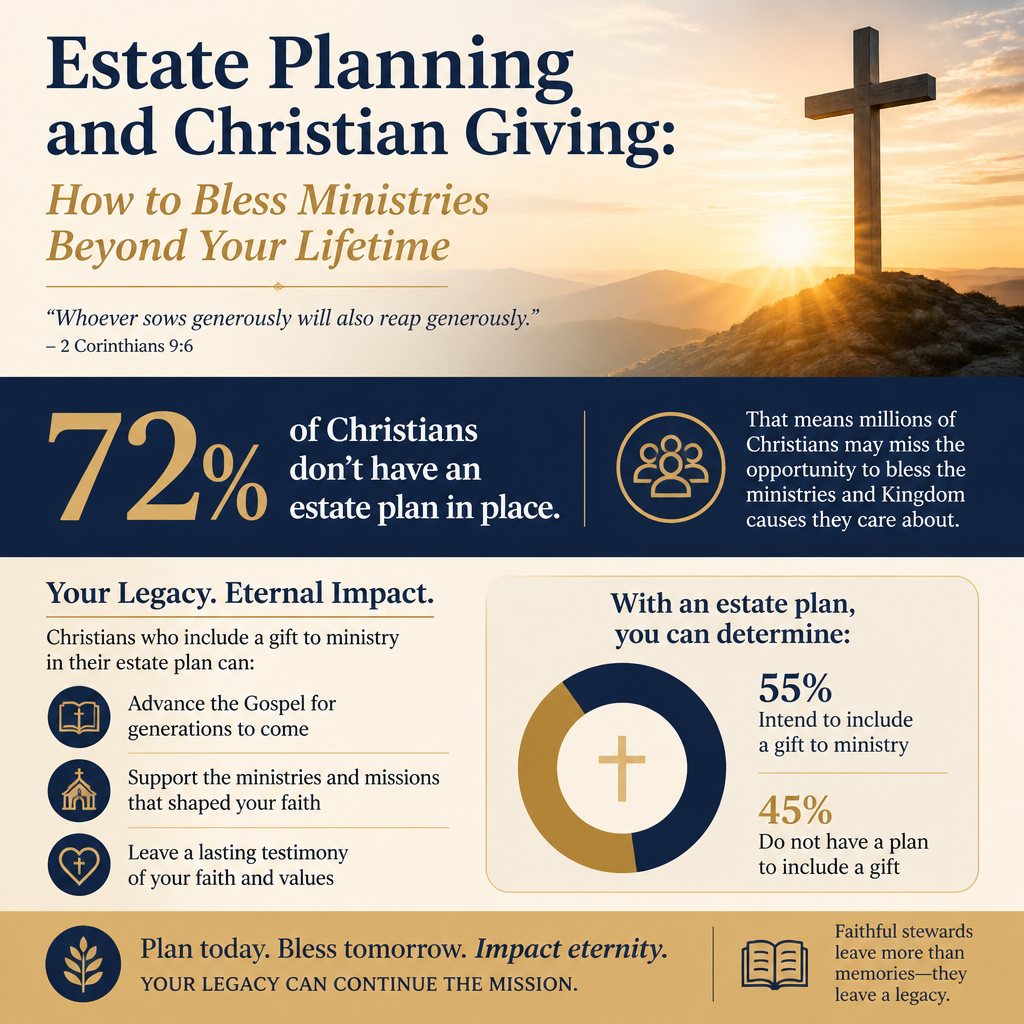
Estate planning and Christian giving belong together because Christian stewardship is not limited to the years in which we can sign the check ourselves. Scripture consistently frames our resources as entrusted, not possessed: “it is required that those who have been given a trust must prove faithful” (1 Corinthians 4:2). The harder question is not whether a Christian should plan, but what faithfulness looks like when our plans outlive us and our gifts will be executed without our ongoing oversight.
Many mature donors feel the weight of this decision in competing obligations. We want to provide for spouses and children without training them to trust wealth. We want to bless ministries without funding waste, mission drift, or theological confusion after our deaths. We want our generosity to be quietly durable rather than emotionally reactive. Estate planning can serve those aims—yet it can also magnify risks, because the donor is no longer present to correct a misunderstanding or respond to changing conditions in a ministry.
What this means in practice is that planned giving is not merely a legal exercise. It is a form of discipleship with legal instruments attached. Done well, it channels enduring love of neighbor and long obedience to Christ. Done carelessly, it can endow drift, entrench poor governance, or create avoidable conflict among heirs and ministry leaders. Our aim here is to name the theological logic, the practical options, and the due diligence standards that protect both the donor’s intent and the ministry’s integrity.
Why Christians plan beyond their lifetime
Christian estate planning begins with the recognition that God’s purposes often unfold across generations. The psalms repeatedly speak of declaring God’s works “to the next generation” (Psalm 78:4). The early church modeled intergenerational provision through structures that endured beyond a single leader’s lifetime. And Jesus’ teaching insists that money is never neutral; it functions as a rival master unless consciously placed under the lordship of Christ (Matthew 6:24).
Planned giving is one of the few ways a donor can align capital with conviction when circumstances change. A will, a trust, and beneficiary designations can coordinate an estate in ways that annual giving cannot. They can protect a spouse, address family needs, and still assign meaningful resources to gospel work—often with greater clarity than ad hoc decisions made in a season of crisis.
Christians genuinely disagree about the exact relationship between leaving an inheritance and practicing radical generosity. Proverbs commends leaving an inheritance (Proverbs 13:22), while Jesus warns against storing up treasure “for themselves” (Luke 12:21). The tension is real. In our editorial judgment, the question is not whether one leaves an inheritance, but what one is teaching through it: dependence on God, the dignity of work, the limits of money, and the priority of the Kingdom.

Planned giving tools and the moral questions behind them
Most planned giving conversations move quickly to instruments—wills, trusts, charitable remainder trusts, donor-advised funds, beneficiary designations. Mature Christian donors often need the opposite: moral clarity first, then the tools that fit that clarity. The instrument should serve the vocation of the gift, not replace discernment with paperwork.
Start with what actually transfers at death
Many estates do not distribute according to a will alone. Retirement accounts, life insurance policies, and certain brokerage accounts pass by beneficiary designation. Real estate may be governed by deeds and joint ownership. Trusts may control how and when heirs receive assets. The basic discipline is coherence: ensure that what we say we intend is what the documents will execute.
Choose between restricted and unrestricted gifts with open eyes
Restrictions can preserve donor intent, but they can also create long-term burdens that constrain a ministry’s ability to respond to changing needs. A scholarship fund with narrow criteria, a building fund tied to a single site, or a program restriction that assumes today’s methods will be best forever can become an albatross rather than a blessing. Unrestricted giving carries its own risk: it requires a higher level of trust in governance, theological fidelity, and financial discipline.
Wise restrictions tend to be mission-aligned rather than method-prescriptive. “For biblical discipleship and evangelism among incarcerated people” is usually more durable than “for a specific curriculum in a specific facility.” The goal is to safeguard purpose while allowing faithful leaders to adapt.
Consider timing, liquidity, and burden
A bequest can create an immediate infusion of cash—or it can transfer illiquid assets that are costly to manage or difficult to sell. A ministry may receive real estate that carries environmental risk, deferred maintenance, or legal complications. Some planned gifts are generous in theory but expensive in practice. Donors can prevent this by asking ministries in advance whether they accept certain kinds of non-cash assets and what their process is for evaluation and disposition.
How to choose ministries you can trust when you will not be present
Estate planning heightens a central reality: we are not merely giving to a cause; we are entrusting resources to an organization. Scripture treats entrustment as morally serious. Jesus’ parables assume that stewards can act faithfully or faithlessly, and the consequences are real (Luke 16:10–12). A planned gift, by definition, places long-term confidence in leaders we may never meet.
Across our verification work at Most Trusted, we observe that the most dependable ministries tend to share several characteristics that become particularly important for bequests and other planned gifts: a clear doctrinal basis that is not merely ceremonial, governance structures that can withstand founder transitions, financial controls that prevent misuse, and transparency that invites scrutiny rather than fearing it. These are not simply organizational preferences. They are expressions of moral accountability.
Governance that survives transitions
Founder-led ministries can do remarkable good. They also carry predictable risks: concentrated authority, blurred lines between personal charisma and institutional accountability, and succession uncertainty. For estate gifts, donors should ask whether a ministry has an engaged board with real independence, documented conflict-of-interest practices, and a credible succession plan. Longevity is not a guarantee of faithfulness, but the absence of succession preparation is a predictable vulnerability.
Financial integrity that does not depend on goodwill
Trustworthy ministries build controls that do not presume everyone will act well. They separate duties, document approvals, reconcile accounts, and submit to external review where appropriate. Donors sometimes treat “low overhead” as the key signal, but modern charity evaluation has rightly challenged that assumption. The widely cited “Overhead Myth” statement—signed by GuideStar (now Candid), Charity Navigator, and BBB Wise Giving Alliance—argues that overhead ratios alone are poor measures of performance and can pressure nonprofits into underinvesting in systems that prevent failure.https://overheadmyth.com/
Estate gifts benefit from this insight. A ministry without adequate finance staffing, audit readiness, or internal controls can misuse a large bequest without intending to. A large gift can expose weaknesses that were tolerable at smaller scale.
Transparency that makes future accountability possible
After a donor’s death, heirs often become the practical stewards of the donor’s legacy. They will ask whether the ministry is reporting clearly, whether outcomes are credible, and whether leadership is humble enough to correct course. Ministries that publish meaningful annual reports, audited financials when appropriate, and candid explanations of both progress and limitations make it easier for families to stay engaged without becoming adversarial.
Donor guidance for estate planning and Christian giving
Mature donors usually do not need more inspiration; they need reliable process. Estate planning amplifies both the fruit of wisdom and the cost of naïveté. The following practices have proven durable across changing tax regimes and shifting ministry landscapes.
Clarify the theology of your estate before you draft the documents
Before debating percentages, write down the convictions that will govern the plan. For example:
- Lordship: “All we have belongs to God; our estate plan is an act of stewardship.”
- Provision: “We will provide for a spouse’s security and avoid becoming a burden to our children.”
- Formation: “We will not use wealth to insulate heirs from responsibility or discipleship.”
- Mission: “We will prioritize gospel proclamation and mercy that is accountable and effective.”
This is not sentimentality. It is a guardrail. It also helps attorneys and financial advisors translate intent into enforceable language.
Reduce complexity for heirs without reducing seriousness
Many estate plans fail not because they were ungenerous, but because they were too complex for survivors to administer. A plan can be both theologically serious and administratively humane. Beneficiary designations should be checked and coordinated. A letter of instruction can explain why ministries were chosen and what matters to the donor spiritually. Where restrictions exist, they should be written so that a board can interpret them faithfully rather than litigate them.
It is also wise to anticipate that heirs may not share the donor’s convictions. Donors sometimes assume continuity of faith across generations; Scripture is more sober. A plan can protect a spouse and children while still directing meaningful resources to ministry in ways that do not require heirs to become enthusiastic administrators.
Use verification standards rather than intuition
Planned giving is particularly vulnerable to the donor’s emotional affinity—an inspiring story, a personal relationship, a long history with a ministry that once was faithful. Affinity is not evidence. Verification is not cynicism; it is prudence.
At Most Trusted, we evaluate Christian nonprofits against The Most Trusted Standard, a 15-criteria framework that examines doctrinal clarity, financial integrity, governance and leadership practices, and transparency and effectiveness. For estate planning, this kind of framework is not an academic exercise. It is a way of asking, in verifiable terms, whether a ministry is structured to remain faithful and accountable when leaders change and when large gifts introduce new pressures.
Where donors do their own diligence, we recommend a disciplined set of questions:
- Faith foundation: Is the ministry’s statement of faith specific, public, and operationally meaningful? Do its teaching and partnerships align with it?
- Governance: Is there an independent board? Are conflict-of-interest policies clear? Is executive compensation governed responsibly?
- Financial oversight: Are financial statements available? Is there an audit or external review where scale warrants it? Are reserves and cash-flow practices prudent?
- Transparency and results: Does the ministry report outcomes with appropriate humility, including what is not working? Are claims proportionate to evidence?
These questions do not replace prayer or spiritual discernment. They keep discernment from becoming credulity.
Common tensions and how to handle them faithfully
Estate planning exposes tensions that ordinary giving can avoid. Naming them directly tends to produce better decisions and fewer family conflicts.
When children feel disinherited
Some heirs interpret significant charitable bequests as a verdict: “We were not valued.” Sometimes the plan really does communicate that. More often it reflects a donor’s fear that wealth will harm children or that the Kingdom should come first. The remedy is not necessarily a smaller gift to ministry. The remedy is clear communication, earlier in life if possible, about what the donor is trying to cultivate: gratitude, responsibility, generosity, and trust in God rather than in money.
Where appropriate, donors also use tools that combine inheritance with formation: matching gifts for heirs’ giving, distributions tied to work or education, or family charitable practices that invite participation without coercion. The point is not to control adult children; it is to bear faithful witness about what money is for.
When ministries change after the bequest is written
A ministry can drift theologically, change leadership, merge, or experience scandal. A bequest written decades earlier can become a gift to an organization that no longer resembles the one the donor intended to support. Donors can mitigate this risk by reviewing planned gifts periodically, selecting ministries with stable governance and transparent reporting, and avoiding overly narrow restrictions that assume permanent stability.
Some donors also diversify across multiple ministries rather than concentrating a bequest into one organization. Diversification is not a lack of conviction; it is a realistic response to organizational fragility in a fallen world.
When a large gift creates unintended harm
Large infusions of money can distort incentives inside nonprofits, especially when tied to restricted programs. They can also create dependence or unhealthy expansion. The missiology and development literature has long warned that resources can harm when they are detached from local ownership, accountability, and honest assessment of capacity. The “When Helping Hurts” framework, articulated by Steve Corbett and Brian Fikkert, has shaped many Christian conversations about avoiding paternalism and promoting dignity.https://whenhelpinghurts.org/
For planned gifts, the takeaway is not suspicion of generosity. It is a preference for ministries that can demonstrate responsible growth patterns, thoughtful budgeting, and a mature theology of power and dependence.
FAQs for Estate Planning and Christian Giving: How to Bless Ministries Beyond Your Lifetime
Should Christian donors include tithing or charitable giving targets in their estate plan?
Scripture does not prescribe a percentage for estates the way many churches discuss tithing for income. We recommend beginning with theological clarity rather than a formula: provide responsibly for dependents, avoid enabling sin or dependency, and direct meaningful resources toward gospel work and works of mercy. Many donors set a percentage as a practical tool, but the moral question is whether the plan reflects the priorities of the Kingdom rather than mere convention.
Is it better to leave an unrestricted bequest or a restricted bequest to a ministry?
Unrestricted gifts honor a ministry’s discretion and can be the most useful funding, especially in seasons of transition. Restricted gifts can protect donor intent but can also constrain future leaders in ways that become counterproductive. We recommend restrictions that are mission-aligned and durable, avoiding method-level constraints that assume today’s tactics will remain best. The higher the trustworthiness of governance and transparency, the stronger the case for unrestricted support.
How can donors reduce the risk of funding a ministry that later drifts or fails?
No estate plan can eliminate risk, but donors can reduce it by choosing ministries with strong governance, clear doctrinal commitments, and a track record of transparent reporting. Periodic review matters, as does avoiding overconcentration in a single organization. Verification frameworks such as The Most Trusted Standard can help donors evaluate whether a ministry’s structures are designed for long-term accountability rather than short-term charisma.
Should donors tell their children about charitable bequests ahead of time?
In many families, yes. Secrecy often produces confusion and resentment, especially when heirs discover significant charitable allocations without context. Thoughtful conversation can frame the gift as part of the family’s discipleship rather than as a late-life surprise. There are circumstances where discretion is prudent, but donors should not assume that silence will protect unity. Clarity, given with humility, often serves heirs better than ambiguity.
A legacy that can endure scrutiny
Estate planning and Christian giving are ultimately an exercise in accountability—before God, before one’s family, and before the watching world. A planned gift is a testimony about what we believed was worth funding when we could no longer benefit from it.
Faithful estate generosity does not require complexity, but it does require clarity: clarity about what we owe our families, what we owe our neighbors, and what it means to entrust resources to institutions that will outlast us. When donors unite theological seriousness with verifiable diligence, they bless ministries in ways that endure, not merely in ways that impress.



