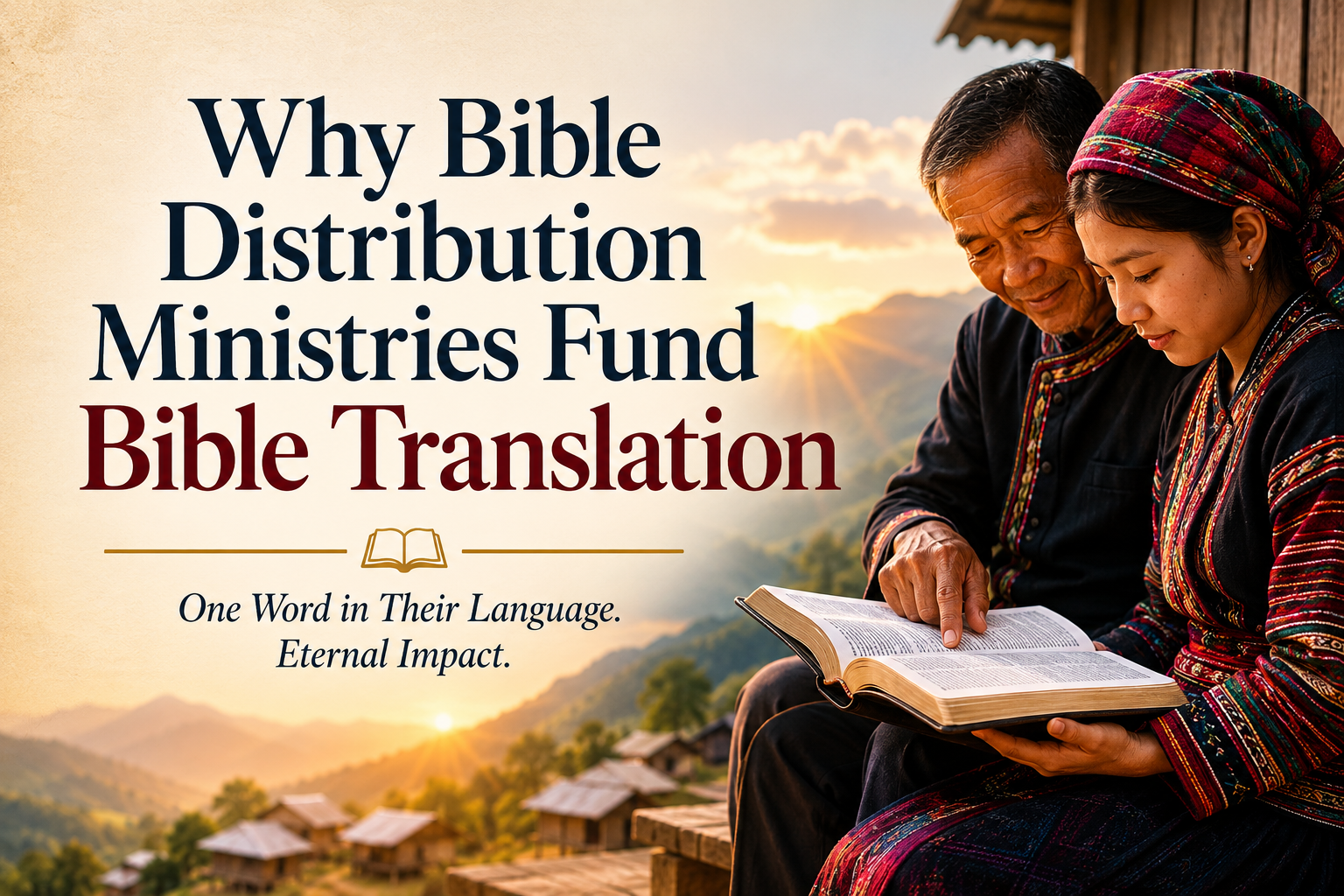
Why Bible distribution ministries fund Bible translation is not a secondary budget question. It is the recognition that “Bible distribution” is only as faithful and effective as the Scripture that is actually reaching people in a language they understand, in forms they can use, through channels they can access.
Christian donors often prefer the tangible: a printed Bible handed to a new believer, a box of Scriptures delivered to a church, a digital download opened on a phone. Those are worthy outcomes. Yet distribution ministries frequently discover that the greatest barrier is not logistics but language—an absence of a clear, trusted translation, or an absence of translation at all for the communities they serve.
Distribution is downstream from translation
What “Bible distribution” assumes
Bible distribution ministries operate at the end of a long chain of work: translation, checking, publication, production, shipping or digital delivery, and local partnership. When donors picture “getting Bibles into hands,” the image can unintentionally compress the entire chain into the final mile. But distribution presumes that Scripture exists in the right language, at an appropriate reading level, and in a form that fits the local church’s discipleship practice.
That is why many distribution-focused ministries allocate funds to translation agencies or to translation components inside broader programs. When Scripture does not yet exist in a community’s heart language, distribution cannot solve the core problem. It can only distribute what already exists.
Language is not a detail in Christian mission
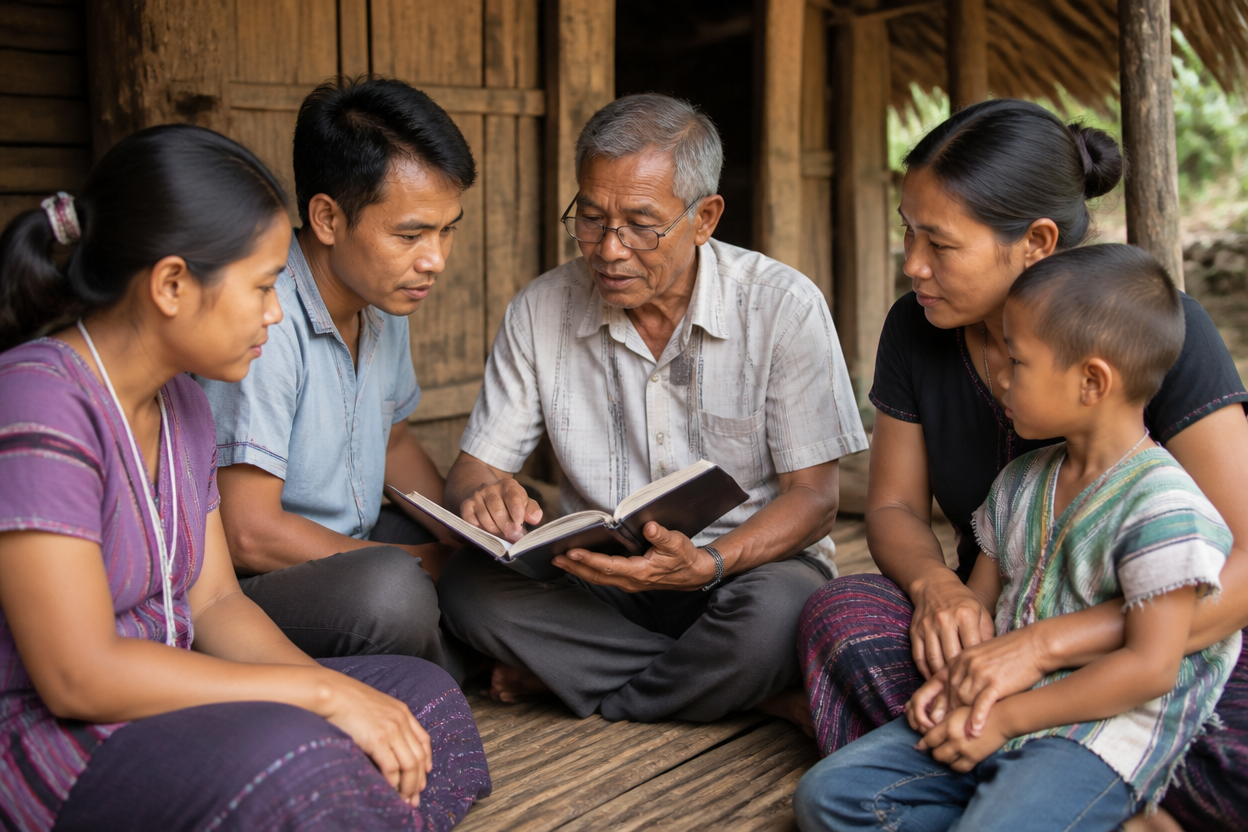
Scripture presents God’s self-disclosure as intelligible communication, not religious atmosphere. At Pentecost, the Spirit’s gift was not a generic spiritual experience but comprehensible speech “in our own tongues” (Acts 2). The church’s missionary history has repeatedly treated translation as an expression of love: to speak the gospel with clarity and to place God’s Word within reach of ordinary people.
Translation is part of faithfulness, not only access
A translation can be present and still be pastorally unusable
Christians genuinely disagree about translation philosophy—formal equivalence, functional equivalence, meaning-based approaches, and the trade-offs each makes. Those debates can become abstract. On the ground, pastors and distribution teams face concrete questions: Is this translation understood by teenagers? Does it read well in public worship? Does it handle key theological terms with stability? Are its footnotes and study helps appropriate in settings where literacy is limited or where syncretism is a live concern?
Distribution ministries fund translation work because “some Bible” is not always “usable Bible.” The aim is not merely coverage but faithful comprehension over time, so that local preaching, catechesis, and family discipleship are anchored in Scripture rather than dependent on imported intermediaries.
Theological seriousness requires careful process
Translation is spiritual work carried out through rigorous method: source-text scholarship, community testing, back translation, consultant checks, and sustained collaboration with local church leaders. Mature donors recognize the tension: speed matters when communities lack Scripture, but haste can embed errors or unnatural language that undermines long-term trust. Funding translation is often a distribution ministry’s way of refusing the false choice between urgency and accuracy.
Translation expands what distribution can responsibly deliver
Print is not the only field of distribution
Distribution ministries increasingly deliver Scripture through multiple formats: print for congregational use and durability, audio for oral learners, and digital for reach where smartphones are common. Translation funding often includes components that make these formats possible—recorded audio New Testaments, app integration, or licensing that enables local printing.
For donors, this can be a point of confusion: why would a distribution ministry pay for linguistic work rather than “more Bibles”? Because the most scalable distribution channel may be blocked without translation assets designed for that channel. Audio Bible distribution, for example, depends on a translation that has been prepared for oral clarity and recorded with appropriate dialect and cadence, not simply repurposed from a print edition.
Where the need is greatest, translation is frequently the constraint
The global church has made significant progress, but the remaining need is still substantial. The field commonly cites that thousands of languages still lack a full Bible, and many more lack even a New Testament. For a verifiable, continually updated reference point, the translation community’s central data source is the progress reporting of SIL International and partner agencies; SIL’s Ethnologue is widely used as a catalog of the world’s living languages and related translation status data (Ethnologue).
What this means in practice is that many distribution ministries operate in precisely the places where translation gaps remain: remote geographies, minority language communities, and areas with limited publishing infrastructure. Funding translation is often the only way to ensure that future distribution is not perpetually dependent on second-language materials.
Donors should evaluate translation funding with the same rigor as distribution
Translation partnerships can be exemplary or opaque
Not every translation or distribution partnership is equally accountable. Some projects are deeply integrated with local churches and governed by clear doctrinal commitments. Others are difficult for donors to assess: licensing terms are unclear, ownership of the text is contested, quality assurance is hard to verify, and local stakeholder involvement is minimal.
At Most Trusted, our work as an independent verification service is to help donors give with confidence by evaluating ministries against The Most Trusted Standard—a 15-criteria framework across Faith Foundation, Financial Integrity, Governance and Leadership, and Transparency and Effectiveness. When Bible distribution ministries fund Bible translation, we look for the same hallmarks we look for elsewhere: clear theological commitments, auditable financial controls, credible oversight, and honest reporting about what has and has not been achieved.
Practical questions that separate strong projects from weak ones
Donors do not need to become linguists to ask disciplined questions. A few inquiries can illuminate whether translation funding is likely to serve the church well over the long term:
- Who provides translation consulting and quality assurance, and what standards govern checking and review?
- How are local pastors and church leaders involved in drafting, review, and community testing?
- What is the ministry’s doctrinal accountability for key theological terms and contested passages?
- Who owns the text, and what licensing terms allow printing, digital distribution, and audio recording?
- How does the ministry report progress and setbacks without overstating impact?
These questions belong to the same family as questions donors already ask about distribution: whether the ministry counts outputs honestly, whether partners are vetted, and whether reported reach corresponds to verifiable activity. They are not suspicions; they are stewardship.
Wise funding recognizes the whole ministry ecosystem
Translation and distribution are complementary, not competing
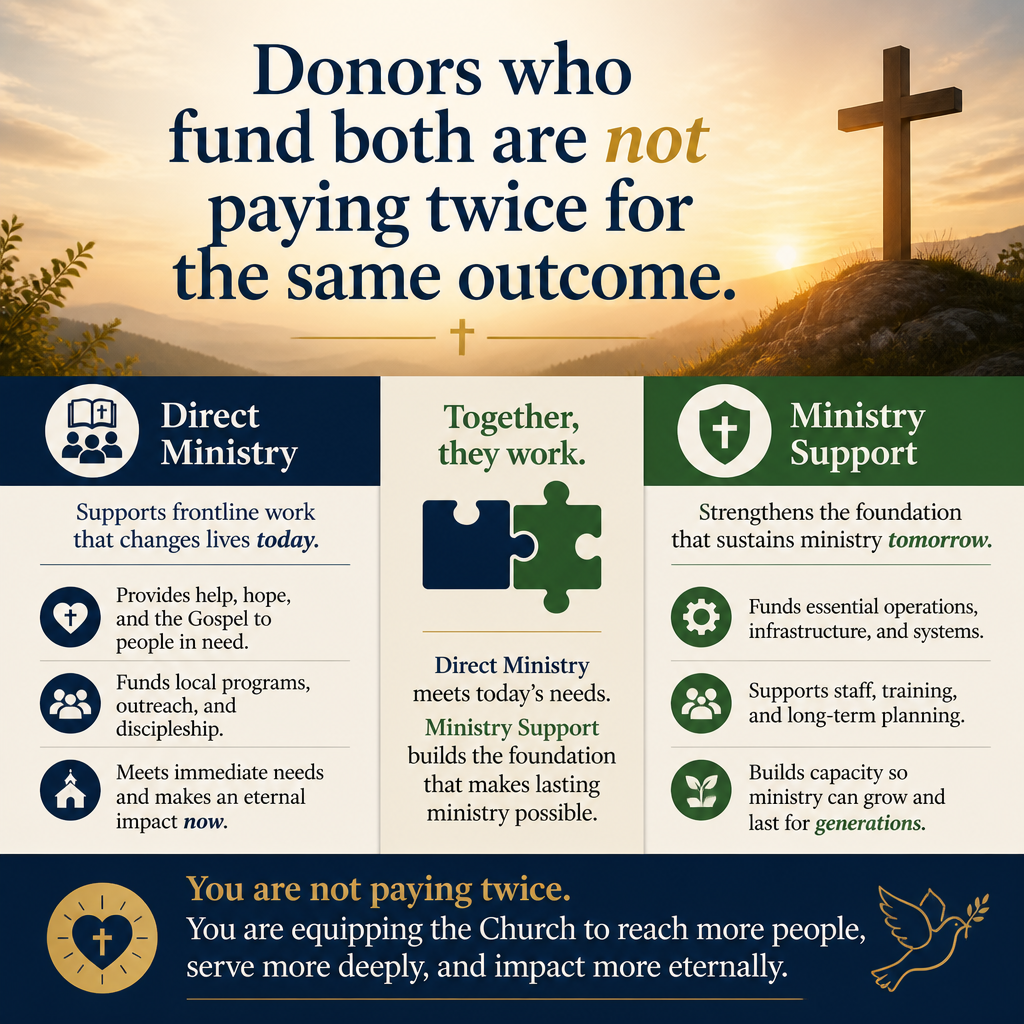
Some donors fear that funding translation will “take away” from Bibles on the ground. The tension is real when budgets are finite and needs are immediate. Yet translation and distribution are not interchangeable line items. Translation is slow capital; distribution is rapid deployment. Faithful ministries often need both, and they need them sequenced properly.
Distribution ministries that invest in translation are often building future capacity: enabling local publishers, equipping churches to disciple in the heart language, and reducing long-term dependence on imported materials. When this is done well, a donor’s gift does not merely move a product; it strengthens a local church’s ability to teach Scripture with clarity for generations.
How this relates to translation choices, formats, and languages
Translation funding decisions also intersect with choices about format (print, audio, digital), literacy realities, and language politics. Some communities have multiple dialects with competing claims to legitimacy. Some regions face governmental restrictions that complicate publication. Some ministry contexts require careful decisions about what to distribute publicly versus what to deliver through church networks.
Donors who want to understand these decisions in context will often find it helpful to think in terms of Bible Distribution Ministries as an ecosystem of language work, production, and local partnership rather than a single act of delivery.
FAQs for Why Bible distribution ministries fund Bible translation
Should donors prioritize translation or distribution if they can only fund one?
The honest answer depends on context. If churches in a region already have a faithful, widely understood translation, distribution may be the highest-leverage need—especially where poverty, persecution, or supply-chain constraints keep Scripture out of reach. If the community lacks Scripture in its heart language, distribution cannot create comprehension, and translation becomes foundational. Mature ministries will explain why their context demands one emphasis now without implying the other is unimportant.
How can a donor tell whether a translation project is credible without being a specialist?
Credible projects are marked by transparent process and accountable partnerships: clear statements of faith, documented checking and review, meaningful local church involvement, and licensing terms that allow the translated text to be distributed in the formats the church actually uses. Donors can also look for evidence of responsible reporting—progress measured in identifiable milestones, not inflated claims. For a broader lens on how translation choices connect to distribution realities, see Translations, Formats, and Languages in Bible Distribution.
Stewardship that funds both Word and way
Why Bible distribution ministries fund Bible translation comes down to a single conviction: God’s Word is meant to be understood, believed, and obeyed. Distribution places Scripture within reach; translation places Scripture within comprehension. Donors who fund both are not paying twice for the same outcome. They are strengthening the entire chain of faithfulness that carries the gospel from the page into the life of the church.